Just Like Me
The Test That Wasnt Fair
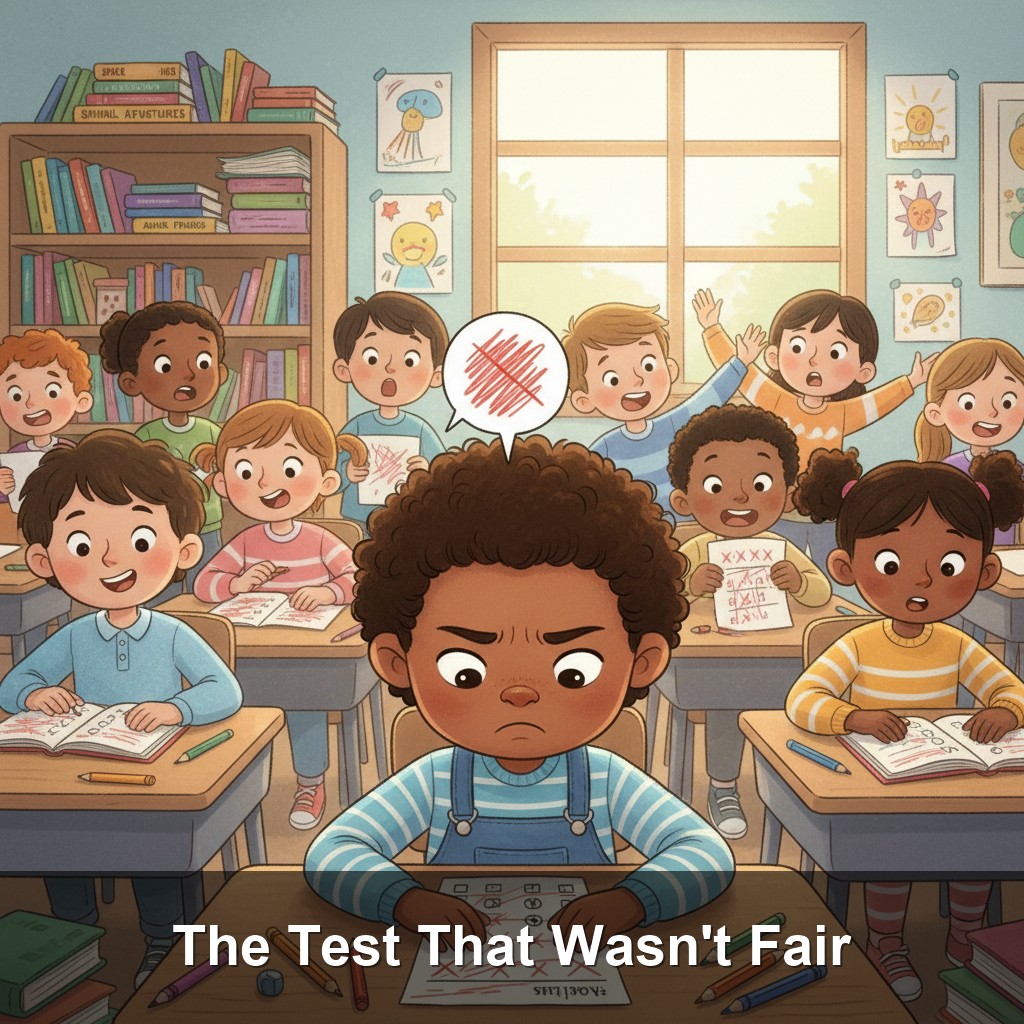
Ms. Chen stood at the front of the classroom with a stack of papers.
"Class," she said, "today we're having our math test. You'll have thirty minutes to complete all twenty questions."
Sam's stomach went tight.
Thirty minutes. Twenty questions.
Sam looked at the paper on the desk. Question one: 7 + 5 = ___
Sam knew 7 + 5. Sam knew lots of math. Sam had counted every tile in the hallway by twos, and fives, and sevens. Numbers made sense to Sam, like old friends.
But thirty minutes was a rule that didn't fit Sam's brain.
While Sam was still reading question one, the clock on the wall ticked.
Tick.
Sam looked at question two. It used the word "borrowed." What did borrowing have to do with math? Sam thought about libraries. Then Sam thought about how borrowing means taking something and giving it back, but in math the numbers just disappear, and who is borrowing from whom, and where does the number go?
Tick.
Sam looked up. Other kids were already on question five.
Sam's hands felt hot. The clock was so loud. Tick. Tick. Tick.
Sam tried question three: A tree has 12 apples. 4 fall off. How many are left?
Sam pictured the apples falling. They made soft thumps on the grass. Sam counted them. Eight. The answer was eight. But Sam had spent a long time watching the apples fall in Sam's mind, and the clock hadn't stopped.
Tick.
Sam's breathing got fast. The room felt too bright. The pencil felt wrong in Sam's hand — too smooth, too thin, not the right kind of grip.
Jordan, two seats away, was writing quickly. Page flips. Everyone was on question twelve, fourteen, seventeen.
Sam was still on question three.
"Five more minutes," said Ms. Chen.
Sam's heart hammered. Five minutes. Sam had seventeen questions left. Seventeen questions with words like "borrowed" and "remaining" and "altogether." Words that made pictures in Sam's mind that were more interesting than the numbers, but took time to move through.
Sam's hand started to flap. Just a little. A way to push the panic out.
But the clock kept ticking.
"Time's up," said Ms. Chen. "Pencils down."
Sam's paper had five answers. Five correct answers. But the paper looked empty. It looked like Sam didn't know math.
Sam knew math. Sam knew a lot of math.
Sam's eyes felt hot. Sam didn't cry at school. Sam's throat was tight like a closed fist.
After lunch, Ms. Chen asked Sam to stay at the desk.
"Sam," she said, gently, "what happened on the test?"
Sam didn't look up. "The clock," Sam said. "The clock was very loud."
Ms. Chen nodded slowly. "And the questions?"
"I read them slowly," said Sam. "I have to read all of them. I can't skip. The words make pictures, and I have to watch the pictures to finish the question."
Ms. Chen sat down. She looked at her hands. Then she looked at Sam.
"I told you thirty minutes," she said. "That was the same as everyone else."
"Yes," said Sam. "That's why it wasn't fair."
Ms. Chen was quiet for a moment.
"Can you tell me more?"
Sam thought carefully. "When you said 'borrowed,' I thought about libraries. When you said 'tree,' I saw a tree. I see everything. The clock kept saying there was no time for seeing. But seeing is how I do math."
Ms. Chen's face changed. It looked like she understood something.
"Sam," she said, "how would a test work for you?"
Sam thought. "If I had more time. Or if there were fewer questions. Or if someone read the questions out loud so I didn't have to read and picture and also watch the clock."
Ms. Chen was quiet for a long time.
"I think I made the test wrong," she said. "Not the math. The way I gave it."
Sam looked up.
Ms. Chen smiled. "I should have asked you first. I'm learning."
The next day, Ms. Chen came to Sam's desk with a new paper.
"This test has ten questions," she said. "The same math. And you can take as long as you need. There's no clock. And I'm here if you want to read the questions out loud."
Sam looked at the paper. Then at Ms. Chen.
"No clock?" Sam said.
"No clock," said Ms. Chen. "I decided that fairness doesn't mean everyone gets the same thing. It means everyone gets what they need."
Sam took the pencil. The pencil felt better today. Sam touched the paper — smooth, familiar.
Question one: 7 + 5 = ___
Sam knew 7 + 5. Sam wrote 12.
Then Sam stopped. And looked at the sunshine coming through the window. It made a pattern on the floor — light squares, dark squares, light squares, dark squares. Like counting by twos.
Sam smiled. Then Sam did the next question.
Ten questions took Sam thirty-five minutes.
Sam got all ten right.
Jordan passed Sam's desk on the way outside and whispered, "You did great, Sam."
Sam nodded. "Ms. Chen made it fair," Sam said.
Jordan smiled. "Yes," Jordan said. "She did."
That evening, Mama asked how the test went.
"It went better," said Sam. "We changed the rules."
"Changed the rules?" said Mama.
"Ms. Chen said fairness means everyone gets what they need," said Sam. "I need time. And I need to see the pictures the words make. And I need no clock watching me."
Mama smiled. "That sounds like exactly what you need, Sam."
Sam nodded. "I knew the math all along," Sam said. "The test was just wrong at first."
"But you fixed it," said Mama.
"I told her about my brain," said Sam. "And she listened."
Mama gave Sam a hug. It was the right kind of hug — Sam's arms, not too tight.
"There's a pattern," said Sam, quietly.
"What pattern?" said Mama.
"When people listen, things get better," said Sam. "Like counting by twos. You just have to get the rhythm right."
Mama laughed. "That's exactly right, Sam."
Author's Note for Grown-Ups: This book is about accommodations — adjusting how a task is given, not what a child knows — so that a kid can actually show what they're capable of. Sam isn't less smart because Sam processes differently. Sam just needed the test to work differently. For many autistic children, standard time limits create so much pressure that thinking itself becomes impossible. A simple adjustment makes all the difference. And when your child tells you what they need, believe them. They know their brain better than anyone.