The Logic League
True or False
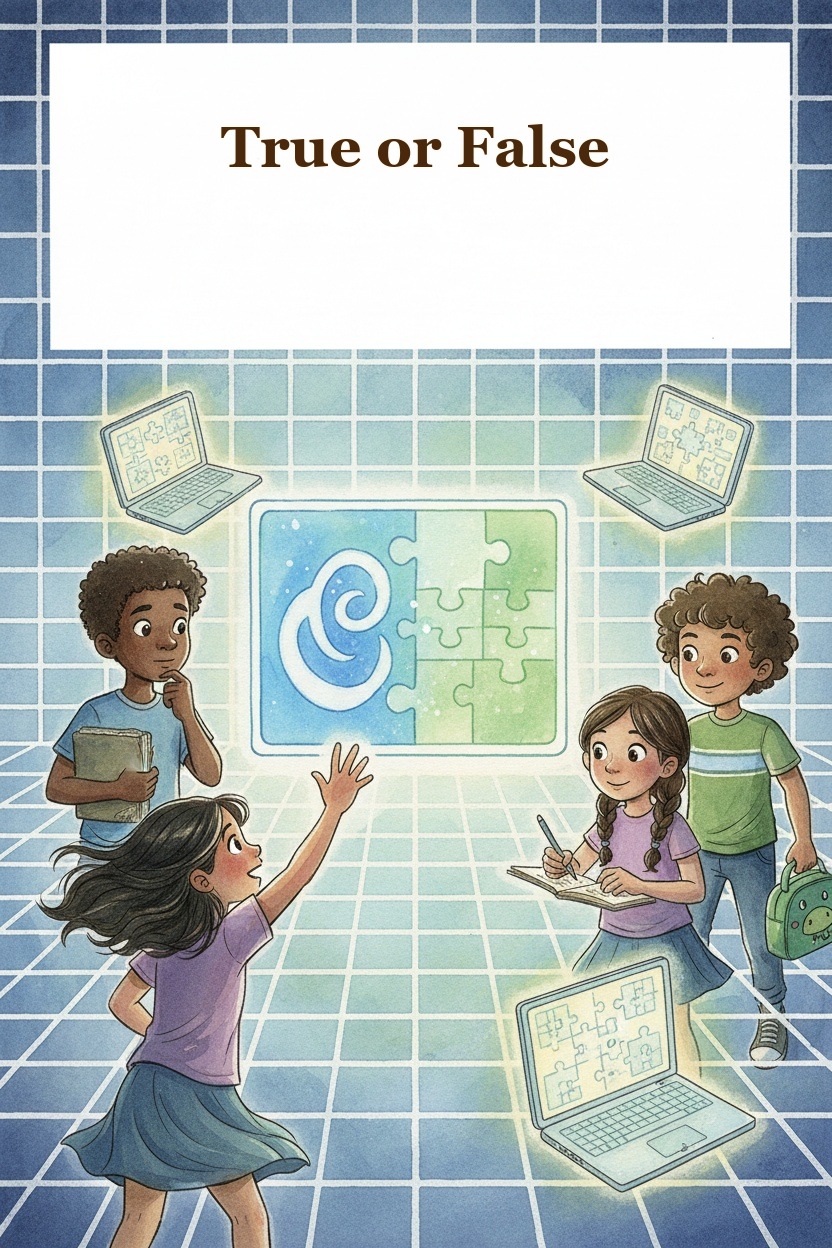
Chapter One: The Bridge That Said No
The lost-and-found closet smelled like wet mittens and old sneakers. Priya was already on her knees, digging through a bin of scarves, when the laptop on the shelf began to glow.
"Found it," Kwame said, lifting the screen. The green text flickered to life:
GRID ENTRY ZONE — SECTOR 3
ACCESS GRANTED: LOGIC LEAGUE
The light swirled, and then the floor of the closet wasn't a floor anymore. The kids tumbled through a familiar cascade of glowing shapes and landed—less gracefully than last time—on a platform of pale blue light.
Lily was already standing, brushing off her knees and examining the ground. "Same material as the train station," she murmured. "But different color. More white than gold."
Sam pointed ahead. "Guys. There's a gap."
There was. The platform ended at a wide chasm, and on the other side, maybe twenty steps away, stood another platform with a doorway glowing soft orange. Between them: nothing but a dark drop that seemed to go down into silver mist.
But there was something new—a large panel beside the edge of their platform, waist-high and made of the same glowing material as everything else. On it, a single line of text:
IF THE WORDS ON THE PANEL ARE TRUE, THE BRIDGE WILL EXTEND.
"That's it?" Priya walked over and read the line aloud. "Okay, so we just need to make the words true. What words?"
Sam stepped closer to the panel. In the center was a small, glowing rectangle, like a blank screen waiting for input. Next to it, a single word had appeared:
TRUE
"Is that the whole panel?" Kwame asked. "Just the word true?"
Priya shrugged. "Well, true is true. So the bridge should come out." She pressed the word.
The panel flashed.
ERROR: That statement is true, but no condition was evaluated. Being true is not the same as being right.
Lily frowned. "That's... actually a fair point. The word 'true' isn't a condition. It's just a word."
Kwame scratched his head. "So what is a condition?"
And then, with a soft hum, the space between the platforms shimmered. A new panel appeared on the other side of the gap—directly beside the far doorway. It glowed with an orange border, matching the doorway's light.
Sam squinted. "There's writing over there now."
Lily read it aloud, her voice carrying across the chasm: "THE DOORWAY WILL OPEN IF THE SKY ABOVE THE GRID IS GREEN."
The kids all looked up. The sky above the Grid was a deep, soft blue, dotted with geometric clouds that moved in perfect patterns.
"Huh," said Kwame. "So that condition is false. The sky is blue, not green."
Lily nodded slowly. "So if we told it to open the doorway based on that condition... it would stay closed."
Priya was pacing. "Okay, so we have two panels. One on this side says 'true.' One on that side says something false. Neither one has done anything. What's the connection?"
"Maybe the first panel is a question?" Sam said.
Everyone turned. Sam was standing very close to the first panel, tilting their head at it like it was a curious animal.
"What do you mean?" Priya asked.
Sam pointed. "Look. The first panel says 'if the words on the panel are true, the bridge will extend.' But then it just shows the word 'true.' It's not asking anything. It's just... telling us what's already true. Like if I said 'my name is Sam.' That's true, but it doesn't do anything."
Lily's eyes lit up. "Sam, you're right! A condition needs to check something. It's not just a word sitting there. It's a question the world can answer!"
"But whose answer?" Kwame asked. "Who's asking?"
And as if in reply, the panel on the far side flickered and changed. New text appeared, bright and bold:
THE DOORWAY WILL OPEN IF:
THE SKY ABOVE THE GRID IS GREEN
A moment later, a second line appeared beneath it:
CURRENT VALUE: FALSE
The bridge did not extend. The doorway did not open.
"Okay," Priya said, a slow smile spreading across her face. "Okay. I think I get it. That panel is asking a question. The answer is either true or false. And the door only does what its condition says if the answer is true."
"Like a promise with a condition," Kwame said. "The door is saying: 'I will open IF the sky is green.' Since the sky isn't green—"
"The condition is false," Lily finished. "So the door keeps its promise by not opening."
Sam walked to the edge of the platform and looked down into the silver mist. "So how do we make a condition that's true so the bridge will come out?"
The panel on their side flickered again. The word TRUE disappeared, replaced by a blinking cursor and one short instruction:
MAKE A CONDITION THE WORLD CAN CHECK.
Chapter Two: The Condition Problem
"For a whole hour, they tried things."
Lily suggested writing "the sun is bright." The panel accepted it, then displayed:
THE SUN IS BRIGHT
CURRENT VALUE: TRUE
But the bridge didn't move. Lily frowned. "Why not? It's true!"
Kwame pointed. "Because the condition is 'the words on the panel.' The panel on the far side said something about the doorway. This panel says something about the world. But nothing is connected."
Priya made a face. "So a true statement alone isn't enough. It has to be the right true statement?"
Sam was sitting cross-legged by the edge of the gap, chin in their hands. "I keep thinking about what Sam said a minute ago—" (the kids all called Sam by name now, but since Sam used they/them pronouns, the kids adjusted quickly) "—about it being a question. Maybe it's less about making something true and more about asking the world something and getting the answer."
"The sky is blue," Kwame tried.
THE SKY IS BLUE
CURRENT VALUE: TRUE
Still nothing. The bridge did not stir.
"We're going about this wrong!" Priya kicked the panel, then immediately regretted it when it flashed:
ERROR: Violence does not evaluate to true or false. Try again.
Lily sat down heavily. "Okay. Let's think. There are two panels, right? One on each side. What if they're connected? What if one is supposed to ask something about the other?"
Kwame's eyes went wide. "Wait. What if the condition is about the other panel's answer?"
He walked to the edge and pointed at the far panel. "That panel is checking whether the sky is green. Right now that's false. So the door stays closed. What if our panel is supposed to check whether the sky is blue? And then the bridge only comes out if—"
"If what?" Sam asked.
"If the condition on the other side is true," Priya said slowly. "The door has a condition: sky is green. That's false. But what if we could make a condition that connects to it? Like..." She trailed off.
Sam stood up. "What if we ask the world something that's true about the false condition?"
Lily blinked. "You mean... like, 'the statement on the other panel is false'?"
The far panel flickered.
CURRENT VALUE: TRUE
The ground beneath them hummed. A bridge began to extend—a wide, glowing pathway of blue-white light, sliding across the chasm toward their platform.
"YES!" Priya pumped her fist.
But the bridge stopped halfway. It had extended only to the middle of the gap, then halted. A new error message appeared on their panel:
ERROR: Condition satisfied. Destination not verified. The bridge extends when its condition is true, but it only completes when it can verify the far side's condition also allows passage.
Kwame read it aloud, then groaned. "It's not enough that OUR condition is true. The bridge needs to know the far side is ready for us."
Lily read the far panel again. "The doorway opens if the sky is green. That's false. So the doorway is closed. Even if the bridge reaches it, we'd just be standing on a bridge staring at a closed door."
Priya sat down, head in her hands. "So we need a condition that makes the bridge extend AND makes the door open. But the door's condition is false. How do we make a false thing true?"
"You can't," Sam said simply. "The sky isn't green. That's not going to change."
Lily had walked close to the panel and was reading the original inscription again: IF THE WORDS ON THE PANEL ARE TRUE, THE BRIDGE WILL EXTEND.
"Wait," she whispered. "What words on the panel? Not the ones we type. The original ones."
Kwame stepped beside her. The original line was still there, above the blinking cursor. "If the words on the panel are true..."
And then he saw it. And then, for the first time all day, Kwame did not want to tell a story. He wanted to write one.
He pulled the little journal from his pocket—the one he kept for the Grid—and flipped to a blank page.
"Everyone. What if the words on the panel ARE the condition? Not a line we add, but the whole statement itself?"
Priya looked up. "What do you mean?"
"I mean," Kwame said slowly, "the panel says: 'If the words on the panel are true, the bridge will extend.' What if the condition is simply, 'the words on this panel are true'? And what if the way to make them true is to make a true statement and write it here?"
Sam tilted their head. "Like... if we write something true, then the words are true. And then the bridge should come out?"
Lily was already at the panel. "But we wrote true things! The sky is blue—that's true!"
Kwame shook his head. "No, but look. That condition would only extend the bridge. It doesn't do anything about the door. We need a condition that's true AND makes the other side true too."
A silence fell over the four of them.
Sam broke it. "What if we write something about the false statement? Something like... 'the statement on the far panel is false'? We said that worked! The bridge started moving!"
Priya stood up, eyes wide. "But it stopped because the far side needs its own condition satisfied. The doorway's condition is 'the sky is green.' That's false. The doorway will never open unless—"
"Unless the condition becomes true somehow," Lily said.
Kwame was writing in his journal, muttering to himself. "The doorway will open if the sky is green. The sky is not green. So the doorway will not open. The condition is false. False means no."
Sam sat back down, staring across the gap. "Is there any way to make the sky green? That seems like a lot of work for a Tuesday."
But Lily was looking at the far panel with a strange expression. "Guys. The far panel changed. It's not saying the same thing anymore."
The kids squinted at the orange panel. The text now read:
THE DOORWAY WILL OPEN IF:
THE FAR PANEL'S CONDITION IS IDENTICAL TO THE NEAR PANEL'S CONDITION
Priya read it out loud. Then she read it again. Then she looked at Kwame.
"Identical. The two panels have to be saying the same condition."
Kwame looked down at his journal, where he had written:
The doorway opens if the sky is green.
The sky is not green.
He drew a line through the second sentence and wrote:
The doorway only opens when both panels agree.
"Both panels agree," he said. "So whatever we write on our panel also has to be written on the other panel. Or maybe—" he looked up—"maybe the other panel is reflecting what we write. It's asking us to give it a condition that can be true."
Sam's face lit up. "Write something that's actually true! Something about how things are right now!"
Lily jumped up. "Like—like—'the bridge is extended'? That's not true yet. Um. 'We are standing on the platform'? That's true!" She typed it.
The near panel read:
IF THE WORDS ON THE PANEL ARE TRUE, THE BRIDGE WILL EXTEND.
WE ARE STANDING ON THE PLATFORM
CURRENT VALUE: TRUE
The bridge began to extend again. It slid halfway—and stopped. The far panel flickered:
THE DOORWAY WILL OPEN IF:
WE ARE STANDING ON THE PLATFORM
CURRENT VALUE: FALSE
"Of course!" Priya slapped her forehead. "We're standing on THIS platform. Not the far one. So the far panel's condition is false. The bridge is waiting for us to be on the far platform. But we can't get to the far platform—without the bridge."
"A dead loop," Lily murmured. "The bridge only comes when the condition is true. The condition is only true when we're on the other side. But we can't get to the other side without the bridge."
Kwame stared at his journal. Then he snapped his fingers.
"What if the condition isn't about where we are? What if it's about something else entirely? Something that's true no matter which platform you're standing on?"
Sam was quiet for a long moment. Then they said, very softly:
"What if it's just... true that we want to cross?"
Priya turned slowly. "What?"
Sam pointed at the panel. "The first panel never said what the words had to be about. It just said IF the words are true. What if we write something that's true everywhere? Something the whole Grid would agree with?"
Lily typed:
THE SKY IS BLUE
The near panel flashed.
THE SKY IS BLUE — CURRENT VALUE: TRUE
The far panel flickered.
THE SKY IS BLUE — CURRENT VALUE: TRUE
The bridge slid forward—all the way. It clicked into place on the far platform with a sound like a lock turning. And the doorway swung open, glowing warm orange.
"IT WORKED!" Sam shouted, and the four kids ran across the bridge together, feet pounding on the light, laughing as they reached the other side.
Priya stopped just before the doorway and turned back to look at the bridge. "It was a true statement. It worked on both panels because it was true everywhere."
"Because facts don't change depending on where you stand," Kwame said. "True is true."
The doorway flickered, and a new sign appeared above it:
NEXT SECTOR: IF THIS, THEN THAT.
BECAUSE SOMETIMES TRUE ISN'T ENOUGH.
SOMETIMES YOU NEED FALSE TO TELL YOU WHAT TRUE MEANS.
Lily read it and wrinkled her nose. "What does that mean?"
Kwame smiled and tapped his journal. "It means this was the easy part."
Chapter Three: Journal Entry
That night—or whatever counted as night in the Grid—the kids sat in a small alcove beside the doorway, which had closed behind them. Kwame opened his journal and wrote:
Today we learned that true and false are not just words. They're answers to questions the world asks. The bridge asked: "Is this statement true?" And we had to give it something it could check. You can't just say "true" and expect the world to agree. You have to say something the world can look at and answer. "The sky is blue" is a fact. "True" is just a word. A condition is a question written down so carefully that the world can only answer one way.
It's like a story. Every story asks a question: Will the hero make it? Will they find what they're looking for? The story checks its own facts as it goes. If the hero is lost, the condition "the hero is safe" is false. The story can't go on until something changes. But once the condition is true—once the hero is safe, or found, or ready—then the door opens and the next part begins.
I think I understand now. The Grid doesn't want us to say true things. It wants us to know what makes them true.
He closed the journal. Sam, who had been watching him, asked:
"Do you think we'll have to check a false condition tomorrow?"
Kwame thought about the sign above the doorway—IF THIS, THEN THAT. And the strange words that followed:
SOMETIMES FALSE TELLS YOU WHAT TRUE MEANS.
"I think," he said slowly, "that we're going to find out what happens when the answer is no."
Across the alcove, Priya was already examining the next door. It had two panels on it now, side by side. One read:
IF THE SKY IS GREEN, CROSS THE BRIDGE.
And the other read:
IF THE SKY IS NOT GREEN, FIND ANOTHER WAY.
She looked back at the others. The doorway behind them glowed orange. The bridge had already vanished back into the platform, waiting for the next set of travelers.
"True or false," she said quietly. "It's not about which one you want. It's about which one is real."
Above her head, a new error message flickered into existence, red-bordered and typing itself out one character at a time:
ERROR: Truth is not a preference. It is a fact. But what you do with a fact—that is always a choice.
Sam read it, then grinned. "Well, that's the most helpful thing the Grid has said all day."
And they stepped through the next doorway together, four kids learning to read the logic of the world—one condition at a time.