Professor Plunks Impossible Lab
The Prism Incident
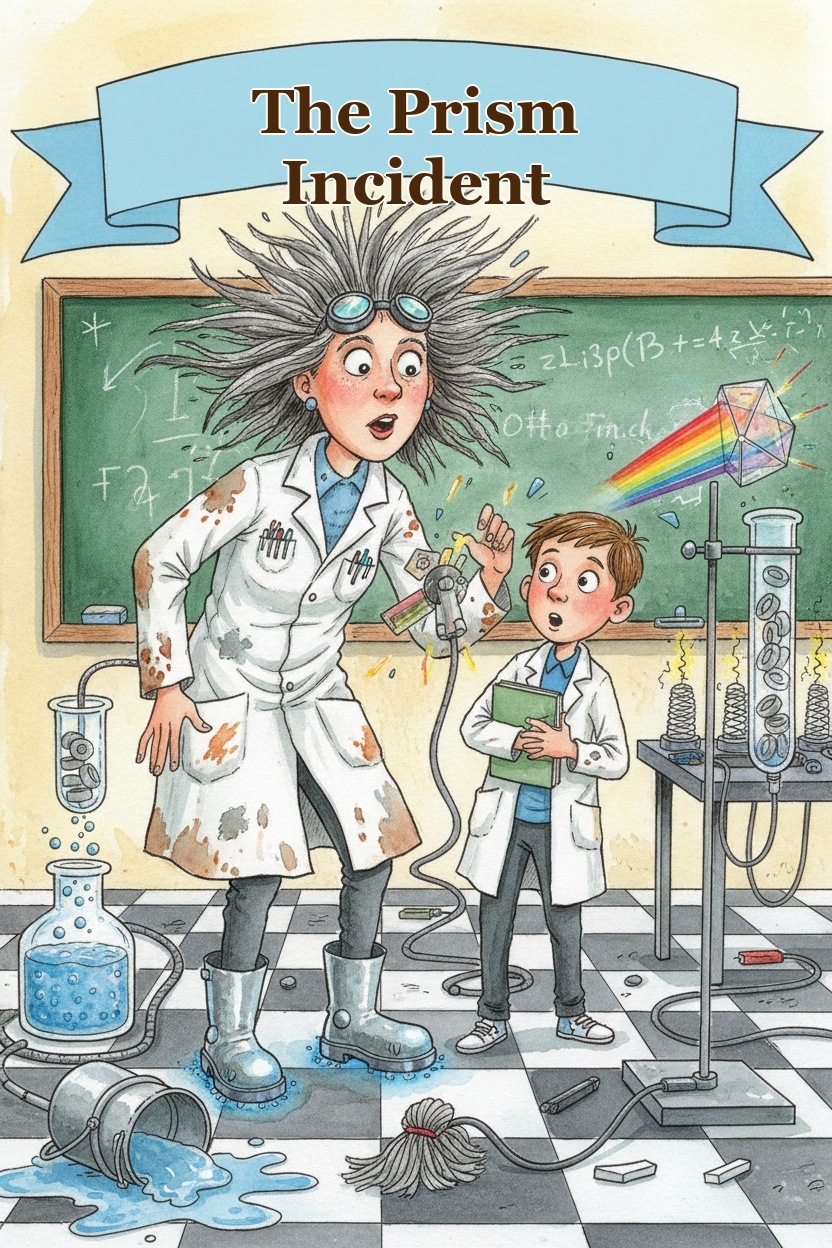
Section 1: A Very Large Delivery
The morning started like any other Tuesday in Professor Plunk's Impossible Lab. Otto was at his workbench, carefully labeling his notebook with the date and the weather (sunny, which he noted would be unusual for a refraction experiment) when he heard the sound.
CLANK. CLANK. CLANK.
It was coming from the street below, and it was getting louder. Otto looked out the window and saw a flatbed truck parked outside. On the back sat something covered in a grey canvas tarp. It was enormous—almost as tall as the lab's front door.
"Professor Plunk?" Otto called. "There's a truck outside. It's making a very loud sound."
"That'll be my new demonstration apparatus!" Professor Plunk's voice echoed down from the third floor. She appeared at the top of the stairs, her wild grey-streaked hair crackling with static electricity. "The world's largest prism, my careful colleague! I had it custom-made!"
Otto's pencil stopped mid-word. "The world's largest prism?"
"Exactly so! A triangle of solid glass, nearly two metres tall! When sunlight passes through it, we shall see dispersion on a scale never before attempted in this city!"
Otto wrote in his notebook:
Today's Experiment: Watching light pass through a very big prism.
Prediction: A rainbow will appear on the lab wall.
Possible problems: The prism is extremely large. I am already worried.
"I'm going to help Gloriana bring it up," Plunk announced, already heading for the stairs. "She says she has a dolly that can handle it, but I think we should use the pulley system from the roof."
Otto closed his notebook and followed. "The pulley system? The one that still has the dent from the anchor demonstration?"
"That was a different pulley system," Plunk called back. "This one is perfectly functional!"
Section 2: The Prism Arrives
Somehow—through a combination of Gloriana's silent competence, a very sturdy dolly, and only one moment where the prism swung dangerously close to the lab's collection of antique barometers—the world's largest prism made it safely to the roof.
Otto had to admit it was beautiful. The prism was a perfect triangle of crystal-clear glass, taller than Professor Plunk herself. The morning sun caught its edges and split into tiny sparkles of colour that danced across the roof tiles.
"Magnificent," Plunk breathed. "Simply magnificent. Now, Otto, here is my plan."
She unrolled a large diagram covered in arrows and notes. Otto recognized her handwriting: enthusiastic, messy, and slightly singed at the edges from a previous experiment.
"We position the prism on this platform," she said, pointing to a sturdy wooden stand that Gloriana had just finished assembling. "The sunlight hits this first face, refracts into the glass, and then—" she traced a line with her finger, "—disperses into its component wavelengths! The rainbow will project perfectly onto the white wall of the water tower across the street!"
Otto studied the diagram. "But Professor, the water tower is quite far away. And the angle you're describing... won't the rainbow go upwards?"
"Upwards?" Plunk looked at the sun, then at her diagram, then at the sun again. "Well. Yes. There may be a slight adjustment needed."
She adjusted the platform's angle. Then adjusted it again. Then turned the whole thing a quarter turn.
"Professor, if you turn it that way, the sunlight will hit the second face instead of the first—"
"Exactly what I intended!" Plunk declared, even though Otto was quite sure it wasn't. "Now, Otto, I want you to stand at the observation point and record the precise colours you see as they appear. Remember: violet bends most, red bends least!"
Otto opened his notebook to a fresh page. He wrote:
Observation Point: Behind the chimney, which is solid and brick-shaped and between me and the prism.
"Ready!" he called.
"Excellent! And... now!"
Professor Plunk removed the canvas cover with a flourish. Sunlight streamed onto the prism's first face, bent through the glass, emerged from the second face, and—
Nothing happened.
"Well," Plunk said, frowning at the prism. "That's not right."
Otto squinted. Far below, on the street, a small patch of rainbow light flickered on the pavement. It was maybe thirty centimetres wide. A pretty little rainbow, certainly. But not the spectacular display Plunk had promised.
"The angle is wrong," Plunk said, adjusting the platform. "Hold on."
She turned the prism. The rainbow moved. It splashed across a bakery window, then across a lamppost, then—
"Professor," Otto said carefully. "The prism is very heavy. Maybe we should—"
But Plunk had already turned the prism all the way around. The full face of the sun hit it dead-on, and suddenly the roof exploded into colour.
Section 3: The Widest Rainbow Ever
Otto had seen rainbows before. Everyone had seen rainbows. They appeared after storms, soft and gentle across the sky.
This was not that kind of rainbow.
The beam of sunlight entered the prism, and inside the glass it separated—violet bending most sharply, red bending least, and every colour between spreading out in between. The rainbow that emerged was easily three metres wide, stretching across the entire sky above the lab.
And because the prism was so large, and the light so intense, the rainbow didn't stop at the water tower. It didn't stop at the next street. It kept going, a blazing arc of colour that painted the clouds themselves.
"Hah!" Plunk threw her arms up. "PERFECT! Look at that dispersion, Otto! Violet is most bent!" She pointed. "There it is, on that cloud! And red is least bent—see how it stretches toward the old clock tower!"
Otto's mouth hung open. He could see the individual colours—not just a blurry mix, but distinct bands of violet, indigo, blue, green, yellow, orange, and red. Each one was slightly offset from the next, like a giant's paintbrush had drawn seven perfect parallel lines across the sky.
"Seven colours," Otto whispered, writing as fast as he could. "Violet bends most, red least..."
"Yes!" Plunk was practically dancing. "Each wavelength refracts at a slightly different angle! Red has the longest wavelength, so it bends the least! Violet has the shortest wavelength, so it bends the most! That's DISPERSION, Otto! The separation of white light into its component colours!"
"Is it going to keep going?" Otto asked, watching the rainbow stretch further and further east.
"THEORETICALLY," Plunk said, "with a prism of this size, the rainbow could be visible from... approximately... let me calculate..."
She pulled a calculator from her coat pocket. Her fingers flew over the buttons. Then she lowered it slowly.
"Oh," she said.
"What?" Otto asked. "From where, Professor?"
"From the next town over," Plunk said quietly. "And possibly the town after that."
Otto looked at the rainbow. It was still expanding.
"We should maybe tell someone," he suggested.
Section 4: The Polite Inquiry
The phone rang exactly forty-three minutes later.
Otto answered it, because Plunk was on the roof, trying to adjust the prism's angle to "bring the rainbow back down a bit," which was not going well. She had already turned the prism three different ways, and each turn had made the rainbow longer in a different direction.
"Good afternoon, Plunk Institute of Physics and Related Mishaps," Otto said.
"Hello," said a very formal voice. "This is the County Office of Coordination. We are calling to inquire about the... phenomena."
Otto covered the phone with his hand and whispered to Gloriana, who was passing with a tray of cleaning supplies. "It's the county."
Gloriana nodded once. "Told her so."
"Yes, hello," Otto said into the phone. "Could you be more specific about which phenomena?"
"The rainbow," the voice said. "The very large rainbow. The one that is currently visible from the County Office, the hospital, and the elementary school. Several children have asked if it's a sign."
Otto looked out the window. The rainbow was now so wide it had split into two distinct segments across the sky. Through the glass, he could see tiny figures on neighbouring rooftops, pointing.
"That's our experiment," Otto said. "Professor Plunk is demonstrating light dispersion with the world's largest prism."
"The world's largest prism," the voice repeated. "I see. Would it be possible to... un-demonstrate it?"
"I'll ask," Otto said. "Hold on."
He ran to the roof. Plunk was standing on a chair, trying to reach the top of the prism, which she had somehow managed to wedge between two chimneys.
"Professor!" Otto called. "The county is asking us to make the rainbow smaller!"
Plunk turned, her safety goggles askew. "Smaller? But it's working perfectly!"
"The rainbow is visible from the next town!" Otto said. "Possibly the town after that!"
Plunk looked at the rainbow, then at her calculator, then at the rainbow again. A slow smile spread across her face. "Well," she said. "That does demonstrate dispersion rather more vividly than I intended."
Then she frowned.
"Though it is rather inconvenient. The dispersion principle works beautifully, but I hadn't accounted for the fact that the rainbow would keep spreading as the sun moves across the sky!" She pointed at the prism. "That's refraction at work! The sun's angle shifts, so the refracted angles shift with it!"
Otto pulled out his notebook.
Observation: The rainbow moves constantly because the sun does.
The physics is very beautiful. Also very embarrassing.
"Professor," he said carefully, "maybe we could turn the prism a little so the rainbow goes toward the lab instead of the whole county?"
Plunk's eyes lit up. "Otto, that's brilliant! We'll redirect the rainbow onto the water tower! There's a white wall there, perfect for viewing!"
She leaped off the chair and began wrestling with the prism. Otto grabbed the other side, and together they managed to rotate the enormous triangle. The rainbow swung across the sky like a searchlight, painting rooftops and trees in brilliant colour as it went.
"Just a little more," Plunk grunted. "Left... left... barely two millimetres to the left—"
The prism tipped.
Otto didn't see exactly what happened. There was a terrible sound of glass grinding against metal, a shout from Plunk, and then the whole world seemed to fill with dancing specks of light.
The rainbow had exploded outward. Not just seven colours—hundreds. Thousands. White light scattering into every possible rainbow at once as the prism finally landed at a perfect angle, catching the full force of the afternoon sun.
It was the most beautiful disaster Otto had ever seen.
Section 5: The Perfect Rainbow
When the light settled, Otto opened his eyes.
The rainbow was gone from the sky. But the lab wasn't. The walls were covered in rainbows. The floor was covered in rainbows. The ceiling had a rainbow that looked suspiciously like a giraffe, and the chalkboard had one shaped exactly like a rocket ship.
The prism had come to rest in the roof's drainage gutter, angled perfectly at a window, and the sunlight streaming through it had filled the entire top three floors of the Plunk Institute with scattered, dancing light.
"WELL!" Professor Plunk announced, picking herself up off the roof. She looked at the rainbows, then at Otto, then at her own hands, which were covered in rainbow light. "That demonstrated dispersion rather more vividly than I intended!"
Otto was already writing.
Key Discovery: White light is made of ALL the colours.
The prism separates them because each colour bends different amounts.
Violet bends most. Red bends least. Everything else is in between.
Also, the lab is now permanently rainbow coloured.
"That's the thing!" Otto said, looking up with wide eyes. "Professor, I've always thought rainbows were something the sky made. But they're in the sunlight all along! The prism is just... showing us what's already there!"
Plunk's face melted into a smile so warm it rivaled the sunlight itself. "Exactly, Otto. Every colour that's ever been in a rainbow has been travelling through space, bent by nothing, invisible, until it meets something that separates it out. The glass just gives each colour its own path."
She looked at the rainbows covering the lab. "We could try to move the prism back into a smaller angle," she said. "But honestly, this is rather lovely."
Gloriana appeared at the top of the stairs. She carried a large bag of what looked like flour, a long-handled squeegee, and a single roll of duct tape.
She surveyed the rainbow-covered lab.
"Nice colours," she said.
Then she walked in, set down the bag, and began gently moving the prism back toward the safe position with the practised hand of someone who had fixed thirty years of Plunk's accidents.
Otto closed his notebook. His final entry read:
Today we made the world's largest rainbow.
The county called. They were polite.
I learned that white light is secretly every colour at once.
That is not a metaphor. It is physics.
The lab is now the prettiest laboratory in the city.
THIS WAS NOT IN THE PLAN. IT WAS BETTER.
The sun set over the Plunk Institute, painting the sky in red and orange and violet. Inside, the lab glowed with a hundred small rainbows, cast by a hundred small reflections off a hundred small pieces of the world's largest prism—which Gloriana had cleaned, straightened, and set on a proper stand in the corner, where it stayed for many years, making the lab's lunchtimes beautifully colourful.
And in the County Office of Coordination, they filed the inquiry away with a note: "Rainbow confirmed. No action needed. Recommend leaving Professor Plunk alone with her experiments, but closing the curtains."
Because every disaster is a discovery.
And every rainbow is just light being honest about what it's made of.