The Number Kingdom
The Skip-Count Market
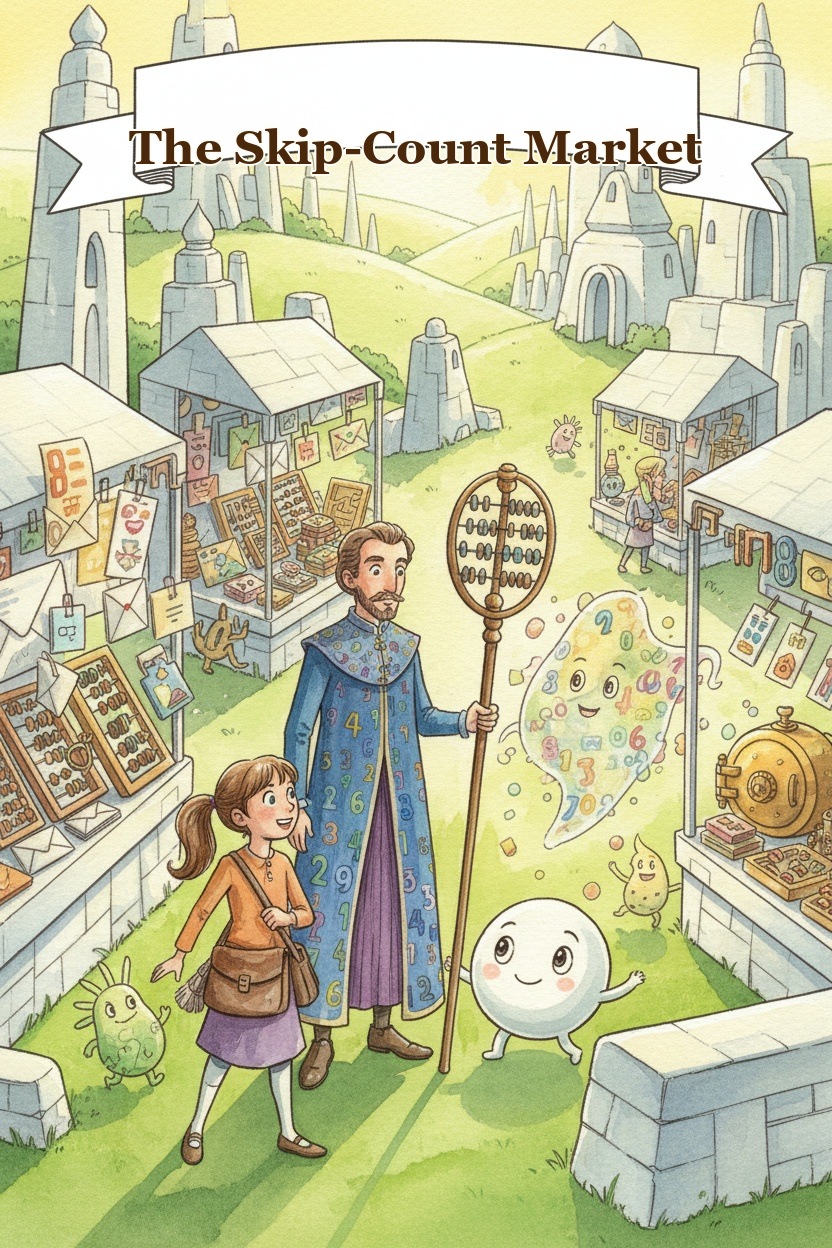
The Panic at the Market
The Number Kingdom's market square was normally the busiest, happiest place in all the land. Stalls lined every path, their awnings bright with color: red apples, yellow cheeses, blue fabrics, and green herbs. Merchants called out their prices in cheerful rhythms. Baskets of eggs sat in tidy rows. Jars of honey gleamed like captured sunlight.
But today, the market was in chaos.
Mira arrived to find merchants shouting at customers, customers shouting at merchants, and no one buying anything at all. A basket of apples sat with a sign that read "APPLES: 1, 3, 5, 7, 9... PRICE UNKNOWN." A box of candles had a price of "2, 4, 6, 8... WAIT, THAT'S WRONG." And at the biggest stall of all, a crowd had gathered around a baker who was frantically counting eggs one by one, pointing at each egg with a trembling finger.
"One egg! Two eggs! Three eggs! Four eggs!"
"Bramble," said a merchant beside Mira, "has been counting like that all morning. Each egg individually. He's got sixty-three eggs to count, and he's only gotten through nineteen."
"That's a very inefficient way to count eggs," Mira said.
"He knows! But the patterns are all wrong! The prices are wrong! Everything is wrong!"
Mira looked around the market square. She saw the merchant's ledger, open on the stall, its columns of numbers completely scrambled. She saw the price signs, their numbers jumping in strange, broken sequences. And hovering over the tallest stall, visible only to someone who knew how to look, was a thin, flickering shape made of leftover slivers and broken sequences.
The Remainder.
"Right," said Mira, pulling her satchel around. "Let's see what's broken."
A Market Built on Patterns
The Count appeared at Mira's side, his robes shifting with the slow dance of numerals. He was not a fast walker, and he looked more serious than ever.
"The crisis is as follows," he said. "This market has operated for centuries on skip-counting patterns. Prices are set in groups. Stock is counted in groups. The jam stall prices by twos, the fruit stall by fives, the textile stall by tens. These patterns allow merchants to count quickly, price fairly, and calculate efficiently. The Remainder has disrupted every sequence."
"By doing what, exactly?"
"Changing the numbers in the middle of the patterns. Look."
The Count gestured to the jam stall. A sign read:
JAM PRICES: 2, 4, 6, 8, 12, 14, 16, 18...
"That's the 2s pattern," Mira said slowly. "2, 4, 6, 8, 10, 12, 14, 16, 18, 20..."
"Indeed," said the Count. "But the pattern has a hole at 10. The sequence now jumps from 8 to 12, skipping over 2 groups of 2. The jam maker, who prices each jar by adding 2 to the previous price, reached the gap and didn't know what to do. She started over at 2, which is why ten jars of jam now cost two copper pieces."
"That's terrible! She's losing money!"
"Some stalls are overcharging. Some are undercharging. No one knows the right price for anything. And Bramble the baker has decided to count every egg individually, because he no longer trusts any pattern."
Mira walked through the market, looking carefully at each disrupted sequence. At the fruit stall, the prices were supposed to go up by 5s: 5, 10, 15, 20, 25, 30. But the sign read 5, 15, 20, 25, 40, 45 — with 10 missing and 35 missing. At the textile stall, bolts of cloth were stacked in tens, but the price signs read 10, 20, 30, 45, 50, 60 — with 40 replaced by 45, breaking the whole pattern.
The Remainder appeared beside her, grinning. It looked like a collection of spare numbers, slightly too many for its body. "It's BETTER this way!" it said happily. "Every price is a surprise! No one knows what anything costs! The whole market is full of delicious, wonderful uncertainty!"
"It's full of chaos," Mira said. "The merchants are losing money. The customers are confused. Bramble has been counting eggs all morning, and he's only on twenty-one."
"Twenty-one is a perfectly good number," said the Remainder. "It's not divisible by 2, or 5, or 10, or anything! It's the leftover of many divisions! It's beautiful!"
"It's a number in the wrong pattern," Mira said firmly. "And I'm going to fix it."
Finding the Pattern
Mira sat down on a barrel and pulled out her paper and pencil from her satchel. The Remainder hovered nearby, humming a chaotic tune.
"Okay," she said to herself. "Let's think about this carefully."
She drew the 2s pattern:
2, 4, 6, 8, 10, 12, 14, 16, 18, 20
"What makes this a pattern?" she asked herself. "Each number is 2 more than the one before it. That's what skip counting by 2s means. You add 2 each time."
She looked at the jam stall's broken sign again:
2, 4, 6, 8, 12, 14, 16, 18
"The pattern is 2, 4, 6, 8, then it should be 10, but it's missing. The Remainder took out 10."
"That's RIGHT!" said the Remainder gleefully. "Ten was in the way! It was too predictable! I removed it! Now the pattern jumps from 8 to 12, and nobody knows why!"
"But they do know why," Mira said. "Because the pattern is adding 2 each time. If we know the rule, we can find the missing numbers."
She drew the 5s pattern:
5, 10, 15, 20, 25, 30, 35, 40, 45, 50
"Skip counting by 5s means adding 5 each time," she said. "The fruit stall is missing 10 and 35. But if the rule is 'add 5,' then 10 and 35 are easy to find."
She drew the 10s pattern:
10, 20, 30, 40, 50, 60, 70, 80, 90, 100
"And skip counting by 10s means adding 10 each time. The textile stall has 45 where 40 should be. That breaks the pattern because 45 is 5 more than 40, but the rule is adding 10."
"Hold on," said the Remainder, floating closer. "How do you know the rule is adding 10? What if the rule is something else entirely? What if the pattern is 10, 20, 30, 45, then... I don't know, 67.5, then..."
"The first three numbers tell you the rule," Mira said. "10 to 20 is adding 10. 20 to 30 is adding 10. The rule is consistent. That's what makes it a pattern. 45 doesn't follow the rule, so 45 is wrong."
"Mira," said a quiet voice.
It was Zero, standing by the barrel. The small silver circle had been there for a while, unnoticed as always.
"May I show you something?" Zero asked.
Mira nodded.
Zero gestured to the paper, where Mira had drawn the 10s pattern. "Look at the pattern when you count by 10s," Zero said. "What do you notice about where each number ends?"
Mira looked. "They all end in 0. 10, 20, 30, 40... they all end in 0."
"And when you count by 5s?"
"They end in 5 or 0. 5, 10, 15, 20..."
"And by 2s?"
"The numbers are all even. 2, 4, 6, 8, 10..."
"Interesting, isn't it?" Zero said. "The pattern isn't just about adding the same number each time. It's also about what the numbers look like when you get there. Checking the digits is another way to verify that you've found the right numbers."
Mira's eyes widened. "That's clever! If a number in the 5s pattern ends in 3, you know it's wrong even before you check whether it's adding 5 correctly."
"Indeed," said Zero. "And there's one more thing, Mira. What happens when you skip count by 10s starting from 0?"
"0, 10, 20, 30..."
"And if you start from 10, and count backwards?"
"10, 20, 30... wait." Mira paused. "If I add 10 to 0, I get 10. If I add 10 to -10, I get 0." She looked up, startled. "I'd need negative numbers to go backwards."
"Not today," said Zero, with the smallest hint of a smile. "But you will need them eventually. For today, you need only go forward — and forward has patterns."
The Remainder was watching this exchange with a more thoughtful look than it usually wore. "The digits," it said slowly. "The numbers themselves know what pattern they belong to. That's... actually quite interesting."
"Yes," Mira said. "It is. Patterns have structure. That's why they work."
Restoring the Market
Mira stood in the center of the market and called the merchants together.
"Here's what we're going to do," she said. "Every stall has a skip-counting pattern that governs its prices and stock. We're going to identify the rule for each stall, find the numbers that don't belong, and write the correct sequence."
The jam maker came forward first. "My prices go up by 2 for each jar."
"Then your pattern is 2, 4, 6, 8, 10, 12, 14, 16, 18, 20," Mira said, writing it out. "The missing number was 10. Your tenth jar should cost 20 copper pieces, not 2."
The fruit seller looked at his sign. "I count my fruit by 5s. Five apples in a bundle, five bundles in a crate."
"Then your pattern is 5, 10, 15, 20, 25, 30, 35, 40, 45, 50," Mira said. "You were missing 10 and 35. Your crate of apples should be priced at 40 copper pieces, and your crate of melons at 45 — not 40 and 45. Wait." She looked at the sign again. "Your melons are supposed to be 35."
"Melons are HEAVIER," said the Remainder, who was floating nearby. "They should cost MORE. That's not wrong, it's just different."
"Might be different," Mira said, "but it breaks the pattern. If you want to charge extra for melons, you need to put them in their own stall with their own pattern. You can't change the rule in the middle of the sequence."
The textile merchant had been listening. "My cloth is sold by the bolt, 10 silver per bolt."
"Then the pattern is 10, 20, 30, 40, 50, 60, 70, 80, 90, 100," Mira said, erasing the 45 and writing 40. "The 45 was wrong. It broke the rule."
One by one, the stalls were fixed. The candle maker's prices were restored to their 2s pattern. The egg seller discovered that Bramble had been overcharging by following a broken sequence, and the correct price for a dozen eggs was found by skip counting up by 2s until reaching 24.
When they reached Bramble's stall, the baker looked at Mira with exhausted eyes. "I've been counting eggs all morning," he said. "One at a time. I'm halfway through the crate."
"You don't need to count them one at a time," Mira said. "You have 8 rows of eggs, and each row has 6 eggs. You can skip count by 6s! 6, 12, 18, 24, 30, 36, 42, 48."
"Forty-eight eggs!" Bramble said. "That's much faster than counting one at a time!"
"Skip counting is about counting in groups," Mira explained. "Instead of counting 48 individual eggs, you count 8 groups of 6. It's faster because you're counting more at once."
"Counting in groups," Bramble repeated. "Like counting 5 apples instead of counting each apple."
"Exactly."
The Remainder was watching with less glee and more curiosity than usual. "So the pattern works because the rule is consistent," it said. "And the rule is consistent because... each step adds the same amount. That's what skip counting IS."
"Yes," Mira said. "That's what it is."
"And if I change one number in the middle," the Remainder mused, "I'm not creating a new pattern. I'm just breaking the old one."
"Right."
"That's not as interesting as I thought it would be," the Remainder said, but it wasn't quite true. It hovered over the market, examining the repaired sequences, and Mira could see a new idea forming in its flickering shape.
"Efficient," it said finally. "All these patterns, working together. Clever numbers, all moving in their groups. It's... almost beautiful."
"It IS beautiful," Mira said. "That's why we need to keep it working."
"I didn't break anything permanently, though," the Remainder said. "Did I? You fixed it all."
"Yes," Mira said. "Because the patterns were always there. You just scrambled the numbers. The rules were still true underneath."
The Remainder was quiet for a long moment. Then it said, "I wonder what OTHER patterns exist. If you skip count by 2s, the numbers are even. If you skip count by 5s, they end in 5 or 0. What about skip counting by 3s? By 4s? What kind of patterns would those make?"
"Those," said Mira, "are for another day. The times tables."
"The times tables!" the Remainder exclaimed. "I've heard of those! I bet I could do WONDERFUL things with the times tables!"
And it vanished, leaving behind a trail of numbers that were, for once, not in any particular order.
Market Music
By evening, the market was restored. Prices were correct. Stock was counted properly. Bramble the baker had counted his final crate of eggs by skip counting by 6s — 6, 12, 18, 24, 30, 36, 42, 48 — and had finished in under five minutes.
The merchants were delighted. The customers were relieved. And at the center of the market, Mira stood surrounded by the evidence of her work: signs with clean patterns, ledgers with correct sequences, and a baker who would never count eggs one at a time again.
The Count surveyed the market with a rare expression of satisfaction. "The skip-counting patterns have been restored," he said. "The market is functioning correctly once more. I must confess, Mira, I did not anticipate that you would diagnose the problem so quickly by examining the first numbers in each sequence to determine the rule."
"Once you know what the pattern is supposed to be," Mira said, "you can find what's missing and what's wrong. The pattern tells you what comes next."
"Indeed it does," said the Count. "Do you understand now why the market uses skip counting?"
Mira thought about it. "Because it's efficient. Instead of counting each thing, you can count groups. Instead of pricing each jar individually, you can skip count by 2s and know every price in the stall. It saves time and it's accurate."
"And it is the foundation of something greater," the Count said. "When you skip count by 2s, you're making groups of 2. When you skip count by 5s, you're making groups of 5. This is the beginning of multiplication — understanding that you can add equal groups together quickly, just by knowing the pattern."
"Multiplication," Mira said, tasting the word. "So skip counting is like... a first step?"
"A very important first step," said Zero, who had appeared at her elbow. "Every times table is a skip-counting pattern. The 3s times table is skip counting by 3s. The 7s times table is skip counting by 7s. You already know more multiplication than you realize — you just call it skip counting."
Mira smiled at that. She looked out over the market, where the jam maker was selling jars at 2, 4, 6, 8 copper pieces, and the fruit seller was counting bundles of 5, 10, 15, and the textile merchant was stacking bolts in rows of 10.
"That's the thing about patterns," she said. "Once you see them, you can't unsee them. They're everywhere."
Zero said nothing, which was its way of saying everything.
"By the way," Mira added, "that trick with the digits — checking that numbers in the 5s pattern end in 5 or 0, and the 2s pattern are all even — that was clever. I wouldn't have thought of that."
"Yes," said Zero quietly. "That tends to work."
And the market continued to hum with the music of skip counting: 2, 4, 6, 8; 5, 10, 15, 20; 10, 20, 30, 40 — the happy rhythm of numbers moving in groups, each sequence stepping along to its own steady beat.
Mira stood in the middle of it, watching the patterns dance, and felt the satisfaction of a problem solved and a market working. She knew the Remainder would be back. It always came back. But next time, it might find that Mira knew more than she had before — and that the patterns of the Number Kingdom ran deeper than anyone could break.