The Number Kingdom
The Pattern Palace
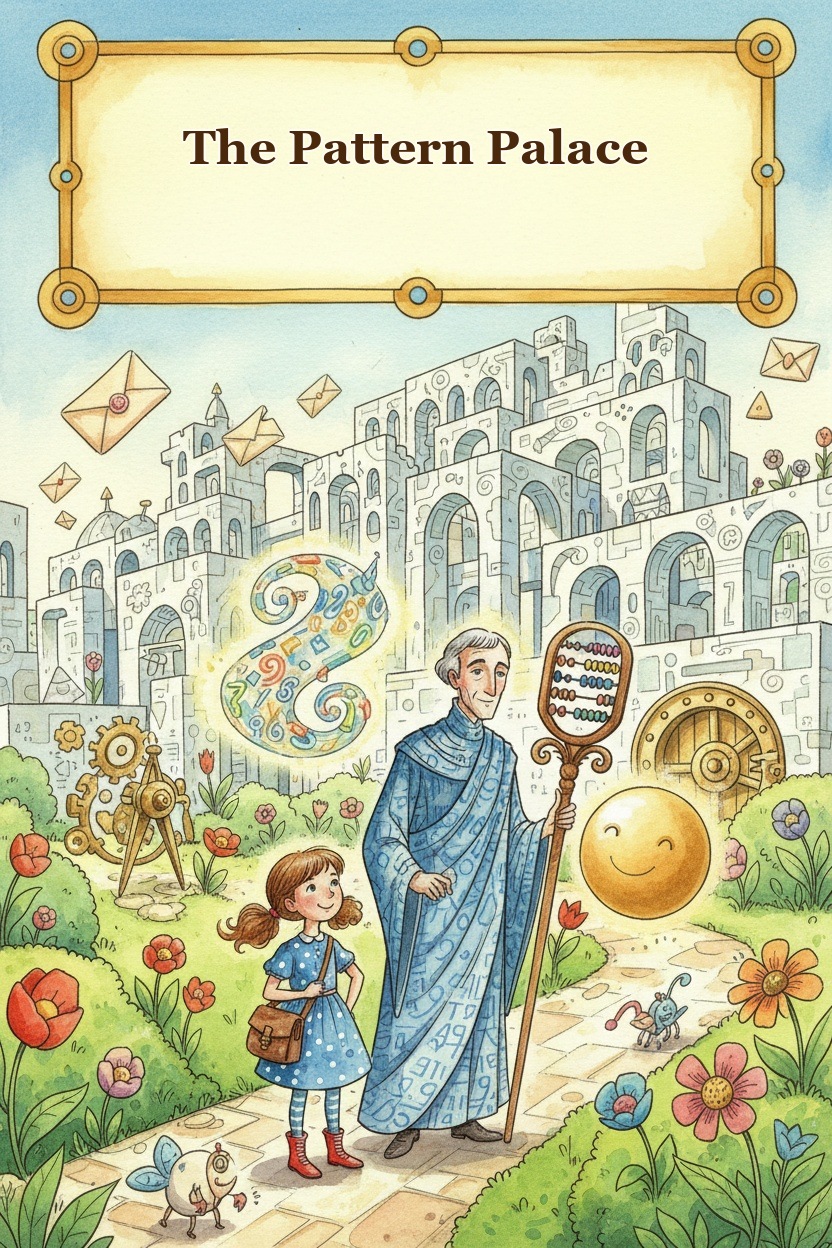
The Summons
Mira was in the middle of sketching a particularly interesting spiral she'd noticed in the palace gardens—each loop getting exactly one petal wider—when the Count appeared beside her, his robe of shifting numerals rustling with urgency.
"There has been an incident," he announced, his voice carrying its usual formal weight. "A considerable incident. Possibly the most pattern-based incident in the kingdom's history."
Mira tucked her pencil behind her ear. "The Pattern Palace?"
The Count nodded grimly. "The Remainder has been busy." He paused. "It has rearranged the patterns."
"That doesn't sound so bad," Mira said, standing up. "Patterns are just—"
"They are the palace's skeleton," the Count interrupted. "The walls are built in sequences. The columns follow multiplication patterns. Even the windows are arranged in geometric progressions. Without the correct patterns, the structure cannot support itself. We have perhaps an hour before the east wing begins to fold."
Mira reached for her satchel. "Right," she said. "Let's see what's broken."
The Unraveling Palace
The Pattern Palace stood at the kingdom's eastern edge, and Mira had always thought it looked like a song made into a building. Everywhere you looked, something was repeating—tiles in growing spirals, columns that got slightly taller in even steps, windows arranged so that each row had two more than the last.
Today, it looked like a song being sung by someone who had forgotten the tune.
The columns along the main entrance were all the wrong heights. They were supposed to go 2, 4, 6, 8—each one two higher than the last. Instead, they went 2, 4, 6, 12, 8, 15, which, as far as Mira could tell, was not a pattern at all. It was just a list.
"That's not a rule," she muttered. "That's a pile of numbers pretending to be a sequence."
The Remainder appeared on top of one of the mismatched columns, looking like a half-finished sketch of a child. It was humming something off-key.
"Pretending to be a sequence!" it said gleefully. "That's a lovely way to put it. But are you sure it's not pretending? The 15 is very confident. It really believes it belongs."
"The 15 has no idea what it's talking about." Mira walked closer, studying the columns. "The rule here is clear. Each column is two taller than the one before. 2, 4, 6, 8, 10, 12. The 12 should be in the fifth position, and the 15 shouldn't be here at all."
The Remainder tilted its head. "But what if the rule is different? What if the rule is 'whatever makes things interesting'?"
"That's not a rule," Mira said. "That's a wish. And wishes don't hold up buildings."
She pulled out her notebook and wrote down the columns as they were:
2, 4, 6, 12, 8, 15
Then she wrote what they should be:
2, 4, 6, 8, 10, 12
"The rule is +2," she said. "Each number is two more than the last. Which means I need to find where the pattern broke."
She studied the sequence again. "The first three numbers are right—2, 4, 6. But the fourth column is 12 when it should be 8. That's where the Remainder struck."
"Struck!" The Remainder clapped its hands. "I like that. I did strike. I struck quite hard, actually. Right in the middle of the fives."
Mira frowned. "The fives?"
"The fifth column," the Remainder said airily. "Which I believe is currently the number 8, which should be a 10. But that's not nearly as interesting as the 12, which is currently where the 8 should be."
Mira closed her eyes and worked through this carefully. The pattern was +2. That meant:
2, 4, 6, 8, 10, 12
The first three were correct: 2, 4, 6. Then the pattern broke. The fourth column should have been 8, but it was 12. And the fifth should have been 10, but it was 8.
"What about the sixth?" she asked.
The Remainder shrugged dramatically. "You'll have to look."
Mira walked past the columns to the entrance, where a row of tiles stretched toward the great doors. Each tile had a number on it, and she could see immediately that they were meant to follow a pattern too.
2, 5, 10, 16, 26
"Wait," she said. "That's wrong too."
She looked more carefully. The first two tiles were fine—2 and 5. But the third should have been... she thought for a moment. 2 to 5 was +3. 5 to 10 was +5. That wasn't the same rule.
"What's the pattern here?" she asked herself out loud. "Is it +3, then +5, then..."
She stopped. "No. That's not a rule. That's just what happened to be there."
She sat down on the steps and stared at the tiles. The Remainder was watching with obvious delight.
"Perhaps the pattern is +3 each time?" she tried. "2, 5, 8, 11, 14. But this tile says 10 where 8 should be. And the next one says 16 where 11 should be."
She crossed out her writing and started over.
"Unless the pattern is something else entirely. Something that doesn't start at the beginning."
She looked at the tiles as they were: 2, 5, 10, 16, 26.
And then she saw it.
"2 to 5 is +3," she said slowly. "5 to 10 is +5. 10 to 16 is +6. Wait—"
She tried again. "2 to 5 is +3. 5 to 10 is +5. What if the difference is increasing by 2 each time? 3, then 5, then 7, then 9?"
She checked: 2 + 3 = 5. 5 + 5 = 10. 10 + 7 = 17. But the tile said 16.
"Close, but not right."
The Remainder leaned forward. "Close! I do like close. It's so near to being interesting."
Mira thought about times tables. The 4-times table went 4, 8, 12, 16, 20. The 3-times table went 3, 6, 9, 12, 15.
She looked at the tiles again. 2, 5, 10, 16, 26.
And then it clicked.
"2 plus 3 is 5. 5 plus 5 is 10. The differences are 3, 5, 6, 10."
She tested another approach. "Or maybe the rule is: each tile is the sum of the two before it, plus one? 2 + 5 = 7, plus 3 is 10. 5 + 10 = 15, plus 1 is 16."
That didn't work either.
She was about to give up when she noticed something. The tiles were arranged in a 3×5 grid, and the rows above had patterns too. The top row was 1, 2, 4, 8, 16. That was doubling. The middle row was 2, 4, 8, 16, 32. Also doubling.
But the bottom row was 2, 5, 10, 16, 26.
She looked at the columns instead:
First column: 1, 2, 2
Second column: 2, 4, 5
Third column: 4, 8, 10
Fourth column: 8, 16, 16
Fifth column: 16, 32, 26
The top and middle rows were doubling. So maybe the bottom row was doubling too, but with something added?
Top row first column: 1. Middle: 2. Bottom: 2. That was doubling.
Second column: 2, 4, 5. There.
Third: 4, 8, 10.
Fourth: 8, 16, 16.
Fifth: 16, 32, 26.
"Wait," Mira said. "If the bottom row is also doubling, it should be 2, 4, 8, 16, 32. But it's 2, 5, 10, 16, 26."
She wrote out the correct pattern:
2, 4, 8, 16, 32
And the wrong one:
2, 5, 10, 16, 26
"The answer to which tile is wrong is simple," she said. "Several of them."
She fixed the second tile: 4 instead of 5. The third: 8 instead of 10. The fourth was correct at 16. The fifth should have been 32, not 26.
As she changed each tile, she could feel the palace settling. The columns at the entrance snapped into alignment: 2, 4, 6, 8, 10, 12.
"A rule," Mira said, tucking her pencil behind her ear. "A pattern has to have a rule. The rule for the columns was +2. The rule for these tiles was ×2. The Remainder didn't break the numbers—it broke the rules."
The Grand Staircase
The entrance hall inside the Pattern Palace was dominated by 12 shallow steps leading up through rows of windows in what was obviously meant to be a striking visual: each step was one unit longer than the last, and the windows above them repeated in a 3-2-3-2 rhythm.
But the steps had been scrambled. The lengths went:
2, 4, 3, 8, 6, 5, 7, 1, 9, 10, 12, 11
Mira set down her satchel. "This is a mess of individual numbers pretending to be a pattern. What's the rule supposed to be?"
The Count appeared beside her, his voice echoing in the vaulted hall. "The steps are built according to the 4-times table—but arranged in pairs, alternating high and low."
Mira thought about this. The 4-times table went: 4, 8, 12, 16, 20, 24, 28, 32, 36, 40, 44, 48.
That didn't seem right for steps.
"Or," the Count continued, "one might say the rule is: the first step is 4 long, the second is 8, the third is 12, and so on."
Mira looked at the steps again. If the rule were +4, the steps would go:
4, 8, 12, 16, 20, 24, 28, 32, 36, 40, 44, 48
That was twelve numbers. But the steps were only twelve steps long—eight units, not forty-eight.
"The steps are built on the 4-times table," the Count said, "but each step is one in length."
Mira frowned. "One? That's not the 4-times table."
"Wait," she said. "Maybe the steps are showing the numbers in the 4-times table, but using the last digit?"
The steps showed: 2, 4, 3, 8, 6, 5, 7, 1, 9, 10, 12, 11.
No, that wasn't right either.
She looked at the correct pattern now forming in her head: 4, 8, 12, 16, 20, 24, 28, 32, 36, 40, 44, 48.
"Four, eight, twelve, sixteen, twenty, twenty-four..."
"Step lengths," she said. "Each step is one longer than the last. So the steps should be: 1, 2, 3, 4, 5, 6, 7, 8, 9, 10, 11, 12."
The Count raised an eyebrow. "And what does that have to do with the 4-times table?"
Mira looked at the wrong steps: 2, 4, 3, 8, 6, 5, 7, 1, 9, 10, 12, 11.
"The rule isn't +4," she said. "The rule is +1."
She stepped back. "The 4-times table is a pattern with the rule +4. But these steps just need to go up by one each time—the pattern here is +1. The 4-times table isn't the pattern of the steps themselves, it's the pattern of the window positions above them."
The Count nodded. "Correct. The windows above the steps are arranged so that every fourth window is larger than the others, creating a rhythm of 4."
Mira looked up. The windows were arranged in rows, and every fourth window was indeed larger—but the Remainder had scrambled them so that the sizes were random, breaking the rhythm.
"Let me fix the steps first," she said. She walked along the row, correcting the step lengths to: 1, 2, 3, 4, 5, 6, 7, 8, 9, 10, 11, 12.
"And the windows," she said. "The pattern is: three small, one large, three small, one large. That's a pattern with a rule of repeating after 4."
She corrected the windows. As she reached the top of the stairs, a deep rumbling sound passed through the palace, and she felt the building settle into place.
"There," she said. "A pattern with a rule is like a promise. The rule is the promise that tells you what comes next."
The Broken Rhythm
At the top of the stairs, the hallway opened into a long gallery lined with paintings. Each painting was a self-portrait of the palace itself, arranged so that each one showed the palace one more time—but the sequence had been thoroughly scrambled.
The paintings showed the palace at: 1, 2, 4, 6, 10, 16, 22, 30
Mira stopped in front of the first few. "That's not the right rule," she said. "This should be the sequence of triangular numbers: 1, 3, 6, 10, 15, 21, 28."
She thought about it. Triangular numbers are what you get when you add each counting number in sequence: 1, then 1+2=3, then 1+2+3=6, then 1+2+3+4=10, and so on. They're called triangular because you can arrange them like triangles of dots.
The paintings were supposed to be at positions 1, 3, 6, 10, 15, 21, 28. But instead they were at 1, 2, 4, 6, 10, 16, 22, 30.
"Let me work out the rule from what's here," Mira said, sitting down on the gallery floor. "The triangular numbers are 1, 3, 6, 10, 15, 21, 28. The rule is: add 2, then 3, then 4, then 5, then 6, then 7. Each time, the amount you add increases by one."
She looked at the wrong sequence: 1, 2, 4, 6, 10, 16, 22, 30.
"From 1 to 2 is +1. 2 to 4 is +2. 4 to 6 is +3. That part is right. But then 6 to 10 is +4. That should have been +4 to give 10, which is right. 10 to 16 is +6, which should be +5."
She corrected the sequence: 1, 3, 6, 10, 15, 21, 28.
As she placed each painting back in its proper position, she could feel the palace's heartbeat steadying. The patterns were being restored one by one, and each restoration made the building stronger.
"There," she said when she was done. "Each painting shows the palace one more time than the last. That's the rule, and the rule tells you what comes next."
The Restoration
The final room was the throne room, a magnificent space where the pattern of the banisters, the pattern of the floor tiles, and the pattern of the ceiling arches all had to be restored at once.
The banisters followed the pattern +3: 1, 4, 7, 10, 13, 16, 19. The floor tiles followed the pattern ×2: 2, 4, 8, 16, 32, 64. The ceiling arches followed the pattern of square numbers: 1, 4, 9, 16, 25, 36.
The Remainder had swapped some terms between patterns, so that the banister had an 8 where a 7 should be, the floor tiles had a 9 where a 16 should be, and the ceiling arches had a 13 where a 9 should be.
"Each pattern has its own rule," Mira said, working carefully. "The banister goes up by 3 each time. The floor tiles double each time. The ceiling arches are squares: 1×1, 2×2, 3×3, 4×4.
I just need to restore each one to its own rule.
She fixed the banister: 1, 4, 7, 10, 13, 16, 19.
She fixed the floor tiles: 2, 4, 8, 16, 32, 64.
She fixed the ceiling arches: 1, 4, 9, 16, 25, 36.
As she placed the final tile, the entire palace gave a long, satisfied sigh. Light poured through the corrected windows, the columns straightened, and the steps settled into perfect order.
The Remainder appeared on the throne, looking almost disappointed.
"You've tidied everything," it said. "It was so much more interesting when the 13 was on the ceiling and the 64 was on the banister. Don't you think 13 is much too heavy for a banister? It had real character."
"It had real chaos," Mira said. "And chaos doesn't hold up buildings."
"No," the Remainder said thoughtfully. "But it does remind you that the order is there. If everything was always in order, you'd never notice the order at all. You'd just walk past it." Its voice was lighter now, genuinely curious. "You have to see the broken pattern to know there was a pattern, don't you?"
Mira paused. The Remainder wasn't wrong. She'd never appreciated the Pattern Palace's beauty until she'd seen it broken.
"That's true," she admitted. "But the broken pattern isn't a new pattern. It's just the old one, interrupted. The beauty is in the rule that makes the pattern predictable."
She looked around the restored room. "The rules are what make patterns meaningful. Without the rule, it's just a list of things that happen to be in the same room. With the rule, it's a story—and you can guess what happens next."
The Remainder tilted its head. "I suppose that is interesting," it said. "In a very ordered way."
And then it was gone, leaving behind only the faint feeling of something that didn't quite fit and was quite proud of that fact.
On the floor, in the palace's centre, lay a small golden compass. Mira picked it up. It was her compass—she must have dropped it.
"Right," she said, tucking it back into her satchel. "Let's see what's broken."
But nothing was broken. The Pattern Palace was whole at last, humming softly with the joy of correct sequences and faithfully followed rules. Mira walked out of the palace, and as she reached the entrance, she saw a small, silver-white circle glitter among the floor tiles.
It was Zero, sitting peacefully in the place where the 64 and the 32 met.
"Hello," Mira said.
"Yes," Zero said quietly, pointing a tiny silver foot at a tile Mira had nearly missed. "I moved that one. It was wrong."
Mira looked down. A single floor tile was out of place—it was 16 where a 32 should have been. The pattern was almost right, but not quite.
"Thank you," Mira said, correcting it.
Zero smiled its tiny, serene smile. "Yes," it said. "That tends to work."