Chef Sparks Kitchen Lab
THE CHEMISTRY OF TEARS
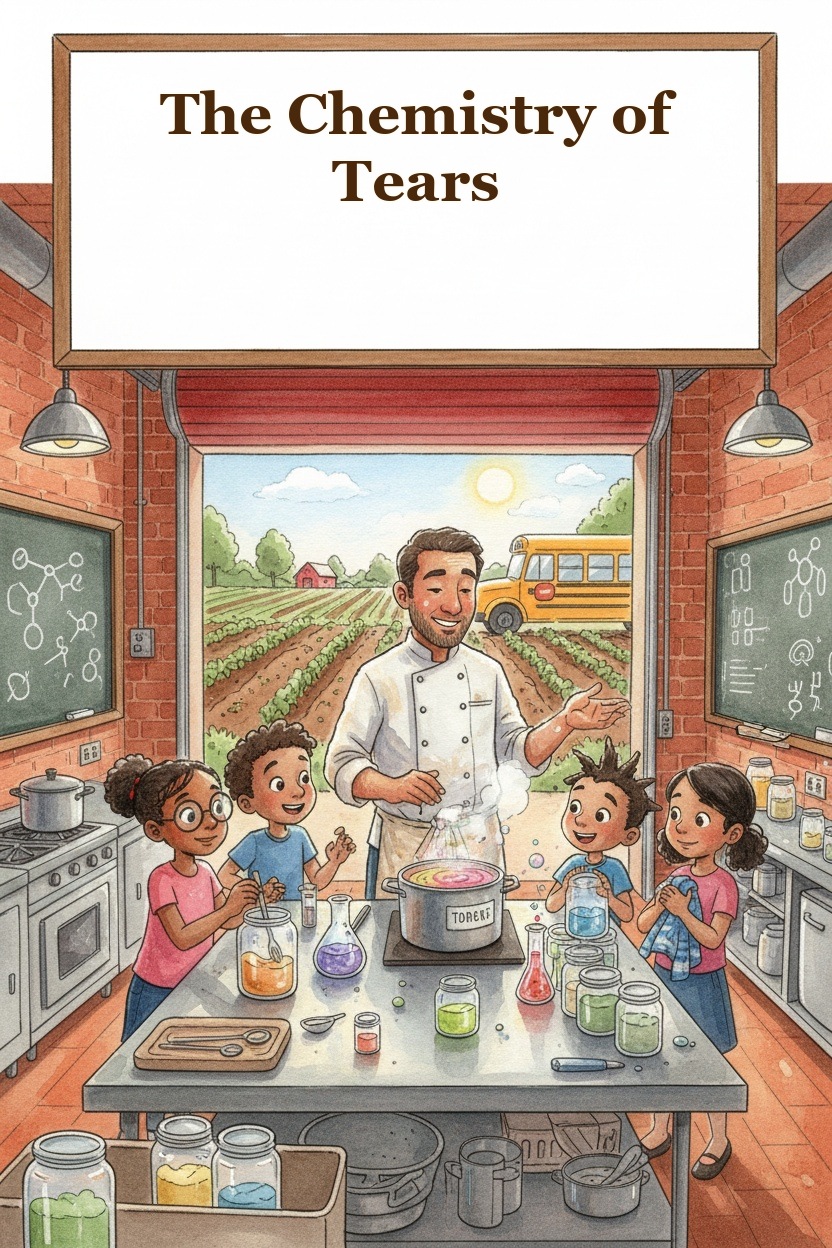
Section One: The Onion Problem
The Riverside Fire Station kitchen smelled like butter and warm bread when Maya, Tommy, Priya, and the rest of the class filed in. On every prep table sat a cutting board, a knife, and a single onion.
Tommy picked his up and sniffed it. "What are we making?"
"French onion soup," said Chef Iggy Spark, sliding down the fire pole and landing with his usual flourish. "But first—" He held up his onion like a trophy. "—we need to talk about crying."
"You cried last time we made this," said Tommy.
Iggy's face went through a complex series of expressions. "Yes. In Book 6, I made French onion soup, and you all cried, and I didn't explain the chemistry properly. It has been bothering me for seven books."
Maya was reading the label on the onion bin. "No allergens listed."
"Onions don't have allergen labels, Maya."
"Still good to check."
Iggy picked up an onion and sliced it cleanly in half. Immediately, the class watched as he blinked. Once. Twice. His eyes got shiny.
"See?" he said. "The onion is already attacking me. But why?"
"Because it's mean?" suggested Tommy.
"Because it's chemistry," said Iggy, dabbing his eyes with his sleeve. "And today we're going to understand exactly what's happening. We're going to learn why onions make us cry—and how to stop it."
Section Two: The Diagram That Hurts
Iggy dragged the chalkboard to the center of the kitchen. On it, he had drawn a beautiful, complicated diagram with colored chalk:
-
A large onion shape labeled ALLIUM
-
Little dots labeled SULFUR COMPOUNDS
-
A pair of scissors labeled ENZYME: ALLIINASE
-
An arrow pointing to a cloud labeled SYN-PROPANETHIAL-S-OXIDE
-
A tear drop labeled LACHRYMATORY FACTOR
"This," Iggy said, "is the story of your tears."
He pointed at the onion drawing. "Onions are part of the allium family—along with garlic, shallots, leeks, and chives. And allium plants are full of sulfur compounds. Sulfur is what makes them smell sharp and taste strong."
"Sulfur," said Priya slowly. "Ammamma says onions are good for you because of the sulfur."
"Your grandmother is absolutely right," said Iggy. "But here's the trick. Those sulfur compounds are stored in the onion's cells, separated from an enzyme called alliinase, which lives in different cells. They're like two ingredients that need to meet to cook—but they're stored separately."
"Like when you keep the peanut butter in the cupboard and the bread in the breadbox," said Maya.
"Exactly! They only come together when you slice the onion and break open the cells."
Iggy mimed a sword slash through the air. "When you chop an onion, you break the cell walls. The sulfur compounds meet the alliinase enzyme. They react. And together they create a brand-new chemical called syn-propanethial-S-oxide."
"Gesundheit," said Tommy.
"That's not a sneeze, Tommy. It's a chemical."
"What does it do?"
Iggy grinned a wicked grin. "It rises. It floats up off the cutting board, into your eyes, and touches the moisture on your eyeball. And when it touches your eye, it creates a mild acid. Your eye doesn't like acid. So your eye sends a message to your brain: Danger! Irritant! Flush it out!"
"And you cry," said Maya.
"You cry," Iggy confirmed. "It's called the lachrymatory factor—from the Latin word for tear. Your eyes are literally washing the acid away."
He grabbed his chalk and scribbled the reaction on the board:
SULFUR COMPOUND + ALLIINASE ENZYME = SYN-PROPANETHIAL-S-OXIDE (THE TEAR GAS)
"Now, the interesting question," said Iggy, turning dramatically, "is—"
The chalkboard was behind him, but the chalk tray was directly in his path. His elbow caught the tray and sent a rainbow of chalk clattering to the floor.
"The Spark Effect!" shouted the class in unison.
"Prediction pool," said Sam, whipping out a notebook. "Tommy had chalk!"
"I had chalk WHEN?" Tommy demanded.
Iggy, as always, did not acknowledge the Spark Effect. He simply picked up a single piece of blue chalk, placed it back on the tray, and continued as if the universe were not conspiring against his teaching materials.
"The interesting question," he repeated, "is how to stop the crying."
Section Three: The Tears Stop Here
Iggy walked to the pantry and returned with a stack of onions—each one prepared differently.
"Option one," he said, holding up an onion sitting in a bowl of water. "The big reveal!" He submerged his hands in the water and began slicing the onion under the surface.
But Tommy was watching the chalkboard, where a new drawing had appeared: THE LACHRYMATORY FACTOR RISES INTO THE AIR.
"He's cutting it under water," Tommy said slowly. "The chemicals can't float up because the water catches them."
"Correct!" Iggy emerged from the bowl, grinning. "Syn-propanethial-S-oxide dissolves in water. When you cut onions underwater, the chemical washes away before it can reach your eyes."
He set down the wet onion and picked up a dry one. "But option two is my personal favorite: chill the onion first."
He pulled a cold onion from a bowl of ice. "The enzyme alliinase works faster when it's warm. Cold slows the whole reaction down. The gas doesn't form as quickly, so fewer tears."
"What about cutting the root last?" asked Priya. "Ammamma says the root has the most sulfur."
Iggy's face lit up with delight. "Your grandmother knows her alliums! The root end of an onion has the highest concentration of sulfur compounds. If you cut it off first, you release all the sulfur at once. But if you cut it last, most of the sulfur is already working away in the pan, safely cooking rather than attacking your eyes."
"Or we could do what my mom does," said Tommy. "She wears swimming goggles."
Iggy paused. "That is also completely valid."
"That's just a physical barrier," said Maya.
"A physical barrier is a legitimate scientific solution, Maya."
Section Four: The Caramelization Lesson
The class chopped their onions—chilled, working from the top down, leaving the roots for last. The kitchen filled with the sharp, clean smell of alliums.
But the crying had mostly stopped.
"The enzyme reaction is prevented," announced Iggy, "by either cold, water, or good knife technique. If any tears fall today, they'll be tears of joy."
"Eat the raw onion," said Tommy. "Joy will not be happening."
Iggy laughed and dumped a mountain of sliced onions into a massive pot with a knob of bubbling butter. "Now for the second chemistry lesson!"
"Two chemistry lessons in one book?" asked Maya.
"You're in the Food Science arc, Maya. We're deep in the weeds now."
Iggy stirred the onions. The first ones at the bottom of the pot began to turn golden. "These onions are about to undergo caramelization—one of the most delicious chemical reactions in cooking. And it's different from what's happening in your eyes."
He pointed to the chalkboard, where he had drawn a new diagram in the space where the chalk tray used to be.
"Syn-propanethial-S-oxide is a reaction between sulfur and an enzyme—it stings. Caramelization is what happens when sugar gets heated high enough that it breaks down and reforms into new compounds, hundreds of new compounds, with new colors and new flavors."
"That's not the Maillard reaction?" asked Sam.
"Great question!" Iggy's voice went up half an octave, and he clapped his hands. "The Maillard reaction is between amino acids and sugars. Caramelization is just sugar getting heated. The onions have natural sugars inside them—sweet, simple sugars. When we cook them low and slow, those sugars slowly melt and brown and transform."
"How slow?" asked Tommy, stirring the onions.
"About forty-five minutes."
"That's a long time."
"Great flavor takes time," said Iggy. "But let me show you what's happening."
He scraped his spatula along the bottom of the pot and lifted it up, showing a brown caramelized streak. "The onions are releasing their moisture. See the steam? As the water cooks away, the sugars get more concentrated. They heat up past boiling, and they start to brown. After forty-five minutes, those onions will be golden-brown, sweet, almost jammy—completely transformed from the sharp, stinging onions we started with."
Priya leaned over the pot and breathed in. "It smells like Ammamma's kitchen when she makes her biryani. The onions she caramelizes for hours."
"Exactly," said Iggy softly. "Every tradition that loves onions knows this trick. The chemistry is universal: low heat, patience, and transformation."
"But we're using a big pot," said Maya. "Won't the flames be too high?"
"Medium-low," said Iggy. "And I will stir. Constantly. Because if you burn the onions, you're not caramelizing them—you're burning them, which is an entirely different chemical reaction and it's not a nice one."
He set the pot on the great stove and turned the burner on. "Now. While we wait for the onions to sweeten, let's practice our knife skills with more onions. Because I want everyone to master the art of the no-tear chop."
"For the book?" asked Lucia, pulling out her sketchbook.
"For the book," Iggy agreed.
Section Five: The Soup Comes Together
By the time the onions had caramelized into a beautiful golden-brown, coffee-colored mass, the kitchen was warm and fragrant. The gas from the onions was exhausted—the lachrymatory factor had dissolved and cooked away under the heat.
Iggy added a splash of wine, and the whole kitchen hissed. "The wine deglazes the pan," he explained. "It picks up all the browned bits—the caramelized sugars stuck to the bottom—and folds them into the broth. That's flavor chemistry at its finest."
He added beef stock, a bay leaf, and a sprig of thyme. The pot bubbled gently.
"The soup is now simmering. While it simmers, let's talk about what we learned."
The class gathered around.
"The onion stores sulfur compounds," recited Maya, "in separate cells from the enzyme alliinase."
"When you cut the onion," continued Tommy, "the cells break, and they meet and make the tear gas chemical."
"Syn-propanethial-S-oxide," Priya said carefully, sounding the word out. "And it floats up and makes a mild acid in our eyes. So our eyes make tears to wash it away."
"And how do we stop it?"
"Cool the onion," said Maya. "Cut the root last. Cut underwater."
"And what happens when we cook the onions?"
"The sugars caramelize," said Sam. "They get brown and sweet and the whole soup changes."
Iggy ladled the soup into bowls and topped them with toasted bread and melted cheese—a golden blanket of gruyère stretching over the edge.
The class lifted their spoons.
The first taste was warm and sweet and deep. The onions had collapsed into silk. The broth was dark and rich and somehow, impossibly, both sharp and sweet at once.
Tommy made the two-note hum that meant success.
The Recipe: Iggy's French Onion Soup
Ingredients:
-
4 large yellow onions, chilled
-
3 tablespoons butter
-
1 splash of white wine (or a squeeze of lemon, for a kid-friendly version)
-
4 cups beef or vegetable stock
-
1 bay leaf
-
1 sprig thyme
-
Salt to taste
-
Baguette slices, toasted
-
Gruyère cheese, grated
Instructions:
-
Chill the onions for 15 minutes.
-
Slice them thin, cutting off the root LAST.
-
Melt the butter in a large pot over medium-low heat.
-
Add the onions and cook slowly, stirring often, for 40-45 minutes. They should turn golden-brown and sweet.
-
Turn up the heat, add the wine (or lemon juice), and scrape up the browned bits.
-
Add the stock, bay leaf, and thyme. Simmer for 15 minutes.
-
Ladle into oven-safe bowls. Top with toasted bread and cheese.
-
Broil until bubbly and golden. Serve warm.
Chef Iggy's Note: Don't rush the onions. The caramelization is the whole point—and the whole chemistry lesson.
Iggy's Kitchen Lab Notes
"Dear class,
Today you learned that the same plant that makes you cry can also become one of the sweetest things you'll ever eat. The onion contains a chemical weapon—and a hidden sweetness—and the difference between them is just an enzyme, some heat, and a little patience. That's the story of chemistry: how the same building blocks become something different depending on what you do with them.
I've been thinking about Book 6 the whole time, and I'm glad we finally got it right. The sulfur chemistry was bothering me. Also, on a personal note, the Spark Effect chalk incident was not my finest moment, and a chalk tray has been replaced. I am told it was a lovely chalk tray. I never saw it fall.
Think about this: what other foods hide their best flavors until you transform them with heat? Find one, and we'll cook it together.
—Chef Spark"