The Logic League
The Short Way
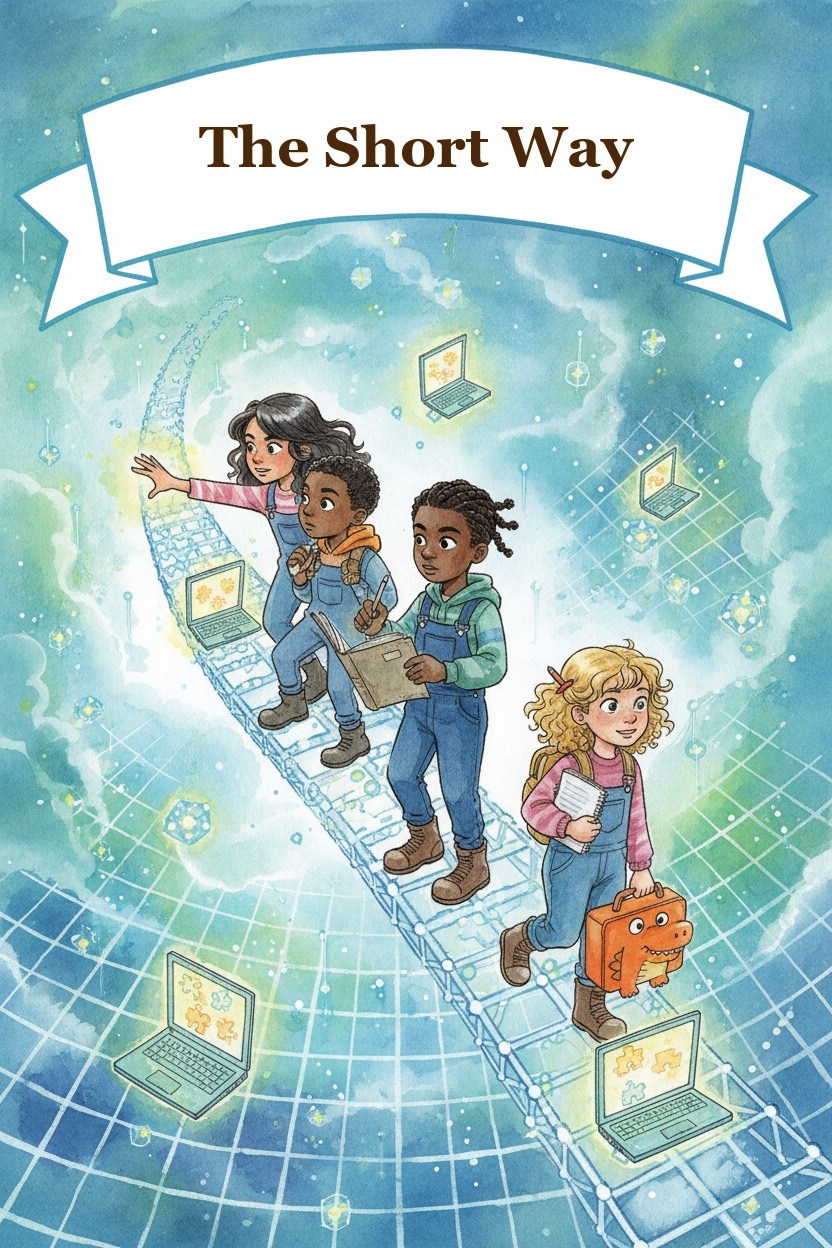
1. The Staircase That Grew
The lost-and-found closet smelled like old sneakers and grape juice. Priya pushed aside a bin of mittens and found the laptop exactly where they'd left it — tucked behind a dusty trophy, its screen dark and waiting.
"Ready?" she asked.
Kwame adjusted his journal in his backpack. Lily checked her watch. Sam bounced on their heels.
Priya opened the laptop. Green light flooded the closet. The screen filled with text, then a doorway shimmered into being — a rectangle of glowing turquoise that hummed like a refrigerator.
They stepped through.
The Loop Lands stretched before them, green and copper and endless, with architecture that curled and spiraled and repeated like a seashell made of light. But today something was different. A massive staircase rose ahead of them, impossibly tall, its steps glittering all the way into the clouds.
A small figure stood at the bottom. It was shaped like a person made of glass — transparent, faceted, and utterly still. When the kids approached, it lit up.
"Travelers," it said. Its voice was flat and polite. "I require passage to the top. The staircase has one hundred steps. Each step must be programmed."
"How?" Priya asked.
The glass figure gestured. Beside the staircase stood a pedestal with four glowing buttons: a blue one marked STEP, a green one marked TURN, a yellow one marked REPEAT, and a red one marked GO.
"Press STEP to make me climb one step. Press TURN to rotate me one quarter-turn. REPEAT stores a sequence. GO runs your stored program."
Kwame studied the buttons. "So we just... tell you to step a hundred times?"
"Correct," the figure said. "Or you may find another way. Your choice."
Priya's eyes lit up. "Easy. A hundred steps. I'll just keep pressing STEP."
2. The Slow Way
Priya pressed STEP.
The glass figure climbed one step.
She pressed it again.
Another step.
Sam watched for a while. "This is going to take forever."
"It's only a hundred presses," Priya said, pressing STEP again. The figure climbed one more step. "I've done nine already."
"You've done nine," Kwame said. "There are ninety-one to go."
Lily wandered over to the pedestal, examining the buttons. "Wait. Why is there a REPEAT button if we're supposed to press STEP a hundred times? What does REPEAT even do?"
Priya's hand paused mid-press. "Repeat what?"
"Maybe you can record a sequence?" Sam suggested. "Press STEP once, then REPEAT would... do it again?"
"No," Lily said slowly. She was studying the pedestal like it was a puzzle box. "I think REPEAT stores whatever you just did and runs it automatically. Like—"
"Like a loop!" Kwame's face lit up. "That's what the Loop Lands are all about. We did loops in Book 5. You tell the Grid to do something again and again until a condition is met."
Priya looked at her hand. She'd pressed STEP eleven times. The glass figure waited on step eleven, patient as a statue.
"But if I use REPEAT," she said, "I still need to tell it how many times to repeat. That's a condition. Otherwise it would just repeat forever."
"Right!" Sam clapped their hands. "So what's the condition?"
They all looked at the staircase. One hundred glittering steps. The top was hidden in a swirl of green mist.
"The condition is reaching the top," Kwame said. "When the figure is on step one hundred, the loop should stop."
Lily pressed REPEAT. A panel slid open beneath it, revealing a small screen with a single line of text:
REPEAT UNTIL: [________]
"Can we type a condition?" Lily asked.
The screen blinked. There was no keyboard. But beneath the screen, etched into the metal, were the words:
REPEAT UNTIL CONDITION IS TRUE
"So we need the condition to be 'reached the top,'" Priya said. "But how do we write that? There's no keyboard. There's no way to—"
"Maybe we don't need to write it," Sam said quietly.
Everyone turned.
Sam pointed at the buttons. "The condition is already true. We just need to make the loop check it. The staircase has one hundred steps. The figure knows when it's at the top. We just need to tell it to step until it gets there."
Priya opened her mouth. Then she closed it.
"That's... actually brilliant," Kwame said. "We don't need to describe the condition because the condition is built into the problem. The figure can't climb higher than the top, right? So—"
"REPEAT STEP ONE HUNDRED TIMES is the same as REPEAT UNTIL THE TOP IS REACHED," Lily finished. "The number of steps IS the stopping condition."
She pressed REPEAT, then STEP, then set the counter to one hundred.
The figure began to climb.
It moved smoothly, one step per second, its glass feet clicking against the crystal steps. The kids watched as it climbed — ten steps, twenty, thirty — each one automatic, identical, perfect.
"See?" Priya said, crossing her arms. "One button press instead of a hundred. We made it efficient."
"We haven't made it yet," Kwame said. "We've made it automatic. There's a difference."
"What difference?"
Kwame pulled out his journal. "I wrote about this after Book 5. What do you call a program that does the same thing many times?"
"A loop," Priya said.
"Right. And what do you call a loop that's faster than the alternative?"
Before Priya could answer, the figure stopped.
It was on step fifty.
Behind it, the staircase below had vanished. In front of it, the remaining fifty steps shimmered — but something was wrong. The steps were getting longer. Each one was taller than the last, and the distance between them was growing.
ERROR: STEP SIZE INCREASING
SUGGESTION: FIND ANOTHER WAY
Lily read the error message twice. "The stairs are changing. Each step is twice as tall as the one before. Our loop will break — it can't climb steps that get bigger."
Priya stared at the staircase. "So we have the wrong solution."
"Not wrong," Kwame said. "Inefficient. And about to fail."
ERROR: STEP SIZE INCREASING
The error message repeated, as if the Grid wanted to be sure they'd noticed.
Sam looked up at the staircase, then at the pedestal, then at the glass figure frozen on step fifty. Their brow furrowed.
"Um," Sam said. "Why is the staircase doing that?"
Priya sighed. "Because the Grid is testing us. It wants us to find a better program."
"No, I mean — why would a staircase get taller as you climb it? That doesn't make sense. If I built a staircase, I'd make all the steps the same height. Otherwise it's not a staircase, it's—" Sam stopped. "It's not a staircase at all."
Kwame's eyes widened. "Sam, what else could it be?"
Sam looked at the stairs again, tilting their head. "A ramp?"
The moment they said it, the staircase flickered.
And then it changed.
3. The Longer Way That Was Shorter
The staircase didn't vanish. It transformed.
The steps melted together, losing their edges, becoming a single smooth slope that rose at a gentle angle. One hundred steps had become one continuous surface — no steps at all, just a long, even incline ascending into the mist.
The glass figure turned to face them.
"Step size error resolved," it said. "New approach required."
On the pedestal, a new button appeared. It was larger than the others, colored purple, labeled SLIDE.
"What does SLIDE do?" Lily asked.
No one answered. But the incline shimmered, and a long silver rail appeared on its surface — like a slide at a playground, stretching from the bottom to the very top.
The answer was obvious.
"If we SLIDE," Priya said slowly, "we don't climb at all. We go from bottom to top in one move."
"One move instead of one hundred steps," Kwame said.
"Or instead of fifty," Lily added, "since the loop was about to break."
They looked at each other. The glass figure waited.
"Which program should we write?" Sam asked. "The one that climbs, or the one that slides?"
Priya was about to answer, but Kwame spoke first. He was looking at the staircase — the ramp, the slide — with a strange expression. "It's the same problem. Get to the top. But the resources are different."
"Resources?" Sam asked.
"Steps. Time. Effort. The sliding program uses one move. The stepping program uses one hundred moves. They both solve the problem, but one does it faster, with less work, using fewer resources."
Lily nodded. "Computational efficiency. When you have two programs that do the same thing, the one that uses fewer steps is more efficient. It's not just about getting the answer right. It's about getting it right without wasting time and power."
Priya looked at her hands. She'd pressed STEP eleven times before Lily had found the REPEAT button. Eleven steps, when they could have just... slid.
"The grid showed us the wrong way on purpose," she said quietly. "The staircase that grows — that's what happens when you write a program that works but isn't efficient. It might succeed for a while, but eventually the cost gets too high. The steps get too big. The loop breaks."
"ERROR: STEP SIZE INCREASING," Lily read again. "That wasn't a warning about the stairs. It was a warning about the program. The more steps we take, the harder each step gets. Any program like that will eventually fail."
Sam was still looking at the slide. "So the efficient solution is—"
"The short way," Kwame said. "Press SLIDE. Watch the figure get to the top in one move. PROBLEM SOLVED."
The glass figure nodded. "Program selection is the final step."
Priya looked at the buttons. STEP. TURN. REPEAT. SLIDE.
"Slide," she said. "The short way. Because it does the same thing in one move instead of one hundred."
She pressed SLIDE.
The glass figure zipped up the silver rail, smooth and swift, reaching the top in a single graceful motion. At the summit, the mist parted, revealing a small platform with a glowing green light — and something else. A tiny silver key, hanging in the air, turning slowly.
"The second Grid Key," Kwame breathed.
But they weren't done yet.
4. What Sam Asked
The glass figure reached the summit and touched the key. A chime rang out, sweet and clear. The staircase — the ramp, the slide — began to fade, and the kids found themselves standing on the platform beside the figure, the key now resting in its transparent hand.
"Efficiency acknowledged," the figure said. "Two programs. Same result. Different costs."
Kwame pulled out his journal and wrote:
Today we learned that two roads can lead to the same castle, but one road is a hundred miles long and the other is a hundred steps. Both get you there. Only one is worth walking. The Grid doesn't just want us to find answers — it wants us to find the shortest way to an answer, because the world has limits. Time is a limit. Energy is a limit. A program that works but wastes is still wasting, and waste is how systems break.
He closed the journal.
Sam was quiet. They were staring at the place where the staircase had been.
"What is it?" Lily asked.
"I'm just thinking," Sam said. "The staircase was trying to trick us, right? It made us think we had to climb. But the answer was always to slide. So how do we know when we're seeing the whole problem? How do we know there isn't an even shorter way than the slide?"
No one answered. The Grid was silent.
Then the glass figure spoke. "There is always a shorter way. The question is not 'how short can the way be?' The question is 'have you found the shortest way that still solves the problem correctly?'"
"As long as the solution works," Priya said slowly, "and you've made it as short as you can make it, that's efficiency. The slide works. The staircase works. But the slide is the best solution we found."
"Using the resources available," Kwame added.
The glass figure extended its hand. The silver key glowed.
"The Key is yours," it said. "One problem solved. But the Grid will test you again. And the next problem may have more than two ways."
A door shimmered into being beside the platform — a doorway back to the real world, back to the lost-and-found closet with its mittens and dust.
Lily looked at the key. "Can we keep it?"
"You may keep it until the next problem requires it. The Grid remembers what you carry."
Priya reached for the key. As her fingers closed around it, the glass figure began to fade, its final words hanging in the air:
ERROR: NONE
PROBLEM SOLVED EFFICIENTLY
THE SHORT WAY IS THE BEST WAY. REMEMBER THIS.
And with a soft green glow, they stepped through the doorway and were home, standing in the lost-and-found, the smell of grape juice and old sneakers filling their noses.
Priya looked down. In her hand, the silver key gleamed.
"One down," she said.
"Technically two," Kwame said.
"First Key," Lily counted.
But Sam was thinking.
"What if the staircase was never the real problem?" they asked.
Everyone looked at them.
"I mean it," Sam said. "The real problem was figuring out which way to go. The staircase taught us that even a solution that works can be too long. And the slide taught us that a shorter solution can be better. But what if some problems have a solution that looks short and is actually wrong? How do we tell the difference between a shortcut and a trap?"
The laptop hummed softly, as if considering the question.
Kwame smiled. "We write it down," he said, patting his journal. "We test it. We compare. And we keep asking questions like that, Sam. Because the Grid can't trick us if we're always thinking."
The key glowed once in Priya's palm.
Then the laptop screen went dark — and the lost-and-found was just a closet again.
But the four of them knew better.
The world ran on code.
And they were learning to read it — one efficient step at a time.