Just Like Me
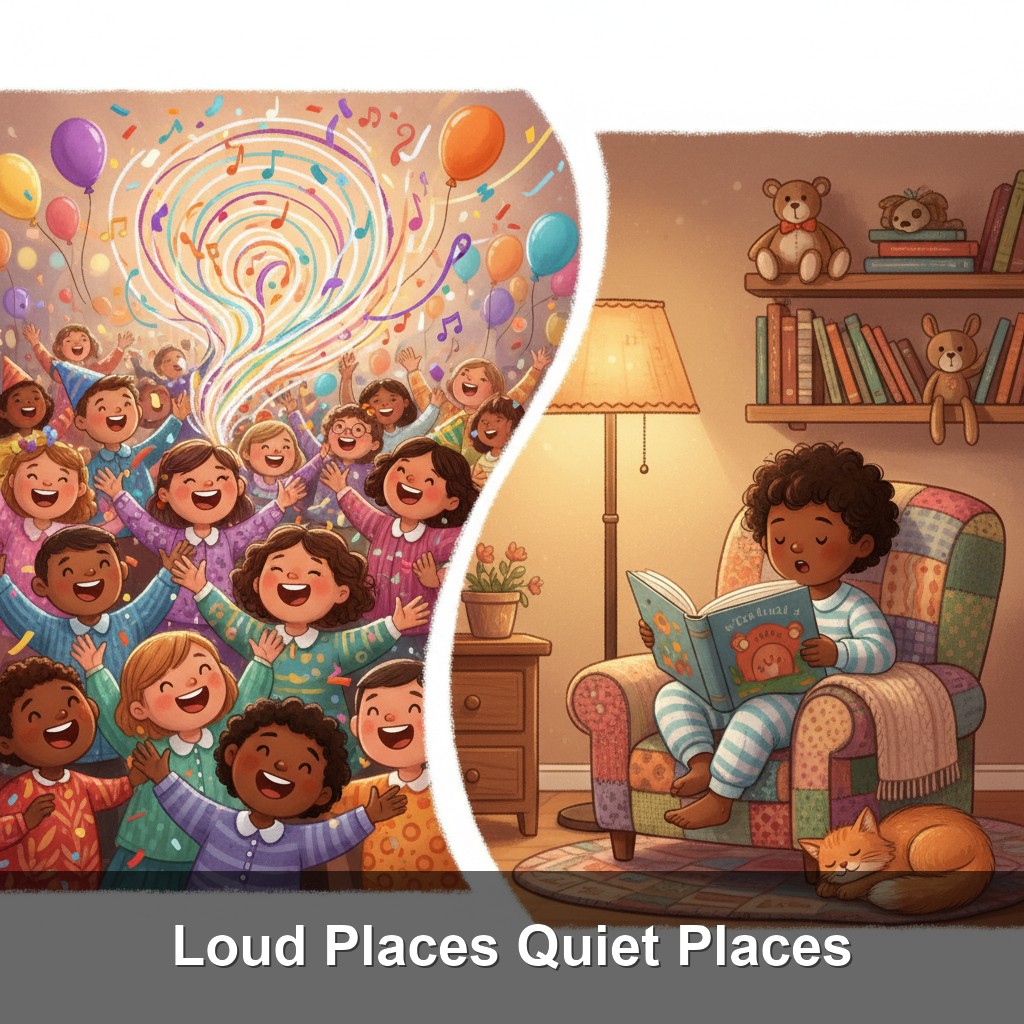
Loud Places Quiet Places
Sam and Jordan were drawing a map.
“This is the whole school,” said Jordan, spreading a big piece of paper across the table. “And this is the whole neighborhood. We need to mark all the places.”
Sam nodded. “All the places. We need to be very careful.”
They started with the cafeteria.
“Loud,” said Sam, writing the word in red marker. “The trays go CLANG. The kids go AAAAAH. The lights go BUZZZZZZ. It’s like a storm in my ears.”
Jordan drew a little storm cloud over the cafeteria. “Okay. Loud place.”
They moved to the gym.
“LOUD,” said Sam, pressing down hard with the marker. “The ball goes BOOM. The whistle goes SCREECH. The feet go STOMP-STOMP-STOMP. It’s like thunder inside my head.”
Jordan drew a lightning bolt. “Very loud. Got it.”
They drew the music room. The hallway at dismissal. The playground at recess when everyone was playing tag at once.
Sam’s shoulders were getting tight. Just drawing the loud places made Sam’s ears feel full.
“Let’s do the quiet places now,” said Jordan.
Sam looked up. “Quiet places?”
“Yeah,” said Jordan. “You said we were making a map of all the places. So we need the quiet ones too.”
Sam hadn’t thought about that.
Sam thought about the library. But only the very back corner, behind the tall shelf with the encyclopedias. The carpet was soft there. The light came in one small window like a golden rectangle. You could hear the pages turning. You could hear your own breathing.
“The library corner,” said Sam, writing it in blue marker. “The one with the soft carpet. I sit there when my brain feels like a radio with all the stations playing at once. I can turn the dial down.”
Jordan drew a little pillow. “That’s a good one.”
“Miss Patel’s classroom,” said Sam, after a minute. “When she leaves at lunch. The whiteboard is clean. The chairs are quiet. Nobody talks. It smells like markers and pencils.”
Jordan drew a tiny pair of glasses on the door. “What else?”
Sam tapped the marker on the paper. “The walk home. The part where the big oak tree blocks the street. The cars can’t be heard as much there. The leaves go shhh-shhh-shhh when the wind comes through.”
Jordan drew a tree with a green crayon. “I never noticed that.”
“That’s okay,” said Sam. “Your brain doesn’t need it. Mine does.”
Jordan nodded. That was something Jordan understood now. Sam had explained it last month. Your brain is a TV. Mine is a radio. Neither one is wrong. They just work different.
“What about your house?” asked Jordan.
Sam smiled. It was the biggest smile of the afternoon.
“My room. In the corner behind the green chair. I put my blanket there. And my books about deep sea creatures. I can see the whole room but no one can see me if they’re standing in the doorway. It’s MY place. It’s the quietest place in the whole world.”
Jordan drew Sam’s house with the green chair shape in the corner. Then Jordan looked at the map.
“It’s half and half,” said Jordan. “Loud places and quiet places. All on the same map.”
Sam looked at it, too.
“Yes. That’s how the world is,” said Sam. “The loud places are there. And the quiet places are there. And I get to know which is which.”
Jordan smiled. “So you can find your way.”
Sam touched the quiet places with a fingertip. “So I can breathe.”
The next day, Sam walked into the cafeteria and the storm began. Trays CLANGED. Kids went AAAAAH. The lights went BUZZZZZZ.
Sam felt the noise climbing up Sam’s neck like it wanted to get inside.
But then Sam remembered. The map. The blue marks.
Sam walked past the storm. Past the thunder and the stomping and the screeching. And into the library, where the carpet was soft and the light was a golden rectangle and the pages whispered.
Sam sat down in the quiet.
And breathed.
Later, Jordan found Sam in the corner behind the encyclopedias.
“It worked?” asked Jordan.
“The map knows,” said Sam. “It knows where I can be.” Sam pulled the paper out of a pocket. It was folded carefully, the edges already soft. “I’m going to add more quiet places. The closet with the extra art supplies. The bench by the nurse’s office. The spot under the slide where the sound goes over you instead of into you.”
Jordan sat down on the carpet. “Can I help you find them?”
Sam shook the map open.
“Yes,” said Sam. “You can mark the ones I miss. Because even though you don’t need them the same way I do, you can see them.”
Jordan took the blue marker.
And together, they made the world a little easier to breathe in.
Author’s Note for Grown-Ups: This book is about recognizing and honoring the sensory needs that many autistic children have. Making a “quiet places map” is a real self-advocacy tool — it helps children identify where they feel regulated, safe, and able to be themselves. If your child finds loud environments overwhelming, creating a map together (of your home, school, or neighborhood) can be a practical and affirming way to build self-knowledge and independence.