The Logic League
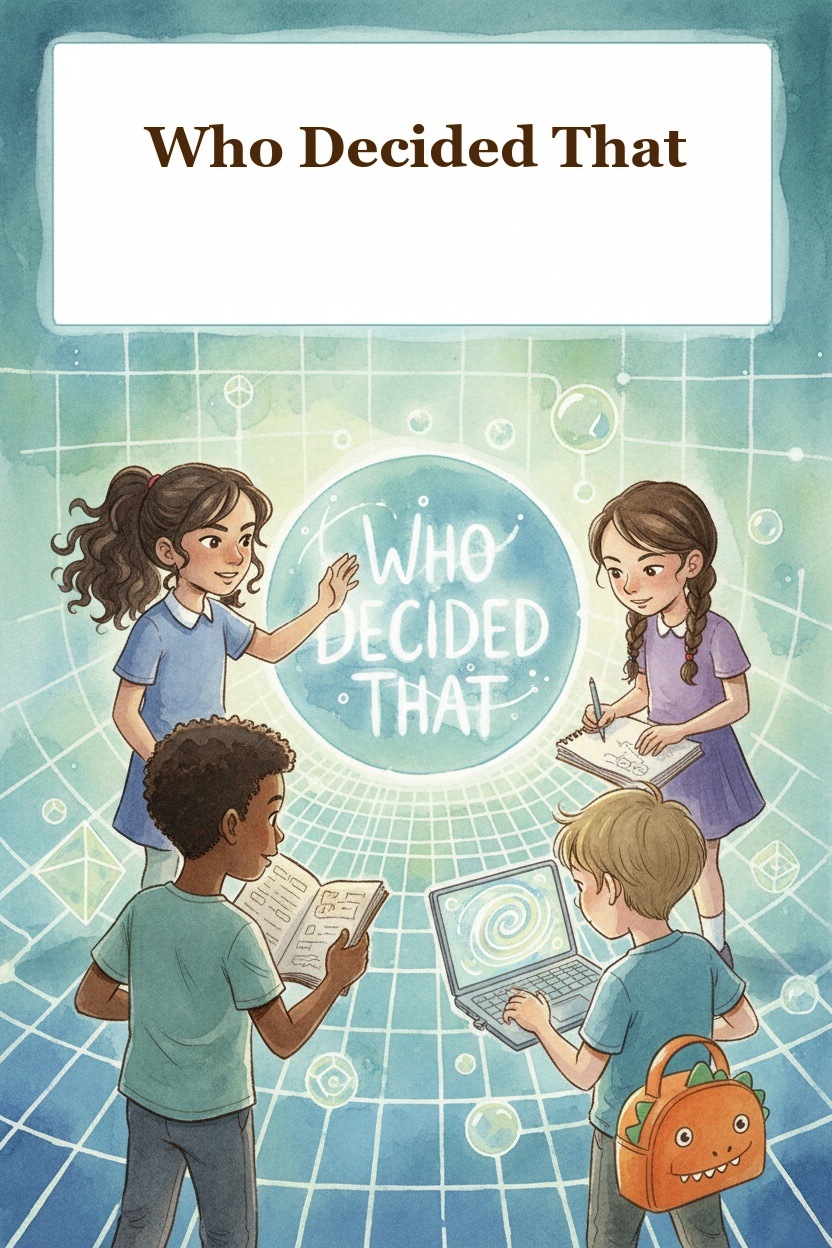
Who Decided That
The Locked Corridor
The school lost-and-found closet smelled like damp mittens and forgotten homework. Priya pushed aside a stack of winter coats and found the laptop exactly where they'd left it—glowing faintly, as if it had been waiting.
"No one's touched it," Kwame said, kneeling beside her.
"Of course no one's touched it," Lily said. "It's in a closet full of lost things. It belongs here."
Sam reached out and opened the screen. Green text cascaded down, then formed a single line:
WELCOME BACK TO THE OUTER GRID.
The light swelled, and the closet floor dissolved beneath them.
They landed in a corridor unlike any they'd seen before. The Outer Grid was usually silver and red, all industrial struts and glowing cables. But this corridor was lined with doors—hundreds of them, stretching in both directions as far as they could see. Each door had a label. Each label had a name.
"The Dormitory of Quiet Algorithms," read Kwame, squinting at the nearest one. "The Chamber of Reusable Functions. The Vault of True Things."
Priya was already pacing. "This must be where the Grid keeps its most important places. Restricted access stuff."
"Why are there so many?" Sam asked.
"Because different people need different things," Lily said, walking slowly along the row. "The Vault of True Things probably has different rules than the Dormitory."
Priya stepped up to the nearest door and reached for the handle.
Nothing happened.
She tried again. Still nothing.
"Error," said a flat, familiar voice. A red-bordered block appeared on the wall:
ERROR: ACCESS DENIED. YOU ARE NOT IN THE PERMITTED SET.
"Not in the permitted set?" Priya frowned. "What does that even mean?"
"It means," said a new voice, "that someone decided you shouldn't be here."
They spun around. Standing at the end of the corridor was a figure made of shifting light—tall and slender, with features that seemed to rearrange themselves every few seconds. It wore what might have been a robe, or might have been a cascade of code.
"Who are you?" Kwame asked.
"I am the Keeper of Entrances," said the figure. "I have been here since the Outer Grid was built. I remember every door that was ever made, and every choice about who could go through it."
Sam tilted their head. "Why can't we go through any of them?"
The Keeper's face flickered—for just a moment, it looked sad. "Because the choices were made a long time ago. And choices, once made, become rules. And rules, once written, are hard to change."
The History Wall
The Keeper led them down the corridor to a wall that wasn't a wall at all—it was a screen, tall as the ceiling, covered in lines of text that shifted and rearranged as they watched.
"This is the History Wall," said the Keeper. "Every decision about who could go where is recorded here. Watch."
The text swirled and settled into a story.
WHEN THE OUTER GRID WAS BUILT, THE FIRST ARCHITECTS MADE THE DOORS. THEY WERE OPEN TO ALL—ANYONE COULD ENTER ANY PLACE, BECAUSE EVERYONE WAS LEARNING TOGETHER.
BUT THEN THE ARCHITECTS DISCOVERED THAT SOME PLACES WERE DANGEROUS FOR THOSE WHO HADN'T LEARNED ENOUGH YET. THE MACHINE ROOMS HAD RIVERS OF ELECTRICITY. THE DATA DEPTHS HAD CURRENTS THAT COULD SWEEP YOU AWAY. SO THE ARCHITECTS MADE A RULE: ONLY THOSE WHO HAD COMPLETED THE FIRST TEN JOURNEYS COULD ENTER THE MACHINE ROOMS.
"That makes sense," Lily said. "It's a safety thing. If you haven't learned about sequences, you might get hurt in a place that runs on sequences."
"Exactly," said the Keeper. "That was the first access rule. It was fair—it was about what you knew, not who you were. And it worked well for a long time."
The wall shifted again.
BUT AS THE GRID GREW, MORE PEOPLE WANTED TO ENTER. THE ARCHITECTS WERE BUSY BUILDING NEW PLACES. THEY ASKED A NEW KEEPER TO MANAGE THE DOORS. THE NEW KEEPER DID NOT HAVE TIME TO CHECK EVERY VISITOR'S KNOWLEDGE. SO THE NEW KEEPER MADE A SHORTCUT.
"Shortcuts are usually trouble," Kwame muttered.
THE NEW KEEPER DECIDED THAT ANYONE WHO ARRIVED FROM THE NORTHERN GATE MUST KNOW ENOUGH—BECAUSE THE NORTHERN GATE REQUIRED A LONG JOURNEY TO REACH. SO THE RULE BECAME: IF YOU COME FROM THE NORTH, YOU MAY ENTER. IF YOU COME FROM ANYWHERE ELSE, YOU MAY NOT.
"That's not about knowledge at all," Priya said slowly. "That's about where you started from."
"Exactly," said the Keeper. "And it was wrong. The Northern Gate was easy to reach if you lived nearby. It had nothing to do with how much you knew. But the rule was written, and rules are sticky."
The wall shifted a third time.
THE RULE SPREAD. OTHER KEEPERS COPIED IT. SOON, ACCESS DEPENDED ON WHICH GATE YOU ENTERED, WHICH PATH YOU TRAVELED, WHICH PART OF THE GRID YOU CALLED HOME. THE RULE HAD BECOME A WALL THAT HAD NOTHING TO DO WITH SAFETY—BUT NO ONE NOTICED, BECAUSE THE CODE WAS OLD AND EVERYONE HAD FORGOTTEN WHY IT WAS THERE.
"Whoa," Sam said quietly. "So the rule is unfair, but it's still running?"
"It is still running," said the Keeper. "Because no one thought to question it. Because the code was written, and the code works, and working code is rarely examined."
The Question
The kids stood in silence, looking at the History Wall. The story glowed before them—a story about choices, and shortcuts, and rules that outlived their reasons.
"So," Sam said, in that way they had—the way that made Priya's face do the complicated thing it did, "if the rule is wrong, why doesn't someone just change it?"
The Keeper's form flickered. "Change it? The rule is old code. It's part of the Outer Grid's foundation. Changing it would require—"
"Editing," Lily said. Her eyes had that particular gleam—the one that meant she'd found a problem and couldn't let it go. "The History Wall isn't just a record. It's the actual code. The rules are written in it."
"I can't change the code," said the Keeper. "I can only maintain it. The code was written by the architects. I am not an architect."
"You're not," Priya said. "But we can."
The Keeper's face flickered through several expressions—surprise, doubt, and something that might have been hope. "You would change the code? You understand that the rule affects who can go where. If you change it, people who were kept out might get in. People who were let in might be kept out. Do you understand what you're doing?"
Priya opened her mouth, then closed it. She looked at the others.
"I think," Kwame said slowly, "that's exactly the question. The rule isn't just a rule. It's a choice that someone made. And if we change it, we're making a choice too."
"We have to think about who it helps," Lily said. "And who it hurts."
"Like the rule about the Northern Gate," Sam said. "It helped people who lived nearby. It hurt people who didn't. And it didn't have anything to do with whether they knew how to be safe."
Priya nodded. "So if we're going to write a new rule, we need to think about what it should actually do."
The New Rule
They stood in front of the History Wall, and Priya raised her hand. The wall flickered, and the old text began to fade.
"What should we write?" Sam asked.
"Let's think," said Kwame. "The original rule was good—it let people in based on what they knew, not who they were. The problem was the shortcut. The rule stopped being about knowledge and started being about location."
"So the new rule should go back to the original idea," Lily said. "Access based on learning, not on where you came from."
"But how do we check what people know?" Priya asked. "The first Keeper had time to check everyone. The new Keeper didn't. We need a rule that works for a busy Grid."
"Maybe the rule doesn't need to check knowledge directly," Sam said. "Maybe it just needs to make sure people have a chance to learn."
Everyone looked at Sam.
"The Northern Gate was the problem because it was fast and easy," Sam continued. "People came through it without learning anything. But what if the gate itself taught people? What if you could only get through the Northern Gate if you could answer a question about safety?"
Lily's face lit up. "A conditional. The gate checks—if you can demonstrate you know the safety rules, you can enter. If not, you learn them first."
"It's a test," Kwame said. "Not a wall. The gate becomes a teacher instead of a barrier."
Priya was pacing back and forth. "That's good. That's really good. But how do we write it?"
The History Wall was waiting, the old rule gone. Green text blinked at them, ready for input.
Kwame pulled out his journal. He wrote:
THE OLD RULE SAID: IF YOU CAME FROM THE NORTH, YOU COULD ENTER.
THE NEW RULE SHOULD SAY: IF YOU KNOW THE SAFETY RULES, YOU CAN ENTER.
AND IF YOU DON'T KNOW THEM YET? THEN THE GATE TEACHES YOU.
BECAUSE A DOOR SHOULD NOT KEEP PEOPLE OUT.
IT SHOULD HELP THEM LEARN HOW TO COME IN.
"That's not code," Lily said, reading over his shoulder.
"It's a story," Kwame said. "A story about what a door should be. The code is the same idea, written differently."
Priya stepped forward. She spoke to the wall:
"New rule: Access to restricted areas is granted when a visitor demonstrates understanding of the safety requirements for that area. If understanding is not demonstrated, the gate provides a learning path. Access is granted upon successful completion. This rule applies equally to all visitors, regardless of origin gate."
The History Wall glowed. Text raced across its surface, rearranging itself into new patterns.
ERROR: A CONDITION WAS TRUE WHICH SHOULD NOT HAVE BEEN TRUE.
The kids froze.
Lily stepped closer to the wall, reading carefully. "It's not an error," she said slowly. "It's the old rule, trying to reassert itself. The old code doesn't want to be changed."
"Code doesn't want anything," Priya said.
"This code remembers that it was once a shortcut," Lily said. "It was easier to check location than to check knowledge. The shortcut became a habit. And habits resist change."
"So what do we do?" Sam asked.
Lily's eyes were bright. "We don't fight the old code. We replace the condition. Instead of 'if visitor comes from Northern Gate,' we write 'if visitor demonstrates understanding.' The structure is the same. The condition is different."
She reached out, and her fingers moved through the glowing text. The old condition flickered and faded. The new condition settled into place.
ERROR RESOLVED: CONDITION UPDATED. ACCESS RULES REVISED.
The corridor hummed. All along the walls, doors clicked—one by one, hundreds of doors unlocking at once.
"Whoa," Sam whispered.
The Keeper's form shimmered, and for a moment, it looked lighter. "You changed the code," it said. "Not by force. By understanding. The old rule was never about safety—not anymore. It was about convenience. And convenience became unfairness. And unfairness became invisible, because no one looked at the code."
"Until now," Kwame said.
The Return
The corridor began to fade, the doors dissolving into light. The Keeper's voice followed them as the world swirled:
"Remember what you did here. Rules are written by someone. They can be rewritten by someone. The question is never just 'what does the code do?' The question is 'who does it serve?' And 'should it?'"
Green light flooded around them, and the lost-and-found closet reformed, solid and smelling of damp wool. The laptop sat on the shelf, its screen dim.
Priya was quiet for a long moment. Then she said, "We changed the rules."
"We changed the code," Lily said. "The rules were the code. And the code was a choice."
"How many other rules are out there?" Sam asked. "How many choices that were made a long time ago, that nobody's looked at since?"
Kwame pulled out his journal and wrote:
TODAY WE LEARNED THAT RULES AREN'T JUST RULES.
THEY'RE CHOICES THAT SOMEONE MADE.
AND WHEN A CHOICE HURTS PEOPLE—
EVEN IF IT'S OLD, EVEN IF IT'S BEEN THERE FOREVER—
IT CAN BE CHANGED.
THE GRID DOESN'T CHANGE ITSELF.
THAT'S WHAT REMEMBERS ARE FOR.
The librarian, Mr. Kofi, poked his head through the door of the lost-and-found closet. "Finding what you need in there?"
"Finding out who decided things," Sam said.
Mr. Kofi smiled. "That's the most important question there is." He held out a book. "I thought you might want this one."
The title read: The History of Rules: Who Made Them, Why They Last, and How They Change.
"The laptop did that?" Kwame asked, as they walked back to the library.
"The laptop found you," Mr. Kofi said. "That was never an accident. You needed to learn what the Outer Grid had to teach. And it needed someone who would ask the right questions."
"Sam asked the right question," Priya said. "Why doesn't someone just change it?"
"Because," Sam said, "someone needed to remember that they could."
The four of them walked into the library, and the laptop glowed faintly in the closet behind them, waiting for the next time someone needed to remember.