Lighthouse Cats
The Upside-Down Map
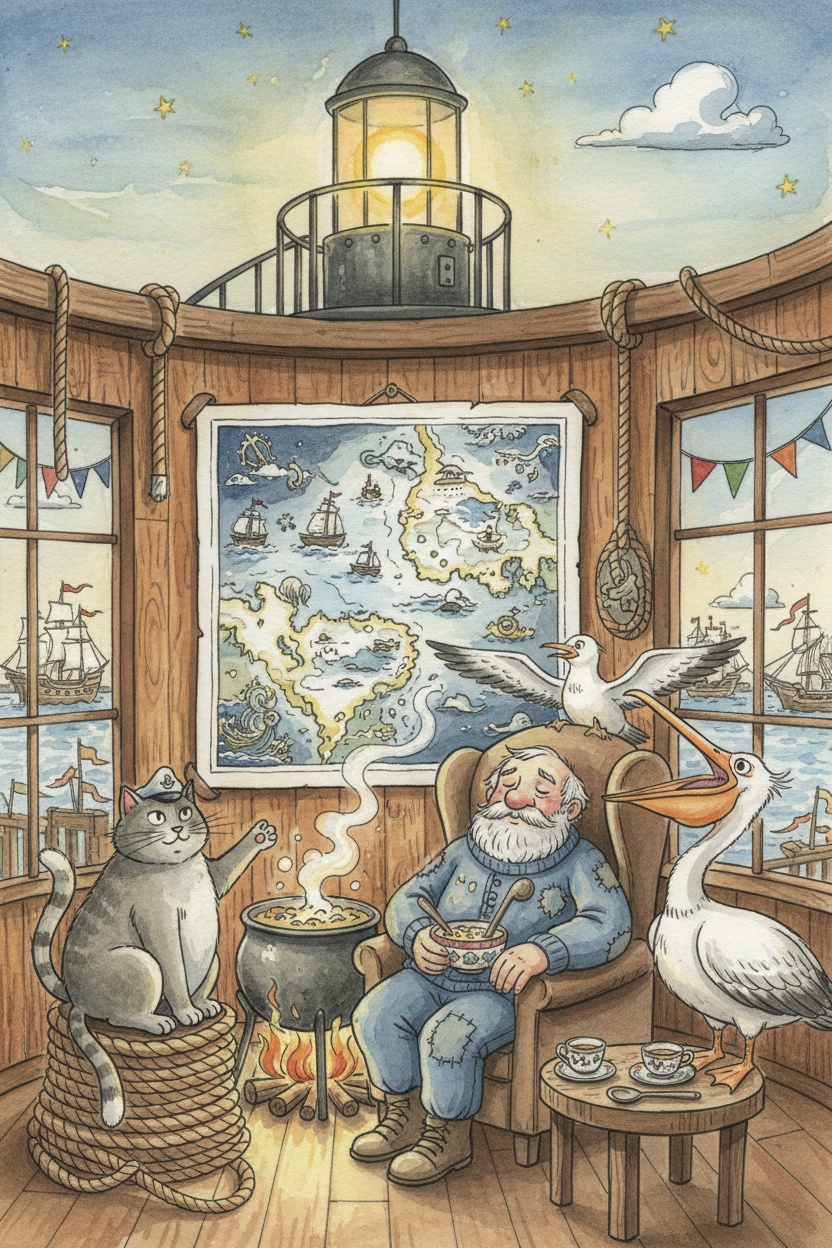
The morning sea was flat and grey as a pewter plate, and the sky was the colour of a friendly whale. Captain Whiskers sat in her window at the top of the lighthouse, watching the horizon with her usual quiet authority.
Morris the Seagull, however, was not quiet.
“SHIP APPROACHING!” he shrieked, flapping down from the widow’s walk. “A VERY SERIOUS SHIP, WHISKERS! IT’S MOVING WITH PURPOSE! I CAN TELL FROM HERE!”
Captain Whiskers blinked once. “What flag does she fly?”
Morris squawked and squinted. “Small. Red. With a… a little yellow thing. Possibly a star. Possibly a biscuit!”
“A star,” said Whiskers. “The Starling. She’s due.”
The Starling was a tidy little vessel with a striped sail and a crew of eight meerkats, all wearing identical blue caps. The meerkats guided her into the harbour with great seriousness, shouting navigation words at one another in confident, cheerful voices.
Captain Whiskers descended from the lighthouse and met them at the dock. Penny the Pelican waddled behind her, carrying a coil of rope in her bill, ready to help.
The senior meerkat, a small fellow with a very large map, stepped forward and saluted.
“Captain Whiskers! We are the crew of the Starling, eight days out from Sandy Bay. We are precisely on schedule and exactly where we ought to be.”
Whiskers looked at the map he held aloft. It was a fine map, crisp and detailed, with little drawings of islands and shipping lanes and a compass rose in the corner.
“May I see your map?” she asked.
The meerkat handed it over proudly. Whiskers studied it. She noticed that the north arrow pointed south. She noticed that the coastline was drawn with the land on the wrong side. She noticed that the little label for Pelican Point was upside down.
And she noticed that the meerkats were not, in fact, at Pelican Point. They had been reading the map upside-down for three days. They were at Empty Cove, which was eleven miles up the coast and had no lighthouse, no harbour, and no fish chowder whatsoever.
“A fine map,” said Whiskers, handing it back. “Very clear.”
“We should reach Crab Rock by midday!” announced the senior meerkat.
Whiskers nodded. “You are closer to Crab Rock than you think.”
The meerkats exchanged delighted glances.
“Splendid!” said one.
“Excellent!” said another.
“But,” said Whiskers gently, “Crab Rock is on the other side of the headland. You could save yourselves three days of sailing if you took the shallows between Fiddler’s Bank and the Old Nettle.”
The senior meerkat frowned at his map. “The shallows? But the map shows no such passage.”
“It does,” said Whiskers. “You just can’t see it from that angle.”
The meerkat turned the map clockwise. He squinted. He turned it again. His frown deepened.
“Hmm. The markings are rather unusual.”
“The best maps are,” said Whiskers serenely. “They speak to whoever is holding them. Some maps prefer to be read one way. Others are more flexible.”
Penny tilted her head. “Captain, is that true?”
Whiskers gave her a long, steady look. “It is true that maps are very good at showing us where we are, if we give them a chance.”
The senior meerkat studied the map again. He turned it a quarter turn. Then another. His eyes grew wide.
“Good heavens,” he said. “The land is on the other side!”
“Is it?” said Whiskers mildly.
The meerkat traced the coastline with a tiny paw. “And the compass rose… oh dear. We’ve been sailing backward. In a manner of speaking.”
Three meerkats gasped. Two sat down. One said, “Does this mean we aren’t at Pelican Point?”
Whiskers looked out at the harbour. She looked at the lighthouse. She looked back at the meerkats.
“You are at the best place you could possibly be,” she said.
The senior meerkat jumped up. “That’s it! We’ll sail the shallows and arrive at Crab Rock by noon! Thank you, Captain! You are a genius!”
Whiskers dipped her head. “I hold the map steady. That’s all.”
The meerkats scrambled aboard the Starling, laughing and chattering, and their sail filled with the morning breeze. As they rounded the headland, the senior meerkat shouted back, “We’ll tell everyone about your fine harbour!”
When they were gone, Penny waddled up to Whiskers.
“Captain,” she said, “you didn’t tell them they were reading the map upside-down.”
“They were doing so well,” said Whiskers. “It would have been a shame to interrupt.”
Penny thought about this. “So you just… pointed them in the right direction without mentioning it?”
“The map was fine,” said Whiskers. “The map was always fine. They just needed a moment to see it clearly. We all do, sometimes.”
From the lighthouse door, Angus appeared, rubbing his eyes.
“Morning, whiskers,” he yawned. “Anything happen while I was asleep?”
“Nothing at all,” said Captain Whiskers.
She sat down on the dock, tail curled neatly, and looked out at the empty sea.
A small red flag with a yellow star was still visible on the horizon, sailing the right way now, thanks to a cat who never mentioned the upside-down part.
Penny sat beside her.
“I think,” said Penny, “that was the best kind of rescue.”
Whiskers said nothing. She didn’t need to.
Somewhere, a crew of meerkats was arriving exactly where they meant to be.
And at Pelican Point, the tea had not gone cold at all.