The Logic League
Make It Make Sense
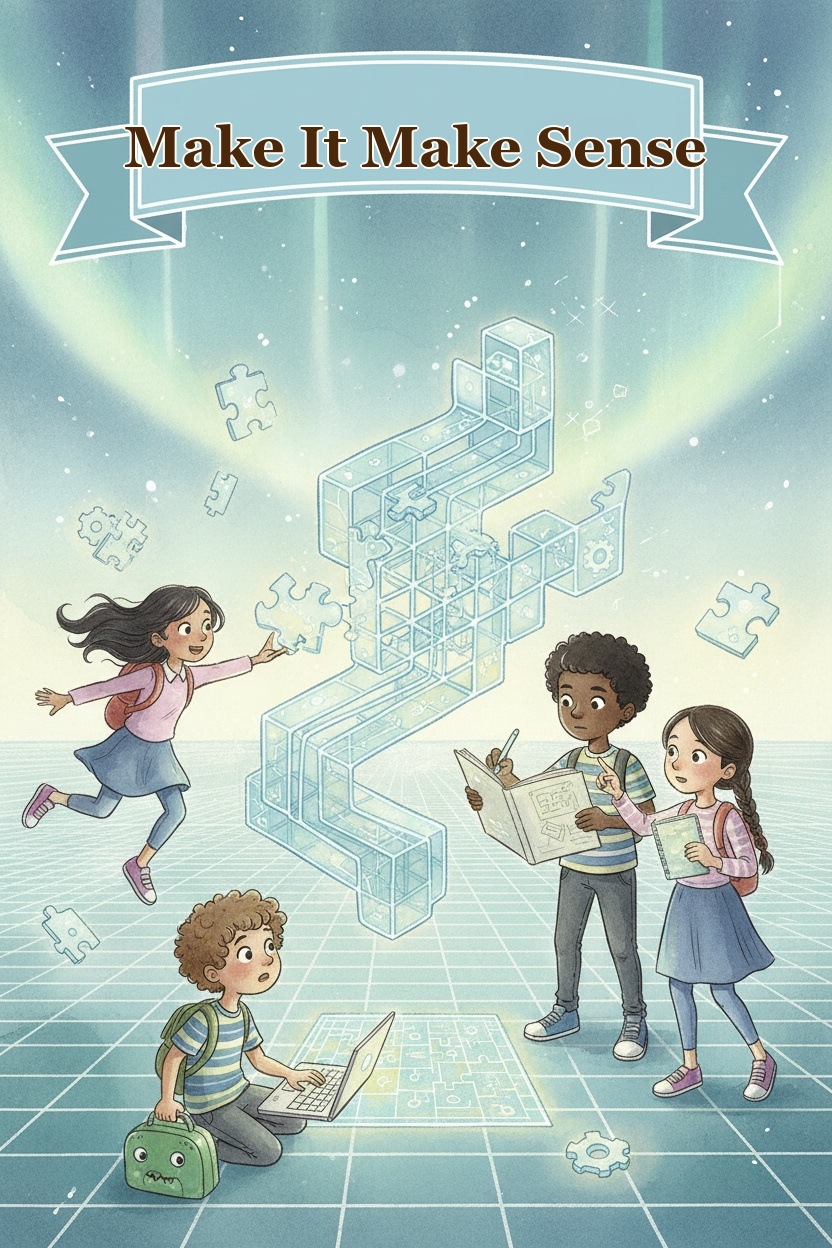
The New World Beyond
The laptop's glow was warm against Priya's face as she opened it in the lost-and-found closet. The screen flickered once, twice, and then the familiar cascade of green text began to fall.
"You ready?" Kwame asked, already reaching toward the light.
"No," Lily admitted. "But I never am."
Sam just grinned and stepped through first.
The four kids landed in a place that looked nothing like the Data Depths they'd just escaped. This was the Outer Grid, and it showed. The walls were made of what looked like giant cables woven together, silver and black and red. Light pulsed through them like blood through veins. Every surface hummed with a low, constant vibration.
"Whoa," Sam breathed. "It's like we're inside a computer's bones."
Priya was already pacing, studying the structure. "This must be the infrastructure zone. The part that connects everything else."
Ahead of them, a massive terminal rose from the ground. It was shaped like a pedestal with a flat screen on top, tilted at an angle that would be comfortable for someone standing at it. Behind the terminal, a door stood sealed, marked with a symbol that looked like a small speech bubble.
"New puzzle?" Lily asked, stepping toward the terminal.
"Only one way to find out."
But when they reached the terminal, something was different. There was no riddle on the screen. No gate condition. Instead, the screen displayed a massive wall of text, scrolling endlessly:
[SYSTEM LOG 4231] PROCESSOR STATUS: OPTIMAL MEMORY ALLOCATION: FAILED SECTOR 7A... RETRY SEQUENCE SERVING QUEUE: 47 REQUESTS PENDING CACHE CLEARANCE REQUESTED: DENIED WAIT TIMES: AVERAGE 14.2 SECONDS MAXIMUM 47.8 SECONDS QUEUE ADJUSTMENT PROTOCOL: ACTIVE NETWORK TRAFFIC: ELEVATED PACKET LOSS: 0.03% BUFFER OVERFLOW RISK: MINIMAL USER PREFERENCES DETECTED: 12,847 SUBROUTINE CHECKSUM: 7F3A9...
"Whoa," Sam said, squinting at the screen. "That's a lot of words."
"Data," Priya corrected. "That's raw data. System information."
Kwame tilted his head. "But what does it mean?"
A voice startled them. "That's exactly the problem."
They spun around. Standing behind them was a small figure made of what looked like translucent glass, glowing faintly with an inner light. It had a round head, a simple body, and large, worried-looking eyes. It was an NPC—a non-player character—but unlike any they'd seen before. It looked tired.
"Who are you?" Lily asked.
"I'm the Kiosk Keeper," the figure said. "I'm supposed to help travelers find what they need. But I can't read any of this." It gestured at the terminal helplessly. "I was designed to be friendly. Helpful. But all I get is... this." It waved a hand at the scrolling text. "Raw system data. Numbers. Status reports. I can't make any sense of it."
Priya frowned. "So you're an interface? For travelers?"
"Yes!" The Kiosk Keeper brightened. "I'm supposed to give directions, answer questions, help people understand how to get where they're going. But to do that, I need to know what the system is doing. And I just... can't understand what it's telling me."
The terminal beeped, and a new message appeared:
ERROR: INFORMATION PRESENTED WITHOUT CONTEXT. USER UNABLE TO PROCESS. DISPLAY FORMAT INCOMPATIBLE WITH USER NEEDS.
Lily read it aloud. "Interesting. It's not that the terminal isn't working. It's that the way it's showing information doesn't work for the Kiosk Keeper."
"Wait," Sam said slowly. "So the data is there. It's just... not making sense to the person who needs it?"
"Exactly!" The Kiosk Keeper nodded eagerly. "The terminal has all the information I need. But I can't use it because it's not arranged in a way I can understand. It's like someone handed me a book written in a language I don't speak, and told me to use it to help people find their way."
Priya's eyes lit up. "We need to build an interface."
"A what?" Sam asked.
"A user interface," Kwame said. "Remember when we had to give instructions to the Grid in Book 1? How we had to be super precise?"
"Uh-huh."
"Well, it's kind of the opposite. A user interface is about taking information and presenting it in a way that makes sense to the person using it. Not the way that makes sense to the system—but the way that makes sense to the user."
What Does the User Need?
The terminal screen was still scrolling with endless technical data. Priya studied it, then studied the Kiosk Keeper.
"Okay," she said, pacing. "Let's think about this like a puzzle. What does the Kiosk Keeper actually need to know?"
"I need to know where travelers want to go," the Kiosk Keeper said. "And I need to know the best way to get them there. And I need to know if there are any problems on the way."
"So we need to take that"—Priya pointed at the scrolling text—"and turn it into something that answers those questions."
Sam looked at the screen. "So not everything on there is important?"
"Right," Lily said. "The buffer overflow risk isn't useful to a traveler. They don't care about packet loss. They want to know where to go."
"Wait," Sam said, and the others could hear the incoming question in their voice. "If the system has all this information already, why can't it just tell the Kiosk Keeper what it needs to know?"
Priya opened her mouth, then paused. That was actually a good question.
"The system can output data," Kwame said slowly. "But it can't know what the user needs. The system thinks in terms of processes and status reports. The Kiosk Keeper thinks in terms of travelers and destinations. The system can't guess what the Kiosk Keeper's questions are."
"So we have to make the system show what the Kiosk Keeper needs?" Sam asked.
"Exactly," Lily said. "This is user interface design. It's all about what the user needs, not what the system wants to show."
The Kiosk Keeper looked hopeful. "Can you really do that? Build something that helps me understand?"
"We can try," Priya said. "Let's look at what travelers would actually ask."
Kwame pulled out his journal and flipped to a fresh page. "Okay, let's list the questions the Kiosk Keeper needs to answer. What do travelers want?"
"Where to go," Lily said.
"How to get there," Sam added.
"When the path is blocked," Kwame said.
"Anything else?" Priya asked.
The Kiosk Keeper thought for a moment. "Whether they need anything special. Like a pass or a key."
"Okay." Priya nodded. "So the interface needs to show:
-
Destinations
-
Routes
-
Problems
-
Requirements"
She looked at the scrolling data. "Now we need to take the raw information and match it to those four things."
Making It Make Sense
It took them a while, but they figured out how to build it.
The terminal had a construction mode—they found it by sending the command "BUILD INTERFACE" and watching as the screen cleared and reformed into an empty workspace. Then the real work began.
"Okay," Lily said, studying the raw data. "The destinations are listed here, but they're buried in a system log. Let's pull them out."
She worked slowly, isolating the destination names from the surrounding data. Each one appeared as a long string of location codes and routing information. The Kiosk Keeper watched, fascinated.
"When a traveler asks where they can go," Priya explained, "we don't want them to see all that code. We want them to see a list of names."
"Names?" Sam asked.
"Words people can understand. Like 'The Library,' 'The Train Station,' 'The Garden.'"
Kwame was building a map. "And for routes, we can show a picture. Not raw coordinates—but an actual visual path."
"How do we do that?" Sam asked.
"We take the coordinates and turn them into a diagram." Kwame sketched in his journal. "Start here. Go there. Turn. Arrive."
"Oh, like a map!"
"Exactly. A map is an interface—it takes complex spatial data and shows it in a way people can understand."
Lily was working on problems. "This is tricky. The raw data shows all kinds of alerts, but most of them are internal system stuff. We need to only show the ones that affect travelers."
"How do we know which ones are important?" Sam asked.
"The same way the Kiosk Keeper would know," Lily said. "If a problem affects the route, it matters. If it doesn't, it doesn't."
"Ah." Sam nodded. "So we have to decide what's relevant."
"Right. The interface isn't just about showing information—it's about showing the right information."
The Kiosk Keeper watched them work, growing more excited. "I can see it! You're taking all that confusion and turning it into... meaning!"
"Sort of," Kwame said, smiling. "We're taking data and making it useful."
After what felt like hours, they had it. The screen now showed a bright, clear interface:
WELCOME TO THE OUTER GRID
Where would you like to go?
Below that, a list of destinations with small icons next to each one: a book for the Library, a train for the Station, a flower for the Garden.
When the Kiosk Keeper selected a destination, a map appeared showing the route. Yellow dots marked the path. Red X's marked blocked areas. A legend at the bottom explained what each symbol meant.
And in the corner, a small icon appeared if a special pass or key was required.
"Let's test it," Priya said.
The Kiosk Keeper approached the screen, its glass eyes wide. It reached out and tapped "The Garden."
The screen glowed, and a clear route appeared. No blocked paths. No requirements.
"The Garden," the Kiosk Keeper read aloud, "is the third stop. The route is clear. No pass required." It looked up, and its face broke into a dazzling smile. "I can read it! I can actually read it!"
"Whoa," Sam said. "It works."
"I can help travelers now," the Kiosk Keeper said, vibrating with excitement. "When someone asks where to go, I can give them a real answer. I can tell them which routes are open. I can warn them about obstacles. I can do my job!"
The terminal beeped again, and a new message appeared:
ERROR: PREVIOUSLY, INFORMATION WAS PRESENTED WITHOUT CONTEXT. USER INTERFACE HAS RESOLVED ERROR. DISPLAY FORMAT NOW MATCHES USER NEEDS. ERROR CLEARED.
Lily read it. "The Grid confirms it. The error is fixed."
Priya looked at the interface, then at her friends. "So what did we just learn?"
"The data was there the whole time," Kwame said. "The system had all the answers. But they weren't useful because they weren't presented in a way the Kiosk Keeper could use."
"An interface," Lily said slowly, "is about matching how information is shown to how the person needs to think."
"Right." Priya nodded. "The raw data made sense to the system. But the Kiosk Keeper isn't a system—it's a person. So we had to design an interface that fits how people think."
"Not how computers think," Sam added.
"Exactly. Not how computers think."
The Journal
That night, back in the lost-and-found closet, Kwame sat on the floor and opened his journal. The others watched as he wrote:
Today we learned about user interfaces. It's like telling a story to a friend. You don't give them all the facts you know—you give them the facts they need, in the order that makes sense to them.
If you tell someone "The library is at coordinate 47.2, 82.9, velocity vector zero," they can't use that. But if you say "Follow the yellow path, turn left at the big tree, and the library is the third door on your right"—that's something they can use.
The information was the same. The words were different. The difference was understanding what the user needed.
The story isn't in the data. The story is in how you tell it.
He closed the journal and looked up. "I think I finally understand what Mr. Kofi meant when he said the best tool is the one that fits the hand."
"What does that mean?" Sam asked.
"It means," Priya said, "that the best system is the one that makes sense to the person using it. Not the person who built it. The person who uses it."
The laptop glowed softly on the shelf, already dimming back to normal.
"Do you think the Kiosk Keeper will be okay?" Sam asked.
"It has everything it needs now," Lily said. "It can help people."
"And that's what matters," Kwame finished. "That's what making it make sense is all about."