Just Like Me
The Game I Dont Understand
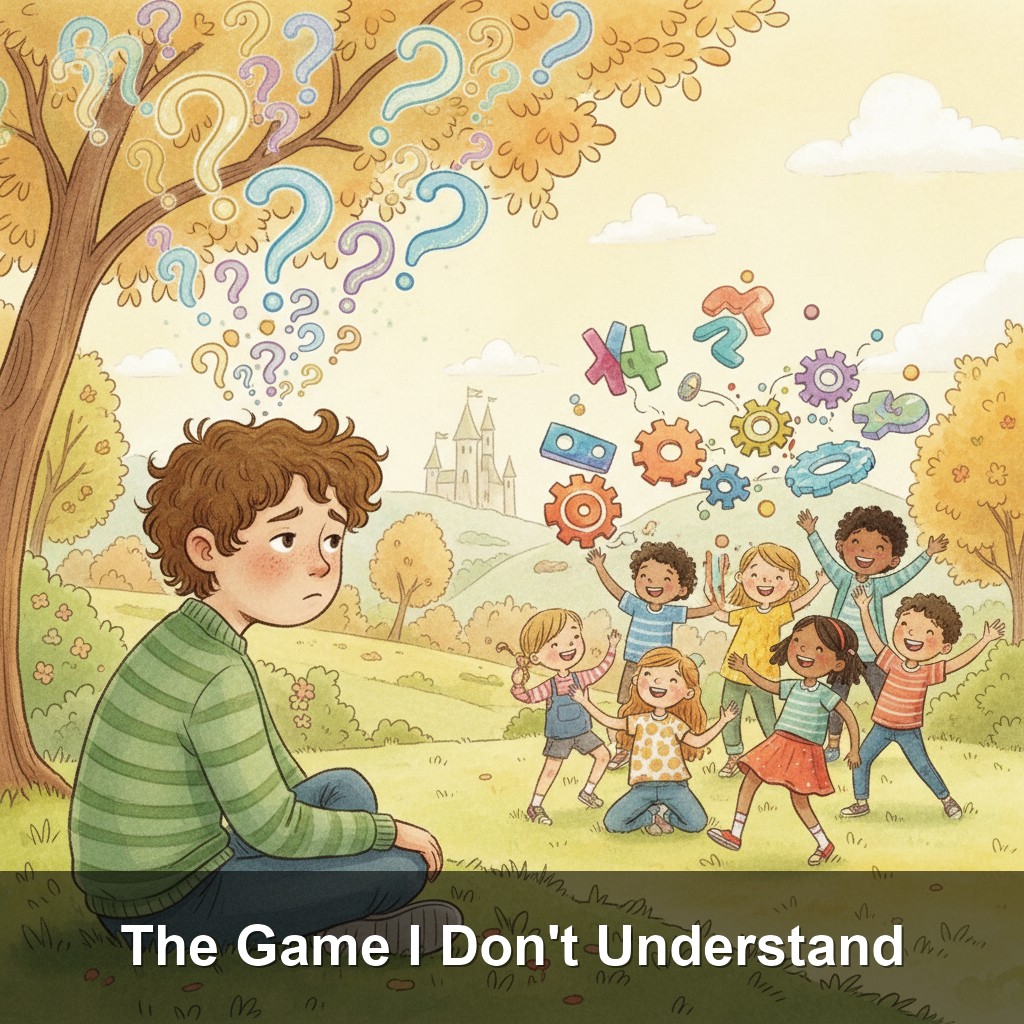
At recess, the playground was a roar of noise and a blur of moving bodies. Sam sat on the bench, watching.
Jordan ran over, a huge smile on their face. "Sam! Come play! We're starting a game."
"What game?" asked Sam.
Jordan pointed. "That one. The one everyone's playing."
Sam looked. A group of kids were running in a loose circle. Some were laughing. One kid was hopping. Two were holding hands. Someone shouted something, and everyone switched directions.
"What are the rules?" asked Sam.
Jordan laughed. "There aren't really rules. You just play!"
Sam's stomach felt tight. "There must be rules," they said. "There are always rules. Like in Sorry, you roll the dice and move. In Uno, if you don't say Uno, you draw two."
"Right," said Jordan. "But this game—you just run and play pretend, and you know what to do."
"Know what to do how?" asked Sam.
Jordan shrugged. "You just... know."
Sam did not know.
Sam walked over to the game. The kids were moving in a swirly pattern. A girl named Priya waved. "Come on, Sam!"
Sam stepped into the circle. A boy named Leo knelt down and tapped the ground twice. Sam knew this meant something—it was a pattern—but Sam didn't know what.
Then everyone jumped. Sam didn't jump. Then everyone crouched. Sam was still standing. Then a kid yelled, "Red light!" and everyone froze.
Sam froze. But someone else yelled, "Blue light!" and everyone moved again.
"That's not how Red Light works," Sam said, but no one heard.
A girl ran past Sam and tapped Sam on the shoulder. Sam did not know why. Was that a tag? Was that a signal? Was that a game? Or was she just running?
Sam's head felt like a radio with all the stations playing at once.
"What am I supposed to do?" Sam called out. But everyone was already doing it.
Sam stood in the middle of the circle, completely still. Everyone was moving around Sam, laughing, hopping, tapping, and yelling.
Sam tried to copy. Sam hopped. But everyone else had stopped hopping and was now spinning. Sam spun, but everyone had stopped spinning and was now walking backwards.
It was like the game had a rule book that was invisible. Everyone else could read it. Sam couldn't.
"Too loud. Too many rules. I can't," Sam said, and walked back to the bench.
Jordan came running over. "Are you okay?"
"I'm not upset at you," said Sam. "I'm upset at the game."
"What happened?"
"I don't understand it," said Sam. "You said there are no rules. But there are rules. I can see them. Everyone knows them except me. They tap the ground, which means something. They freeze when someone says red light, but they don't freeze when someone says blue light, even though the words are the same pattern. And they know when to be in a circle and when to be in a line and when to hold hands—"
Jordan sat down next to Sam. "Oh. I see."
"Everyone has the instruction book except me," said Sam. "And no one gave me a copy."
Jordan was quiet for a minute. Then Jordan said, "You're right. There is an instruction book. But it's not written down."
"Where is it?"
Jordan tapped Sam's head. "It's in everyone's head. And it says what feels right in the moment. That's it. That's the whole rule."
"But that's not a rule," said Sam. "A rule is the same for everyone. 'What feels right' is different for everyone. That means the game is different for everyone. That's not a game. That's a mess."
Jordan laughed. "Yeah. Yeah, you're right. It is a mess."
Sam looked at the game. It was definitely a mess. It was loud and chaotic and no two kids were doing the same thing.
"I think I could play a version of that mess," Sam said slowly. "But I would need my own rules."
"Go for it," said Jordan.
Sam stood up. Sam walked back to the circle of kids. Sam put a hand in the air.
"Stop," Sam said loudly.
Everyone stopped.
Sam spoke very clearly: "The game you are playing has no written rules. This is a problem for me. I am going to make up my own rules. If my rules work, I will play. If they don't, I will go back to the bench. Does anyone have a problem with this?"
Everyone shook their heads. Priya grinned.
Sam continued. "Rule one: We run to the slide. The first person to touch the slide becomes the Pattern Master."
"What's a Pattern Master?" asked Leo.
"A Pattern Master decides the pattern," said Sam. "And the pattern is always a tap, a snap, and a spin. In order. Tap, snap, spin. If you do the pattern, you're in. If you don't, you go to the end of the line and try again."
Sam turned to the group. "You tap the ground, then you snap your fingers, then you spin once. Ready? Go!"
Everyone tapped. Everyone snapped. Everyone spun.
Sam watched. It was beautiful. It was orderly. It was a pattern that everyone could follow.
"Now," said Sam, "we run to the swings. The first person to touch the swing chooses the next pattern. And the pattern can be any three movements. As long as everyone does the same three movements. No one changes the rules mid-game. That's the rule."
The kids looked at each other. Jordan smiled a huge smile.
"Go!" shouted Sam.
The whole group ran to the swings—in a line, because that was the new rule. The first person to touch the swing was a girl named Maya.
"I choose: wobble, clap, jump," she said.
Tap, snap, spin. Wobble, clap, jump. The whole playground was moving in patterns now.
Sam stood in the middle of the circle—not confused, not lost. Sam was the one who made the rules. Sam was the Pattern Master.
Jordan came up and said, "This is way better than the other game."
"I know," said Sam. "This one has an instruction book."
Sam looked at the group, all tapping and snapping and spinning and clapping and jumping. Everyone knew the rules. Everyone knew what came next.
"It's not a mess," said Sam to Jordan. "It just needed better rules. The other game had too many secret ones. My game has rules you can say out loud."
"Will you teach me the Pattern Master game at lunch tomorrow?" asked Jordan.
"Of course," said Sam. "There are three rules. That's all there are."
Sam held up three fingers.
"Rule one: Anyone can make a pattern. Rule two: Everyone does the same pattern. Rule three: If you don't know the pattern, you ask. Nobody ever gets left out because they didn't know."
Jordan nodded. "I think I can remember those."
Sam smiled. "Good. Because that's the best part of my game."
"What's that?" asked Jordan.
"No one ever plays wrong," said Sam. "Because the rules are written—in the air, with words, for everyone. It's a game everyone can understand."
And from the bench, the pattern drifted up into the air—tap, snap, spin, wobble, clap, jump—and the whole playground moved like one great machine, all because Sam had found a better way to play.
Author's note for grown-ups: This story is about "hidden curriculum" — the unwritten social rules that many children pick up intuitively and others need named explicitly. Sam isn't being difficult by asking for rules; Sam is trying to participate. When given the chance to create their own structure, Sam leads everyone toward a play that is kinder, clearer, and more inclusive. It's okay if your child asks for rules at games. It's often their way of saying "I want to play, and I need to understand first."