Inside Out Academy
HOW MUSCLES WORK
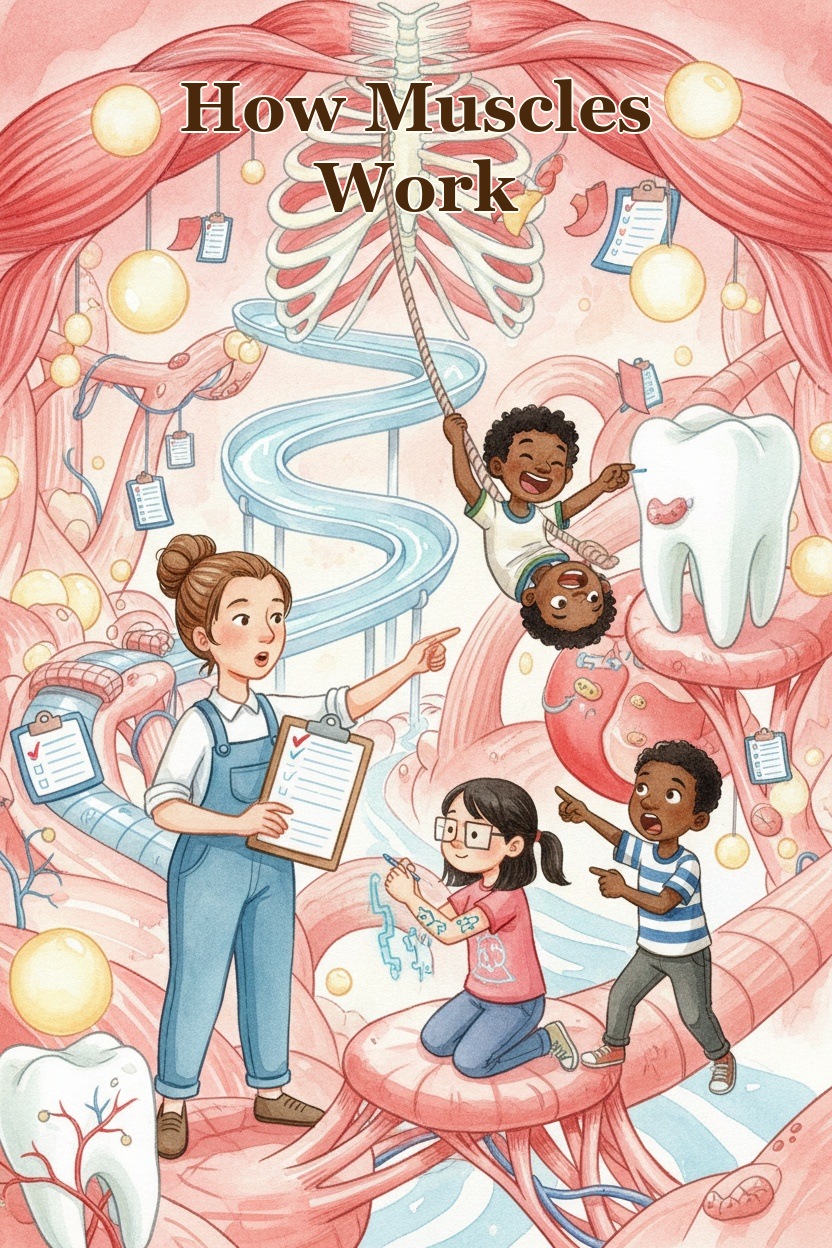
MS. VANCE’S CURRENT CHECKLIST
Location: Inside Mr. Gomez, left gastrocnemius (calf muscle)
Date: Still Tuesday. Somehow.
Students accounted for: 22 (plus herself)
Current objective: Understand muscle contraction well enough to navigate through the muscle without getting crushed.
Note to self: Ask Mr. Gomez to stop flexing.
PART ONE: THE CROWDED ROOM
The class had been inside the calf muscle for two days, and Marcus had not stopped talking.
It wasn't his fault, exactly. The muscle was extraordinary, and Marcus couldn't help it. Everywhere they looked, there were fibers—long, bundled strands of muscle tissue stacked together like a tightly packed forest of thick, red-brown cables. Each fiber was a single cell, enormous at their scale, stretching up and up and up until it disappeared into the gloom above them.
"Fascicles," Marcus announced, pointing at the bundles. "The fascicles are made of muscle fibers, and the fibers are made of—"
"Fibrils," Leo said.
"I was going to say that."
"You said it yesterday."
"Yesterday was review." Marcus crossed his arms. "Today is deepening."
Sadie was sitting on a small ledge of connective tissue, tapping her chin with a pencil. She had her emergency medical kit open, which she did when she was thinking especially hard about something that might go wrong.
"Okay, so technically," she said, "the problem is that knowing what a muscle looks like isn't the same as knowing how it moves. We need to understand the contraction mechanism."
"Right," Marcus said. "We need to understand the contraction mechanism."
Fatima was looking at a single muscle fiber up close. She had been staring at it for several minutes. "It has stripes," she said quietly.
"Striations," Marcus corrected.
"I said stripes. I meant stripes."
Ms. Vance was consulting her checklist, which was now three pages long and had been updated nine times since the morning. "The thing about muscles," she said, "is that they're the only thing in the body that actively pulls. Everything else—bones, cartilage, even the skin—just sits there. Muscle is what makes it move. So if we're going to navigate through Mr. Gomez's body, we need to know exactly how this works."
She looked at Marcus. Marcus looked at her.
"The molecular mechanism," he said, with the gravity of someone announcing a royal visit.
"The what now?" asked Leo, who was trying to climb a tendon.
"Marcus," Ms. Vance said, "I think this one is yours. Explain it to the group. Three times, if you need to."
Marcus's face lit up. "Three times?"
"Until we understand."
"I understood the first time," Leo said. "But I'll let him keep going. It's funnier."
PART TWO: THE TWO PROTEINS AND THE LITTLE KICK
Marcus gathered the group in a small clearing between two muscle fibers. He stood on a small rock of connective tissue, which made him feel authoritative.
"Okay," he said. "Deep breath. Actually, don't take a deep breath. The air here is weird. But metaphorically, deep breath."
"I'm taking a literal deep breath," Leo said.
"Stop."
"What's it made of?"
Marcus paused. "What's what made of? The air?"
"Inside Mr. Gomez. The muscle. When we were in the bone, you said the bone was alive. Is the muscle alive?"
Marcus nodded. "Yes. Very. And that's the thing—muscle is alive and it works on a system. A simple system, once you understand it. There are two proteins. They are the entire secret."
He held up his hands. "Actin. Myosin."
"Actin and myosin," Sadie said, nodding along. "The thin filament and the thick filament."
"Right. They're arranged in these repeating sections inside the muscle fiber. You can see the stripes from the way they overlap. And when the muscle contracts—when Mr. Gomez's calf shortens—these two proteins slide past each other. They don't change length. They don't compress. They slide."
"Like a zipper," Fatima said.
"Exactly like a zipper, but the zipper is made of protein and the thing pulling the zipper is"—Marcus paused for dramatic effect—"a little molecular kick."
Leo raised his hand. "What's the kick?"
"The myosin head." Marcus held up his index finger. "The myosin is a thick filament, and it has little heads sticking out. Imagine arms. Imagine little arms that reach out, grab the actin filament, and pull it toward themselves. That's the kick. That's the entire contraction. The myosin heads grab, pull, release, grab, pull, release."
"Like a team of rowers," Sadie said. "Oars going backward, pulling the boat forward."
"Except the boat is the actin filament and the oars are the myosin heads," Marcus said. "Exactly. This is called the sliding filament theory."
Leo nodded. "I understand this already."
"You don't."
"I do. The myosin is the puller. The actin is the rope. The pulling happens."
Marcus took a deep breath. "That's correct, but you're missing the details."
"I like the details," Fatima said. "Give me the details."
Marcus smiled. This was his moment.
PART THREE: THE TRIGGER AND THE MONEY
"Okay," Marcus said. "So the myosin heads are the pullers, but here's the important part: the myosin heads don't grab the actin unless they're told to."
"Who tells them?" asked Leo.
"Calcium."
"Calcium? Like in milk?"
Sadie nodded. "Calcium ions. The body stores calcium inside the muscle fiber in a special structure—you can see it if you look closely. It's called the sarcoplasmic reticulum. And when a nerve signal arrives, the sarcoplasmic reticulum releases a burst of calcium."
"The calcium barrels through the muscle fiber like a wave," Marcus said. "And when the calcium reaches the actin filaments, it causes a change in shape. There are other proteins on the actin—troponin and tropomyosin—and they act like a lock. The calcium unlocks them."
"Like turning a key," Fatima said.
"Exactly like turning a key. The myosin head can't grab the actin until the lock is off. And the calcium is the key. No calcium, no contraction."
"So if you ran out of calcium, you couldn't move," Leo said.
"If you ran out of all the calcium in your body, you couldn't move. But your body is very good at storing it. And your bones are full of it." Marcus pointed at his own leg. "That's one of the things the skeleton is for. Calcium storage."
"I remember that from the bone book," Leo said. "The honeycomb."
"The honeycomb."
There was a moment of collective appreciation for the honeycomb.
"Okay," Marcus said. "Now the second question. The myosin heads are doing the work. They're reaching out, grabbing the actin, pulling it. That takes energy. Where does the energy come from?"
"Food," said Fatima.
"Not exactly."
"Food becomes energy."
"Food becomes ATP," Marcus said. "ATP is the energy currency of the body. It's a molecule called adenosine triphosphate. And when the myosin head needs to do its job, it uses ATP."
"Adenosine triphosphate," Sadie said, sounding the word out carefully. "Triphosphate means three phosphates. The energy is in the bonds between the phosphates. When the bond breaks, energy is released."
Marcus looked at her with genuine admiration. "That's exactly right. The myosin head grabs the ATP, breaks off one of the phosphates, and uses the released energy to perform a power stroke—to pull the actin filament."
"The next grab and pull," Leo said.
"The next grab and pull."
"So the myosin head runs on ATP," Fatima said. "And the whole muscle runs on myosin heads. And the whole body runs on ATP."
"Exactly." Marcus's voice was warm with the joy of teaching. "ATP is the money. The body spends it to make everything happen. And when the body runs out of ATP, the muscle can't contract properly anymore. That's what fatigue is."
"Tired muscles," Sadie said, "are muscles that have spent all their ATP."
"Or that have gotten too much calcium back into the sarcoplasmic reticulum because the nerve signal is gone. There's a whole system for that called—"
"Relaxation," Fatima said. "The muscle relaxes."
Marcus looked at her. "Fine. Yes. The muscle relaxes. But the molecular mechanism for relaxation is—"
Marcus paused. He had been about to say "fascinating," but something was happening.
The muscle around them was contracting.
PART FOUR: THE MACHINE IN MOTION
The world compressed.
Not gently. Not gradually. It was like standing inside a concertina being squeezed by a giant. The muscle fibers around them slid past each other, a rush of movement as the actin filaments pulled between the myosin filaments, the whole space narrowing and tightening.
"Mr. Gomez!" screamed Ms. Vance into her walkie-talkie. "What are you doing?!"
The response came back crackly and calm. "Sorry! My bacon is burning."
"Your what?"
"My bacon. I'm making lunch. I had to bend my foot to reach the pan."
"Your foot." Ms. Vance's voice was the flat voice of a woman who had experienced many things but somehow never this. "You moved your foot."
"Just a little. It's fine."
Inside the muscle, the class was pressed against the connective tissue, watching in awe. The contraction had everything moving—the actin and myosin sliding, the fibers bunching, the space around them filling with a wave of activity.
"Look at it!" Marcus's voice was reverent. "Look at exactly what we're describing! The filaments are sliding! The sarcomeres are shortening! This is—this is—"
"Real," Sadie said. "It's real."
"Of course it's real! It's the actual mechanism!"
Leo was pressed up against the wall of the muscle, his face level with a contracting sarcomere. The striped pattern was moving, the light and dark bands shifting as the proteins slid past each other. It was like watching a machine at work—but a machine made of living things.
"Can one of you tell Mr. Gomez to put his foot down?" Ms. Vance said.
"Please," added Sadie, who had her backpack pressed against her chest and was trying not to imagine all the ways a contracting muscle could crush a class of miniaturized fifth-graders.
Mr. Gomez's voice came back through the walkie-talkie. "It's done. I'm putting it down. You're fine. The whole thing lasted four seconds."
Four seconds.
Inside the muscle, the contraction had ended. The space was loosening again, the filaments sliding back apart, the sarcomeres returning to their original length. Marcus was breathing hard, not from exertion but from wonder.
"Did you see the myosin heads?" he asked.
"I don't think we could see them at this scale," Sadie said.
"I saw them anyway," Marcus said. "In my heart."
Fatima was looking at the muscle fiber. "It was exactly what you said," she told Marcus. "The stripes moved."
Marcus smiled so hard his face hurt. "That's it," he said. "That's the whole thing. That's how muscles work. And there are about six hundred muscles in the body, each one doing this thousands of times a day, without you even thinking about it."
"With ATP," Sadie said.
"With ATP."
"And calcium."
"And calcium."
"And myosin heads grabbing actin filaments and pulling," Leo said.
Marcus looked at him. "You understood."
"I understood after the first time you explained it, Marcus."
"You let me do three explanations?"
"I wanted to see if you'd run out of energy." Leo grinned. "You didn't."
Marcus's jaw dropped. Then he laughed. "You let me—"
"It was funny," Fatima said.
"It was educational," Marcus said.
"It was both," Sadie said.
Ms. Vance was updating her checklist. "Note: fish oil. Also, apparently, bacon."
MR. GOMEZ’S EXTERNAL LOG
Entry #8
I felt a mild tingling in my left calf today. I assume that was the class. I was cooking lunch—bacon and eggs, the eggs were very good—and I moved my foot quickly to reach the pan, and the tingling got intense for about four seconds. Then it stopped.
I called in to check on them. The teacher, Ms. Vance, said they were fine and that I should stop surprising them. I apologized.
The principal has sent an email asking if I plan to return to work tomorrow. I have replied that I am experiencing a medical situation that is "difficult to explain."
I am technically telling the truth.
My calf still tingles sometimes. It's not uncomfortable. It's just unusual, knowing there are twenty-three people in there. It's like having a very well-read team of tiny scientists riding around with you all day.
I have decided to soften the bacon next time. Cheaper meat is tougher, and I don't want to make them work too hard.
— Mr. Gomez
THE END
Next in the series: BOOK 9 — THE CONNECTORS