The Logic League
The Grid Remembers
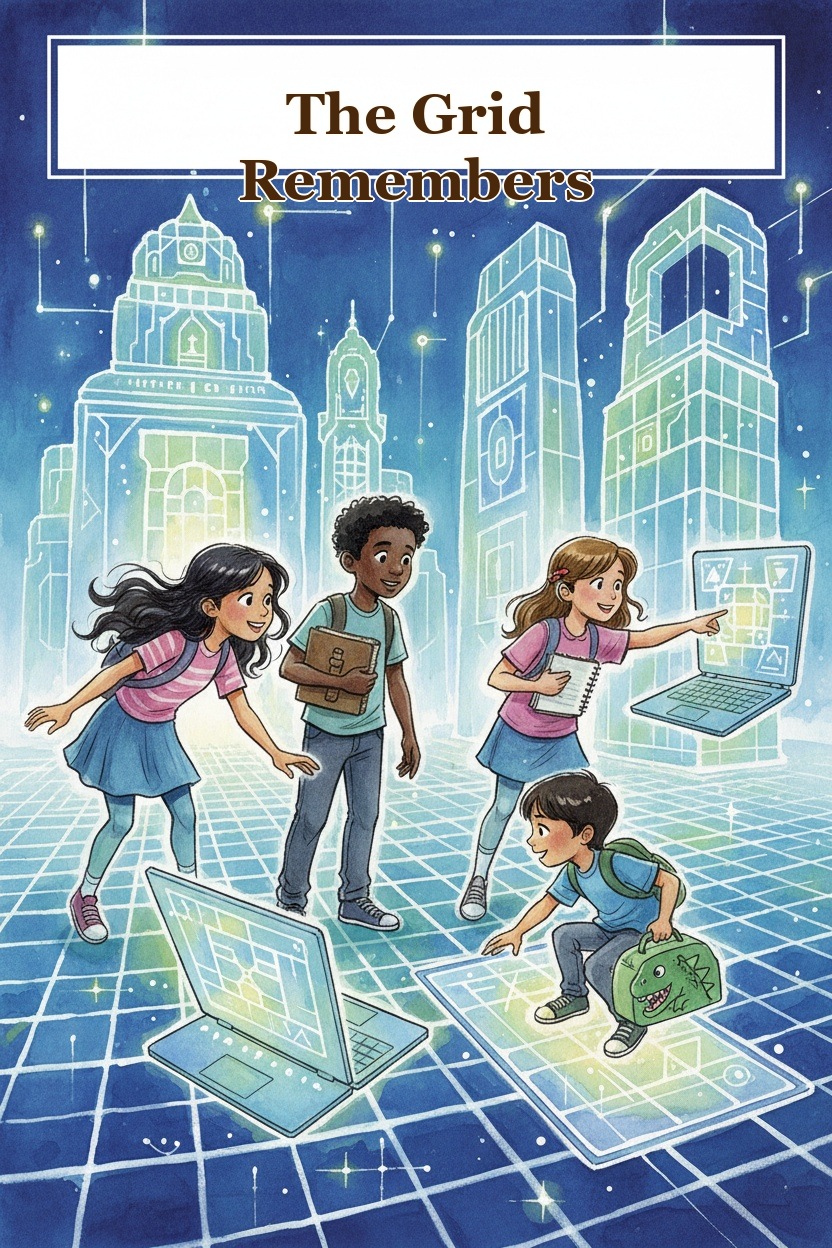
Chapter One: The Archive Gate
The Loop Lands had a new place for the kids to explore. After their last adventure—finding the First Key hidden in the pattern of a thousand repeating doors—the Logics had earned a moment of peace. But peace never lasted long in the Grid.
"Look at that," Priya said, pointing.
Ahead of them, the spiraling green-and-copper architecture of the Loop Lands opened into something different: a massive building shaped like a stack of books, each one the size of a house. Its entrance was a tall gate made of interlocking puzzle pieces, and beside the gate stood a small pedestal with a glowing screen.
"An archive," Kwame said, reading the words carved above the entrance. "This is where the Loop Lands keeps its records. Everything that ever happened here is stored inside."
"Everything?" Sam asked, tilting their head. "Like, everything everything?"
"The sign says so." Kwame squinted. "It says: 'The Grid Remembers All States. Past Data Is Available for Retrieval.'"
"States?" Sam asked. "Like, places?"
"Not places exactly," Kwame said. "More like... how things were at a certain time. What was true and what was false. What values things had. What conditions were met."
Lily was already at the pedestal, studying the screen. "I think this archive runs on data," she said. "The sign says it's been recording everything since the Loop Lands began."
"That's a lot of stuff to remember," Sam said.
"That's the point of an archive," Priya said. "It stores information. Raw facts, just sitting there, waiting for someone to look at them."
The screen on the pedestal flickered, and a new message appeared:
ERROR: ARCHIVE ACCESS REQUIRES KNOWLEDGE OF WHAT IS STORED.
HAVE YOU CONSIDERED WHAT DATA MEANS?
"Data," Kwame said slowly. "That's just... information, right? Like numbers and words and facts?"
"Raw information," Lily corrected. "Before you do anything with it. Just the facts, exactly as they are."
The gate hummed. The puzzle pieces began to shift.
Chapter Two: A Million Tiny Sparks
The gate opened onto a vast room that stretched farther than the kids could see. It was filled with floating spheres of light, each one no bigger than a marble. They drifted in the air like a galaxy of fireflies, each one glowing with a different color.
"Whoa," Sam breathed.
"These are the data points," Lily said, reaching out to touch one. Her finger passed through it harmlessly. "Every state the Loop Lands has ever been in. Every door that opened or stayed closed. Every loop that ran or didn't run. Every condition that was true or false."
"There must be millions," Priya said.
"Billions," Kwame corrected. "Every single moment, recorded. That's a lot of raw data."
Sam floated a hand through a cluster of golden sparks. "But what do we do with it? How do we find anything in here?"
A new message appeared in the air, formed from drifting sparks:
ERROR: RAW DATA IS NOT KNOWLEDGE.
STORING INFORMATION IS NOT THE SAME AS UNDERSTANDING IT.
"Okay," Lily said, tapping her chin. "So we have all these data points. But they're just... sitting here. Individual facts that don't mean anything on their own."
"Right," Priya said. "Like having a million puzzle pieces dumped in a pile. You can't see the picture until you put them together."
"That's what organizing data is for," Kwame said, pulling out his journal. "You take the raw facts, and you sort them. Group them. Compare them. Then you can see patterns."
Sam picked up one of the spheres—it was heavier than it looked. "What's in this one?"
Lily examined it. Green-gold light swirled inside. "That one seems to be recording where doors were open at a certain time. See how the light pulses? Each pulse is a door."
"Some of them pulse faster than others," Sam observed.
"Because some areas have more doors," Priya said. "The data reflects the real state of the Grid."
Kwame flipped through his journal to a fresh page. "Let's try organizing them. Sam, that sphere you have is about doors in the eastern section. Let's see if we can find all the spheres that match."
The kids began pulling spheres from the air, grouping them by color and pulse-rate. Green for doors. Blue for loops. Orange for conditions. Copper for memory values. Each sphere was a single piece of raw information—meaningless alone, but together, they formed a picture of how the Loop Lands actually worked.
"This is incredible," Kwame said, writing quickly. "The Grid remembers everything. Every door, every loop, every state of every variable. The data is all here—it's just a matter of sorting through it."
Chapter Three: The Weight of the Cloud
But the archive was bigger than they thought. Much bigger.
They walked for what felt like hours, passing through chamber after chamber of drifting sparks. Red ones. Blue ones. Green ones. Every color imaginable, every pulse-rate possible, every combination of data the Grid had ever recorded.
"Maybe this is too much," Sam said, stopping in the middle of a particularly dense cloud. "There's so much data. How can anyone possibly organize all of it?"
"That's the problem," Lily said. "Data is just... raw material. It doesn't tell you anything on its own. You have to know what to look for, and then you have to group it in a useful way."
Priya was pacing, her thinking walk. "But there's something else. The error message said that storing information isn't the same as understanding it. So what makes the difference? What turns data into understanding?"
Kwame looked at his journal. "I wrote something down after our last adventure. About patterns. Let me read it."
He cleared his throat.
"The pattern is in the way things repeat. A single door opening doesn't tell you much. But a hundred doors opening in sequence, each one after the previous one moves—that tells you something. The pattern is the meaning hidden inside the noise. The data is just the notes; the pattern is the song."
"Right!" Priya said. "Data is individual facts. But when you organize it—group it by category, or order it by time, or find patterns in it—you learn something new. Something that wasn't obvious when the data was just sitting in a pile."
"Like how knowing every door is open at night," Sam said slowly, "is data. But knowing that the doors open at night because the night-loops run at sunset—that's what you learn by organizing the data."
"Yes!" Lily said, getting excited. "And once you know that, you can predict what will happen. You can use the data to make decisions."
A shudder ran through the archive. The drifting sparks began to swirl, gathering together in a massive cloud above their heads.
ERROR: ORGANIZATION IS NOT THE SAME AS INTERPRETATION.
DATA TELLS YOU WHAT HAPPENED.
IT DOES NOT TELL YOU WHY.
The cloud of sparks twisted into a shape—an enormous hourglass made of light. Sand was falling through it in two separate streams, each one a different color.
Chapter Four: Two Streams
"What is that?" Sam asked.
"It's a demonstration," Kwame said. "Look at the two streams. They're both data—facts about the Loop Lands. But one of them is organized, and one of them is just raw."
The left stream of sand was golden and flowing smoothly. The right stream was copper-colored and chaotic, falling in scattered clumps.
"Which one do you think is organized?" Priya asked.
Sam pointed at the left stream without hesitation. "The golden one. It flows evenly. It's consistent."
"Right. But why does that matter?"
Lily was counting under her breath, timing the falls. "The golden stream has a pattern. Each grain falls at exactly the same interval. The copper stream is random—you can't predict where the grains will land."
"Exactly!" Priya said. "Organized data has structure. You can see patterns in it. You can understand it. Raw data just sits there—it's technically true, but it doesn't help you."
The hourglass glowed, and a new message appeared:
DATA: WHAT IS.
KNOWLEDGE: WHAT IT MEANS.
WISDOM: WHAT TO DO ABOUT IT.
"That's it," Kwame said softly. "That's the whole lesson."
The hourglass began to dissolve, its sand flowing back into the millions of floating sparks. But the sparks didn't stay scattered—they began to arrange themselves into shelves. Rows and rows of glowing shelves, each one labeled with a category.
"Where's the key?" Sam asked. "The second Key—it's supposed to be here, right?"
Priya nodded. "But the archive won't just give it to us. We have to prove we understand data first. We have to show that we know the difference between raw information and organized knowledge."
A door appeared at the far end of the archive, shimmering with green light. Above it, a message glowed:
FIND THE PATTERN. UNDERSTAND THE STATE.
THEN THE WAY FORWARD WILL BE CLEAR.
Chapter Five: The Pattern in the Sparks
The kids stood before the shelves, looking at the millions of organized sparks. Each shelf held a category of data: doors, loops, conditions, variables, memories. Each spark was labeled with its time and place.
"We have to find something," Kwame said. "Something that tells us where the Key is."
"But the data is everywhere," Lily said. "How do we know what to look for?"
Sam walked along the shelves, reading labels. "Maybe we don't need to look for something specific. Maybe we need to look for a pattern."
"What do you mean?" Priya asked.
"Like..." Sam thought for a moment. "If I show you ten numbers, you might just see ten numbers. But if I organize them in order, you might see that they're all even. Or all counting by twos. The organization reveals something the raw data didn't show."
Lily's eyes lit up. "So we need to find data that, when organized, points to the Key!"
The kids spread out, pulling sparks from the shelves and examining them. Blue sparks for loops. Orange sparks for conditions. Green for doors.
But something was odd.
"Hey," Kwame said. "Look at this."
He held up a cluster of green sparks. They all came from the same sector of the Loop Lands—the one they'd just explored. But each spark recorded a door state, and each spark showed something different.
"These doors opened and closed in a pattern," Kwame said. "But if you just look at individual sparks, you'd never see it. You have to line them up in order."
"What pattern?" Sam asked.
Kwame arranged the sparks in a row. Open, open, closed, open, open, closed, open, open, closed.
"Every third door was closed," Priya said. "In the entire sector, every third door was closed. The raw data just shows random doors closing. But organized in order, the pattern is clear."
"Every third door," Lily repeated. "That's a repeating condition."
"Like a loop!" Sam said. "Every third door was closed. The loop was cycling every three doors. And when we entered that sector, we used the second door, the fifth door, the eighth door—all open doors."
"Because we followed the pattern of open ones," Kwame said. "The doors opened for us because we understood the loop."
A deep hum filled the room. The shelf in front of them began to glow, and a slot opened in the middle of it. Inside the slot lay a small object—not the Key, but a card made of pure light.
"It's a data card," Lily said, picking it up. "It's storing something."
On the card, words appeared:
LOOP LANDS KEY LOCATION:
SECTOR 7, PARTITION 3, SHELF 14,
ITEM: THE SECOND KEY
"Seven, three, fourteen," Priya said. "That's a set of organized data. If we'd just had all the sparks randomly floating, we'd never have found it. But when the archive organized the data for us, the location became clear."
"That's what data does," Kwame said gently. "It doesn't give you answers. But organized well, it helps you find the right question."
The Return
The kids found the Second Key exactly where the data card said it would be: Sector 7, Partition 3, Shelf 14. It was a small copper key, shaped like the letter K, and it glowed warmly when Priya held it.
"Two down," she said. "Two to go."
As they turned to leave, the archive's voice appeared one last time:
ERROR: DATA IS POWER.
BUT KNOWLEDGE IS POWER APPLIED.
REMEMBER THE DIFFERENCE.
Back in the school lost-and-found closet, the laptop's glow faded as the kids stepped through the portal. Kwame opened his journal to a fresh page and began to write.
"The Grid remembers everything. Every door, every loop, every state it has ever been in. But remembering isn't the same as understanding. A phone book is data—thousands of names and numbers. But knowing that all the people on one street share a surname—that's knowledge, found by organizing the data and seeing the pattern. The archive taught us that data is the raw material of understanding. It's not the answer. It's the way to find the answer. And maybe that matters even more."
He closed the journal, smiling.
"Ready for the next adventure?" Sam asked.
The laptop glowed faintly on the shelf, waiting.
"Always," Kwame said.
End of Book 14: The Grid Remembers