The Number Kingdom
The Equivalent-Fraction Bridge
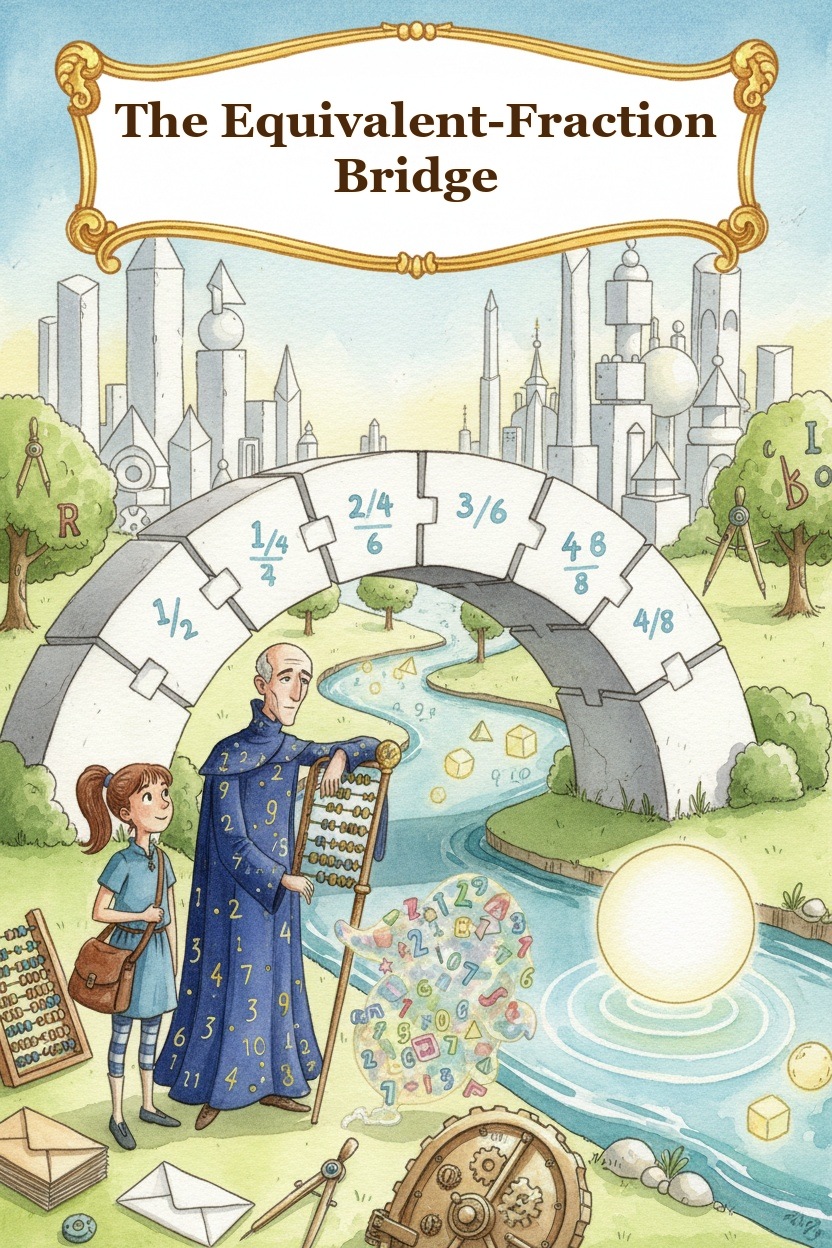
The Two Bridges
"Right. Let's see what's broken," Mira said, sliding down from the saddle of the Count's mathematical mount.
Before her stretched the great gap of the Fraction Highlands — a chasm so deep that the bottom was lost in cloud. And spanning it, not one bridge but two.
They were identical in length. Identical in height. Identical in the pattern of their cables and the shape of their towers. They ran side by side, so close that Mira could have touched both railings at once if she stretched her arms wide.
The Count stepped forward, his numeral-covered robes shifting slowly. "The crisis is as follows," he announced. "The bridge across the Great Gap has been doubled. The Remainder has constructed a second bridge, and now the kingdom's travelers do not know which one to take."
The Remainder appeared between the two bridges, looking like a wisp of smoke with a grin in the middle of it. "Two bridges! Two choices! One leads to the Honeycake Valley, and one leads to the Sour-Pickle Swamp! Isn't it WONDERFUL? You have a fifty-fifty chance of a very sticky day!"
Mira looked at the two bridges. They looked exactly the same.
"Every bridge in the Highlands is labeled with the fraction of its span," the Count said grimly. "The first bridge bears the label one-half. The second bears the label two-fourths. They are different bridges, and you must choose correctly."
The Remainder giggled. "Different labels mean different destinations! Everyone knows that!"
Mira didn't think the Remainder was right. But she didn't know why yet.
The Labels
She walked to the first bridge and examined its plaque. A large, clear label read: 1/2.
She walked to the second bridge and examined its plaque. A second label read: 2/4.
"One over two," she said slowly. "Two over four. The numbers are different. The fractions are different."
The Remainder clapped its wispy hands. "Different fractions! Different bridges! Different destinations! One of us is going to eat honeycake, and one of us is going to eat—" it paused dramatically, "—pickles!"
Mira pulled out her paper and pencil. In the Number Kingdom, she'd learned that when something felt wrong, it was worth drawing a picture.
She drew two rectangles, exactly the same size.
The first rectangle she divided into two equal parts and shaded one. "This is one-half," she said.
The second rectangle she divided into four equal parts and shaded two. "And this is two-fourths."
She stared at her drawing.
The shaded parts looked the same size.
"No," she said, shaking her head. "That can't be right. The numbers are different. One-half is one part out of two. Two-fourths is two parts out of four. They're different fractions."
She was about to fold up her paper when Zero appeared beside her, perfectly round and silver-white, taking up no space and yet somehow filling it.
"I notice," Zero said quietly, "that no one has considered what happens when you look at how much of the rectangle is shaded, rather than how many pieces it's cut into."
Mira looked again.
The first rectangle was cut into two big pieces. One was shaded.
The second rectangle was cut into four smaller pieces. Two were shaded.
But the amount of shaded space?
Identical.
"Wait," Mira said. "Wait wait wait. If the shaded space is the same, then... one-half equals two-fourths?"
"Preposterous!" boomed the Count. "The labels are different! A half is not the same as two-fourths! Everyone knows that a fraction's label tells you what it is!"
"Does it?" Mira asked. She was learning that in the Number Kingdom, it was always worth checking what "everyone knows."
The Proof
Mira drew two circles, exactly the same size.
The first circle she divided into two equal slices and shaded one. "One-half of a circle."
The second circle she divided into four equal slices and shaded two. "Two-fourths of a circle."
She held them up side by side.
The shaded slices formed exactly the same amount of pie.
"But the denominators are different!" the Count protested. "One-half means one part of two! Two-fourths means two parts of four! They cannot be the same!"
"They can be the same," Mira said slowly, "if the parts are smaller."
She wrote on her paper:
1/2 = 2/4
"How?" the Count demanded.
Mira looked at her two rectangles again. She noticed something.
"The first rectangle has two parts," she said. "The second has four parts. Two times two is four."
She picked up her pencil and wrote:
1 × 2 = 2
2 × 2 = 4
"One-half. If I multiply the numerator by two, I get two. If I multiply the denominator by two, I get four. Two-fourths."
She drew another rectangle. "But that's just making more pieces out of the same space. If I cut each half into two smaller pieces, I get four pieces total. And if one piece out of two is shaded, then two pieces out of four must be shaded, because each piece is half as big."
She demonstrated by drawing a rectangle and cutting it in half. Then she added a line through the middle of each half. "One half becomes two quarters. The amount doesn't change. Only the number of pieces does."
The Count stared at her drawing for a long moment. "You are saying," he said slowly, "that multiplying both the numerator and denominator by the same number does not change the fraction's value?"
"Because it's just cutting the same amount into more pieces," Mira said. "The pieces get smaller, but there are more of them. It balances out."
The Remainder had stopped giggling. It was watching Mira's drawing with its head tilted.
"So one-half and two-fourths and three-sixths and four-eighths and five-tenths," Mira continued, writing each fraction down, "all show the same amount? Because in each one, I'm multiplying one and two by the same number?"
"Ten-tenths!" the Remainder cried gleefully, emerging from its silence. "That's the same as one! It's ONE! At least, it is if you're right, and I don't think you are!"
Mira thought about this. "If I multiply one and two by five, I get five and ten. Five-tenths. And if I shade five pieces out of ten, that's... half the rectangle."
She drew it. Five out of ten pieces shaded. Exactly half.
"I think I'm right," she said.
The Shortcut
Mira had proven that one-half and two-fourths were the same amount. But there was a second bridge still to check.
"What if the bridges have different labels that look nothing alike?" she asked. "What if one says three-fourths and one says six-eighths? How do I know if they're the same?"
Zero spoke quietly. "You could multiply three and four by two, and see what happens."
Mira did.
3 × 2 = 6
4 × 2 = 8
"Six-eighths," she said. "The same amount as three-fourths."
The Remainder appeared beside her, examining her work. "But what if the labels are small? What if one says two-thirds and one says eight-twelfths? You don't know what number to multiply by to get from one to the other! The game is ruined! RUINED!"
"Actually," Mira said, "if eight-twelfths is the same as two-thirds, then I can go backward. I can find what number I need to divide by."
She wrote:
8 ÷ 4 = 2
12 ÷ 4 = 3
"Eight-twelfths divided by four on the top and four on the bottom gives me two-thirds," she said. "So eight-twelfths and two-thirds are the same amount, just written differently."
"What is this backward process called?" the Count asked, and for the first time, he didn't sound certain the problem was unsolvable. He sounded interested.
"Simplifying," Mira said. "You're making the pieces bigger by clumping them together. Eight pieces out of twelve, clumped into groups of four, becomes two pieces out of three. The amount doesn't change. You're just describing it with bigger pieces."
She drew a rectangle. She divided it into twelve parts and shaded eight. Then she traced the shaded parts, grouping them into two large shaded regions out of three large regions.
"I started with eight-twelfths," she said. "I divided by four to get two-thirds. And the shaded amount stayed the same."
"Because dividing both by the same number is just the opposite of multiplying both by the same number," Zero said. "It's a shortcut. A way of finding the same amount with a simpler label."
The Remainder had gone quiet. Very quiet.
"That's not fair," it finally whispered. "That means there's not actually a fifty-fifty chance of a sticky day. Both bridges lead to the Honeycake Valley, don't they?"
Mira looked at the two bridges. The first was labeled 1/2. The second was labeled 2/4.
"One-half," she said, "and two-fourths. I multiply one and two by two to get two and four. Same amount. Same destination."
"Do I even want to go to the Sour-Pickle Swamp?" the Remainder asked dejectedly.
"No," the Count said firmly. "No one does. The bridges are equivalent, and travelers may take either one."
The Crossing
Mira stepped onto the first bridge — the one labeled 1/2. The wood was firm beneath her feet. The cables held steady.
Halfway across, she paused and looked back at the second bridge — the one labeled 2/4.
"Same bridge, really," she said. "Same gap, same destination. Just described with more pieces."
The Remainder sat on the railing of the second bridge, dangling its wispy legs. It wasn't giggling. It was thinking.
"The interesting thing," it said slowly, "is that there isn't just one way to describe the same amount. You can multiply by two, or three, or a million. There are infinite labels for the same fraction."
It looked at Mira with something like admiration. "That's actually rather elegant. No matter how many pieces you cut something into, you can always find a label that describes the same amount. The label changes. The amount doesn't."
"Yes," Mira said. "That's what equivalent means."
"Even so," the Remainder said, and a sly grin crossed its smoky face, "I wonder what happens when you try to add two fractions with different denominators. Because I have some ideas about that."
It vanished in a puff of smoke, but its words lingered.
Mira made a note in her book: Equivalent fractions = same amount, different label. x top and bottom by same number to find equivalent. ÷ top and bottom by same number to simplify. But adding? That's tomorrow's problem.
On the far side of the gap, she found the Honeycake Valley. The air smelled like sugar and butter. A small signpost read:
WELCOME TO THE HONEYCAKE VALLEY
Because of the Equivalent-Fraction Bridge, travelers may cross by any route: 1/2 = 2/4 = 3/6 = 4/8 = 5/10 = ... (the list continued around the post and out of sight)
Mira laughed.
Behind her, Zero appeared on the railing of the bridge, its small round body silver-bright in the sun.
"Six-twelfths also works," it said quietly. "And twenty-fortieths. And one hundred two-hundredths. People rarely multiply by me. Perhaps they should."
Mira turned back. "Why? What does multiplying by zero give?"
"Zero," Zero answered. "And zero is the same amount as zero, no matter how you describe it. Which is, I suppose, a kind of equivalence."
"Of course," Mira said.
"Yes," said Zero. "That tends to work."
And somewhere in the Fraction Highlands, the Remainder was already planning its next disruption, muttering something about denominators that didn't match, while Mira — for the first time — felt ready to follow it into whatever came next.