Inside Out Academy
THE LONG STORY
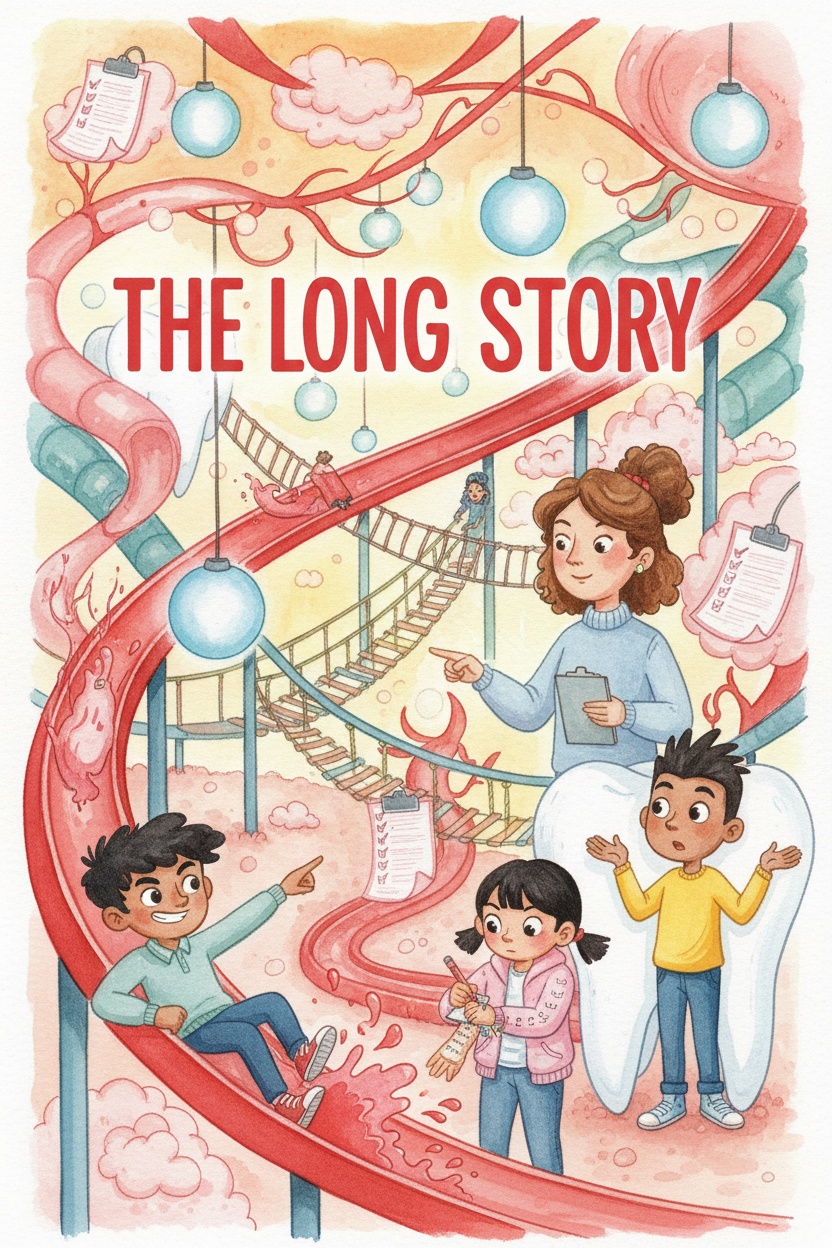
Ms. Vance's Current Checklist:
-
Location: Mr. Gomez's right knee joint (near the femur)
-
Day 6 of the tour
-
Students accounted for: 22 + Ms. Vance
-
New item: Find out why Mr. Gomez's knee sounds like that
The Story in the Bones
The class stood in a vast, dim space that looked like a cathedral made of pearl. The cartilage surface of Mr. Gomez's knee joint stretched in every direction, smooth and gleaming under their lamp.
"Okay," Marcus said, touching the wall beside him. "This is amazing, but we've seen a joint before. Book 6. The hip. Why are we stopping here?"
Ms. Vance knelt down and ran her hand along the cartilage. "Because, Marcus, this particular joint has a story to tell. And I need you all to listen."
She pointed to a series of faint lines on the bone surface nearby—like rings on a tree stump, but finer. "Do you know what these are?"
"Scratches?" Leo guessed.
"Growth plates," Fatima said quietly. Everyone turned to look at her. She was standing very still, examining the bone with the lamp. "These are the lines where Mr. Gomez's bones used to grow."
Ms. Vance smiled. "Exactly right, Fatima. These are the epiphyseal plates—growth plates. When Mr. Gomez was a child, these plates were open. His bones were actively growing longer at these very spots."
"Growing?" Sadie said, her voice doing the shaky thing it did when she was about to share medical knowledge. "Like—measured growth? With a pencil mark on the doorframe?"
"Exactly like that," Ms. Vance said. "But instead of a pencil mark, Mr. Gomez's body kept the record inside his bones."
The Five-Year-Old Body
Mr. Gomez's voice crackled through the walkie-talkie. "Everything okay in there? My knee feels tingly."
"We're fine, Mr. Gomez," Ms. Vance said into the device. "We're looking at your growth plates. Do you remember being small?"
There was a long pause. "I remember being the shortest kid in my class until I was about thirteen," he said. "My mom used to tell me I'd grow eventually. I didn't believe her."
"Your mom was right," Ms. Vance said. "Class, I want you to imagine Mr. Gomez at five years old. His body was—proportionally—a child's body. His head was bigger relative to his body. His arms and legs were shorter. His bones had open growth plates like the ones we're looking at now."
"How tall was he?" Leo asked.
The walkie-talkie crackled. "About three and a half feet," Mr. Gomez said. "I remember because I could stand under the kitchen table without hitting my head."
"Where does a child's growth come from?" Ms. Vance asked. "What tells the body to grow?"
Sadie's hand shot up before Ms. Vance even finished the question. "Growth hormone! From the pituitary gland in the brain. FSH and LH too but those come later, that's puberty."
"Sadie's right," Ms. Vance said. "Growth hormone is released in pulses, especially during sleep. That's why Mr. Gomez's mother made him go to bed early—her body knew what it was doing. The growth hormone travels through the bloodstream to the growth plates and tells them to make new bone."
"So when Mr. Gomez was sleeping..." Marcus said slowly, "his legs were literally growing?"
"Yes," Ms. Vance said. "And his arms, his fingers, his spine. Every night. A little more bone, a little more length."
The class was quiet, thinking about this.
"I slept a lot when I was a kid," Mr. Gomez said. "Maybe that's why I'm so tall now."
"Six feet," Sadie said. "I saw it on his health form." She sounded proud, like she'd won something.
The Twelve-Year-Old Body
Ms. Vance gestured for the class to follow her along the bone surface. They walked past the closed growth plates and into a region where the tissue looked different—rougher, with visible ridges.
"Now," she said, "let me show you the twelve-year-old Mr. Gomez."
"Twelve was a big year," Mr. Gomez said. "I grew six inches in one summer. My knees hurt all the time."
"That's called growing pains," Ms. Vance said. "And they're real. When bones grow quickly, the muscles and tendons have to stretch to catch up. For a while, the body is out of balance."
"That sounds uncomfortable," Fatima said.
"It was," Mr. Gomez confirmed. "But my grandmother used to rub my legs with warm oil before bed. She said I was 'stretching into my future.'"
Ms. Vance stopped at a spot where the bone showed a visible bump. "This is where the future caught up. Mr. Gomez, what happened when you were twelve?"
"Oh." Mr. Gomez's voice was sheepish. "I broke my wrist. Fell out of a tree."
Leo's eyes went wide. "You can see the break? From inside?"
"Bones heal by creating new bone material around the fracture," Ms. Vance explained. "It's called a callus. Over time, the bone remodels and smooths out—but it never quite looks the same as the original."
"Does it still hurt?" Marcus asked.
"Nah," Mr. Gomez said. "It's just a story my body tells."
Ms. Vance nodded. "Your whole body is a story, class. Every scar, every healed fracture, every wear pattern—it's a record of everything you've ever been through."
"But that's not all that was happening to Mr. Gomez at twelve," Sadie said, bouncing slightly. "Puberty. Because that's when—"
"Thank you, Sadie," Ms. Vance said quickly, "and yes. Puberty is when the body changes from a child's body to an adult body. Hormones—estrogen or testosterone, which I see you're very eager to talk about—trigger a growth spurt."
"I grew six inches," Mr. Gomez said. "Ask me about my shoe size."
"What was it?" Leo asked.
"Ten and a half. By the end of that summer."
Marcus did math in his head. "That's a big foot."
"Thank you," Mr. Gomez said.
The Twenty-Five-Year-Old Body
The class moved deeper into the joint, where the cartilage began to show interesting patterns—tiny ridges and indentations that looked like map lines.
"This is where we start to see the twenty-five-year-old Mr. Gomez," Ms. Vance said. "What do you notice?"
Leo squinted at the cartilage. "It's less... wet?"
"Good observation. The extracellular matrix—the jelly-like substance that cushions joints—starts to change in your twenties. The cartilage becomes slightly less elastic. It doesn't recover as quickly from pressure."
"Wait," Fatima said, "this is wear and tear? He's wearing out?"
"Not wearing out," Ms. Vance said. "Wearing in. This is the body aging—developing, changing. It's not a flaw. It's part of the design."
The walkie-talkie crackled. "I did a lot of running in my twenties," Mr. Gomez said. "Loved it. Ran three miles every morning before work." There was a pause. "My knees remember."
"How old is Mr. Gomez now?" Marcus asked.
"Forty-seven," Mr. Gomez said. "You can tell by my knees, apparently."
Ms. Vance smiled. "Mr. Gomez's body has been living for forty-seven years. It's been growing, healing, changing, aging—every single day. And here's the most important thing: it's not finished."
"What do you mean?" Leo asked.
"A five-year-old Mr. Gomez was a different body. A twelve-year-old Mr. Gomez was a different body. The Mr. Gomez we're inside right now is the result of every meal, every sleep, every fall out of a tree, every run in the morning, every growth spurt, every healing break, every day of his life."
Fatima was very quiet. "So the body isn't a thing. It's a process."
Ms. Vance's voice was warm. "Yes, Fatima. The body is a process. It is never finished. From the moment you're born until the day you die, your body is always growing and changing and becoming something new."
"So we're not just inside Mr. Gomez," Leo said slowly. "We're inside his whole life. All the versions of him."
"Yes," Ms. Vance said. "Exactly that."
The Story That Never Ends
Mr. Gomez cleared his throat. "That tingly feeling is happening again. Also, I think I'm hungry. Can we wrap it up in there?"
"One more thing," Ms. Vance said. "I want you all to touch the bone right here."
The students pressed their hands against the bone surface. It was warm—slightly warmer than the temperature of the space around them. It moved rhythmically, almost imperceptibly.
"What do you feel?" Ms. Vance asked.
"It's alive," Sadie whispered. "It's still growing and changing.