The Logic League
The Important Parts
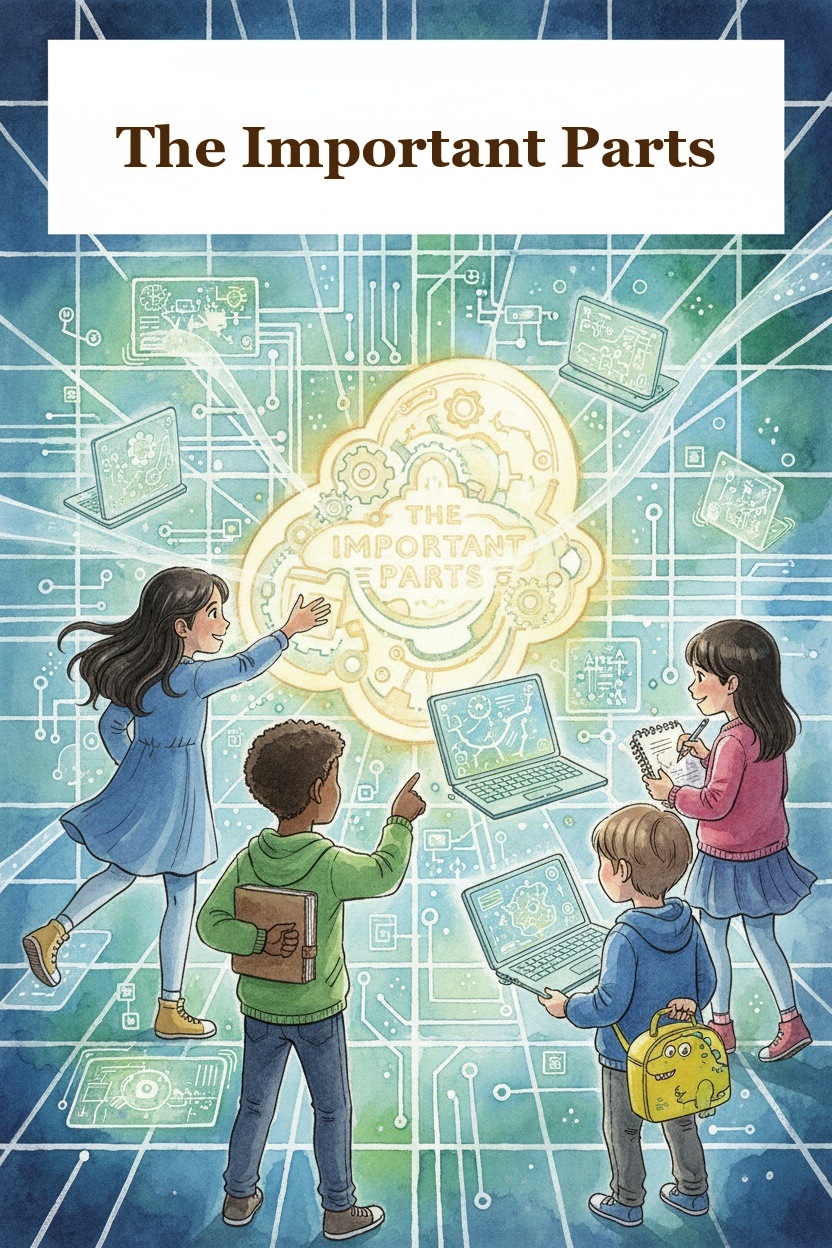
The laptop was warm when Priya opened it, which meant it had been waiting. The glow filled the lost-and-found closet like a tiny sunrise, and the familiar green text blinked once before becoming a doorway.
"Loop Lands again?" Kwame asked, peeking over Priya's shoulder.
"Loop Lands," she confirmed.
Sam was already halfway through the glow. "Race you to the train station!"
Lily caught Sam's sleeve. "If it's a race, we should agree on the finish line first. Otherwise how will we know who won?"
"We'll know," Sam said, and disappeared.
The others followed.
Too Much Everything
The Loop Lands had always been strange, but today they looked wrong. The train station at the Grid's heart—usually a tidy hub of spiraling paths—had become a jungle of detail.
Every wall was covered in glowing text that scrolled endlessly. Every floor tile displayed its own diagram, its own set of numbers, its own tiny animated icon. The air itself shimmered with floating labels: "Platform 7B," "Ticket Required," "Next Loop: 0.3 seconds," "Don't Forget Your Hat."
Kwame blinked. "There's... a lot going on."
"Platform 7B is that way," Priya said, pointing at a sign. Then she pointed at another sign. "Wait, that also says Platform 7B. And that one." She spun in a slow circle. "Every sign says Platform 7B."
"Maybe they all lead there?" Sam suggested.
"I don't think so," Lily said. She was reading one of the wall texts, her finger tracing the lines. "This one says 'Platform 7B: 42 steps, 3 turns, 17 potential obstacles.' And that one says 'Platform 7B: 39 steps, 4 turns, 22 potential obstacles.' They disagree with each other."
The scrolling text on the walls accelerated. More labels appeared in the air. The floor tiles began displaying arrival times, departure times, weather forecasts, lunch menus, and something that appeared to be a history of every train that had ever stopped at Platform 7B, including its original construction date.
"I can't think," Priya said, pressing her hands to her head. "There's too much. I can't find the pattern because there are too many patterns."
A red box appeared in front of them, sharp-edged and blocky.
ERROR: INFORMATION OVERLOAD. PLEASE REDUCE INFORMATION.
"Please reduce information," Sam read aloud. "How do we do that?"
"No," Kwame said slowly, "the question is which information. We can't un-see things. We have to decide what's worth looking at."
Lily was still reading. "This wall text says the station was built in three phases. It lists the architect's name, the materials used, the number of bolts in the ceiling—"
"None of that helps us get to the second Key," Priya said. Then she stopped. "Right? None of that helps us. We need to know where Platform 7B is, and when the next loop leaves, and—"
"And what a 'loop' even means for a train," Kwame added. "Is it a route that repeats? A circular track?"
"Stop." Sam held up both hands. "I have a question."
Priya braced herself. Sam's questions were always small and always dangerous.
"Why do we need all the details?" Sam asked. "Like, why do we need to know how many bolts are in the ceiling? The ceiling isn't going to fall on us."
"Probably not," Lily admitted.
"Then why show it to us?"
Priya's eyes widened. "Because the Grid is showing us everything. Every detail it has. And we're trying to look at all of it."
"But we don't need all of it," Kwame said. "We need some of it. A specific part."
"The important part," Sam said.
The red error box flickered. A new line appeared beneath it:
ERROR: INFORMATION OVERLOAD. PLEASE REDUCE INFORMATION. SUGGESTION: IGNORE MOST OF IT.
"Did the Grid just give us a hint?" Lily asked, astonished.
"Ignore most of it," Priya repeated. "How do we know which part to keep?"
The Map That Wasn't
Kwame pulled out his journal. The pages were warm and slightly worn, and he flipped to a fresh spread.
"Okay," he said. "Let's think about this like a story. We're in a train station. Our goal is to reach Platform 7B. What happens next in a story isn't determined by the number of bolts in the ceiling—it's determined by the plot."
"So we need the plot," Priya said. "We need the part that moves the story forward."
"Which is...?" Sam asked.
"Where the platform is," Lily said. "And maybe when the next train leaves."
"Exactly." Kwame drew two circles on the page and labeled them: "WHERE" and "WHEN." Then he stopped, looking at his drawing. "But how do we get the Grid to show us just that?"
Priya was pacing. "We can't un-see the details. But we can choose not to use them. We can ignore them. We can build a picture in our heads that only has the important parts."
She stopped pacing. "It's like... when you're describing your day to someone, you don't tell them that you tied your left shoe before your right shoe, and that the hallway smelled like sour milk, and that your backpack had exactly nine zipper pulls. You tell them: what happened, and why it matters."
"That's a story," Kwame said, smiling.
"That's abstraction," Priya said. "You take the mess of everything that's true, and you keep only what matters for what you're doing right now."
"Can we do that with the signs?" Sam asked.
"I think we have to."
Priya walked to the nearest wall, which was covered in scrolling text. She closed her eyes for a moment, then opened them.
"I'm going to pretend all of this is noise," she said. "I'm going to look for just one thing."
The text kept scrolling. Priya watched it for a long moment. Then her eyes caught something: one line, repeated every few seconds among the flood of other information.
"Platform 7B. Follow the copper tracks."
She grabbed it. "That's the important part. Follow the copper tracks."
Kwame looked at the floor. There were dozens of tracks: silver, gold, green, blue, black. And there, barely visible among them in the corner, were copper tracks, almost hidden by a large display of historical train schedules.
"Copper tracks," he said. "We could've missed those forever."
"But we didn't," Lily said. "Because we ignored the rest."
The wall text began to slow. The floating labels faded from the air. The floor tiles stopped changing—they simply sat there, a flat gray path stretching toward the copper tracks.
ERROR RESOLVED. ABSTRACTION SUCCESSFUL.
"Is abstraction a Grid term?" Sam asked.
"It's a thinking term," Priya said. "It's what you do when you decide what's important and what isn't."
"And what's important," Kwame said, "is getting to that train."
The Train That Had Too Much
The copper tracks led them to a train that was, impossibly, too detailed to see.
At first, it looked like a shimmering blob. Then, as the kids approached, the blob resolved into thousands of parts: wheels and windows and doors and bells and whistles and mirrors and handles and vents and pipes and dials and gauges and something that might have been a periscope.
"The train," Sam said, "is basically all the trains."
They circled it. There were words everywhere: specifications, passenger lists, cargo manifests, maintenance records, a forty-year history of delays.
Priya groaned. "We just fixed the station. Now the train is overwhelming."
"Maybe same trick?" Lily suggested. "Look for the important part?"
But here, there was too much to scan. The words were layered on top of each other, scrolling over every surface.
"I can't even tell which door opens," Sam said.
Kwame opened his journal again. He'd written something in the margin: A good story doesn't describe everything in the kingdom. It describes the hero's journey.
"Your map," he said to Priya. "The one you made in your head. What's on it?"
Priya closed her eyes. "The copper tracks. A train. A platform. A departure time."
"Can you imagine the train?"
She tried. She pictured a simple shape: a box on wheels, with a door. That was it. That was all she needed.
She opened her eyes. The train was still a chaotic mass of detail.
But now she could see the box.
It was there—a simple, box-shaped outline, hidden among the details. And it had a door. The door was ordinary, unlabeled, but it was undeniable.
"The important part," Priya said, and walked toward the door.
"Wait," Sam said. "How do you know that's the right door?"
"I don't. But the details are telling me it's the train. And the train needs a door. And that's the door that looks like a door." She paused. "The simplified model says: door. That's the door."
She pulled it open.
Inside, the train was almost empty. There were a few simple benches, one window, and a sign that read:
NEXT LOOP: ETERNITY. EXIT CONDITION REQUIRED.
On the benches sat a small, round object: the second Grid Key. It glowed a deep teal, matching the Loop Lands' circular architecture.
"We found it," Lily whispered.
"Don't touch it yet," Kwame said. "Look at the sign. 'Exit condition required.' We can get on the train, but we need to know when to get off."
The Important Part of the Key
The Key sat on the bench, gleaming. Priya reached for it.
"Wait," Sam said again. "Why would they just leave it there?"
"They didn't," Lily said. She was examining the sign. "'Next loop: eternity. Exit condition required.' I think the train is a loop—like a repeating path. If we take the Key, the train starts moving, and it doesn't stop until we can tell it when to stop."
"Tell it how?" Kwame asked.
Lily tapped the sign. "Exit condition. We have to name the thing that makes the loop end."
"We can't name a thing that doesn't exist yet," Priya said.
Sam looked at the Key. Then back at the sign. Then at the Key again. "I have a question."
"Always," Kwame said.
"What's the important part of the Key?"
The others blinked. The Key was a small, smooth circle with a spiral carved into its center. That was it. No engravings, no symbols, no complicated patterns.
"The important part," Sam said slowly, "is that it's the thing we want. The exit condition could be 'when we have the Key.' When we pick it up, the loop ends."
"Because the goal is already achieved," Kwame said. "We don't need the train to take us anywhere. We came here to get the Key. Once we have it, the loop should end."
Priya reached out and touched the Key.
The train began to hum. The door slid shut behind them. The windows filled with motion—the train was moving, sliding along the copper tracks in an endless circle.
"Exit condition now!" Lily called.
"The Key!" Priya shouted. "Exit condition: we have the Key!"
The train stopped. The door slid open. Outside, they saw the station—calm now, its details quiet and organized.
ERROR RESOLVED. LOOP TERMINATED.
They stepped off the train, and the Key pulsed warmly in Priya's hand.
"Abstraction," Kwame said, writing in his journal, "is deciding what matters and letting go of everything else. The train wasn't a million details. It was just a way to get us here. The station wasn't a million signs. It was a path. And a story isn't every true thing—it's just the true things that matter."
The Journal Entry
Later, back in the lost-and-found closet, the laptop's glow flickered once and dimmed. The kids sat on the floor in a circle.
"Kwame," Sam said, "what did you write?"
Kwame opened his journal and read:
*"A story is not everything that happened. A story is the part that moved. When I tell you about my day, I don't mention that the sky was blue or that my shoes have laces. I tell you: I went somewhere. I found something. I came home. The details are true, but they are not the truth. The truth is the map that shows you the way. Everything else is scenery."
"The Grid showed us everything, and that was the problem. Too much everything is nothing. We had to choose. And choosing is not leaving things out—choosing is knowing what to hold on to."
He closed the journal.
"That's abstraction," Lily said. "And we're good at it."
"We're good at it," Priya corrected, but she was smiling. "Sam's question was the important part. As usual."
Sam shrugged. "It was obvious."
"Only after you said it," Kwame said. "That's the best kind of obvious."
The laptop blinked once, almost like an eye closing.
Then it was just a laptop.
And the kids, back in the lost-and-found closet, looked at each other and then looked at the door—the quiet, normal door that led to the quiet, normal hallway and the quiet, normal rest of their Friday afternoon.
"Race you to the library?" Sam asked.
"Finish line?" Lily asked.
"The front desk."
"Deal."
And they ran.