Chef Sparks Kitchen Lab
THE GARDEN IN YOUR GUT
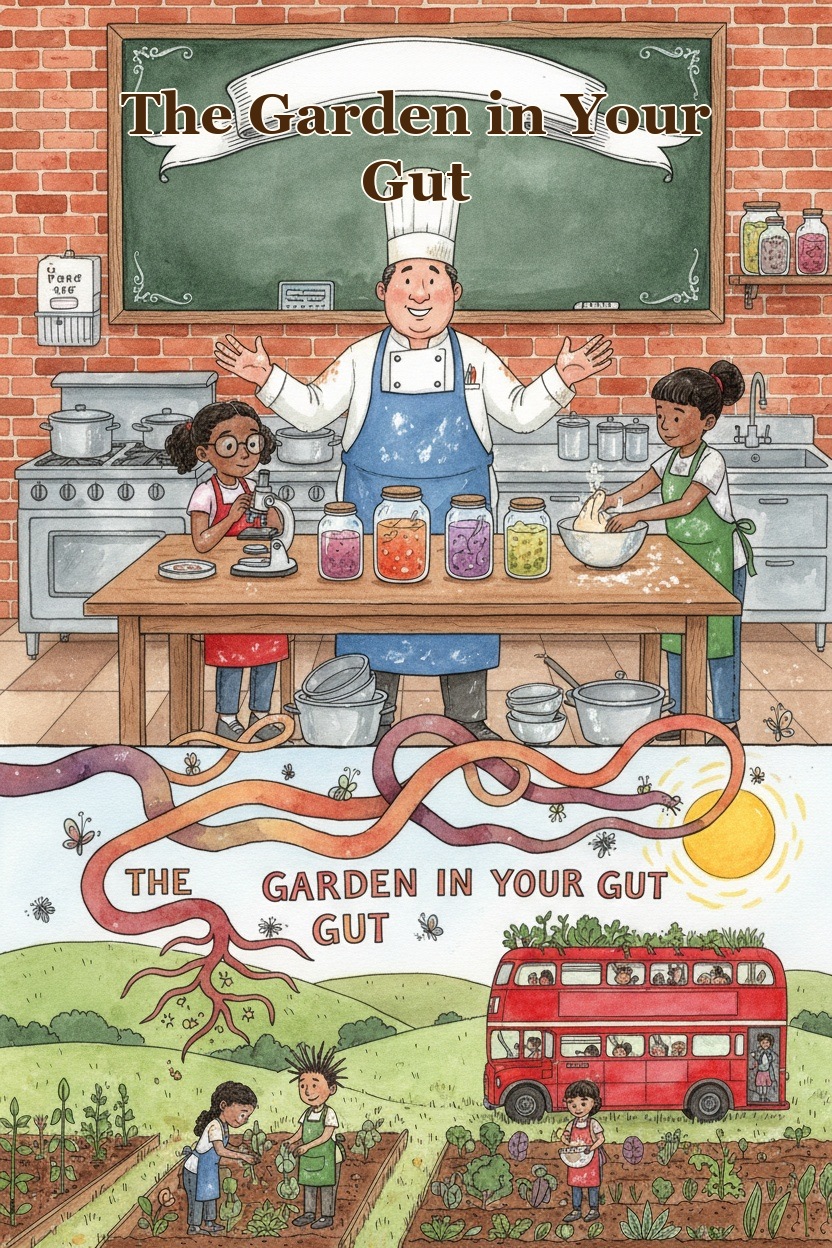
Chapter 1: The Most Important Garden You Can't See
The Riverside Fire Station kitchen smelled like its usual Thursday self: warm bread, fresh herbs, and something Iggy had been testing that morning that smelled suspiciously like pickles.
"Gather round, gardeners!" Iggy announced, clapping his hands together.
Tommy looked up from the carrot he was already eating. "What are we planting today? I thought the courtyard garden was done for the season."
"We're not planting in the courtyard today, Tommy." Iggy's eyes had that particular shine they got when he was about to say something he considered enormously exciting. "We're planting in here."
He tapped his stomach.
Priya tilted her head. "In... your stomach?"
"Not mine specifically. Yours. Everyone's. Every human being's." Iggy swept his arm in a wide arc, and the Spark Effect claimed its victim: a wooden spoon that had been resting innocently on the counter behind him clattered to the floor.
Maya, who had been watching the spoon with the expression of someone tracking a weather system, added a tally mark to the prediction chart on the chalkboard. "Twenty-three and a half. No one predicted wooden spoon."
"Noted," Iggy said, completely ignoring her. "Now. Does anyone know what a microbiome is?"
Dev raised his hand tentatively. "Isn't that... bacteria?"
"Bacteria, yes! And viruses and fungi and other tiny microorganisms. But here's the thing." Iggy leaned forward conspiratorially. "There are about one hundred trillion of them living inside your body right now. Right this very moment."
Tommy stopped chewing. "That's... a lot."
"It's more than the number of stars in the Milky Way galaxy," Iggy said. "And most of them live in your digestive system. Your gut."
Sam immediately pulled out the notebook they used for ratings. "This is either the best fact I've ever heard or the worst. I'm giving it a tentative nine and a half."
"They're not just in you," Iggy continued, climbing onto a step stool so he could see everyone over the prep table. "They're part of you. They help digest your food. They train your immune system. Some of them even help make vitamins your body needs but can't make on its own."
Maya frowned. "So they're... good bacteria?"
"Some of them! And some of them aren't so good. But here's the extraordinary part—" Iggy paused for dramatic effect. "They all live together in a community. A garden, if you will. A garden that needs to be tended."
He jumped off the step stool and grabbed a piece of chalk.
"So if it's a garden," Priya said slowly, "then what are the plants?"
"Great question!" Iggy drew a circle on the chalkboard. "Let me show you."
Chapter 2: The Gardeners and the Fertilizer
Iggy drew a long, winding tube across the chalkboard. "This is your digestive system. But we're zooming in on the large intestine—here—where most of your microbiome lives."
He drew hundreds of tiny shapes inside the tube.
"Your gut is like soil," he explained. "Good soil has lots of different organisms living in it—fungi, bacteria, worms, all of it—and they help plants grow. Your gut is the same. The more diverse your gut garden is—the more different kinds of beneficial bacteria you have—the healthier it tends to be."
"Are all bacteria good?" Lucia asked, already sketching a tiny cartoon bacterium with a watering can.
"Remember, bacteria aren't 'good' or 'bad' like characters in a story," Iggy said. "They're just... life-forms. And like all life-forms, some help us and some don't. The ones that help us—the beneficial ones—they eat the food we can't digest, and when they eat it, they produce things our bodies need. Short-chain fatty acids, for example. Those tiny molecules help our intestines stay healthy."
Maya raised her hand. "So how do we get more of the helpful ones?"
"Two ways," Iggy said, holding up two fingers. "First: probiotics. These are living beneficial microorganisms that you eat directly. Foods like yogurt with live cultures, kefir, kimchi, sauerkraut, miso—foods that have been fermented."
"We made yogurt in Book 14!" Tommy said.
"We did! And that yogurt had live cultures—living beneficial bacteria that can join your gut garden." Iggy drew a tiny door on his digestive tube. "They come in through here, like new plants being introduced to a garden."
"Wait," Priya said. "You said there were two ways. What's the second?"
Iggy's whole face lit up. "Ah. That's the one I'm most excited about. The second way is prebiotics."
"Probiotics, prebiotics, they sound the same," Dev said.
"They're related, but they're different. You can remember it this way: probiotics are the plants, and prebiotics are the fertilizer."
Iggy drew a small plant and then a watering can. "Probiotics are actual living bacteria you eat. Prebiotics are not bacteria at all. They're a type of fiber—food that feeds the good bacteria that are already living in your gut."
"But I thought fiber was for us," Maya said. "Isn't fiber the thing that helps you go to the bathroom?"
"Fiber does help with that—it adds bulk to what you digest. But here's the secret: your body can't break down most fiber. You can't digest it. But your gut bacteria can. They eat it, and when they eat it, they multiply. They grow. They flourish."
Iggy drew a picture of a tiny bacterium eating a piece of what looked like a rope. "Fiber is the food for the food that lives in you. It's like... a compost pile feeding a garden."
Tommy's eyes went wide. "So when I eat an apple, I'm not just eating an apple. I'm feeding billions of tiny creatures that live inside me."
"Yes!" Iggy's voice cracked with excitement. "Yes, Tommy! That's exactly it! You are a walking city, and your gut bacteria are the citizens, and fiber is the grocery store!"
The Spark Effect claimed a measuring cup.
Chapter 3: The Garden Brain
"So," Iggy said, "let's talk about something scientists are learning more and more about. The gut-brain connection."
"Wait," Sam said, looking up from rating a piece of celery they'd been examining. "The gut is connected to the brain?"
"Connected and talking. Constantly. All the time." Iggy drew a line from his digestive tube drawing up to a squiggly drawing of a brain. "There's a direct communication pathway between your gut and your brain. Scientists call it the gut-brain axis."
Maya looked skeptical. "So my stomach can... talk to my brain?"
"Not in words," Iggy said. "But through signals. Chemicals. Nerves. The vagus nerve, specifically—a major nerve that runs from your brain stem all the way down to your gut."
"And what does it say?" Priya asked.
Iggy's voice softened. "Scientists are still figuring all of this out. But we know that the gut microbiome produces chemicals that affect your brain—including some of the same neurotransmitters that influence mood. A huge portion of your body's serotonin—a chemical that helps you feel calm and happy—is actually produced in your gut."
"So," Lucia said slowly, "the bacteria in my gut can affect how I feel?"
"The evidence suggests it's possible," Iggy said. "Scientists are studying it. But here's what we know for sure: eating foods that support a healthy gut—lots of fiber, fermented foods, a wide variety of plants—is associated with all sorts of health benefits. And eating a poor diet can hurt the diversity of your gut garden."
"Like a garden with no water," Tommy offered. "And then the good plants die, and the weeds take over."
"Exactly. And 'weeds' in this case might be harmful bacteria that can cause inflammation—which is linked to lots of things, including poor digestion, weakened immunity, and maybe even mood issues." He paused. "But here's the thing I love most about this: you don't need to take special pills or buy expensive supplements. You just need to feed your gut garden well. With real food."
"Iggy," Priya said, "you said something about what feeds beneficial bacteria. What foods, exactly?"
Iggy grabbed a marker and started drawing on the chalkboard. "Fruits and vegetables! Legumes—beans, lentils, chickpeas. Whole grains. Onions and garlic. Bananas—especially slightly green ones. Oats. And then in the fermented category: yogurt, kefir, sauerkraut, kimchi, miso, tempeh, pickle—real fermented pickles, not just vinegar."
"That's a lot of plants," Dev said.
"That's the point! The more variety of plant foods you eat, the more diverse your gut garden becomes.