Lighthouse Cats
The Clock Ship
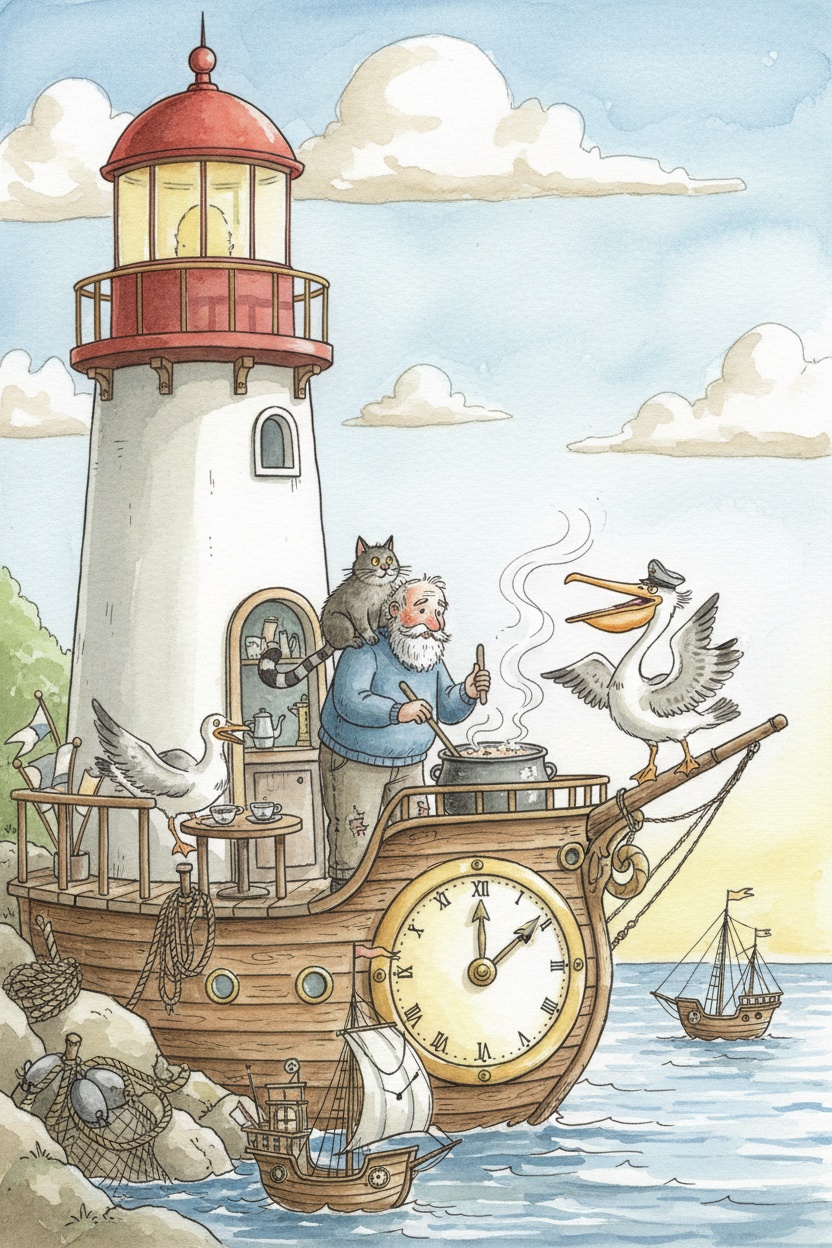
The morning sea was flat and grey, the colour of a well-worn tin bucket. Captain Whiskers sat in her window, washing one perfect silver paw, when Morris the Seagull arrived in a flurry of panic.
“WHISKERS!” he screamed, sliding across the lighthouse roof. “A SHIP! IT’S STOPPED! IT’S FROZEN! THE SEA HAS TURNED IT TO STONE!”
Captain Whiskers blinked. “Morris. Lower your voice and raise your facts.”
Morris panted, his feathers askew. “It’s true! It’s just… floating there. Not moving. No sail. No smoke. No anything!”
From the window, Whiskers could see it — a small, neat ship drifting in the current, listing gently. It was a beautiful vessel, all brass fittings and polished wood. But something was odd. There was no flag. No sound. And no one on deck.
“Fetch Penny,” said Captain Whiskers. “And see if Angus has a wheel of good cheese in the pantry.”
Morris squawked. “Cheese?! The ship is DYING and you want CHEESE?”
“The cheese is for the crew,” said Whiskers. “A ship with no one on deck always has a crew below, waiting for help.”
Penny the Pelican arrived, trying to look calm and crashing into the doorframe instead.
“Ready, Captain!” she said, wobbling.
Together, the three of them rowed out in Angus’s little dinghy — Whiskers at the oars, Penny perched at the bow, and Morris circling overhead, narrating the tragedy.
“THE HORROR! THE SILENCE! THE— oh, it’s quite pretty up close, actually.”
The mystery ship was called The Tick-Tock. Her deck was spotless. Her ropes were coiled like sleeping snakes. And in the middle of the deck stood a small, grand figure: a mouse captain in a tiny blue coat, frozen mid-salute.
He was made of brass and clockwork. Behind his glass eyes, tiny gears gleamed. And all around him, scattered across the deck, were more clockwork mice — the crew — paused in every position of shipboard work. One held a tiny rope. Another balanced a tiny cup of tea. A third had been caught mid-sneeze.
“They’re clocks!” gasped Penny. “A whole ship of clockwork mice!”
“They’ve wound down,” said Captain Whiskers, stepping aboard with a soft thump. “Every clockwork creature needs winding. But this crew cannot wind themselves.”
She inspected the captain. His little brass tail curved upward, and on the tip, glinting in the morning light, was a brass key. It had been there the whole time.
“The key,” Whiskers murmured. “Attached to the captain’s tail. No one can wind him but someone else.”
Morris landed beside her. “THIS IS THE WORST THING THAT HAS EVER— well, actually, it’s rather clever. But still terrible! How do we wind a whole crew?”
Whiskers looked at the mice. There were twelve of them, each no bigger than a walnut. She turned to Penny.
“Penny. Your bill. How precise can you be?”
Penny’s eyes went wide. “I… I can pick up a single grain of sand. Most of the time.”
“Good,” said Whiskers. “Then you will wind them, one by one. Grip the key with your bill. Turn gently. Don’t drop anyone.”
Penny gulped. Her bill opened, closed, opened again. “What if I break them?”
“You won’t,” said Whiskers simply. Because sometimes the best thing a captain can say is that she believes in you.
Penny approached the first mouse. A little deckhand with a tiny mop. She lowered her great bill, closed it around the key on the mouse’s back, and turned — click.
The mouse’s eyes brightened like stars coming on. Its little head turned. It looked at Penny, saluted, and ran off to find a puddle.
“IT WORKED!” shouted Morris.
“Keep going,” said Whiskers.
Penny wound another mouse. And another. One key was stiff; she had to try three times. One mouse was upside down; Whiskers gently righted it first. And all the while, the clockwork captain stood frozen, his empty eyes watching the sea.
Finally, only the captain remained.
Penny looked at him. He was magnificent — tall as a teacup, with a real felt hat and a tiny brass telescope. His key, bigger than the others, gleamed on the end of his tail.
“Should I…?” she asked.
“That’s the one who matters most,” said Whiskers. “Steady now.”
Penny leaned in. Her bill trembling, she took hold of the captain’s key. She turned it slowly, carefully, one full circle.
Tick.
The captain’s eyes glowed warm gold. His whiskers twitched. His little chest rose and fell with a whirr-chime like a tiny bell.
He looked up at Penny. Then he looked at Captain Whiskers. And then he spoke, in a voice like a music box:
“Thank you. I have been waiting a long time for someone to notice my key.”
“It was attached to you all along,” said Whiskers.
The captain smiled a tiny brass smile. “Yes. But a ship’s captain cannot wind himself. That is the rule of the clock. I needed a friend.”
Penny looked proud enough to pop.
The clockwork crew sprang to life. Tiny mops scrubbed, tiny pots clanged, and the captain raised his telescope. The Tick-Tock began to move, her gears humming a gentle tune.
Back at the lighthouse, Angus opened his eyes, stretched, and looked out the window. The clock ship sailed past, all her lights glowing, the tiny captain waving from the deck.
“Funny,” said Angus, scratching his beard. “That ship looked like it was dancing.”
Captain Whiskers, back in her window, watched the ship glide away. Morris landed beside her, quiet for once.
“That was a good one,” he said. “No one got hurt. Everyone got wound.”
Whiskers looked at the tiny gold key the captain had left her — a gift, he’d said, for their kindness. She placed it gently on her wall of treasures.
“Every ship gets home,” she said.
And on the sea, The Tick-Tock sailed on, ticking to the rhythm of a steady, grateful heart.