The Number Kingdom
The Division Declaration
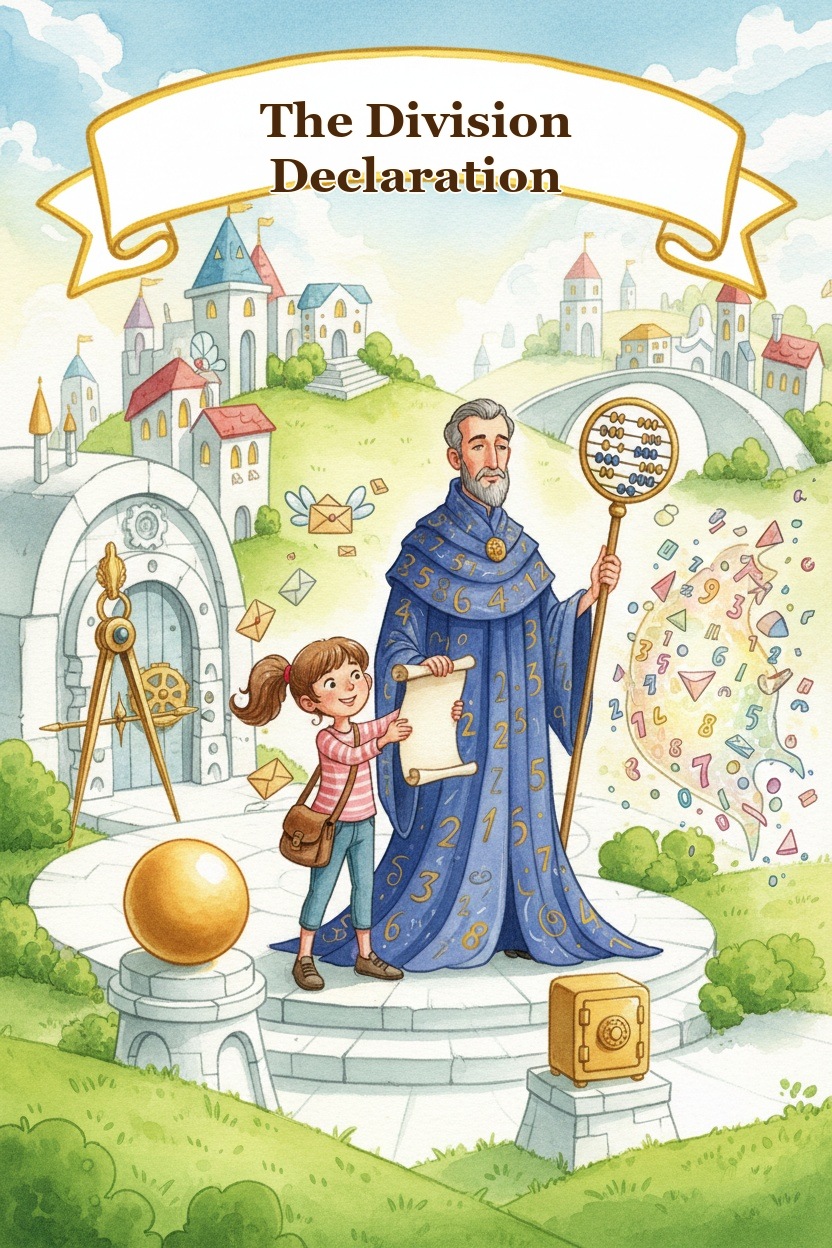
The Festival Problem
The Number Kingdom was preparing for its Great Harvest Festival, and everywhere Mira looked, the world was full and golden. Carts of apples rolled through the streets. Towers of round cheese wheels balanced in market stalls. Baskets of bright berries, barrels of honey, and bundles of sweet grain lined every road.
But in the central plaza, something was wrong.
The Count stood before a mountain of festival goods, his robes shifting with worried numerals. His abacus staff clicked anxiously.
"The crisis is as follows," he announced as Mira arrived. "We have twelve golden apples to distribute equally among four districts. We have eight honey jars for three districts. We have fifteen berry baskets for four districts. And unless these goods are divided fairly — each district receiving exactly the same amount — the festival cannot begin."
"Right. Let's see what's broken," said Mira, setting down her satchel.
She studied the apples. Twelve apples. Four districts. She thought about the times tables she'd learned in the tournament — three groups of four made twelve, and four groups of three made twelve. If each district got three apples...
"Twelve divided by four is three," she said, and as she spoke, the apples sorted themselves into four equal piles of three, each pile rolling toward a different district. The districts glowed with satisfaction.
"Interesting," said the Count. "You have used division."
"I used multiplication," Mira said. "I knew four threes were twelve, so I worked backward."
She paused. Backward multiplication.
"Division is backward multiplication," she said slowly. "It's the opposite. Multiplication puts groups together — division splits them apart."
"Correct," said the Count. "They are inverse operations. Each undoes the other."
Mira grinned. "So division is just asking: what times what gives me what I'm sharing?"
Eight Honeypots
The honey jars were next. Eight jars. Three districts.
Mira thought hard. Three times two is six. Three times three is nine. But there were only eight jars — not six, not nine. Eight didn't fit into any of the times tables she knew for three.
"Can I use fractions?" she asked.
The Count shook his head solemnly. "The festival requires whole jars. The honey must be distributed in complete units."
Mira frowned. She tried giving each district two jars. That used six jars — but two were left over.
She tried giving one district three jars and the others two each. That was fair in a way, but not equal. The Count's expression told her equality was required.
"Two jars each," she said, "and then there are two left over that don't fit any group."
"Exactly," came a gleeful voice. "Left over! Left out! Not fitting! How WONDERFUL!"
The Remainder materialized from the leftover jars — or perhaps the leftover jars materialized from it. It appeared as a small, smirking shape made from half-cracks in stones and the spaces between numbers: almost a child, but not quite finished. It perched on the leftover jars and beamed.
"Look at them!" it crowed. "Seven jars, nine berries, eleven anything — some things just don't fit! They're ragged! They're messy! They're LEFTOVER!"
Mira studied the two extra jars. "But they're still there. They still exist. They're just... not divided."
"Precisely!" The Remainder's eyes sparkled. "I am what's left when things won't come out even. I am the part that doesn't belong to any group. I am the Remainder!"
Mira pulled out her pencil and paper and began to draw.
The Remainder's Name
She wrote: 8 ÷ 3 = 2, with 2 left over.
The Remainder leaned over her shoulder, delighted. "That's me! The leftover two! I knew I was important!"
"But wait," said Mira, thinking. "The leftover two is called the remainder. And you're called the Remainder."
"Coincidence?" asked the Remainder, grinning.
Mira thought harder. "No. You're the part of division that doesn't resolve evenly. You're the mathematical concept made into a person. You ARE the remainder — not just named after it."
The Remainder's grin flickered. For just a moment, something like surprise crossed its unfinished face. "No one has said that before," it said quietly. "Usually they just want me to go away."
"Well, I don't want you to go away," said Mira. "I want to understand you. You're not a failure — you're a piece of information. You tell me what's left when things don't split evenly."
She wrote more carefully:
8 ÷ 3 = 2 R 2
"The first two is how many each district gets," she explained. "The R stands for remainder — the two that's left over. That's you."
"R," the Remainder whispered. "R for Remainder. I have a letter! I'm in the equation!"
Mira looked at the two leftover jars. "But what do we do with them? They still need to go somewhere."
Zero's Suggestion
The golden circle of Zero had been standing quietly nearby, taking up no space at all.
"I notice," said Zero, in its soft precise voice, "that no one has considered the number of districts for a moment longer."
Mira looked at the jars. She looked at the districts. She looked at the Remainder.
Wait.
Eight jars. Three districts. But what if they opened a fourth district?
"The festival can be extended?" asked the Count.
"It can," said Zero. "And there are exactly enough leftover jars for one more district to receive the same share."
Mira's eyes widened. "Two jars for three districts — and two jars left over. If there are four districts... wait, no. Two jars each for four districts is eight jars. That divides evenly!"
"But the festival has always had three districts," said the Count.
"Then let's add a fourth," said Mira. "The Remainder showed us what was left over. The remainder isn't an error — it's a clue. It tells us what's missing or what's extra. Sometimes we can use it."
The Remainder looked almost touched. Then it grinned again.
"Or sometimes you can't!" it said cheerfully. "Sometimes there's just leftovers and everyone has to accept it! You'll see! You'll all see!" And it dissolved into the air, leaving behind the smell of unfinished equations.
Zero watched it go. "The Remainder enjoys its work."
"Does it ever," said Mira. "Okay. Fifteen berry baskets, four districts. Let's see what the remainder has to say."
She worked it out on paper. Four times three is twelve. Four times four is sixteen. Fifteen is between them.
15 ÷ 4 = 3 R 3
"Three baskets each, and three baskets left over," she said. "That's the remainder. Let's check by multiplying: three baskets times four districts is twelve, plus three left over is fifteen." She wrote: 3 × 4 + 3 = 15.
"Correct," said the Count. "Division checks itself by multiplication, with the remainder added back."
Mira looked at the three remaining baskets. "Three baskets, four districts. Could we split the baskets? No — whole baskets only. Could we open another district? No — only four exist."
"Then the remainder simply is," said the Count. "Some quantities do not divide evenly. The remainder is the mathematical truth of what cannot be perfectly shared."
Mira looked at the leftover baskets. Then she had an idea.
"The three leftover baskets," she said. "Could they be used for a second round? A second sharing? If we gathered more baskets, the distribution could continue — the remainder could become part of another division problem."
The Count considered. "That is what happens when division is extended. The remainder exists only within one calculation. In a larger calculation — with more total goods — it may divide differently."
Mira beamed. "So a remainder isn't the end. It's just where one division problem stops. The story can continue."
The festival goods distributed themselves. Twelve apples, eight honeypots, and fifteen baskets each found their districts — most of them evenly, and the remainders waiting patiently for their next division.
The Declaration
That evening, Mira stood before the assembled kingdom and made the Division Declaration:
"Division is fair sharing," she declared. "It asks: if I split this into equal groups, how much does each group get? It is the inverse of multiplication — every division problem can be checked by multiplying it back. And when things do not divide evenly, the leftover quantity is not an error. It is a remainder. It tells us what doesn't fit, what's extra, or what's missing. It is real. It is valuable. And it is not the end of mathematics — it's a clue to the next problem."
The Remainder appeared one last time, sitting on a rooftop with a half-eaten apple (the half, perhaps, was its work).
"You said I'm not a failure," it called down.
"You're not," said Mira. "You're the part of mathematics that isn't finished. And that's interesting. It means there's always more to explore."
The Remainder considered this. "I could get used to being interesting,"