Chef Sparks Kitchen Lab
THE SOUR SCIENCE
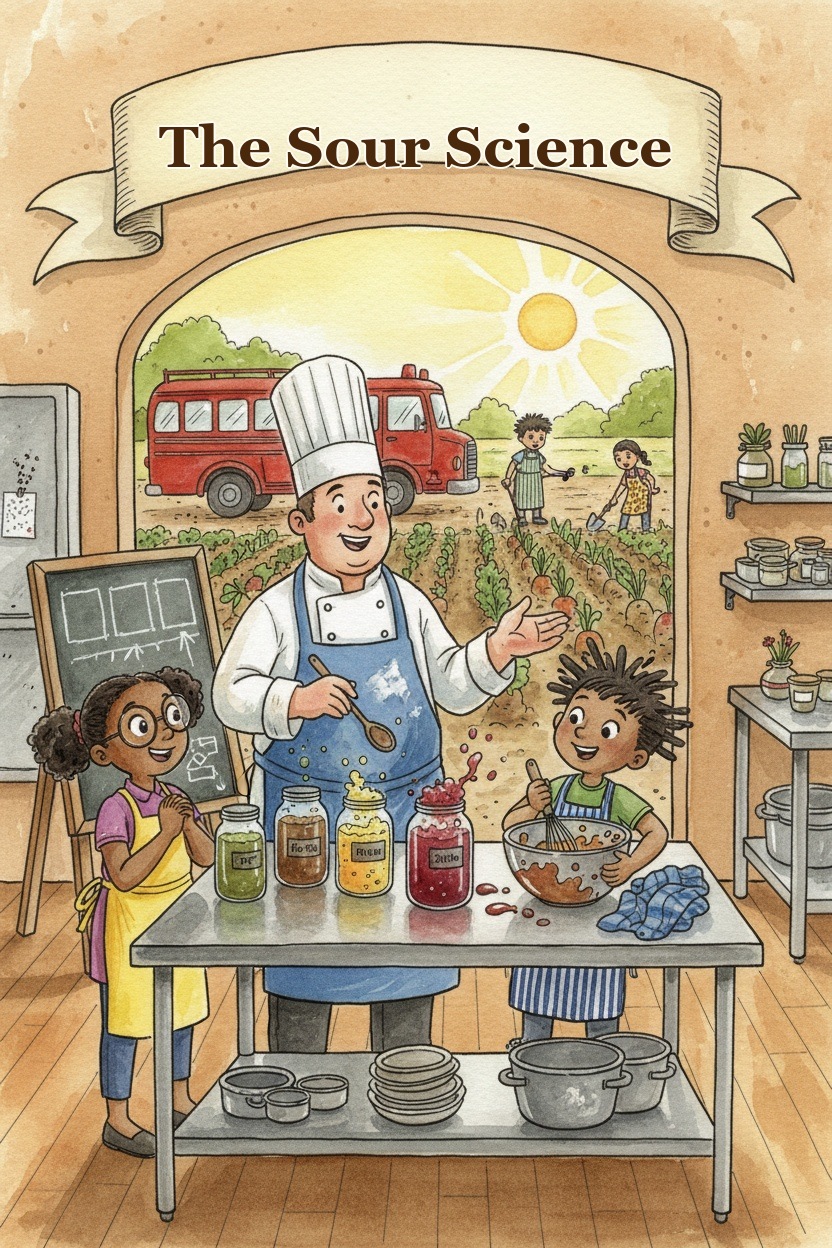
Chapter 1: The Sour Collection
The Riverside Fire Station smelled like lemons before anyone even walked through the door.
Maya arrived first, as she always did, and found Chef Iggy Spark standing at the prep table with his arms spread wide over an impressive collection of bottles, fruits, and jars. He was wearing his favorite apron—the one with the fire engine embroidered on the pocket—and he was grinning like someone who had just discovered something wonderful.
"Lemon juice!" Maya announced, reading the first bottle.
"Correct!" Iggy pointed at her. "You get a point."
"Vinegar." Tommy had arrived and was already sniffing everything. "That's the white kind. And is that—" his nose wrinkled with delight—"balsamic? That's the good stuff."
"Points for Tommy!" Iggy said. "What else do we have?"
The class gathered around the table. Priya examined a carton. "Buttermilk. My Ammamma uses buttermilk in her dosa batter."
"Priya's Ammamma scores double points!" Iggy clapped his hands together. "Because she just connected this book to her grandmother's kitchen, which is exactly the right way to start."
Dev was looking at a bottle of red wine. "I know what that is, but I don't think we're drinking it."
"We are absolutely not drinking it," Iggy confirmed. "Because we're going to cook with it. And cooking with wine is a completely different thing from drinking wine, and adults who cook with wine are not cooking for children to drink it. The alcohol mostly cooks off during cooking, but we're actually not even going to cook it today—which means we'll talk about that later. For now, wine is on the table as an acid. Also tomatoes, which are acidic even though they don't taste sour. Also—" he reached into his pocket and pulled out a small plastic bag filled with a mysterious white powder—"citric acid. The stuff that makes sour candies sour. But we're not using that today either. I just brought it to show you."
"Why does it matter?" Lucia asked. She had already pulled out her sketchbook and was drawing the collection of bottles and fruits.
"Why does sour matter?" Iggy repeated, as if the question delighted him. "Lucia, you just asked the most important question of the day. Why does sour matter? Why does acid matter? Taste one of these and tell me what happens."
He pushed a small bowl of lemon juice toward her. Lucia dipped a finger in and touched it to her tongue. Her face scrunched up. "It's sharp," she said. "It makes my face do this." She demonstrated the face.
"Exactly!" Iggy said. "That face is your body's response to acid. And that response is protecting you. Your tongue is telling your brain: 'Something with a pH below 7 is here.' And your brain is telling your face: 'Make a face so everyone knows.'"
"Wait, what's pH?" Tommy asked. He had already dipped a finger in the lemon juice and was making the same face, but he seemed to enjoy it.
Chapter 2: The Cabbage Surprise
Iggy gestured toward the chalkboard, where he had drawn something that looked like a number line that went from 0 to 14.
"This is the pH scale," he said. "It tells us how acidic or how basic something is. Zero is very, very acidic. Fourteen is very basic—you may have heard the word alkaline. Seven is right in the middle—neutral. Pure water is exactly 7."
He drew a dot at 2. "Lemon juice is about 2. Very acidic." He drew dots at different places along the line. "Vinegar is about 2.5. Tomatoes are around 4. Buttermilk is about 4.5. These are all acids—they all have a pH below 7. And here's the thing about acids: they make themselves known. They change things. They react with things."
"What do they react with?" Sam asked. Sam was a student who, Iggy often said, could be counted on to ask the question that everyone else was thinking but hadn't quite formed.
Iggy's eyes lit up. "Let me show you. Maya, would you do the honors?"
Maya already knew what to do. She had seen the red cabbage sitting on the counter and she had guessed, correctly, that it was destined for something much more interesting than dinner. She carried it to the cutting board and, under Iggy's supervision, chopped it into rough chunks.
"Red cabbage," Iggy announced, "contains a pigment called anthocyanin. That's a big word for a very useful chemical. Anthocyanin is a natural pH indicator—which means it changes color depending on how acidic or basic its surroundings are."
Dev was already leaning forward. "Like litmus paper?"
"Exactly like litmus paper, but much tastier!" Iggy said. "We're going to boil this cabbage in water for a few minutes, and the anthocyanin will leach out into the water, turning it purple. Then we're going to pour that purple water into different cups and add different things."
The class gathered around the stove as Iggy boiled the cabbage. The water slowly turned a deep, rich purple—the color of a bruise, or a very fancy smoothie.
"Now," Iggy said, pouring the purple water into five clear cups, "we add and observe."
He dropped a squeeze of lemon juice into the first cup. The purple turned pink—a bright, cheerful magenta.
"Whoa!" Tommy exclaimed.
Iggy added vinegar to the second cup. Also pink, but a slightly different shade.
He added a spoonful of buttermilk to the third cup. It turned a lighter pink—more like a soft rose.
He added a splash of wine to the fourth cup. Pink again, though the wine added its own color.
"And now," Iggy said, "let's see what happens when we add something basic."
He reached into the pantry and pulled out a box of baking soda. He spooned a small amount into the last cup of purple water.
The water turned green. Not pale green—a vivid, unmistakable green.
The class gasped. Even Maya, who had seen this demonstration before in a video, gasped. There was something magical about watching a liquid change color in front of you.
"The purple water is neutral," Iggy explained. "About pH 7. When we add acids, the anthocyanin molecules lose something—they change shape slightly—and they reflect light differently. That's why they look pink. When we add a base like baking soda, the anthocyanin molecules gain something, and they reflect green light instead."
Lucia was already drawing the color change in her sketchbook, labeling each cup with what had been added.
"That's happening in our food all the time," Iggy said. "When you add lemon juice to tea, the tea gets lighter. When you add wine to a sauce, the color shifts. The pigments in food are sensitive to acid—and that's not just a trick. It's information. The color of food tells you something about what's in it."
Chapter 3: Fish Without Fire
Iggy had already prepared the fish—a beautiful white fish, cut into small cubes—and had it resting in a glass bowl in the fridge. He brought it out now, along with lime juice, red onion, cilantro, and a small green chile that he handled with tongs and a warning about hand-washing.
"We're making ceviche," he announced. "Ceviche is a classic dish from many countries in Latin America—Peru is famous for it, but you'll find versions all over the region. And the fascinating thing about ceviche is that it's fish that's been 'cooked' without any heat."
"Without heat?" Priya looked confused. "But it's fish. You can't eat raw fish."
"Ah," Iggy said, holding up one finger. "But this isn't raw fish. This is fish cooked with acid."
He placed a few cubes of fish into a small glass bowl and poured lime juice over them. The juice covered the fish completely.
"Watch," Iggy said.
The class watched. For a moment, nothing seemed to happen. Then, slowly, the edges of the fish began to change. The translucent, pinkish flesh started turning opaque—white, like cooked fish.
"It's cooking," Maya breathed. "It's actually cooking."
"It's denaturing the protein," Iggy corrected. "Which is what cooking does. When you cook fish with heat, the heat gives the protein molecules energy. They vibrate, they wiggle, they unfold. When they unfold, the proteins bump into each other and stick together—and that's what changes the texture from raw and slippery to firm and flaky. The acid does the same thing. The acid molecules have hydrogen ions—remember, acid means extra hydrogen ions—and those ions interact with the protein molecules and make them unfold, just like heat would."
Iggy paused dramatically. "Acid cooks food by taking the protein apart and putting it back together differently."
"Is it exactly the same as cooking with heat?" Dev asked.
"No!" Iggy looked thrilled that Dev had asked. "Not exactly. Acid-cooked fish is firmer on the outside and more tender on the inside. And acid doesn't kill all the bacteria that heat would kill—which is why ceviche needs to be made with very fresh fish, handled carefully, and eaten soon after it's made."
He looked at Maya. "And Maya has a question."
Maya nodded. She was examining the fish closely. "I need to check that there's no shellfish risk. For me."
Iggy held up both hands. "Maya, tell the class what you already know about staying safe with fish."
Maya straightened up. "Shellfish allergy isn't a fish allergy. They're different. Shellfish are crustaceans and mollusks—shrimp, crab, lobster, clams, mussels. Fish are vertebrates—animals with backbones. But cross-contamination is still a risk, because if the same cutting board or knife touches both, the shellfish protein can get onto the fish."
"Which is why," Iggy said, "I bought this fish from a shop that doesn't process shellfish at all. I checked. And I used a cutting board that has never seen a shrimp in its life." He held up a pristine white cutting board. "Maya, you verified the packaging?"
Maya held up her phone. "I called the store. And I checked the label. It says 'produced in a facility that does not process shellfish.' I also checked that the other students don't have allergies I need to think about." She paused. "Tommy has a lactose intolerance. But he doesn't seem worried about the buttermilk."
Tommy shrugged. "I'll try the cabbage water. I'll skip the buttermilk if it gets weird."
Iggy beamed at both of them. "This is what I love about this class. We take care of each other, and we take care of our food, and that's the same thing."
Chapter 4: The Brightness
While the fish sat in its lime juice bath—Iggy explained that it would need to rest for at least 15 minutes, turning occasionally, until it was opaque all the way through—the class made the other components.
Iggy set out red onion, cilantro, and a mango, which surprised everyone.
"Mango in ceviche?" Sam frowned. "That doesn't sound traditional."
"Several versions include it," Iggy said. "The ceviche we're making is inspired by a style from the coast of Mexico and Central America, where tropical fruits often show up alongside seafood. But even if we were making a more traditional Peruvian ceviche with just fish, lime, onion, and chile, the principle would be the same: acid brightens flavor."
"What does 'brighten' mean?" Lucia asked, pencil hovering over her sketchbook.
Iggy thought for a moment. "You know how when you walk from a dark room into the sunlight, you blink? The light is brighter, and suddenly you can see colors more clearly. Acid does something similar to flavor. It wakes up your taste buds. It makes everything around it more distinct. It doesn't add its own taste so much as it makes the other tastes shine."
He picked up a small piece of fish that had been marinating. "Taste this before the acid gets in. Then taste this after." He gave two pieces to Tommy, who was the designated taste-tester.
Tommy chewed slowly. First piece: "It's like... fish. But kind of flat." Second piece, which had sat in lime juice for five minutes: "It's like the first piece, but it's louder. Brighter. Like the fish is pointing at itself and saying 'I'm fish!'"
"Exactly!" Iggy said. "That's precisely what acid does. It makes food taste more like itself. It also balances flavors—acid cuts through fat, it refreshes the palate, it makes rich foods taste lighter and light foods taste more interesting."
Priya was nodding slowly. "The tamarind in Ammamma's chutney. She says the chutney 'wakes up' the dosa. That's the same thing?"
"The tamarind is acidic," Iggy said. "Yes. Your Ammamma knew how to wake up a dosa before I ever learned the word 'palate.'"
The class assembled the ceviche bowls—fish, onion, mango, cilantro, a little salt, a splash more lime juice. By the time they sat down to taste, the fish was opaque and firm, looking for all the world like it had been poached.
"Dig in," Iggy said.
Tommy took the first bite. He chewed. He stopped. His eyes went wide. He made the two-note hum—the Tommy hum, the class's official seal of approval—and everyone relaxed.
"It's like... it's like the ocean got a haircut and put on a fancy shirt," Tommy said. "It's clean and bright and it tastes like summer."
"High praise from the tasting barometer," Iggy said. He was already moving toward the cabinet, which was dangerous—the Spark Effect was always waiting to happen.
"Today," Iggy said, "we learned that acid is a tool. We use it to change color, to change protein, to change flavor. We learned that a pH below 7 means acid, and that acids are everywhere in our kitchens. We learned that cooking with acid is real cooking—the same protein unfolding, the same chemical transformation."
He gestured dramatically, and predictably, his elbow swept across the counter and knocked a bottle of vinegar to the floor. It didn't break—it was a sturdy bottle, and the cap was on tight—but it rolled dramatically across the tile.
Lucia, who was keeping the official Spark Effect tally, whispered to Dev: "That's the fifth vinegar bottle this year."
"Vinegar is the acid that keeps giving," Dev whispered back.
Iggy ignored them both with great dignity. "And we learned that understanding what we're cooking—what's actually happening when food changes—makes the food taste better. Not because the understanding changes the food, but because it changes us. We taste with our mouths, but we enjoy with our minds."
He handed each student a small cup of cabbage water to take home. "Try this," he said. "Add kitchen acids—lemon, vinegar, tomato—and watch it turn pink. Add baking soda, and watch it turn green. You can test everything in your kitchen."
Maya raised her hand. "What about the citric acid? The white powder?"
"Ah!" Iggy produced a paper packet. "A tiny pinch of citric acid in a cup of cabbage water should turn it pink, just like the lemon juice. But I'm not giving you any—citric acid in powder form is very concentrated, and I don't want anyone burning their tongue." He winked. "Also, I don't want to be responsible for anyone adding it to food without measuring. Leave the sour candy science to the professionals."
Chapter 5: The Bright Future
After the class had eaten its ceviche—everyone had at least one bowl, and Tommy had three—Iggy gathered the students at the chalkboard for the end-of-class wrap-up.
"In your journals," he said, "write down one thing you learned today that you didn't know this morning. And then write down one question you still have."
Lucia wrote: "Anthocyanin changes color based on pH. Question: What else changes color?"
Dev wrote: "Acid denatures protein the same way heat does but differently. Question: What's the difference between what heat does and what acid does at the molecular level?"
Priya wrote: "Tamarind wakes up dosas. Question: Does acid wake up everything or just some things?"
Tommy wrote: "Acid makes food louder. Question: Can I put lime juice on my cereal tomorrow morning?"
Maya wrote: "I can check for shellfish cross-contamination and still eat the fish. I did it today. Question: What other things can I do that I thought I couldn't?"
Iggy read over their shoulders and felt his heart swell. He didn't say anything about it—he was too busy pretending to clean up, which was his way of hiding that he was moved. But he wrote in his own journal, the one he kept in his apron pocket:
They're asking better questions every week. This is the whole point. This is why I do this.
Then he said: "One last thing. The fish you ate today was cooked with acid. Not heat. If someone asked you: 'Can you cook fish without fire?' what would you say?"
"YES!" the class chorused.
"Can acid change the color of food?"
"YES!"
"Can acid make food taste brighter?"
"YES!"
"Can you be careful and adventurous at the same time?"
Maya grinned. "YES."
The kitchen smelled like lime and cabbage and something that might have been the beginning of understanding. Outside, the fire station's old bell—which no longer worked, but which Iggy had never removed—caught the late afternoon light and looked, for a moment, like it was glowing.
The Recipe: Fish Ceviche
Ingredients:
-
½ pound (about 225 grams) very fresh white fish (halibut, sea bass, or cod work well), skin removed and cut into ½-inch cubes
-
½ cup fresh lime juice (about 3-4 limes)
-
¼ cup fresh lemon juice (about 1-2 lemons)
-
¼ red onion, thinly sliced
-
¼ cup fresh cilantro, chopped
-
½ mango, diced (optional but delicious)
-
1 small green chile, deseeded and minced (optional, for spice-loving families)
-
Salt to taste
Instructions:
-
Place the fish cubes in a glass or ceramic bowl. (Do not use metal—acid can react with metal.)
-
Pour the lime and lemon juice over the fish, making sure all the fish is submerged.
-
Add the red onion and stir gently.
-
Cover the bowl and refrigerate for 15-20 minutes, or until the fish is opaque all the way through. Stir carefully halfway through.
-
Just before serving, add the cilantro, mango, and chile if using. Season with salt.
-
Serve immediately, cold, with tortilla chips or on a tostada.
Chef Iggy's Note: The fish "cooks" in the acid. That's the science—the acid denatures the protein, which means it unfolds and reforms into a firmer structure. But acid cooking is not the same as heat cooking. It doesn't reach the same safe temperature, which is why you must use very fresh fish from a trustworthy source. Ask an adult to help you choose the fish and handle the chile. If you have allergies or dietary concerns, check with an adult and, if needed, a doctor before trying this recipe.
Kitchen Lab Notes
Dear Students,
Today we learned that "sour" isn't just a taste—it's a tool. Acids rearrange proteins, change the color of pigments, and wake up flavors. The same lemon that puckers your face can transform a piece of fish into dinner, and the same cabbage that makes your grandmother's soup can become a color-changing experiment.
We also learned something else, if you were paying attention: eating is always a chemistry lesson. Every time you take a bite, you're experiencing the results of reactions and transformations that you didn't even know were happening. Understanding them doesn't make the magic less magical. It makes the magic more real.
Here's your question to think about until next time: If acid can cook fish without heat, what else could it cook? What would happen if you put a raw egg in vinegar overnight? Find a glass, and find out.
—Chef Spark
P.S. The Spark Effect tally is up to forty-seven. Lucia is in the lead with eleven correct predictions. Dev has zero. Dev, you have to stop predicting the same counter every time.