Chef Sparks Kitchen Lab
THE GARDEN
The Story So Far
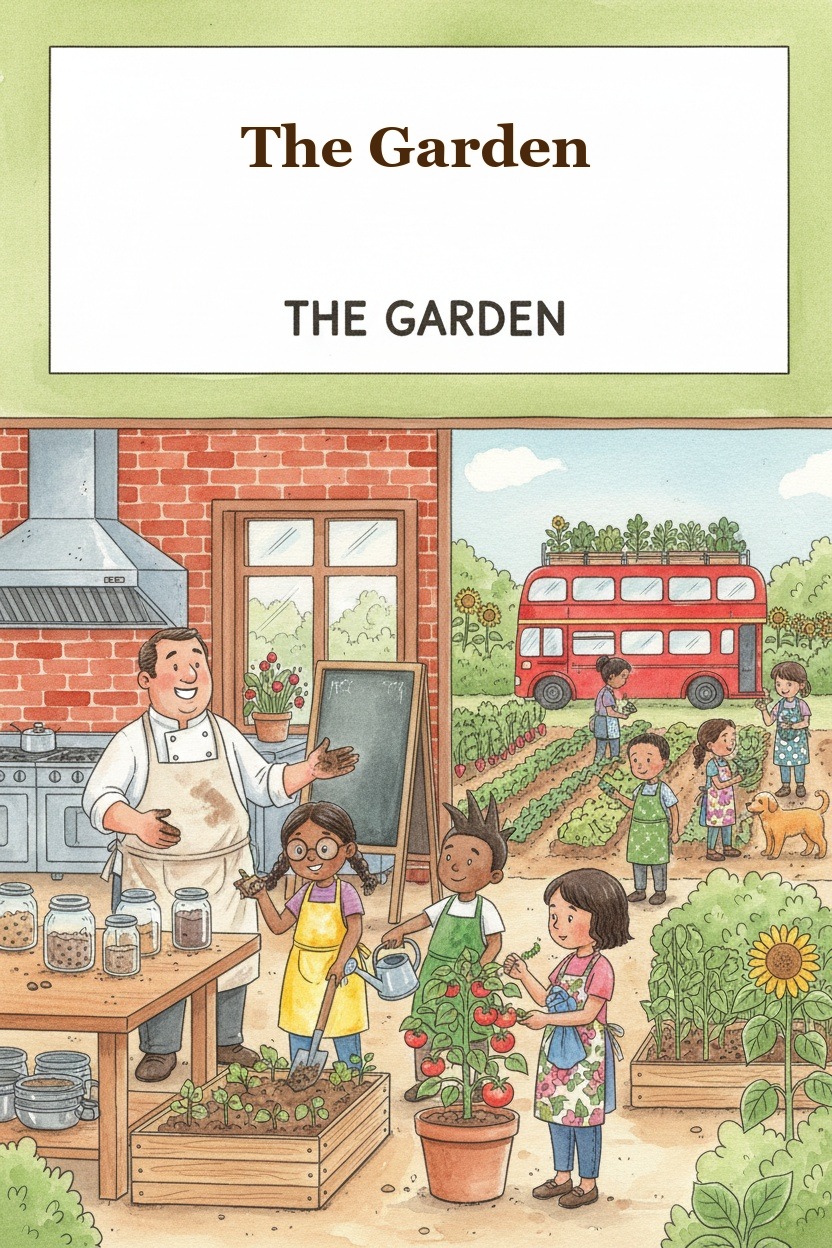
For eleven months, the class had watched the courtyard through the big glass doors of the converted fire station. What had started as a patch of bare dirt bordered by old bricks had become... something. First there were tiny green shoots, then leaves, then more leaves, then flowers, then—finally—actual food.
The kitchen garden had been growing quietly all year. Iggy had planted it in the spring, back when the class was learning about nutrients and food groups. He had watered it during the summer, when the lessons moved to food science and the children learned about fermentation and emulsification and the Maillard reaction. And now, in late autumn, the garden was ready.
"Today," Iggy announced, rubbing his hands together with the energy of a man about to do his favorite thing in the world, "we harvest."
The class pressed against the glass doors, peering out at the courtyard. The garden had become a jungle of green and red and orange.
"It's still there," Tommy said, sounding genuinely surprised. "I thought maybe it would have died by now."
"It's been growing for months," Priya said. "That's what gardens do."
"Exactly," Iggy said. "And today, we get to see what all that growing has produced. But first—" He swept his arm toward the chalkboard, and the Spark Effect claimed its victim: a small wooden spoon clattered off the counter behind him. Sam wrote something in their notebook without looking up. "First, we need to understand what a garden actually is."
Maya raised her hand. "It's where vegetables come from?"
"That's what I used to think," Iggy said. "But a garden is not just where food comes from. A garden is a food system. A tiny, self-contained food system that fits in a courtyard. Think about everything you've learned this year. What does food need?"
"Sunlight," Dev said.
"Water," Lucia added.
"Nutrients," Maya said. "From the soil."
"Exactly," Iggy said. "And a garden provides all of those things—but it also provides something else. It completes the cycle. The soil feeds the plant. The plant feeds us. And what do we give back to the soil?"
The class was quiet.
"Compost," Iggy said. "The scraps from our cooking. The leaves that fall. The things we don't eat. The soil gives us food, and we give the soil the remains of that food, and the soil turns it back into nutrients, and the nutrients feed the next generation of plants. It's the most elegant recycling system ever invented. And today, we get to participate in it."
He led them outside, and the class gathered around the garden beds.
The Harvest
The garden was divided into four raised beds, each one bordered by weathered wooden planks. Iggy had built them himself in the spring, back when the class was learning about where vegetables come from. The beds were labeled with small wooden signs that had faded in the sun.
Bed One: TOMATOES. The tomato plants had grown tall and sprawling, their branches heavy with fruit. Some were round and red, some were small and yellow, some were long and orange. They looked like they had been painted by someone who loved color.
Bed Two: HERBS. Basil, parsley, oregano, thyme, mint. The smells hit the class before they even got close.
Bed Three: CHARD. The chard leaves were enormous, their stems bright pink and yellow and white. They looked almost too beautiful to eat.
Bed Four: COURGETTES. The courgette plants had leaves the size of dinner plates, and hidden beneath them were vegetables that ranged from tiny and delicate to enormous and almost comically large.
"This is what the garden has been doing all year," Iggy said. "Every day, while we were inside learning about food science, these plants were doing their own science. They were taking sunlight and water and carbon dioxide and turning them into—what, class?"
"Sugar," Maya said. "Photosynthesis."
"Photosynthesis," Iggy repeated, savoring the word. "The plants are solar-powered sugar factories. They take light and make food. And some of that food they use for themselves—to grow, to make leaves, to make roots. But some of it they store in these—" He gestured at the garden. "In these beautiful packages we call vegetables."
Tommy was already crouching down, examining the tomatoes. "Can I pick one?"
"That's the entire point of today," Iggy said. "But first, let me show you how to pick them properly."
He knelt next to the tomato plants and gently lifted a branch. "A ripe tomato comes off the vine with almost no effort. You don't pull it, you don't yank it. You hold the fruit, you twist it gently, and—" The tomato came away in his hand, perfectly ripe, still warm from the sun. "It lets go when it's ready. The plant has been growing this tomato for weeks. It has been putting sugars and water and nutrients into this fruit. And now it's telling us: I'm done. Take me."
"That's beautiful," Priya said softly.
"It's also practical," Iggy said. "If you have to pull hard, the fruit isn't ready yet. The plant knows. You just have to listen."
The class split into teams. Dev and Sam took the courgettes. Lucia and two other students took the chard. Maya, Priya, and Tommy took the tomatoes and herbs.
For the next hour, the courtyard filled with the sounds of harvesting. There was the soft snap of courgettes being twisted from their stems. There was the rustle of basil being clipped. There was the weight of the harvest basket as it filled with tomatoes, and the smell of fresh herbs rising into the courtyard air.
"The chard is huge," Lucia said, holding up a leaf the size of her face. "Do we eat the whole thing?"
"You eat the leaf," Iggy said. "And you can eat the stem too. Chard is one of those vegetables that gives you everything. The leaves are full of vitamins—vitamin K, vitamin A, vitamin C. And the stems are a different set of nutrients. When you eat a rainbow of colors, you're giving your body a rainbow of micronutrients."
"We learned that in like, the first few books," Tommy said.
"And I'm going to keep teaching it until the last one," Iggy said. "Because it's true, and it bears repeating."
Maya had found the herb bed and was gently cutting basil leaves with a pair of scissors. "Should I cut the whole stem or just the leaves?"
"Just the leaves," Iggy said. "Cutting the whole stem would damage the plant. But taking just the leaves is a haircut—it'll grow back. A garden is generous like that. It gives and gives, as long as you take care of it."
Priya was holding a tomato up to the light. "It's still warm," she said. "From the sun."
"Everything in this garden was made by light," Iggy said. "The heat of the sun, the light of the sun, the energy of the sun. That tomato is basically sunshine with a little bit of soil and water mixed in."
"That's the best thing I've ever heard," Tommy said.
"It's also the most accurate thing I've ever said," Iggy replied.
The Soil and the Compost
With the harvest complete, the class carried the baskets inside and set them on the prep table. The kitchen smelled like basil and tomato leaves and fresh earth.
"Before we cook," Iggy said, "I want to show you something."
He led them to a corner of the courtyard where a black plastic bin stood, half-hidden behind the herb bed. The lid was secured with a bungee cord.
"This," Iggy said, "is our compost bin. Every week for the past year, we've been putting our kitchen scraps in here. The carrot peelings from the risotto lesson. The onion skins from the French onion soup. The tops of the strawberries from the dessert we made in Book 19. Fruit cores, eggshells, coffee grounds—anything that came from a plant, we've been saving."
He unclipped the bungee cord and lifted the lid. The class leaned in, then pulled back at the earthy smell.
"Doesn't smell great," Tommy said.
"That's the smell of decomposition," Iggy said. "That's the smell of tiny microorganisms breaking down our scraps and turning them into something new. Millions of bacteria and fungi have been working in here for a year. They've been eating our food waste and transforming it into—"
He reached in and pulled out a handful of dark, crumbly material. It looked almost like soil, but richer, darker, with a sweet smell beneath the earthiness.
"Compost," Iggy said. "The most valuable substance in any garden. It's not dirt. Dirt is just dead rock and minerals. This is alive. This is full of nutrients that plants can use. This is what the garden has been eating all year."
"Wait," Priya said. "So the garden ate the scraps from our cooking?"
"Exactly," Iggy said. "And the garden grew food from those scraps. And now we're going to eat that food. Do you see the cycle?"
"The scraps fed the plants," Maya said slowly. "The plants grew. We're going to eat the plants. And the parts we don't eat will go back into the compost."
"To feed the next generation of plants," Iggy finished. "It's a circle. Not a line. Food never stops being food. It just changes form."
He put the compost back into the bin and washed his hands at the outdoor spigot.
"This is what gardening teaches you," he said. "Nothing is wasted. Everything is connected. The soil doesn't care where the nutrients come from—it just uses them. And when we take care of the soil, the soil takes care of us."
The Cooking
Back inside, the class stood around the prep table, looking at the harvest. There was a pyramid of tomatoes in three colors. There was a mountain of chard with stems like ribbons of stained glass. There were the courgettes—some small enough to hold in one hand, one enormous one that looked like it had been training for a weightlifting competition. And there were the herbs, tied in bundles, perfuming the whole kitchen.
"This is the entire meal," Iggy said. "Everything on this table, we grew. The tomatoes, the chard, the courgettes, the herbs. And in a few minutes, we're going to turn them into dinner."
"All of them?" Tommy asked. "That's a lot of vegetables."
"Vegetables shrink when you cook them," Iggy said. "Especially chard. A mountain of chard wilts down to almost nothing. That's mostly water cooking off. The flavor stays, but the water goes."
He organized the class into stations.
"Team one: the tomatoes. We're making a simple tomato salad with basil. Maya, you're in charge. The tomatoes need to be washed and cut. Then you'll season them with salt, just a little, and let them sit. Salt draws out the juices—that's osmosis, remember from Book 18?"
"The water moves from where there's more water to where there's less," Maya said.
"Exactly. The salt creates a concentration gradient. The tomatoes release their juices, and those juices combine with the salt and the basil to make a dressing. You don't even need to make a separate dressing—the tomatoes dress themselves."
"Team two: the courgettes. Dev and Lucia. You'll slice them into rounds and sauté them in olive oil with garlic. High heat, don't crowd the pan. You want browning—that's the Maillard reaction, Book 15 and Book 20."
"Team three: the chard. Priya, Tommy, Sam. Separate the stems from the leaves. The stems need more cooking, so they go in the pan first. The leaves go in at the end, and they'll wilt in about two minutes. And Team three, you're also in charge of the herbs—we'll add them at the very end, right before serving."
Iggy moved between the stations, watching, guiding, occasionally reaching out to adjust a hand or a knife grip. The kitchen filled with the sounds of cooking: the sizzle of courgettes hitting hot oil, the hiss of chard stems, the thunk of knives on cutting boards.
"The tomatoes are releasing their juice," Maya reported.
"That's the osmosis working," Iggy said. "Give them five more minutes."
"These courgettes are browning perfectly," Dev said.
"I can smell it," Tommy said.
The kitchen smelled like a garden that had caught fire in the best possible way. Basil and garlic and sautéed vegetables and warm bread—Iggy had made a loaf of simple flatbread earlier that morning, and it was heating in the oven.
When everything was ready, they brought it all to the big wooden table in the center of the kitchen. The tomato salad glistened with its own juices. The courgettes were golden at the edges. The chard was tender and bright, the stems still holding their color. And the flatbread was warm and soft.
"This is the first meal we've cooked entirely from our own garden," Iggy said. "Everything on this table started as a seed in the soil and grew because we took care of it. We watered it. We weeded it. We fed it our compost. And now it's feeding us."
"The tomatoes taste like sunshine," Tommy said.
He had already taken a bite, which was typical, but this time the class heard something different in his voice. A kind of wonder.
"They don't taste like tomatoes from the store," he said. "These taste like—" He paused, searching for the words. "These taste like they were grown. They taste like they came from somewhere."
"That's exactly what they taste like," Iggy said. "Because they did."
Priya was holding a piece of chard between her fingers. "We grew this. From a seed. We put it in the ground and watered it and watched it grow." She bit into it. "It's the most delicious thing I've ever tasted."
"Because you grew it," Iggy said. "That's the secret ingredient in every home garden. You don't taste it, but it's there. The time you spent. The attention. The care. That's in the food too."
The Circle
After lunch, Iggy led the class back to the garden with a bucket of scraps from their cooking. The chard stems, the courgette ends, the tomato skins, the wilted basil leaves.
"Now we close the circle," he said.
The class gathered around the compost bin. Iggy lifted the lid.
"Everything we just ate came from this garden. And the parts we didn't eat are going to go back into this bin. Soon, they'll break down into compost. And next year, we'll mix that compost into the soil. And next year's plants will eat it. And next year's plants will grow bigger and stronger because of what we're putting in today."
"It's a cycle," Maya said.
"It's the most important cycle on Earth," Iggy said. "The food chain, the nutrient cycle, the way life feeds life. It happens everywhere, all the time, but it's easiest to see here, in a garden."
He dumped the scraps into the bin and closed the lid.
"Every seed is a promise," he said. "Every plant is a story. And every meal is a chance to be part of something bigger than yourself."
On the way back inside, the Spark Effect finally claimed its victim: the watering can, which had been sitting on the edge of the garden wall, tipped over and spilled its last few drops onto the brick path.
No one was surprised.
Recipe Card: Garden Tomato Salad
Ingredients:
-
4 ripe garden tomatoes (mixed colors if possible)
-
8-10 fresh basil leaves
-
1/2 teaspoon salt
-
2 tablespoons olive oil
-
1 clove garlic, peeled and very finely minced (optional)
-
Fresh ground black pepper (optional)
Instructions:
-
Wash the tomatoes and pat them dry.
-
Cut out the stem end, then cut the tomatoes into wedges or slices.
-
Place the tomatoes in a bowl.
-
Tear the basil leaves into pieces and add to the tomatoes.
-
Sprinkle with salt and olive oil. Toss gently.
-
Let sit for 10 minutes so the salt can draw out the tomato juices.
-
Taste. Add the minced garlic if you like, and pepper if you want.
-
Serve with bread and a smile.
Chef Iggy's Recipe Note: "The salt is doing science here, not just seasoning. It's drawing out the water in the tomatoes and mixing it with the basil and oil to create a dressing. The longer it sits, the more sauce you get. But don't let it sit too long—the tomatoes start to lose their texture. Ten minutes is the sweet spot. Just like the garden taught us: timing is everything."
Iggy's Kitchen Lab Notes
Dear Class,
Today we completed the circle. We planted seeds in the spring. We tended the garden all year. We fed it our compost and watched it grow. And today, we ate it. The tomatoes and herbs and chard and courgettes started as tiny seeds in dark soil, and they became a meal on our table, and their scraps are already becoming next year's soil.
A garden is the only food system you can hold in two hands. It teaches you patience, because you can't hurry a plant. It teaches you attention, because if you don't water, the plant fades. And it teaches you wonder, because the fact that a seed becomes a plant becomes food is honestly incredible when you think about it.
You don't have to have a big garden to grow food. A pot on a windowsill can grow herbs. A bucket can grow a tomato. Any seed you plant and care for is a promise kept.
Here's my question for you to think about until next time: What would you grow if you had your own garden? And what would you cook with it?
—Chef Spark