The Capy Series 2
Terrified of the Tapir
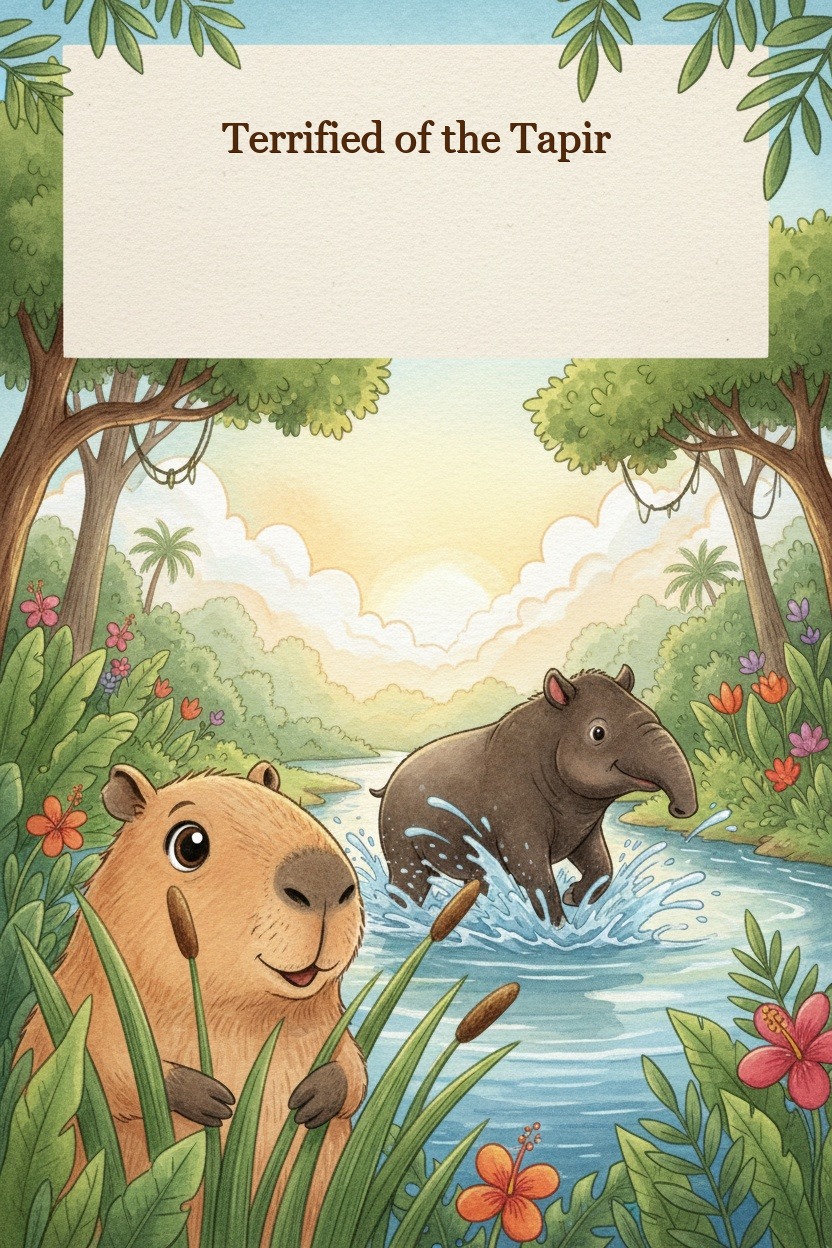
Caper woke up to the sound of splashing. Not gentle splashing, like when Hisss practised his swimming strokes. Not quick splashing, like when Squeaky dropped his latest invention into the water by accident. This was BIG splashing. The kind that meant something heavy was moving through the river.
“Maybe it’s a jaguar?” Caper whispered to himself, pulling his nose back into the water.
He peeked out from behind a curtain of hanging vines. The morning light made everything glow green and gold. And there, at the edge of the mudbank, was the strangest creature Caper had ever seen.
The animal was big—almost as big as Hisss was long. It had a round, plump body covered in short brown hair. Its legs were sturdy, like little tree trunks. And its nose! The nose stretched out into a long, rubbery snout that looked like it might wiggle right off its face if it sneezed too hard.
But what Caper noticed most were the eyes. They were small and dark and looked… scared.
Caper had only met one tapir before—little Lila, at the sloth’s cove—and she had been far too sleepy to be shy. Flora sometimes talked about them when she described faraway places she’d seen during her flights. “They’re like living boulders with personalities,” she’d said once. “And they’re terribly shy.”
This tapir was definitely shy. It stood at the water’s edge, shifting its weight from one foot to another, looking around like it expected something to jump out and yell “BOO!” at any moment.
“Hello there!” Caper called out, trying to sound friendly.
The tapir let out a startled squeak and scrambled backward. Its feet made loud squelching sounds in the mud, and it knocked over a small sapling in its hurry to get away.
“Wait! I didn’t mean to scare you!” Caper shouted.
But the tapir had already disappeared into the thick jungle, leaving only a trail of broken branches and worried-looking footprints in the mud.
“Ooh! Ooh! I saw it! I saw it!” Squeaky chattered, swinging down from a vine and landing on Caper’s back. The little monkey was so excited he couldn’t sit still. “A tapir! An actual real truly genuine tapir! Do you know what those are, Caper? Do you? They’re related to horses and rhinos! Can you believe it? Horses and rhinos! And they have snouts like little elephants! Well, not LITTLE elephants exactly, but you know what I mean!”
“I saw him,” Caper said. “He seemed very nervous.”
“Nervous? Nervous doesn’t even begin to cover it! I was up in the trees watching, and he nearly jumped out of his skin when a fish splashed! A FISH, Caper! What kind of animal is scared of fish?”
“A fish that doesn’t want to be eaten?” Hisss grumbled, sliding up from the river. His massive green coils shimmered in the morning light. “Or maybe a fish that jumps right at your face. I’ve met some rude fish in my time.”
Flora landed on a branch above them, her rainbow tail trailing behind her like a ribbon of light. “The tapir is not scared of fish, you overgrown noodle. They’re just skittish creatures. Very private. Very shy. They prefer to be left alone.”
“Well, he’s got nothing to worry about there,” Hisss said. “I’ve got no interest in meeting anyone who makes that much noise. He sounded like a herd of elephants doing the tango.”
“T-tango?” Caper asked.
“Never mind. It’s an old snake saying.”
Later that day, Caper found Flora perched on her favourite branch, grooming her feathers.
“Flora,” he said, “you know a lot about tapirs, right?”
“Obviously,” Flora said, fluffing her chest feathers. “I know everything about everything. It’s a gift.”
“Can you tell me more about them?”
Flora tilted her head, considering. “Tapirs are forest gardeners, in a way. They eat fruits and seeds, and when they… well, when they go to the bathroom, they spread those seeds all over the jungle. New plants grow where they walk. They’re very important for the health of the rainforest.”
“That’s wonderful!” Caper said. “Maybe we could be friends with him. He seemed so scared, and I thought if we showed him we’re friendly…”
Flora’s feathers drooped slightly. “Caper, dear, I don’t want to dampen your enthusiasm, but tapirs don’t really… make friends. They keep to themselves. It’s just how they are.”
“But everyone needs friends,” Caper said quietly.
Flora looked at him for a long moment, then sighed. “You have a good heart, little capybara. That’s why I put up with you. But don’t be disappointed if the tapir doesn’t want to play.”
The next morning, Caper went looking for the tapir. He followed the trail of broken branches and wide footprints through the jungle, calling out softly, “Hello? Tapir? I just want to talk!”
After a while, he came to a small clearing near the river. And there, in the middle of the clearing, surrounded by neat rows of tiny green plants, was the tapir. It was standing perfectly still, like a statue made of mud and fur.
“Oh! Hi!” Caper said, trying to sound cheerful. “I’m Caper. I’m a capybara. We’re neighbours, sort of. I live just down the river there—”
The tapir took a step backward, trampling one of the little plants.
“No, wait, don’t go!” Caper hurried forward. “I just thought… I thought maybe you’d like to be friends? We could share the river! I know this great spot where the water is warm and the mud is extra squishy and—”
The tapir backed up more, and more, and more. It stepped on another plant. And another. Its eyes were getting wider and wider, and Caper could see its whole body trembling.
“Please don’t be scared of me,” Caper said softly. “I promise I won’t hurt you.”
But it was too late. The tapir let out a loud snort, spun around, and crashed into the jungle, leaving a trail of flattened plants and disturbed soil behind.
Caper sighed and looked down at the ruined garden. He’d tried his best, but he’d only made things worse.
“He’s stomping on the plants! The precious, beautiful, important plants!”
Caper had never seen Flora so upset. She was pacing along the branch, her tail feathers puffed out in distress.
“Stomping?” Squeaky asked. “What do you mean, stomping?”
“I saw it with my own eyes!” Flora said. “This morning, I was flying over the clearing, and there he was—the tapir—stomping all over the sprouts! Deliberately! Crushing them with his big clumsy feet!”
“Maybe he didn’t mean to,” Caper said. “I saw him yesterday, and he was really nervous. I think I scared him and he—”
“Nervous? He wasn’t nervous! He was stomping with PURPOSE, Caper! Each step was very intentional. Step, squash, step, squash!”
Hisss lifted his head from where he was napping. “Sounds like a troublemaker to me. A big, clumsy, troublemaking tapir.”
“I’m sure there’s an explanation,” Caper insisted. “He seemed so gentle. His eyes were so frightened…”
“You know what else has frightened eyes?” Hisss asked. “Criminals caught in the act.”
“Squeaky, what do you think?” Caper asked.
Squeaky was swinging from a vine, hanging upside down. He had that look on his face—the one he got when he was thinking about something really hard.
“Well,” he said slowly, “if the tapir was trying to grow those plants, why would he ruin them? That doesn’t make any sense. Unless…”
“Unless what?” Caper asked.
“Unless he doesn’t know they’re his plants! Maybe he’s just clumsy! Maybe he’s walking around at night and bumping into things and not knowing what he’s doing!”
“That’s ridiculous,” Flora said. “He lives right there. He has to know.”
“Or maybe,” Squeaky said, a new idea dawning on his face, “he’s NOT ruining the plants. Maybe he’s doing something else, and the stomping is just what it looks like from the outside!”
Hisss snorted. “Now you’re just making up stories.”
That night, Caper couldn’t sleep. He kept thinking about the tapir’s scared eyes. He kept thinking about how the animal had trembled when Caper approached. There was nothing mean about that tapir. Caper was sure of it.
When the moon was high and the jungle was full of night sounds—the chirping of insects, the hooting of owls, the distant roar of some hunting cat—Caper slipped away from his sleeping spot and made his way back to the clearing.
He moved slowly and quietly, using the shadows. When he finally reached the edge of the clearing, he stopped and watched.
The tapir was there, standing in the middle of the garden. The moonlight made its brown fur look silver. It was not stomping. It was standing still, its long snout pointed down at the ground.
Then, very gently, the tapir lifted one foot and pressed it down into the soil. It lifted another foot and pressed down. It moved slowly through the garden, pressing its feet into the ground in careful patterns.
Caper watched, confused. What was the tapir doing? It wasn’t stomping. It was… pressing?
One of the tapir’s feet pressed down near a little sprout. And then, to Caper’s amazement, the sprout wriggled. It pushed up, just a little bit, out of the freshly pressed soil.
The tapir moved on, pressing more soil. Pressing. Pressing. Pressing.
Caper must have made a sound, because suddenly the tapir froze. Its head snapped up, and those frightened eyes locked onto Caper’s.
“Please don’t run!” Caper said quickly. “Please. I’m not going to hurt you. I just… I want to understand.”
The tapir stood frozen, like it was deciding whether to flee.
“I saw you,” Caper said. “You’re not stomping on the plants. You’re… you’re helping them, aren’t you? The soil is packed too tight, and you’re loosening it with your feet so the roots can breathe.”
The tapir didn’t move.
“My friend Flora said you were ruining the plants,” Caper continued. “But that’s not true, is it? You’re trying to save them. The Blight—it makes the soil hard and dead, doesn’t it? And you’re trying to break it up so the ground can live again.”
Something changed in the tapir’s eyes. The fear didn’t disappear, but it softened. It looked at Caper like no one had ever looked at him before.
The tapir took a slow step toward Caper. Then another. It was still trembling, but it was moving forward.
“My name is Caper,” Caper said softly. “I’m a Capy-bar-ian. We protect the Great Waterways. And I think you’re trying to do the same thing.”
The tapir stopped right in front of Caper. Its long snout twitched, and then it leaned forward and gently touched Caper’s nose with its own.
“My name is Tito,” the tapir whispered. His voice was as soft as silk. “And I’m so, so scared.”
“I’m not supposed to be brave,” Tito said, sitting down in the soft mud with a wet plop. “Tapirs are supposed to be quiet and hidden. We’re supposed to stay out of sight. That’s how we survive.”
“But you’re fighting the Blight,” Caper said. “That’s the bravest thing I know.”
Tito shook his head. “I’m not fighting anything. I’m just… I’m just pressing the soil. When the Blight spreads, it hardens the earth. The roots can’t breathe. The water can’t flow. Everything gets sad and grey. So I press the soil with my feet. I loosen it up. I let the air in. I let the water in. And the plants come back.”
“That’s amazing,” Caper said. “That’s really, truly amazing.”
“It’s not amazing,” Tito said miserably. “It’s clumsy. I’m too big and too heavy. I can’t help without breaking things. I try to be careful, but I always, always mess up. The other animals think I’m a monster. They see me stomping around, and I try to explain, but I get scared and I can’t say the words, so I just… I just run away.”
Tito’s eyes filled with tears. “I thought if I stayed quiet and didn’t bother anyone, everything would be okay. But now the Blight is here, and the plants are dying, and I’m making it worse, and I don’t know what to do.”
Caper sat down next to Tito and pressed his warm, furry shoulder against the tapir’s side. “You’re not making it worse,” he said. “You’re making it better. And you don’t have to do it alone anymore.”
“But I’m scared,” Tito said. “I’m scared all the time. I’m scared of the dark and of the light and of big animals and small animals and—”
“I’m scared too,” Caper interrupted. “I’m scared all the time. But being scared doesn’t stop me from doing what’s right. It just means I hold my friends’ paws when I do it.”
Tito looked at Caper with those big, frightened eyes. “Your friends… would they want to be my friends? Even after I stomped on their garden?”
“Well,” Caper said, “Flora might need a little convincing. And Hisss grumbles a lot, but he’s a big softie. And Squeaky will probably ask you a thousand questions about being related to rhinos. But yes. I think they’ll want to be your friends. Because you’re important, Tito. The rainforest needs you.”
Tito sniffled. “I—I don’t know what to say.”
“You don’t have to say anything,” Caper said. “Just keep pressing the soil. I’ll help you explain to the others.”
The next morning, Caper gathered his friends in the clearing. The sun was warm, and the little plants were standing tall and proud in the freshly pressed soil.
“Everyone,” Caper announced, “this is Tito. He’s a tapir, and he’s been here for weeks, working hard to fight the Blight from the ground up. He’s not stomping on the plants. He’s aerating the soil so the roots can breathe. Without him, these plants would be dead already.”
Flora looked at the healthy green sprouts. Then she looked at Tito, who was trying very hard to make himself look small.
“I… I may have misjudged you,” Flora said, her feathers ruffling with embarrassment. “I saw your feet, but I didn’t see your heart. I’m sorry.”
“It’s okay,” Tito whispered. “I’m used to it.”
“Well, you shouldn’t be,” Hisss said, surprising everyone. He slithered over to Tito and looked up at him with his golden eyes. “You must be strong to press all that soil. Stronger than you look.”
Tito blinked. “I… I guess?”
“That’s the first compliment I’ve given all month,” Hisss said. “Don’t waste it.”
Squeaky bounced up and down. “Ooh! Ooh! Can I see your nose? Can I touch it? Does it move? Can you pick things up with it? How much can you lift? Can you—”
“Give him some space!” Caper laughed. “He’s still shy.”
Tito smiled—a small, wobbly smile. “It’s okay. I like questions. They mean people are paying attention to me in a good way.”
“Let’s show you around,” Caper said. “There’s a spot in the river where the water is warm, and the mud is extra squishy. It’s my favourite place to think.”
“The mud is good for pressing,” Tito said thoughtfully. “Mud carries seeds. Mud carries life.”
“Exactly!” Caper said. “You understand.”
And as the sun rose higher over the Amazon, the Capy-bar-ians walked together toward the river—a capybara, a squirrel monkey, an anaconda, a quetzal, and a very scared tapir who was learning that bravery didn’t mean not being afraid. It meant pressing forward anyway.
The Blight was still out there. There was still so much work to do.
But for the first time in a long time, Tito didn’t feel so alone.
The End.