Inside Out Academy
THE DEFENDERS
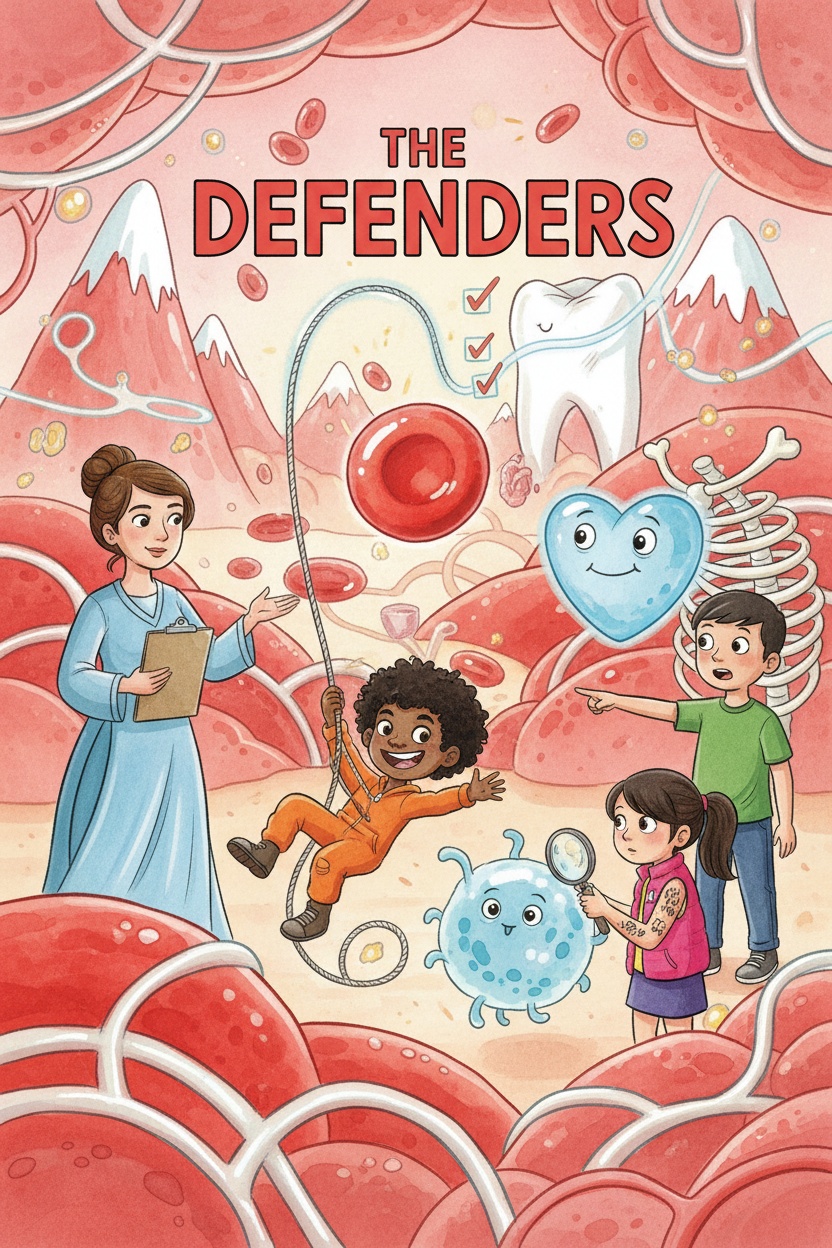
Ms. Vance's Current Checklist:
-
Location: The outer layer of Mr. Gomez's left index finger
-
Status: The class has been detected by the immune system (Book 33 incident)
-
Current count: All 22 students + Ms. Vance accounted for. Leo is holding still. This is suspicious.
-
Emergency plan: Learn everything about the immune system before it learns everything about us
Part One: The Squeaky-Clean Surface
Mr. Gomez had washed his hands three times that morning. Ms. Vance had requested this, politely, through the walkie-talkie, the way she requested most things: as if she were managing a very small military operation. Mr. Gomez had complied without asking questions. He was good at that.
"Everyone stay close," Ms. Vance said, leading the class across the ridged landscape of skin cells. "We're looking for a safe place to observe from."
The skin was not flat. It was a rolling terrain of overlapping squamous cells, each one slightly raised at the edges, and traveling across it felt like walking through an endless field of very shallow, very pale hills.
"Where are we exactly?" Marcus asked, pulling out his notebook.
"Left index finger," Sadie said, consulting her own notes (written on the back of her hand in permanent marker, because she had run out of paper in Book 31). "Fingertip area. Mr. Gomez, can you tell us what you're doing right now?"
The walkie-talkie crackled. "I'm making toast," Mr. Gomez's voice came through. "Should I be concerned about that?"
"Only if you have any small cuts on your fingers," Sadie said.
A pause. "I might have one," Mr. Gomez said. "I was slicing a bagel this morning. Paper towel caught me."
"A paper cut," Sadie translated. "On your finger. That's—"
She stopped. Everyone stopped.
Because approximately thirty feet ahead of them, a battleground had just opened.
Part Two: The Front Line
The cut was small. To Mr. Gomez, it was a line of red the size of a pencil mark. To the class, it was a canyon—a long, narrow fissure cutting through the skin layers, opening into the body's interior.
And something had already come through.
"The bacterium," Sadie said, her voice going into her sports-announcer-crisis-mode. "A single bacterium entered the cut during breakfast. It has penetrated the epidermis and is heading toward the dermis—"
"I can see it," Leo said, all business for once. He pointed toward the canyon's edge.
The bacterium was definitely visible. It was enormous—as big as a school bus, if school buses were covered in what looked like armor plating. It moved with a rippling motion, pushing forward through the tissue, and it was making a sound that the class could only describe later as a sort of wet, squirming rumble.
"It's a staphylococcus," Sadie said, squinting. "I can tell from the shape. Round clusters. That's the grape-cluster bacteria."
"Get closer," Leo said, already moving toward the canyon.
"No," said Ms. Vance, Fatima, Marcus, and Sadie simultaneously.
But they didn't need to get closer. Because something else had already arrived.
It was fast. That was the first thing they noticed. It was moving with a sureness that suggested it had been tracking the bacterium long before it entered the cut. It came in through a capillary wall—the class could see the vessel behind it—and landed on the tissue between the bacterium and the body's deeper layers.
The neutrophil.
"Okay," Sadie said, adjusting her imaginary microphone (she was doing this, and no one was going to stop her). "Here we go. This is the moment. Ladies and gentlemen, white blood cell versus intruder, and let me tell you, this neutrophil has been LOOKING for this."
The neutrophil was bigger than the bacterium. It had a shape that seemed almost random—a lumpy, multilooped ball of membrane—and it was moving by extending itself forward, flowing into new shapes as it went.
"Amoeboid motion," Marcus said, scribbling in his notebook. "It's chasing it."
"It's not chasing," Sadie said. "It's hunting. The neutrophil can sense the bacterium. It's following chemical signals—proteins and other molecules released by the injury and by the bacteria themselves. That's called chemotaxis. And now—"
The neutrophil reached the bacterium.
"—it's engulfing it."
Part Three: The Engulf And The Destroyed
What happened next was the most dramatic thing the class had ever witnessed, and Marcus would later say—emphatically—that it was better than the time in Book 13 when Leo got swept into the left ventricle.
The neutrophil threw itself at the bacterium. Not sideways, not carefully. It threw itself. The leading edge of the white blood cell flowed around the bacterium like a wave, wrapping around the invaders' surface on all sides.
"Phagocytosis!" Marcus shouted, unable to contain himself. "The membrane is wrapping around the cell!"
"The bacterium is trying to escape," Sadie announced, and indeed the bacterium was pushing hard against the membrane that was now surrounding it on three sides. "But the neutrophil is NOT letting go. It's extending pseudopods—those are fake feet, class—around the entire organism—"
"Pseudopods," Leo murmured. "Fake feet."
"—and now the membrane has completely closed around it! The bacterium is inside the neutrophil! It's in a phagosome—a bubble of membrane inside the cell—"
"And lysosomes," Ms. Vance added quietly, leaning in. "Notice what's coming next, everyone."
Sadie was bouncing on her heels. "LYSOSOMES. The phagosome is fusing with lysosomes—these are little bags of digestive enzymes—and they are dumping enzymes all over the bacterium. The bacterium is being DISSOLVED. It is being eaten. From the inside out. It is—"
She paused for dramatic effect.
"—neutralized."
A round of applause. The class couldn't help it. The neutrophil, its meal complete, began to move away from the cut site, carrying its consumed enemy inside it.
"Did it just... win?" Marcus asked.
"One battle," Sadie said. "Welcome to the innate immune system."
Part Four: The Memory Keepers
"That was the first line of defense," Ms. Vance said, gathering everyone into a huddle a safe distance from the active cut site. "The neutrophils are the rapid responders. They come in huge numbers, they eat everything suspicious, and they sacrifice themselves doing it. That bacterium will be nothing but powder in a few minutes."
"And they all die?" Fatima asked, quietly.
"Many do," Ms. Vance said. "They make pus. That's what pus is—dead neutrophils, dead bacteria, and cellular debris all mixed together."
"How romantic," Leo said, but he was smiling.
"Now," Ms. Vance said, "the neutrophils were rapid response. But there's a second, even more specialized layer to this." She looked at Sadie. "Would you like to explain?"
Sadie cleared her throat. "So, okay, technically we have two immune systems. The innate—that's the fast, general one, like the neutrophils and macrophages—and the adaptive. The adaptive is slower, but it's specific. It remembers."
"Remembers?" Marcus leaned forward.
"Well," Sadie said, "one of the things I learned watching that little fight is that the immune system is now doing a very specific thing. Some pieces of the bacterium—called antigens—will get absorbed by another kind of white blood cell. A macrophage will eat some, and then it's going to hold up the pieces like a wanted poster."
"For the B cells," Ms. Vance said.
"For the B cells," Sadie agreed. "B cells make antibodies. They're like hand-shaped proteins that fit onto specific antigens. One B cell might make antibodies for this exact bacterium. And when it finds a match—"
"It makes a million copies of itself," Marcus said.
"Two million," Sadie corrected. "At least."
"And then the T cells," Leo said, which surprised everyone because Leo rarely knew anything about immune function, "they're the ones that kill infected cells, right?"
"A group project," Fatima said, and everyone turned to look at her.
"Immune memory," she said. "The B cells that match this bacterium will both fight it now AND stay in the body as memory B cells for years. If Mr. Gomez gets this bacterium again—"
"The immune system remembers," Marcus said, slowly. "It knows the wanted poster. It makes antibodies faster, even before the bacteria can get established."
"That," Ms. Vance said, "is exactly why vaccines work. A vaccine shows the immune system a dead or weakened or just-the-wanted-poster version of the bacterium. No infection, but plenty of memory cells. The body prepares for a war it hopes it never has to fight."
From the walkie-talkie: "My finger's already feeling better," Mr. Gomez reported. "Should I wash the cut again?"
"Yes," Ms. Vance said, "but gently. And please eat more protein. Your white blood cells needed energy for that battle."
"Was it a good battle?" Mr. Gomez asked.
"The best," Sadie said, and the bounce returned to her voice. "We watched a neutrophil engulf a live staphylococcus in real time. There was phagocytosis. There were lysosomes. It was—"
"Amazing," Fatima said, and her voice carried a weight that made everyone stop.
Fatima didn't use words casually. She looked around at the class, and then at the canyon in Mr. Gomez's finger, where the battle had occurred.
"Every single day," she said. "Mr. Gomez fights wars he never knows about."
Mr. Gomez's External Log
Day 4 of the field trip (I've lost count).
Ms. Vance asked me to make toast, which I did, and then she asked me to describe what my finger felt like, which it turned out I couldn't, because there was nothing to feel. It was just a paper cut. I put a band-aid on it and went about my day.
Apparently, inside my finger, there was a naval battle.
The class sounds very excited. Sadie is still talking about something called a neutrophil like it's the greatest thing she's ever seen. Leo asked if I could get sick again so they could watch it happen again. Ms. Vance told him no. I am, for the first time, very grateful for Ms. Vance's one word vocabulary.
The principal called about the "field trip." He has stopped asking for details. He now starts every conversation with "So, about the class."
I've started telling him they're in the library.
My finger is fine. The skin is already beginning to close.
Inside Out Academy students: 110% accounted for.
— Mr. Gomez, Janitor, Westbrook Elementary, currently wondering if he needs to start buying gloves.