Inside Out Academy
THE ARMY WITHIN
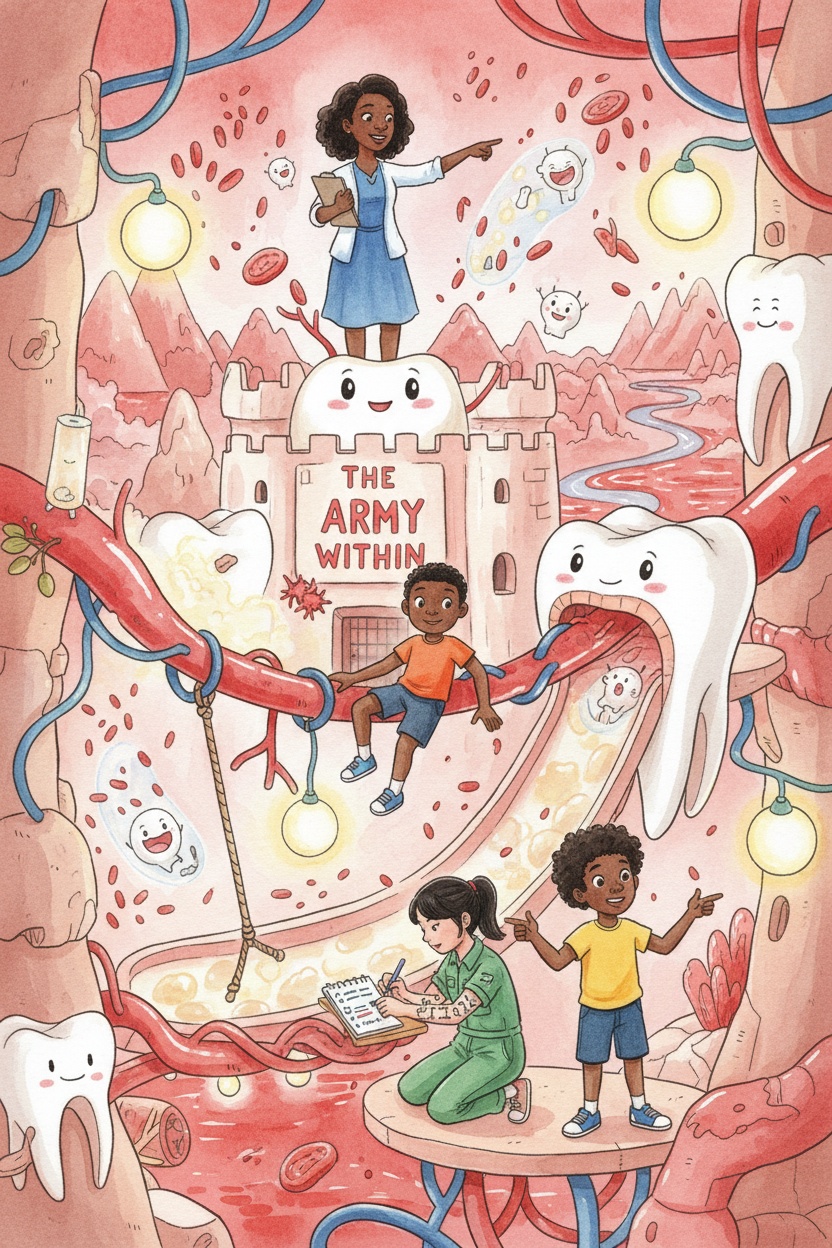
MS. VANCE'S CURRENT CHECKLIST — STATUS: REVISED 14 TIMES
-
Location: Interstitial fluid, near the left elbow (Unknown Territory)
-
Students accounted for: All 22 + Ms. Vance
-
Current Objective: Avoid immune response. Do not be detected. DO NOT BE DETECTED.
-
New Objective (just added): What is that white blob doing here?
Chapter 1: The White Blob Has Opinions
The class was moving through a wide, jelly-like space between layers of Mr. Gomez's forearm tissue. It was quiet here. The lamp cast long shadows through the pinkish gel, and the students walked in single file along what Sadie had called "the safe route" — a path that avoided lymph nodes entirely.
"Stay together," Ms. Vance said, her voice clipped and slightly louder than necessary. "Stay calm. No one—"
"Uh," said Leo. "Ms. Vance?"
"Not now, Leo."
"Really, you're going to want to see this."
The class stopped. Leo was standing at the front of the group, pointing at something ahead. It was round. It was whitish. It was moving toward them.
"What is that?" asked Marcus.
Sadie took one look and went very pale. "Okay, so technically," she said, her voice rapid, "that's a neutrophil. A type of white blood cell. And it's—it's patrolling. It's looking for—"
"For us," said Fatima.
The neutrophil rolled closer, its surface covered in tiny, vibrating bumps. It wasn't fast, but it was relentless, sweeping side to side like a security guard checking every corner of a parking lot.
"Does it know we're here?" asked Marcus.
"It's a phagocyte," Sadie whispered. "It engulfs things. It eats them. It identifies anything that doesn't belong—bacteria, viruses, dead cells—and it—"
"It eats them," Leo repeated. "Great. Love that."
Ms. Vance held up the lamp. The neutrophil paused.
"Don't move," she said.
The neutrophil's surface seemed to ripple, studying them. The class held their breath.
Then the neutrophil turned slightly and rolled past, continuing its patrol.
"That," said Ms. Vance, exhaling, "was too close. Sadie, why did it pass us?"
Sadie's hands were shaking slightly as she pulled out her emergency kit. "Because—I think—we don't have the right surface markers. Or maybe it didn't recognize us as dangerous. But it noticed us. It stopped. It looked."
"And that means?"
"It means we need to understand how the immune system works," Sadie said. "Before it decides we're threats."
Chapter 2: The First Line and the Second
The class set up a temporary camp inside a tiny crevice in the tissue, far from the patrol route. Ms. Vance brought out her checklist and added three new items while Sadie drew diagrams on the back of Marcus's notebook with a borrowed pencil.
"Okay," Sadie said. "So Mr. Gomez has two armies. The first one is quick and general. The second one is slow and specific."
"Two armies," Marcus said. "Name them."
"Innate and adaptive immunity," said Sadie. "The innate system is the first responder. It's not smart, but it's fast. It's always on."
"Like a guard dog," Fatima said.
"Yes. Exactly like a guard dog. It bites everything suspicious. Neutrophils are part of it. They're the first to arrive. They don't know exactly what they're fighting, but they know what's 'self' and what's 'non-self.'"
"And us?" asked Ms. Vance.
Sadie hesitated. "We're non-self. Sort of. We're alive, but we're not Mr. Gomez's cells. So the immune system has to decide whether we're a threat."
Leo raised his hand. "So what's the second army?"
"The adaptive system," Sadie said. "It's slower, but it's precise. It has memory. It sends out T cells and B cells. B cells make antibodies—little Y-shaped proteins that lock onto specific things called antigens."
"We have antigens," Ms. Vance said quietly.
"Right. Antigens are markers on the surface of every cell. If the immune system recognizes an antigen as foreign, it attacks it specifically. That's how vaccines work—they teach the immune system to recognize a specific antigen before the real threat arrives."
"So if we trigger an immune response," Marcus said, "we get a specific antibody response. And then—"
"And then it remembers us," Fatima said. "Forever."
The class was quiet.
A distant sound echoed through the tissue — a low, pulsing hum.
"What's that?" asked Leo.
Sadie's face went white. "That's—that's the sound of inflammation. Something's happening."
Chapter 3: The Alarm System
The floor beneath them began to shake. Not violently, but steadily, as if the entire tissue was swelling.
"Mr. Gomez just cut his hand!" came the voice of Mr. Gomez through the walkie-talkie, faint but clear. "Just a small one. I was opening a can of—anyway, it's nothing."
"It's not nothing," Sadie said, grabbing the walkie-talkie. "Mr. Gomez, the cut is close to us. Your immune system is about to respond—full alert."
"Uh, should I get a Band-Aid?"
"That won't help us."
The shaking intensified. From beyond the crevice, the class could see lights—flashing, pulsing signals in the tissue. The body was sending messages: Danger. Damage. Respond.
"This is what inflammation looks like from the inside," Sadie said, her voice quick. "Mast cells in the tissue release histamine. That makes blood vessels widen—vasodilation—so more blood flows to the area. That brings more white blood cells. That's why inflammation gets red, hot, swollen, and painful from the outside."
"So it's an alarm system," Fatima said.
"Yes. And it's ringing right now."
Through the widened blood vessels, the class could see them coming—neutrophils, hundreds of them, pouring out of the vessels and streaming toward the site of the cut. It was like watching an army of tiny white soldiers pour over the hills of the tissue, racing toward battle.
"They're heading for the cut," Leo said. "But the cut—that's where Mr. Gomez's skin is broken. That's where bacteria might get in."
"Right," Sadie said. "They're responding to the alarm. That's the innate system. Fast, blunt, effective."
"And they're not looking at us?"
"Not right now. They're focused on the cut. But when they've finished—when the bacteria are gone—they'll go back to patrolling. And they'll remember this area showed signs of strange activity."
Ms. Vance tapped her checklist. "So we have a window. Tell me more about what the adaptive system does."
"After the innate system responds," Sadie said, "specialized cells called macrophages—the 'big eaters'—come in. They don't just eat bacteria. They take pieces of the bacteria and display them, like showing a wanted poster. They show those pieces to T cells and B cells."
"So the immune system learns," Marcus said.
"Exactly. That's adaptive immunity. When a B cell finds a piece it recognizes, it starts making antibodies—millions of them, customized to lock onto that specific antigen. And once it learns, it never forgets."
Fatima spoke quietly: "So if we leave now, it won't learn us."
"Correct," Sadie said. "But if we stay, eventually a macrophage will show a piece of us to a T cell. And then—"
"Then we're in the army's database," Ms. Vance finished.
Chapter 4: Invisible
They had to move faster. The class packed up camp and began their journey toward the skin surface, where they had a plan for escape — but they had to get there without being identified.
"How do we not get identified?" Marcus asked. "We're not Mr. Gomez's cells. We have different antigens."
"We have to hide our antigens," Sadie said. "Or cover them. Or—"
"Or what?" Leo asked.
Sadie stopped walking. She looked at Leo. "Or we need to look like something the immune system doesn't recognize as living."
"What's the strangest thought you've had all week?" Leo said. "Because this is mine."
"Complement," Fatima said.
Everyone looked at her.
"The complement system," she said. "It's a group of proteins that float in the blood and tissue. They don't need antibodies. They just sit there, waiting. And when they find a foreign cell without the right markers, they—"
"Punch a hole in it," Sadie said. "Yes. The complement system forms protein rings that poke holes in the cell membrane. The cell bursts."
"Okay," Leo said. "I don't like that."
"Neither do the cells."
Ms. Vance was looking at her checklist, then at the class, then at her checklist again. "We need a way to move that the immune system doesn't see as movement. We need to travel through the body without looking like we're traveling."
"We could stick to the walls," Marcus suggested.
"The immune system patrols the walls."
"We could move only when the heartbeat is loudest," Leo said.
"The immune system doesn't take breaks."
Fatima was quiet for a long moment. "What if we don't move at all?"
The class turned to her.
"What do you mean?" Sadie asked.
"We're small," Fatima said. "We're in Mr. Gomez's tissue. The immune system ignores cells that are alive and normal. If we stop moving, stop making noise, stop doing anything that looks like a foreign organism—"
"We become invisible," Leo said slowly.
"Not invisible," Fatima said. "Just... unremarkable. Like a plant in a forest."
Ms. Vance smiled. "Fatima is right. The immune system is looking for threats. If we don't act like a threat, we won't be detected. But we still have to get to the surface."
"We'll move slowly," Fatima said. "One step at a time. When a white blood cell passes, we stay perfectly still. When the tissue is clear, we move again. We don't run. We don't jump. We become part of the scenery."
Leo sighed dramatically. "So I can't touch anything?"
"Definitely not."
The class made their way forward, step by step, pausing every time a white cell passed. Leo was remarkably disciplined, moving slowly, standing still, not touching anything.
For a long time, it worked.
And then, from beyond the tissue, the walkie-talkie crackled.
"Uh," came Mr. Gomez's voice. "You might want to speed up. I'm about to sneeze."
"A sneeze?" repeated Marcus.
"A sneeze creates a massive air pressure event in the lungs," Sadie said, grabbing her kit. "It's a force wave that travels through the body. If we're not braced—"
The world turned white as the tissue convulsed.
Final Chapter: The Quiet Way
When the wave passed, the class was still there. They had clung to a collagen fiber, holding on until the sneeze settled. Mr. Gomez had apologized seven times through the walkie-talkie.
"It's okay," Ms. Vance said, dusting herself off. "We're okay. We're still invisible."
A neutrophil appeared at the edge of the crevice.
Everyone froze.
The neutrophil hovered beside them. It was close enough that the class could see the details of its surface — the tiny proteins scanning, testing, tasting the area.
A vein in the tissue pulsed.
The neutron passed, continuing its patrol.
"Keep moving," Fatima whispered. "Slowly."
They reached the skin layers an hour later. The exit route was visible—a small gap between the layers of the epidermis, through which they could reach the surface.
Nobody spoke. The class filed through the gap, one by one, like mice slipping through a crack in a wall.
Leo was the last one. He paused at the edge, looking back at the tissue.
"Innate," he said quietly. "Adaptive. Neutrophils. Macrophages. Antibodies. Antigens. Complement. Inflammation."
"That's right," Sadie said.
"That's a lot of guards."
"Twenty-four hours a day," Sadie said. "From birth to death."
Leo nodded, then turned away from the tissue and followed the class into the light of the skin surface.
Behind them, the macrophage that had been following the entire time stopped at the edge of the tissue, tasted the air, found nothing strange, and turned away.
MR. GOMEZ'S EXTERNAL LOG — DAY 7, LATE AFTERNOON
I sneezed. It was not a nice sneeze. The class was apparently inside my left arm at the time and they were not happy with me. They asked me to be careful about opening cans. The principal called again about my sick leave and I told her I was having a "deep systemic issue" which is not a lie. I think I felt something brush past my skin near the wrist about an hour ago. The kids are out now. I have never been so glad to get a chance to scratch my own nose. My knee is doing that thing again.
—Mr. G.