Inside Out Academy
THE PRESSURE
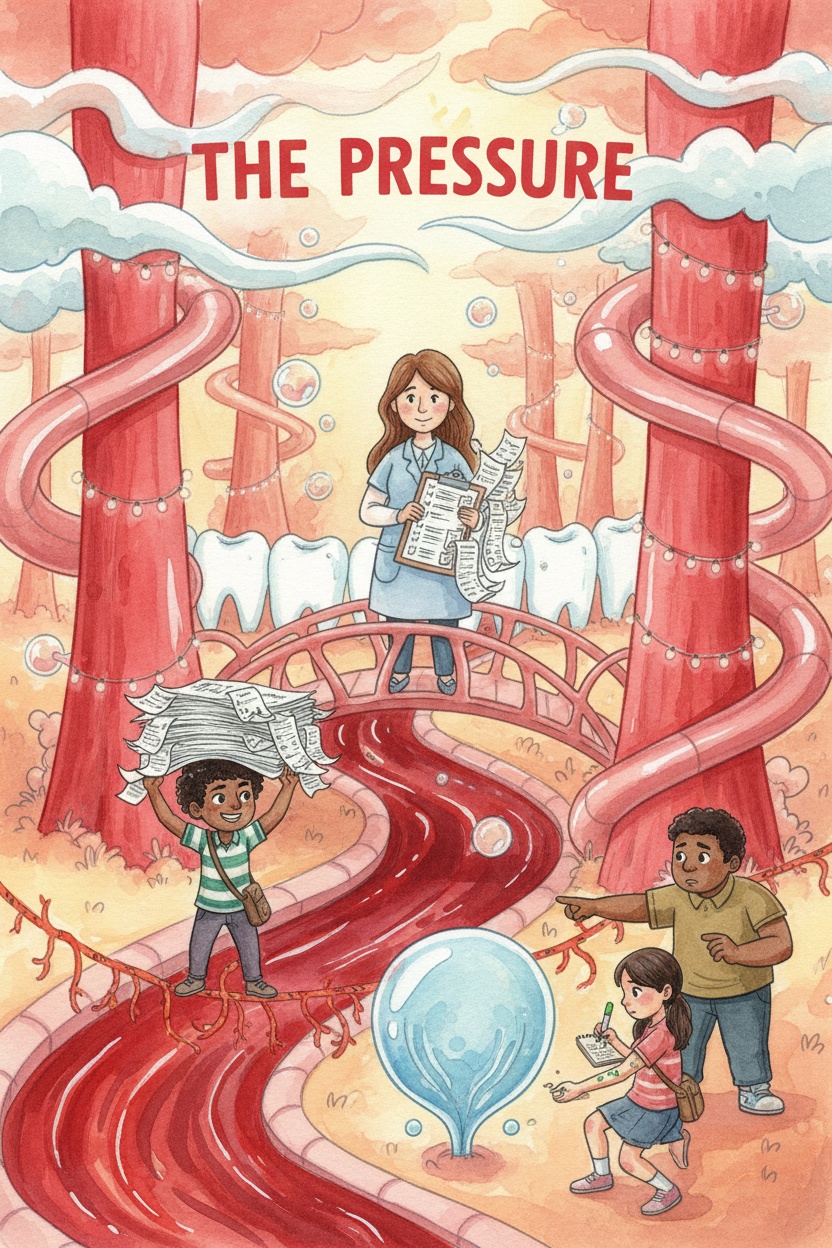
MS. VANCE'S CURRENT CHECKLIST STATUS:
-
Location: Inside Mr. Gomez's circulatory system, approximately 2 cm from the brachial artery of his left arm
-
Date: Day 6 of the field trip (unofficially extended)
-
Students accounted for: All 22 (Leo is currently being retrieved from a capillary)
-
New item added: "Locate pressure point and proceed with caution"
-
New item added: "Remind Leo he cannot fit through a capillary"
-
New item added: "Remind Leo that 'fitting' is not the same as 'trying'"
SECTION 1: THE RIVER GETS FASTER
The class was resting on the inner wall of a medium-sized artery, which Sadie had explained was "a perfectly reasonable place to stop, as long as nobody does anything stupid."
This was, of course, a direct invitation to Leo.
"I think I can fit through that capillary," he said, pointing at a branching vessel that was, from their perspective, approximately the width of two school buses.
"Leo," said Fatima, without looking up from her map, "you are the size of a red blood cell."
"Exactly," said Leo. "Red blood cells fit through capillaries. That's their whole thing."
"Red blood cells are flexible," said Sadie, who was organizing her medical kit with the intensity of someone preparing for surgery. "They can deform and squeeze through openings smaller than their diameter. You are not flexible. You are a fifth-grader. The two are not the same."
"I'm pretty flexible—"
"Leo," said Ms. Vance, in the tone she used when she had reached the end of a conversation, "come back here."
Leo came back. He always came back when Ms. Vance used that tone. It was the same tone she used when she said "Leo, put down the Bunsen burner" and "Leo, you cannot dissect the frog that is still alive" and "Leo, that is the principal, not a field trip opportunity."
"Thank you," said Ms. Vance. She consulted her clipboard. "Now, before we continue, let's review our situation. We have successfully mapped the complete circulatory route. We have survived the heart—twice. We have learned about the structure of blood vessels and the nature of blood itself. Today, we are going to learn about something that affects every single one of these vessels."
Sadie raised her hand. She was already vibrating slightly. "Are we going to talk about blood pressure?"
"Yes, Sadie, we are."
"Because Mr. Gomez's doctor told him to watch it."
"That's correct."
"Because his family has a history of high blood pressure."
"That is also correct."
"Okay," said Sadie, taking a deep breath. "Okay, good. That's fine. I have a great deal to say about this."
"I assumed you would," said Ms. Vance.
SECTION 2: THE WALLS ARE STILL AND THE RIVER MOVES
Ms. Vance gathered everyone into a loose semicircle on the vessel wall. The surface beneath them was smooth and slightly yielding, like standing on a very firm waterbed. Above them, the river of blood rushed past—red cells streaming by like traffic on a highway, each one moving at a speed that was, as Marcus had calculated, "really quite fast if you think about it."
"Okay," said Ms. Vance. "Sadie, I believe you have information."
Sadie stood up. She had prepared notes. She had prepared three pages of notes, which she had clipped to a piece of cardboard from her emergency energy bar wrapper to keep them from fluttering in the blood current.
"Okay," she said. "So technically, blood pressure is the force that blood exerts against the walls of your blood vessels. It's measured in millimeters of mercury, which is a weird way to measure something but it's because the original blood pressure machines used a column of mercury to measure the pressure."
"Like a barometer," said Marcus.
"Like a barometer, yes, Marcus, very good, thank you," said Sadie, who was slightly annoyed that Marcus had stolen her barometer analogy. "And when the doctor measures your blood pressure, they get two numbers. The first number is the systolic pressure. That's the pressure when the heart beats—when it squeezes and pushes blood out into the arteries. The second number is the diastolic pressure. That's the pressure when the heart relaxes and refills with blood."
"So there's a high number and a low number," said Fatima.
"Exactly," said Sadie. "High and low, over and over, with every single heartbeat. And the difference between them—the pulse you can feel in your wrist—that's the wave of pressure traveling through your arteries."
"The river pulses," said Fatima softly.
"It does," said Sadie. "It absolutely does."
"Okay," said Leo, who had been uncharacteristically quiet. "But like, what does that have to do with us? What does that have to do with Mr. Gomez?"
Sadie opened her mouth. Closed it. Opened it again.
"Right now," she said slowly, "the pressure in this artery is normal. Mr. Gomez is calm. He's sitting down, probably reading something boring, maybe drinking a glass of water. His heart is beating steadily. The pressure here is—" She paused, tilting her head as if listening. "Can you feel it? The rhythm?"
The class went still. They were learning to feel the body now. The vessel walls around them pulsed gently, rhythmically, like a distant drum.
Thump. Thump. Thump.
"That's the systole," said Sadie. "That's the diastolic. And in between—that's Mr. Gomez, just living his life."
"I like that," said Marcus. "The pulse is a heartbeat you can feel from the outside."
"From the inside, too," said Sadie.
SECTION 3: THE PHONE CALL
The sound came through Mr. Gomez's earpiece—the small walkie-talkie that Ms. Vance carried. It was set to transmit from outside, so the class could hear Mr. Gomez's voice. But the earpiece could also pick up sounds from Mr. Gomez's world, transmitted through the tiny speaker.
What they heard was: brrrring.
A phone. The class had heard phones before. But this was different. This was Mr. Gomez's phone, and Mr. Gomez was answering it.
"Hello?" His voice came through the earpiece, slightly muffled, but clear enough.
"Mr. Gomez," said a voice on the other end. "This is Principal Hendricks."
The class felt it before they understood it. The vessel wall beneath them—which had been pulsing gently, reliably, drowsily—suddenly tightened. The change was immediate and unmistakable. The walls of the artery became firmer, more rigid. And the blood—the river of blood rushing past them—got faster.
"Whoa," said Leo.
"Everybody hold on," said Ms. Vance, grabbing a fold of the vessel wall.
"What's happening?" asked Fatima.
Sadie's eyes were wide. Her voice came out in a rapid, breathless stream:
"Mr. Gomez is stressed. He just got a call from the principal. He's worried. His body is releasing stress hormones—adrenaline and cortisol—and those hormones are telling his heart to beat faster, and they're telling the muscles in his blood vessel walls to contract, and—"
"English, Sadie," said Marcus, gripping the wall as the surge of blood swept past them.
"The blood pressure has gone UP," said Sadie. "The arteries are constricting. The heart is pumping harder. The pressure in this vessel has increased significantly. This is what blood pressure looks like when it goes up."
The class held on as the river surged. Above them, the rush of red blood cells had become a torrent. The vessel walls were tight now, the smooth surface more rigid, like a hose that had been squeezed.
"Is this dangerous?" asked Fatima.
"For you, yes," said Sadie, "because you're standing on the wall. For Mr. Gomez? It depends. A short-term increase in blood pressure is normal. It's what the body does in response to stress. It prepares you to fight or escape. It's the 'fight or flight' response."
"I've heard of that," said Leo.
"Everybody's heard of it," said Sadie. "But here's the problem. If Mr. Gomez's blood pressure stays high for a long time—because he's under stress all the time, or because his body doesn't properly regulate it—then the pressure does damage. It wears down the vessel walls. It makes them stiff. It makes it harder for the heart to pump blood, which makes the heart work harder, which makes it get bigger and weaker, and—"
"Okay," said Ms. Vance, who was still gripping the vessel wall. "Sadie, that is an excellent explanation. Now can you tell us how we get back to a calmer pressure?"
Sadie took a deep breath.
"The principal is still talking," she said. "Whatever he's saying is still stressing Mr. Gomez out. We can't change that. But eventually, Mr. Gomez will hang up. And when he does, his body will calm down. The stress hormones will clear. The vessel walls will relax. The pressure will go back to normal."
"Because the body regulates it," said Marcus.
"Yes," said Sadie. "The body has ways of controlling blood pressure. There are sensors in the walls of certain blood vessels—the carotid artery in the neck, the aorta near the heart—that detect changes in pressure. They send signals to the brain, and the brain sends signals back that tell the heart to speed up or slow down and the vessels to constrict or relax."
"It's a feedback loop," said Fatima.
"Exactly," said Sadie. "The body keeps the pressure in a normal range by constantly adjusting it. That's called homeostasis."
"Homeostasis," repeated Marcus. "The body always trying to balance."
"Always," said Sadie. "Every second of every day."
SECTION 4: THE NORMAL PRESSURE
They stayed in the vessel while the phone call continued. It was, as it turned out, a long phone call. Principal Hendricks had a great deal to say about Mr. Gomez's extended sick leave, his "medical accommodation," and the fact that the school budget did not, in fact, include money for a substitute janitor who kept slipping on mysterious puddles in the science lab.
Mr. Gomez listened. He said things like "I understand" and "I appreciate that" and "I am aware of the situation."
And through the earpiece, the class felt something else: Mr. Gomez's heart rate. It was elevated. The pulse in the vessel wall was faster than it had been, and stronger.
"Do you think he's getting angry?" asked Leo.
"It doesn't matter," said Sadie. "Stress is stress. Whether it's fear or anger or worry—the body responds the same way. The pressure rises."
"That seems unfair," said Fatima.
"It is," said Sadie. "But it's also useful. You can't control every stressful situation. But the body's job is to keep you alive through it."
Finally, mercifully, the phone call ended.
"Thank you," said Mr. Gomez. "I'll speak to you on Monday." There was a pause. The earpiece transmitted the sound of him putting the phone down.
And then—slowly, gradually—the class felt the pressure ease.
The vessel walls relaxed. The rush of blood slowed to its normal, steady current. The pulse returned to its comfortable, drowsy rhythm.
Thump. Thump. Thump.
"The body goes back," said Fatima. "It fixes itself."
"Not always," said Sadie quietly. "If the pressure stays high for years—if Mr. Gomez's body doesn't bring it down after stressful moments, if his vessels stay tight and his heart keeps working too hard—then the damage adds up. It's like the blood is always knocking on the vessel walls, and the knocks get harder and harder, and eventually, the walls get damaged. Scar tissue forms. Fat can build up in the damaged areas. The vessels get stiffer. The heart gets tired."
"Sadie," said Ms. Vance.
"I'm just saying," said Sadie. "My mom says high blood pressure is a silent problem. You don't feel it. You don't know it's happening. But it's doing damage the whole time."
The class was quiet. The vessel pulsed around them, steady now, calm.
"So what do we do about it?" asked Leo.
Sadie blinked. "What do we do about it?"
"Yeah. Like, if we're in Mr. Gomez, and Mr. Gomez has to watch his blood pressure—what does he do?"
Sadie considered this. The question was, for her, unexpectedly practical. She was used to describing problems, not solutions.
"He—" She stopped. Started again. "He takes medicine, if the doctor says so. And he eats healthy—less salt, because salt makes the body hold onto water, and more water makes the pressure go up. And he exercises, because exercise makes the heart stronger and the vessels more flexible. And he sleeps. And he tries to manage stress."
"That last part's hard," said Mr. Gomez's voice through the earpiece. He had been listening. "But I'm trying."
"That's all we can ask," said Ms. Vance. "That's all anyone can ask."
SECTION 5: MEASURE THE PRESSURE
Later, the class found a side branch of the artery where the current was calmer, and they set up camp. Ms. Vance got out the last of the emergency food bars and made sure everyone had a portion. Sadie packed away her notes.
"We should measure the pressure," said Marcus suddenly.
Everyone looked at him.
"What?" asked Leo.
"The actual blood pressure. We should measure it." Marcus's face was flushed with excitement. "We have the knowledge. We understand what it is. Now we should measure it."
"How?" asked Fatima.
"We can feel the pulse," said Marcus. "We can feel how strong it is. But that's not a number. We need a number."
Sadie chewed her lip. "We know the approximate diameter of this artery. Mr. Gomez's arm is, what, about thirty-five centimeters in circumference? The brachial artery is about four millimeters in diameter. From our position, we could... we could calculate the wall tension. The force the blood is exerting against the vessel wall."
"We measured that yesterday," said Fatima. "With the rope and the something-or-other." She said "something-or-other" with a note of impatience, because she had in fact been the one to suggest the method, and she remembered exactly what it was called. "The tensiometer."
"Right," said Sadie. "The rope and the tensiometer. It was a good method. If we measure the wall tension now—with Mr. Gomez calm—we can estimate his blood pressure."
Leo scrambled to get the tensiometer, which was, in fact, just a specially knotted rope that they had calibrated against the string of Sadie's backpack. It was crude but effective. They had learned in Book 14 that improvisation was the heart of field science.
The measurement took twenty minutes. Fatima held the rope steady. Leo read the markings. Marcus did the calculations in his notebook. Sadie verified them three times.
"One hundred and ten over seventy," said Marcus finally. "That's the estimate."
"One-ten over seventy," repeated Sadie. "That's normal. That's a healthy blood pressure."
"And during the phone call?" asked Fatima.
Marcus flipped back a page in his notebook. "Estimating from the increased wall tension—I'd say it was probably one-forty over ninety. Maybe higher."
"There's our lesson," said Ms. Vance. She sat down on the vessel wall, crossing her legs, and looked at her students. "Blood pressure goes up with stress. It comes back down when the stress passes. And the numbers matter, because over time, high numbers can cause real harm. But the body is built to manage it. The body keeps the balance. Homeostasis."
"Homeostasis," the class said together.
"The body always trying to balance," added Fatima.
"And we can help it," said Sadie. "By eating well and sleeping and exercising and—" She paused. "And by not worrying so much." She laughed, a little embarrassed. "My mom says high blood pressure runs in our family too. She says it's why she does yoga."
"Yoga," said Leo. "I know yoga. There's a position called the Downward Dog."
"There is," said Ms. Vance. "And it's excellent for managing stress."
CHECKLIST UPDATE (INSERTED BY MS. VANCE)
-
Location: Side branch of brachial artery, left arm
-
Students accounted for: All 22 (Leo is now calculating his own blood pressure using the Marcus Method; Marcus has confirmed the math is sound)
-
Lesson completed: Blood pressure, systolic and diastolic, measurement
-
Lesson completed: The body's regulation of pressure, stress response
-
New item added: "Teach Leo the Downward Dog position"
-
New item added: "Find out what Mr. Gomez's doctor said about his blood pressure"
-
New item added: "Remind Leo that yoga is not an excuse to go into the right ventricle"
-
New item added: "Remind Leo that SOMETHING is always about to go wrong when he says 'Downward Dog'"
MR. GOMEZ'S EXTERNAL LOG
Day 6, Evening
The principal called today. He wanted to talk about my sick leave. I thought I was managing it fine, but my left arm felt a little tight during the call. Tight and a little fast. The tiny people inside me were doing something—I could feel them moving around, like a little crowd shifting in my arm.
Then after the call, I sat down. I had some water. I thought about the ocean, which is what I do when I need to calm down. The ocean is very big and very blue and it doesn't have a principal.
The tightness went away.
I think the little people noticed. I hope they noticed. I hope they know that it goes away.
I ate a baked potato for dinner. No salt. The doctor said no salt.
My knee is fine. My blood pressure is probably fine. My heart is doing what hearts do.
One-ten over seventy, the little people told me through the speaker. I didn't know they had numbers for me. It was a comfort.
Tomorrow, I will tell them about my doctor's appointment. They'll want to know.
Today was a good day. The principal called, but I hung up, and the ocean came back.
END OF BOOK 15
Next: Book 16 — THE BREATHING ROOMS