Professor Plunks Impossible Lab
The Unstoppable Slide
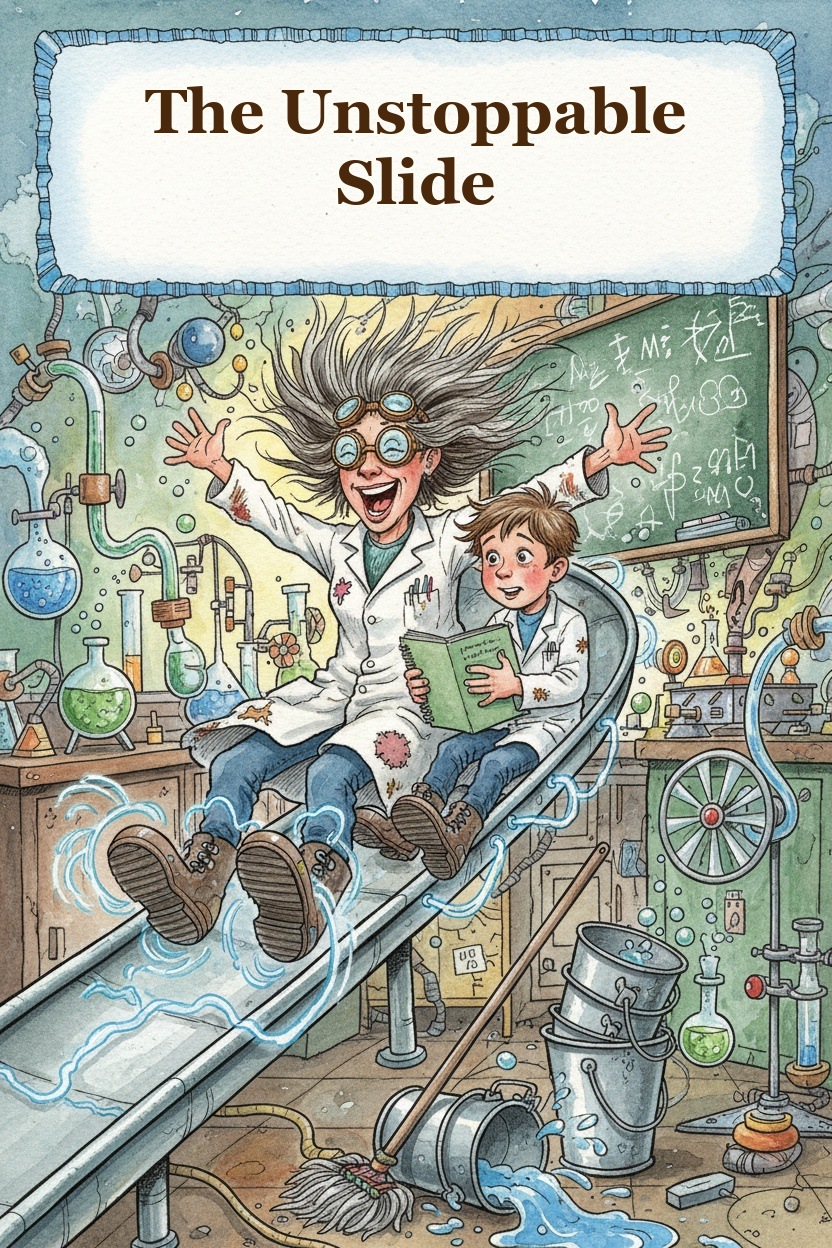
- The Slippery Idea
"Otto! My careful colleague! Prepare yourself for the SLIPPERIEST experiment in scientific history!"
Professor Plunk burst through the lab door with a rolled-up poster under her arm and what appeared to be a frozen smile on her face. Otto looked up from his notebook, where he had been sketching a very detailed diagram of the lab's ceiling tiles.
"Good morning, Professor. What's slippery?"
Plunk unrolled the poster with a dramatic THWACK. It showed a picture of a small wooden block sliding down a ramp, with arrows pointing in every direction. At the top, in enormous letters, it said: FRICTION: THE FORCE THAT SLOWS YOU DOWN.
"Today, Otto, we explore friction! The invisible force that grabs at everything it touches!" Plunk's eyes gleamed. "When you slide across a carpet, friction catches you. When you slide across ice, you glide. And when I demonstrate exactly how much friction matters—" she paused for dramatic effect, "—you will never look at a floor the same way again!"
Otto opened his notebook to a fresh page. He wrote:
Tuesday, 9:15 AM
Professor Plunk announces friction experiment.
She seems very confident.
This worries me.
"What's the experiment exactly?" Otto asked, his pencil hovering over the page.
Plunk spread her arms wide. "We will build the FRICTIONLESS SLIDE!"
Otto wrote:
Experiment: Frictionless Slide.
I do not like the name.
- The Slippery Problem
The "Frictionless Slide" turned out to be a long, silver sheet of metal that Professor Plunk had been polishing for three weeks. It gleamed like a mirror and felt so smooth that Otto's finger practically slid off it by itself.
"This, Otto, is the smoothest surface in the entire city!" Plunk announced. "I call it the SUPER-SLICK 3000!"
Otto touched the surface. It was, indeed, extremely slick.
"But Professor," Otto said, "a slide needs to be slanted. And even a smooth slide still has some friction. That's what stops you at the bottom."
"Exactly!" Plunk beamed. "That's the demonstration! We'll start with the Super-Slick 3000 at a gentle angle, and send different objects down it. We'll measure how far they travel after they leave the slide. Rough objects will stop quickly. Smooth objects will travel further. And the Super-Slick 3000 will show us what happens when friction is very, very low."
Otto considered this. It actually sounded... reasonable.
"Where will the objects land?" he asked.
"On the lab floor, of course!" Plunk gestured to the long corridor outside the lab door. "Plenty of room to measure distances! We'll mark everything with chalk lines."
Otto wrote:
Objects will slide down the metal ramp.
They will travel across the floor.
Friction should slow them down.
I have checked: the corridor is 40 metres long.
This seems like enough space.
It was not enough space.
- The Slippery Parade
Plunk set up the Super-Slick 3000 on a workbench at the top of the corridor. The metal sheet extended from the bench, angled down toward the floor. At the bottom of the slide, the corridor stretched away in a long, straight line.
"First test!" Plunk announced. "A rough wooden block!"
She placed a block of sandpaper-wrapped wood at the top of the slide and gave it a gentle push.
Scritch-scratch-scritch. The block slid down, hit the floor, and stopped almost immediately.
"Excellent!" Plunk marked the spot with chalk. "Thirty centimetres! Friction stops it fast! Now..." she reached into her pocket and pulled out a smooth, polished stone. "A smooth pebble!"
The pebble slid down the ramp, hit the floor, and skittered a good two metres before stopping.
"NINE times further!" Plunk crowed. "The science is working perfectly! Now for the true test of the Super-Slick 3000!" She pulled out a gleaming metal ball bearing. "This, Otto, is the smoothest object in the lab. Watch closely!"
The ball bearing rolled down the ramp, hit the floor with a bright TING, and continued rolling.
And rolling.
And rolling.
It rolled past the chalk mark for the wooden block.
It rolled past the chalk mark for the pebble.
It rolled all the way down the corridor, bounced off the wall at the end with another bright TING, and rolled all the way back to stop at Otto's feet.
Otto stared at it. He wrote:
Ball bearing travelled approximately 40 metres.
Twice.
THIS WAS NOT IN THE PLAN.
Plunk clapped her hands together. "Marvellous! Otto, do you see what this means? The smoother the surface, the less friction, the further things travel! Now—" she pulled out a folded-up piece of paper from her pocket, "—we make it even better!"
The folded paper turned out to be a diagram. It showed the Super-Slick 3000 with some modifications.
"This," Plunk announced, "is the SUPER-SLICK 4000! We'll add MORE metal sheets! A whole path of them! The floor of the corridor, covered in smooth metal, will create a FRICTIONLESS HIGHWAY!"
Otto blinked. "Professor, if we cover the floor with smooth metal, then nothing will stop moving. Objects will just... keep going."
"Yes!" Plunk's eyes lit up. "That's the whole point!"
- The Slippery Truth
Gloriana appeared from the supply closet, carrying a stack of polished metal sheets that looked exactly like the Super-Slick 3000. She did not say anything. She simply helped Plunk arrange them across the entire corridor floor, forming a gleaming silver path from the workbench to the far wall.
Otto wrote:
Corridor floor is now covered in polished metal.
Total friction approximately zero.
I am standing at the side of the corridor.
VERY FAR AWAY FROM THE SLIDE.
Plunk stood at the top of the ramp, holding a selection of objects: a book, her favourite wrench, a tray of lunch that had been sitting on the workbench, and Otto's desk chair (which had wheels).
"We'll send them down one at a time," Plunk announced. "Observe how they interact with the frictionless surface!"
The book went first. It slid down the ramp, hit the metal floor, and sailed down the corridor, coming to rest against the far wall.
The wrench went next. It clattered down the ramp and shot across the floor like a tiny metal torpedo.
The lunch tray was a disaster. It slid down the ramp, spun in a slow circle on the metal floor, and continued sliding for so long that Otto had time to eat a granola bar from his pocket before it stopped.
"Magnificent!" Plunk cried. "Now—" she grabbed the desk chair "—let's see how the SUPER-SLICK 4000 handles something with wheels!"
"Professor," Otto said carefully, "maybe we should stop while we still have—"
But Plunk was already launching herself into the chair. She kicked off from the top of the ramp and went zooming down the corridor, her lab coat streaming behind her like a grey-and-green cape.
"WHEEEEEE!" she shouted, until she hit the far wall and stopped with a gentle thump.
"PERFECT demonstration!" she announced, pushing herself back up the corridor. "The wheels reduce friction even further! Otto! Your turn!"
"No thank you," Otto said, backing away.
"Oh, don't be silly! It's completely—"
But Otto never found out what the ride "completely" was, because at that moment, the wrench—which had been sliding slowly back down the corridor from the far wall—arrived at Plunk's feet. She stepped on it.
In science, this is called a chain reaction.
Plunk's foot shot out from under her. She grabbed for the nearest thing to steady herself, which happened to be the tray of lunch. The tray skidded. The lunch—sandwiches, apples, and a very confused-looking pudding cup—flew into the air and scattered across the metal floor.
Plunk landed on the desk chair, which immediately started rolling.
"OTTO!" she shouted, rolling past him. "This is DEMONSTRATING something unexpected!"
Otto did the only sensible thing. He jumped onto the desk chair with her, because by this point, every single object in the corridor—the book, the wrench, the lunch tray, and now a variety of tools that had been knocked from the workbench—was sliding in every direction on the frictionless metal.
"Hold on, Otto!" Plunk shouted. "We're experiencing the complete ABSENCE of friction!"
"YOU SAID IT WAS ABOUT FRICTION SLOWING THINGS DOWN!" Otto shouted back, gripping the chair's armrests as they spun in a slow circle.
"IT IS! But too LITTLE friction means things DON'T stop! That's the very same lesson!"
They slid past the lab door, where Gloriana stood watching with her arms crossed and a very patient expression on her face. In her hand, she held a mop.
"Having fun?" Gloriana asked. Five words.
"Gloriana! Perfect timing!" Plunk called as she and Otto slid past. "Could you fetch the emergency brake?"
Gloriana said nothing. She reached into her tool belt and pulled out a large, heavy sandbag.
Otto had a moment to think: That's not an emergency brake.
Then Gloriana placed the sandbag directly in the path of the chair.
- The Slippery Discovery
The chair hit the sandbag and stopped so gently that Otto barely felt it. Plunk, however, launched forward, flew over the sandbag, and landed on the metal floor with a smooth, elegant slide that carried her all the way to the far wall.
"WELL!" she announced, sliding to a halt. "That demonstrated friction rather more vividly than I intended!"
Otto climbed off the chair, his legs shaky but his mind working. "Professor," he said, "I think I understand."
"Understand what, my careful colleague?"
"Look." Otto pointed at his notebook, which had fallen on the floor and slid to a stop against the sandbag. "When the book hit the metal floor, it kept going because the metal was so smooth. But when it hit the sandbag, the rough fabric created friction, and it stopped."
"Exactly!" Plunk scrambled to her feet and slid over to Otto. "Friction is the force that opposes motion between surfaces! The smoother the surfaces, the less friction, the easier things slide!"
"And look at the sandbag," Otto said. He touched the fabric. "It's warm."
Plunk's eyes widened with delight. "OF COURSE! When friction slows things down, it converts the energy of motion into heat! All that sliding—" she gestured to the corridor, which was now covered in books, lunch items, tools, and one very confused lab chair, "—generated thermal energy!"
Otto wrote in his notebook:
Friction opposes motion between surfaces.
Smoother surfaces = less friction = more sliding.
Friction converts kinetic energy to heat.
Sandbags are warm.
I am going to suggest we use sandbags at the end of every experiment from now on.
Gloriana walked down the corridor, picking up objects with the same calm expression she always wore. She handed Otto a piece of chalk.
"For your notebook," she said. Four words.
Otto took it. "Thank you, Gloriana."
She nodded once, then picked up the pudding cup, examined it carefully, and put it back on the lunch tray.
Plunk stood in the middle of the corridor, her lab coat covered in a fine layer of chalk dust, and looked around at the mess with an expression of pure joy.
"Do you know what this means, Otto?" she asked.
"That we should invest in more sandbags?"
"That we discovered something beautiful! Friction protects us! It stops our slides, it warms our hands, it helps us walk without slipping!" She picked up the smooth wooden block from earlier and ran it along the wall. It moved easily. Then she picked up the sandpaper-wrapped block and ran it along the wall. It stopped with a scratch.
"Rough surfaces create more friction," Plunk said. "Smooth surfaces create less. Either way, friction is what makes the world work. Without it, nothing could ever stop moving!"
Otto thought about this. "So friction is like... a brake for the world?"
"Exactly!" Plunk beamed. "The whole world has brakes! And today, we discovered exactly how important they are!"
Otto looked at his notebook. He looked at the corridor, which Gloriana was sweeping with sweeping calmness. He looked at the warm sandbag, still sitting where it had stopped them.
He wrote:
Friction is a force that opposes motion.
It turns movement into heat.
It stops things from sliding forever.
Without friction, lunch = everywhere.
THE EXPERIMENT WAS NOT IN THE PLAN.
BUT THE DISCOVERY WAS PERFECT.
"Professor?" Otto said.
"Yes, Otto?"
"Can we do this experiment again tomorrow?"
Plunk's face lit up brighter than the polished metal floor. "Otto! My careful colleague! I thought you'd never ask!"
Gloriana paused her sweeping. She looked at Otto, then at Plunk, then at the sandbag.
"More sandbags," she said. Three words.
Otto wrote them in his notebook under FUTURE SAFETY NOTES.
And somewhere in the corridor, very faintly, the last few marbles from a jar on the workbench were still rolling, rolling, rolling, demonstrating friction's opposite with every tiny revolution.
THE END
Next: Book 4 — The Push and the Pull