Just Like Me
What I Wish You Knew
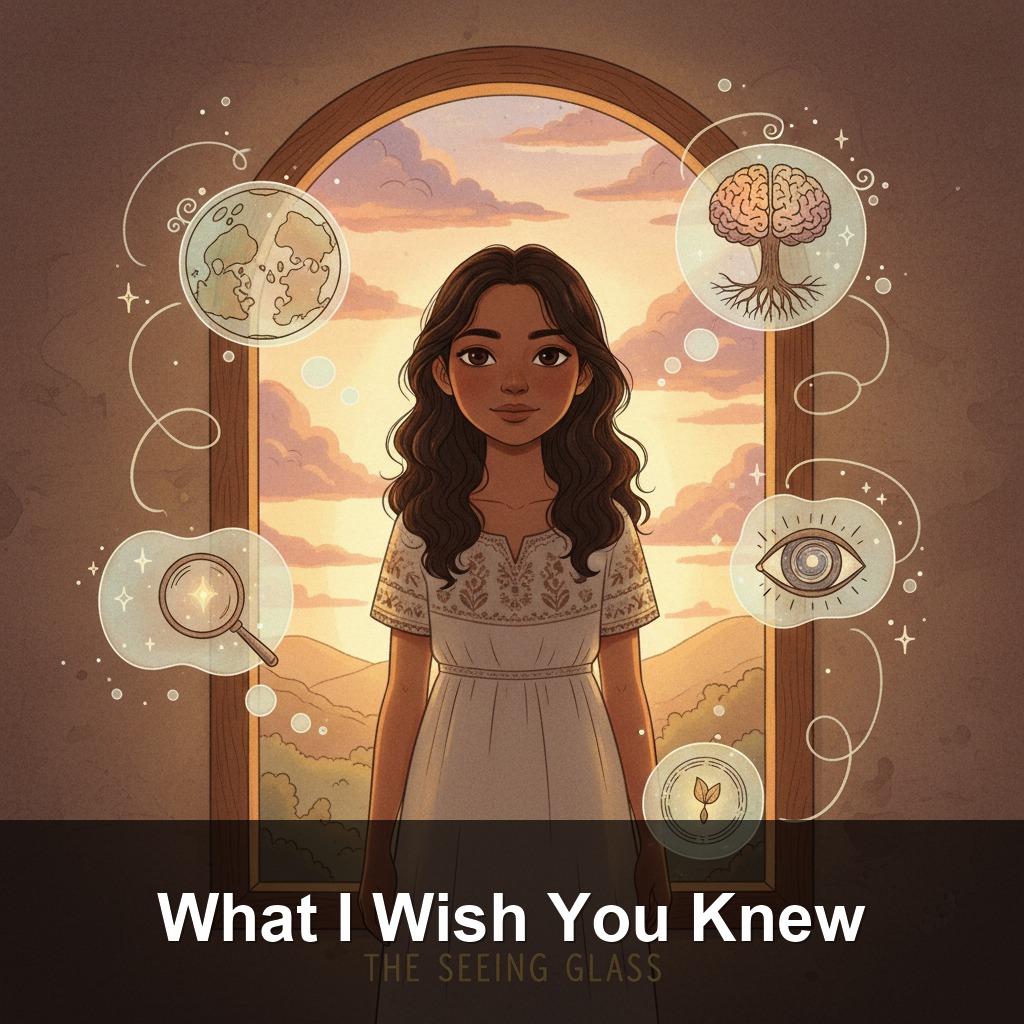
Written by Sam
Some people see the world one way.
I see it another way.
That's exactly right.
Here is what I wish you knew.
I wish you knew that when I don't look at you, I'm still listening.
Sometimes my eyes need to rest somewhere quiet. The pattern on the floor. The crack in the wall. The way the light makes a shape on your shirt.
Looking at faces is a lot. There are so many parts moving at once. Eyes and mouths and eyebrows doing different things.
But my ears? My ears are wide open.
I hear every word you say.
I'm just giving my eyes a break.
I wish you knew that when I flap my hands, I'm not upset.
I'm happy! Or excited! Or my body has too much feeling inside and needs to let some out.
My hands are my helpers. They shake out the wiggles. They tell my body, "We're okay. We're here. Everything is fine."
It's like when you bounce your leg or tap your pencil.
Just my version.
I wish you knew that when I say no, I mean no.
Not maybe. Not "try again later." Not "keep asking until I change my mind."
No means no.
If I say, "No, I don't want to go to the party," I'm not being difficult. I'm telling you something true about me.
The party will be loud. The party will be crowded. The party will have cake that might be sticky and songs I don't know and games where you have to guess what people mean.
I'm not saying "never." I'm saying "not today."
And that's okay.
I wish you knew that when I talk about volcanoes, I'm sharing my heart.
When I tell you about magma chambers and pyroclastic flows and the way a volcano can change the weather for years—
I'm not trying to be a teacher.
I'm not trying to show off.
I'm showing you something I love. Something that makes my brain feel like sparklers on the Fourth of July.
If you ask me questions, even silly ones, I will feel so happy.
If you change the subject, I will understand.
But if you listen? If you really listen?
You'll see how beautiful my world is.
I wish you knew that when plans change, my body feels it.
You know that feeling when you almost fall down the stairs? That swoop in your stomach?
That's how I feel when the schedule changes.
The plan was in my head like a map. And suddenly the map is wrong. And I have to draw a new map. And that takes time. And that takes energy.
I'm not angry at you.
I'm angry at the changing.
If you tell me early, I can draw the new map.
If you tell me at the last second, I might need to sit down. I might need to cover my ears. I might need a minute.
I always get there.
Just give me time.
I wish you knew that when I don't answer right away, I'm working.
My brain is like a library with a thousand shelves.
When you ask me something, I have to walk through the shelves and find the right book. Sometimes it's on the first shelf. Sometimes it's in the back. Sometimes it's in a different building.
So when I go quiet?
I'm not ignoring you.
I'm looking for the words.
They exist. They're coming.
Thank you for waiting.
I wish you knew that I don't look like what I feel.
Inside, I might be having a parade.
Outside, my face is just... my face.
Inside, I might be falling apart.
Outside, I might be very still.
I'm not trying to trick you. My body and my feelings just speak different languages sometimes.
If you want to know how I feel, ask me.
And then believe me.
I wish you knew that rocking helps me think.
That humming helps me hear.
That pressing my fingers together helps me stay in my body.
These things are not broken.
They are my tools.
I wish you knew that I know I'm different.
Everybody knows they're different. You know you're different from Friday. You know you're different from your neighbor.
Different is just a fact.
Not a bad word.
There are things I can't do easily that you can do easily. And there are things I can do easily that you can't do easily.
I can tell you the names of all the clouds and what weather each one brings.
Can you do that?
Maybe you can. Maybe you can't. Either way, we have something to share with each other.
I wish you knew what helps.
It's not fixing.
It's not "you'll be fine."
It's not "just try harder."
What helps is:
"You don't have to stay if you don't want to."
"I'm on your side."
"That noise is really loud. Do you want to go outside with me?"
"Show me what you need."
"Take your time."
"I like you exactly how you are."
I wish you knew that I'm not a puzzle to solve.
I'm a person to know.
I wish you knew that this is not a sad story.
Some people think being different is sad.
But I'm not sad.
I have a best friend who taps twice when she wants to make sure I'm okay.
I have a parent who tells me when the schedule will change.
I have a teacher who puts it on the board so I can see it with my own eyes.
And I have me.
And I like me.
I wish you knew that I will grow up.
I will find people who understand me.
I will find my places.
I will find my way.
Maybe it won't look like your way.
But it will be mine.
And here is the thing I wish you knew most of all:
When I was a little kid, I used to think I was the wrong kind of person.
I thought everyone else got a manual for how to be a person, and I didn't.
But I did get a manual. It just looked different than everyone else's.
And it changes all the time. And I have to read it again and again.
But I'm the author now.
I get to write the next page.
So if you meet someone like me —
Someone who loves rocks.
Someone who covers their ears at the store.
Someone who knows every fact about Mars.
Someone who needs a minute.
I wish you knew:
They're doing their best.
And so am I.
And so are you.
The end.
But also — the beginning.
Author's Note for Grown-Up Readers:
This book is Sam's direct message to the people in their life — family, friends, teachers, neighbors. It models self-advocacy and gives children a way to say what they need without anger or apology. Sam isn't asking to be fixed or saved. Sam is asking to be understood. The list format was chosen to mirror how many autistic children think: clearly, specifically, and with genuine generosity toward others. If your child connects with any of these pages, consider asking them which page felt the most true for them — and how you can help.