Inside Out Academy
THE BREATHING ROOMS
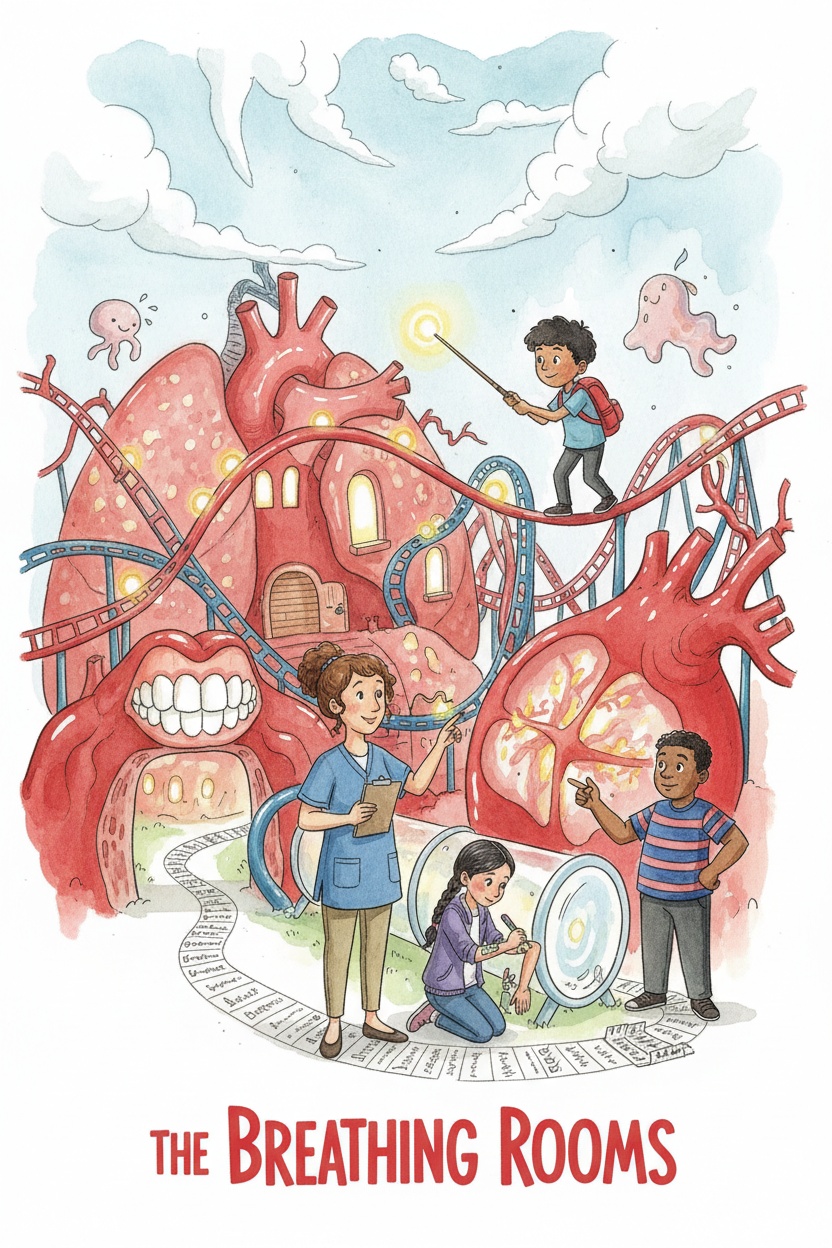
MS. VANCE'S CURRENT CHECKLIST STATUS:
-
Location: Circulatory System Exit Point (Left Subclavian Vein)
-
Current Objective: Navigate to Respiratory System
-
Students Accounted For: 22 (Leo is currently inside his own shirt for reasons that will not be explained)
-
Days Inside Mr. Gomez: 14
-
Checklist Pages: 23 and growing
Chapter 1: The Wrong Way Down the Right Tube
The class stood at the edge of a crossroads. Not a road crossroads—a body crossroads. Two large tubes branched off from the main passageway, each one wide enough to drive a bus through.
"Trachea," Sadie said, pointing to the main tube. "The windpipe. And it's splitting into two bronchi—one for each lung."
Leo was already at the edge of the left bronchus, peering down. "It's like a water slide," he said. "But with air."
"It's not a water slide, Leo," Ms. Vance said, consulting her checklist. "Do not—"
"I'm not going to jump in," Leo said. "I'm just looking. I'm a careful observer now. I've grown."
"You said that last week, and then you rode a red blood cell through a heart valve."
"That was educational," Leo said. "I learned a lot about turbulence."
The class moved into the left bronchus in a loose formation. The walls were pink and glistening, lined with a layer of mucus that caught the small particles floating in the air. Marcus, walking beside Fatima, was already quizzing himself.
"Left bronchus," he muttered. "Left lung has two lobes. Right lung has three. The heart sits in the middle, tilted slightly left, so the left lung is smaller—"
"Slightly smaller," Sadie corrected. "Not smaller enough to matter. The heart takes up more space on the left, but the left lung compensates by being—"
"—broader," Marcus finished. "I knew that."
"You didn't say it."
"I was going to say it."
"You were going to say 'the left lung is smaller,' which is misleading."
Fatima walked between them, saying nothing, observing everything.
The bronchus split again. And again. Each split was smaller than the last, but the pattern was the same: a tube dividing into two tubes, dividing into two more tubes.
"Conducting zone," Ms. Vance said, gesturing at the branching structure. "Everything from the trachea through the bronchioles. This part moves air but doesn't exchange it. It's like the hallways of a school—you walk through them, but you don't learn anything in the hallway."
"You learn things in hallways," Leo said. "Last month I learned that if you run with a juice box—"
"We don't need that story," Ms. Vance said quickly.
The air around them was moving. It wasn't wind, exactly—more like a slow, rhythmic current that pushed gently against their backs and then pulled away. In and out. In and out.
"Mr. Gomez," Ms. Vance said into her walkie-talkie. "Are you doing anything unusual?"
A pause. Then Mr. Gomez's voice, calm and vaguely distracted: "Just breathing, Ms. Vance. Reading some mail. Should I be doing something else?"
"No, this is perfect. Keep breathing."
"I was planning on keeping breathing."
The air pushed in again. On the wall beside the class, a hair-like structure waved past, then another, each one sweeping in the same direction.
"Cilia," Sadie said. "They move mucus up and out. Keeps the lungs clean."
Marcus wrote something in his notebook. Leo watched the cilia for a moment, then looked up at the branching passage ahead.
"Where does this end?" he asked.
No one answered. For a moment, they just kept walking.
Chapter 2: The Staircase of the Lungs
The bronchioles grew smaller as the class climbed. What had started as a cathedral-sized airway became a hallway, then a corridor, then a passage barely wide enough for two students to walk side by side.
"Scale shift," Fatima said quietly.
"What?" Marcus asked.
"Everything's getting smaller. The tubes are dividing so many times that we're going deeper and deeper. The branching is exponential."
"So?"
"So if the trachea is a highway," Fatima said, "those are streets. Now we're on sidewalks. The classrooms are coming."
The walls around them changed. The cartilage that had ringed the larger bronchi—firm, supportive, like the ribs of an umbrella—thinned and disappeared. The walls became soft and elastic, collapsing slightly with each breath and springing back.
"Bronchioles," Ms. Vance said. "No more cartilage. The air is getting where it needs to go."
"How much farther?" Leo asked.
"About twenty-three more branchings," Sadie said. "From trachea to alveoli, there are roughly twenty-three generations of branching."
Twenty-three more. The class kept walking. The passage split again—left, right—and again—left, right—and again. At each split, the class had to choose a side. Fatima kept track of their route on the back of Sadie's emergency energy bar wrapper.
"We're going down the left side," she said. "Fourth branch. Then sixth. Then twelfth."
"Does it matter which way we choose?" Marcus asked.
"Not for the lesson," Sadie said. "All routes lead to the same place. But for the map—it documents the route."
They climbed. The passage tilted upward, then leveled out, then tilted again. The air was warm and moist and moved with a rhythm that was beginning to feel as natural as music.
At the end of the twenty-third branch, they stopped.
The wall in front of them was covered in tiny bumps. Dozens of them. Hundreds. Each one no bigger than a grape—but at the class's scale, each one was the size of a small room.
"The alveoli," Ms. Vance said. "The respiratory zone. This is where it happens."
Leo pressed his face close to one of the bumps. It was translucent, glistening, so thin he could almost see through it. Behind it, a network of delicate red lines wrapped around the surface like ivy.
"Capillaries," Sadie said. "Blood vessels. They wrap around each alveolus so that oxygen can move across."
"Air on one side," Marcus said slowly. "Blood on the other. They're that close?"
"Thinner than paper," Sadie said. "The alveolar wall is one cell thick. The capillary wall is one cell thick. Between the air and the blood, there are only two cell membranes."
Leo peered closer. Inside the capillary, he could see red blood cells—enormous, disk-shaped, moving slowly through the narrow channel. And as he watched, he saw something strange.
A red blood cell paused. It pressed against the capillary wall. And then, right before his eyes, something moved.
"Is it—" Leo started.
"Yes," Ms. Vance said. Her voice was very quiet. She had been waiting for this moment. "Watch."
The oxygen molecules were so small the class could barely see them—just a shimmer in the air, a slight thickening as they passed through the alveolar wall, through the capillary wall, and attached to something on the surface of the red blood cell.
"Hemoglobin," Sadie whispered. "It grabs oxygen. Carries it away."
Another red blood cell paused at the same spot. Another cargo of oxygen attached.
"How many?" Marcus asked.
"Each hemoglobin can carry four oxygen molecules," Ms. Vance said. "And each red blood cell has about 270 million hemoglobin molecules."
Marcus's eyes went wide. He did the math. His lips moved silently.
"That's a billion oxygen molecules," he said. "Per red blood cell."
"And there are twenty-five trillion red blood cells in Mr. Gomez's body," Fatima said.
The class stood in silence. Somewhere above them, Mr. Gomez was reading his mail, breathing in and out, in and out, while twenty-three tiny people watched his body trade air for blood.
"In and out," Leo said. "That's all it is. Just breathing."
"The most important thing you do all day," Ms. Vance said, "and you don't even have to think about it."
Chapter 3: The Great Trade
The class set up observation posts along the bronchiole wall. Ms. Vance assigned stations: Leo and Marcus on the north side, where the capillary network was densest; Sadie and Fatima on the south, where the wall was thinnest; everyone else scattered between.
The air moved. The blood moved. And between them, the great trade happened in silence.
"Carbon dioxide," Sadie said, pointing at a red blood cell that was releasing something into the alveolar space. "The blood brings it here. The lungs get rid of it."
"Oxygen in, carbon dioxide out," Marcus said. "Like a trade route."
"Exactly," Ms. Vance said. "The body needs oxygen for everything. Every cell in Mr. Gomez's body is burning fuel, and that fire needs oxygen. The waste product is carbon dioxide."
"So the lungs are the exchange window," Leo said. "The place where the body trades its trash for treasure."