Inside Out Academy
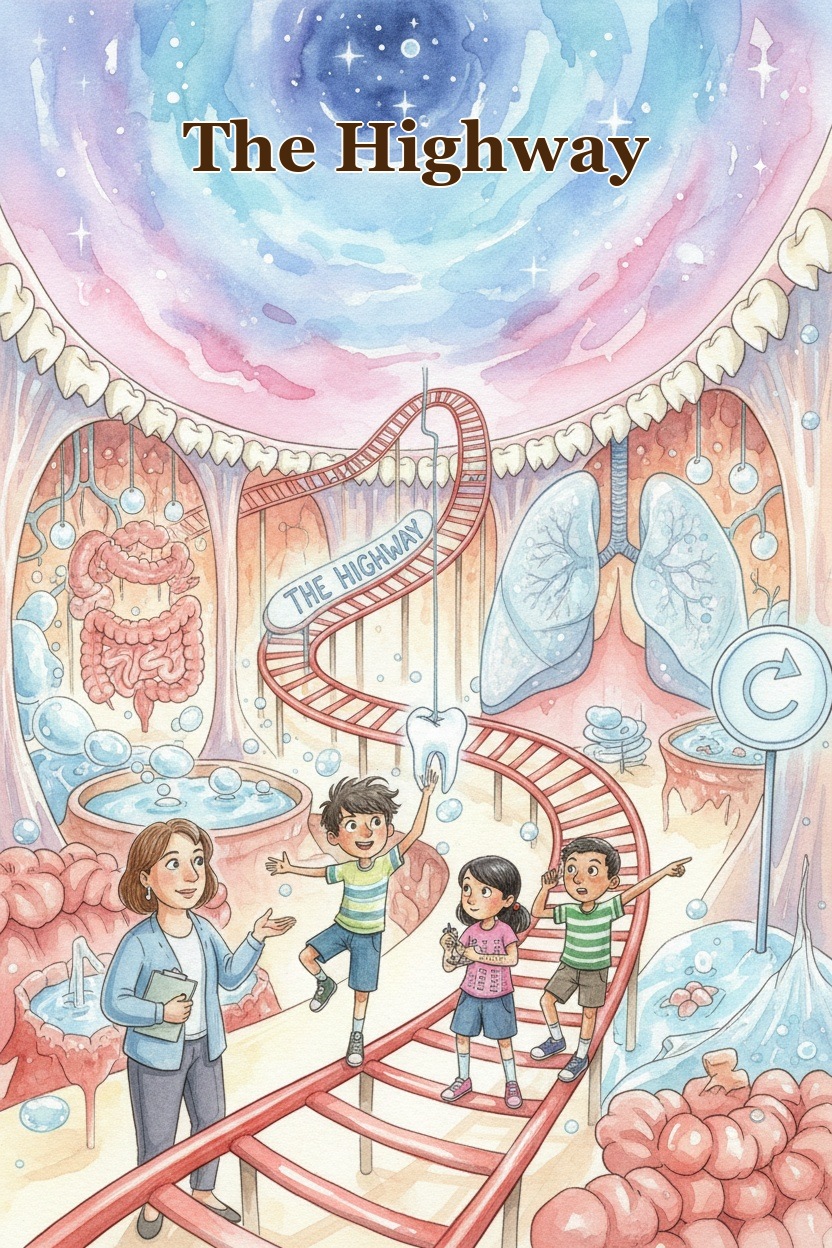
THE HIGHWAY
Ms. Vance's Current Checklist Status:
-
Location: Base camp at the base of the skull, transitioning to the spinal cord
-
Date: Day 34 of the journey (Thursday, approximately 2:47 PM)
-
Students accounted for: 22 out of 22 (Leo has been counted four times; he keeps moving)
-
Objective: Navigate the spinal cord from top to bottom; understand how information travels
-
Mr. Gomez's last report: "My neck is doing that thing where it feels like there's a parade in my spine."
- THE WHITE ROAD
The class stood at the edge of the brain stem, looking down at what Fatima called "the most important road in the entire body."
It was a thick, cream-colored cable about as wide as a fire hose, descending from the base of the brain into a tunnel of bone. The tunnel was the vertebral column — the same stack of bones the class had climbed in Book 5, when they'd learned every vertebra's name. Now they saw it from the inside, and it looked completely different.
"The bones aren't just stacked," Marcus said, his voice hushed. "They're like... guards."
"Exactly," Ms. Vance said, consulting her checklist. "The vertebral column protects the spinal cord the way a castle wall protects the people inside. Every vertebra is a ring of bone, and the spinal cord passes through the middle. That's why it's called the spinal column — it's a column of bone with a highway running through it."
Leo was already at the edge of the cord, crouching. "It's squishy."
"Don't touch it," Sadie said, her voice a full octave higher than usual. "The spinal cord is the most important nerve tissue in the body after the brain. If you damage it—"
"I'm not going to damage it," Leo said, and then he poked it. "It's got a texture like a marshmallow that's been left out too long."
"Leo," Ms. Vance said, in a voice that meant she would be adding something to her checklist.
"Sorry. It's just—there are grooves. And it's got, like, a seam down the middle."
He was right. The spinal cord was not a smooth tube. It had a deep groove running down its front — the anterior median fissure, Sadie explained — and the surface was marked with tiny ridges and valleys, like the bark of a tree but softer, more organized.
"Everyone, look at this," Fatima said. She was standing at the side of the cord, pointing at something that emerged from it in regular intervals. Thin white threads, like telephone wires, branched out from the cord and disappeared through gaps between the vertebrae.
"Those are spinal nerves," Ms. Vance said. "Thirty-one pairs. They branch out from the cord and go everywhere — every muscle, every patch of skin, every organ. The spinal cord is the highway, and these are the exit ramps."
"The exits go both ways," Sadie added. "Some of them bring information in from the body — that's sensory. And some of them carry commands out to the body — that's motor. Sensory in, motor out."
"How do you know which is which?" Marcus asked.
Sadie opened her mouth, closed it, and looked at Ms. Vance. "That's actually a really good question that I don't know the complete answer to," she admitted — which was, everyone agreed, the most surprising thing that had happened all day.
- THE WAY DOWN
Ms. Vance decided the class would walk the length of the spinal cord, from the top where it met the brain, all the way down to where it ended in a fan of nerves that reminded Leo of a horse's tail.
"This is going to take a while," she said, measuring the distance with her eyes. "The spinal cord in an adult is about eighteen inches long. At our scale, that's—"
"About three miles," Fatima said.
There was a collective groan. But there was no other way to see it — and Ms. Vance was already moving, her lamp held high, so the class fell into line behind her.
The journey down the spinal cord was unlike anything they'd experienced. The cord itself was alive with movement — not the churning of the digestive tract or the beating of the heart, but something subtler. Tiny pulses of light flickered along the surface, racing each other up and down, always in a hurry.
"What are those?" Leo asked, pointing at one of the pulses.
"Signals," Sadie said. "Nerve impulses. Every time Mr. Gomez moves a finger or feels a breeze or even thinks about moving, there's a signal traveling through this cord. They're happening all the time, even when he's asleep. The nervous system never stops."
"Mr. Gomez," Marcus said loudly, "can you wiggle your toes?"
A pause. Then Mr. Gomez's voice came through the walkie-talkie, crackling with good humor: "Already doing it."
The class looked down. Far below them — miles below them, at the scale they were traveling — there was a sudden burst of activity. Signals streaming down, a cascade of light racing through the cord.
"Those are motor signals," Ms. Vance said, pointing. "They started in his brain, traveled down through the brain stem, and now they're going down the spinal cord. When they reach the right exit — the right spinal nerve — they'll branch off and travel to the muscles in his toes."
"Like a highway with specific exits," Leo said. "The toe exit."
"The toe exit," Ms. Vance agreed.
"And the signals know which exit to take?"
"Each signal is going to a specific destination. The spinal cord is organized — each segment of the cord corresponds to a specific part of the body."
Marcus pulled out his notebook. "I want to map this. Every segment. Every exit."
"You'll need a bigger notebook," Fatima said.
- THE TOLLBOOTHS
They had been walking for nearly an hour when Leo stopped.
"Where are the ganglia?" he asked.
The class turned to look at him. This was, everyone agreed, the first time Leo had ever used the word "ganglia" voluntarily.
"The dorsal root ganglia," he said, pointing at the base of each spinal nerve where it connected to the cord. "See those little bumps? I saw one when we stopped for a break. Sadie said they're where the cell bodies of sensory neurons live."
Sadie looked at him with an expression that was half impressed and half alarmed. "You were listening?"
"I listen sometimes. Usually when I'm not running."
Ms. Vance walked over to where a spinal nerve exited the cord. The junction was more complex than it looked from a distance. The nerve split into two roots — one that entered the cord from the side, and one that exited from the front. The dorsal root, Sadie explained, was sensory — information coming in from the body. The ventral root was motor — commands going out.
"The signals move in different directions on different roads," Ms. Vance said. "Sensory signals come in through the back — they tell you what's happening to your body. Motor signals go out through the front — they tell your body what to do."
"And the dorsal root ganglion is the tollbooth," Leo announced, incredibly proud of himself. "The sensory signals have to pass through it."
"Every single time," Sadie confirmed. "Every sensation you've ever felt — every tickle, every ache, every warm breeze — has passed through one of those little bumps."
Fatima was staring at a single signal traveling up the cord. It was moving slowly, deliberately, like a messenger with important news.
"What is that one?" she asked.
Sadie followed her gaze. "That's a sensory signal. It started somewhere in Mr. Gomez's body and it's traveling up to his brain. When it gets there, he'll become conscious of whatever it is he's feeling."
"Is he feeling something right now?"
Ms. Vance raised the walkie-talkie. "Mr. Gomez? Are you feeling anything at that exact spot where we are?"
A pause. "My left elbow feels a little itchy," Mr. Gomez said. "Does that help?"
The class looked at the slow-moving signal with new respect. Somewhere below them, in Mr. Gomez's elbow, a patch of skin had sent a message. The message had traveled through a spinal nerve, through a dorsal root, and was now making its way up the spinal cord toward the brain.
"A signal from his elbow," Marcus said, writing furiously. "Going up. That's sensory."
"And if we wait, we'll see what happens next," Ms. Vance said.
They didn't have to wait long. They saw the signal reach the brain stem. They saw it disappear into the lower part of the brain — and then, seconds later, they saw Mr. Gomez's hand come up to scratch his elbow.
"Is that a motor signal?" Leo asked, pointing at the new wave of activity streaming down the cord.
"That's a motor signal," Sadie confirmed. "The brain received the sensory message — 'itchy elbow' — decided what to do about it, and sent a motor command — 'scratch the elbow' — back down the same highway, out a different spinal nerve, all the way to the muscles in his arm."
"His brain did that in, like, three seconds," Marcus said.
"Brains are fast," Ms. Vance said. "That's the whole point of the highway system. Feel something, send the message up. Decision, send the message down. The spinal cord is how the brain stays in touch with the body and the body stays in touch with the brain."
Mr. Gomez's voice came through the walkie-talkie: "Okay, the itch is gone. Also, I'm proud of you all. I don't know why, but I somehow feel like I should say that."
- THE TAIL OF THE HORSE
The class traveled for another hour, stopping at every exit along the way. Marcus mapped each segment:
-
The cervical segments, high in the neck, where signals branched off to the arms and hands.
-
The thoracic segments, level with the ribs, where signals went to the chest and upper back.
-
The lumbar segments, lower down, which controlled the legs.
-
The sacral segments, deepest of all, which connected to the pelvis, the bladder, and the lower legs.
"Every segment has a number," Marcus said, showing everyone his notebook. "C1 through C8 is the neck. T1 through T12 is the chest. L1 through L5 is the lower back. S1 through S5 is the sacrum."
"And each segment controls a specific part of the body," Ms. Vance said. "The spinal cord is like a remote control with thirty-one buttons — each button controls a different region."
"Which button controls my left pinky toe?" Leo asked.
"A combination," Sadie said. "The signal for any movement comes down the cord and exits at the right segment — but it's not like a single button. It's more like... the signal knows where it's going. The nervous system is precise."
By the time they reached the bottom, the class was exhausted — but also transfixed. The spinal cord didn't just stop. Instead, it tapered into a cone, and from that cone, a final group of nerves fanned out downward, like the tail of a horse.
"The cauda equina," Ms. Vance said. "It means 'horse's tail' in Latin. These are the nerves that continue down after the cord itself ends, carrying signals to and from the lower parts of the body."
"It looks like a waterfall," Fatima said quietly. "A waterfall of information."
Leo was sitting at the edge of the taper, looking up at the long road they'd traveled. "So this is the highway. Every thought, every feeling, every movement. All of it goes through here."
"All of it," Ms. Vance confirmed.
"And the bones protect it the whole way."
"The vertebral column — every vertebra we climbed in Book 5. Each one is a ring of bone surrounding the cord."
Leo was quiet for a moment. Then: "So when we climbed those bones, we were walking on the roof of this highway. We were walking on the protection."
"You were," Sadie said. "And you didn't even know it."
"Now I know it," Leo said. And then, because he was Leo, he jumped off the end of the spinal cord, caught a nerve root, and swung on it like a rope until Ms. Vance made him stop.
- THE ROUND TRIP
They regrouped at the base of the cord for their final lesson.
"Let's do the round trip," Ms. Vance said. "Sadie? Marcus? Give us the whole route."
Marcus went first. "Sensory signals start in the body — in the skin, the muscles, the organs. They travel through the spinal nerves, through the dorsal root, through the dorsal root ganglion, and into the spinal cord. Then they travel UP the cord, to the brain."
"Then the brain decides what to do," Sadie continued. "And it sends motor signals DOWN the cord. Those signals exit through the ventral root, travel through the spinal nerves, and reach the muscles. The muscles move. The body responds."
"And the whole thing takes less than a second," Ms. Vance said.
"If everything works properly," Sadie added, because Sadie could not let a teaching moment pass without adding a qualifier.
"Let's test it," Leo said. "Mr. Gomez! Move your right hand!"
The class watched as the signal began. High above them, a command streamed down from the brain, racing along the spinal cord. It reached the cervical segments, branching off to the right — and then, somewhere beyond the cord, in the nerves they couldn't see, it traveled to the arm and hand.
"I moved my right hand," Mr. Gomez reported.
"And Mr. Gomez?" Leo called. "Could you feel it happen?"
"I felt it," Mr. Gomez said. "I always feel it. It's strange — I know you're in there, and I feel you doing things, but I can't tell exactly what you're doing. It's like having a really organized itch."
"THE HIGHWAY," Leo announced, spreading his arms wide. "Information goes up, information goes down. And the bones protect it so it never gets hurt."
"The bones protect it," Ms. Vance said, checking off a box on her checklist. "And now you understand why the vertebral column is built the way it is. It's not just a support structure — it's an armored tunnel for the most important communication line in the body."
Fatima looked up the length of the spinal cord. The paths of light were still racing up and down — sensory signals and motor signals, an endless stream of information keeping Mr. Gomez alive and aware, connected to himself.
"It's like a conversation," she said quietly.
"What is?" Marcus asked.
"The body talking to the brain. The brain talking to the body. They're always talking. Even when we're not thinking about it, they're talking."
Nobody said anything for a moment. The class stood at the bottom of the highway, listening to the hum of a conversation that had been happening continuously for Mr. Gomez's entire life — and would continue until the end of it.
"Alright," Ms. Vance said eventually. "Let's set up base camp. We need to decide where to go tomorrow — and I believe there's a reflex test on Mr. Gomez's schedule in the morning."
"Is that safe?" Marcus asked.
"It's a knee-jerk reflex," Sadie said. "It's completely safe and also amazing. The signal doesn't go to the brain at all. It loops at the spinal cord."
"A loop," Leo said, a grin spreading across his face. "I want to see a loop."
"We know you do, Leo," Ms. Vance said. "We know."
Mr. Gomez's External Log - Day 34:
Today I felt like something was walking through my spinal column from the inside. I didn't know that was possible, but I'm learning that everything is possible this week.
The principal called again to see when I'm coming back to work. I told her I was still recovering. I didn't tell her from what. I don't think she would understand.
I helped the class with their lesson by wiggling my toes, scratching my elbow, and moving my right hand on command. They seemed very excited about all three things, which made me feel like I'd accomplished something important by doing almost nothing.
One of the students — I think it was Marcus — asked if I could feel them inside me. I said yes. I always feel them. I can tell when they're moving through a part of me. It's not painful. It's just there. Like a reminder that I'm not alone, even inside my own body.
Tomorrow they want to test my reflexes. I'm a little nervous, because the last time a doctor hit my knee with that little hammer, my leg kicked so hard I kicked over a stack of medical magazines.
I should warn them.
But also: it's kind of nice, knowing that I have a highway inside me, and that people are walking on it, learning stuff. My body might be the most useful thing I've ever done.
I ate a really good burrito for lunch. I hope they could feel the burrito from in there.