Chef Sparks Kitchen Lab
THE OLIVE AND THE GRAIN
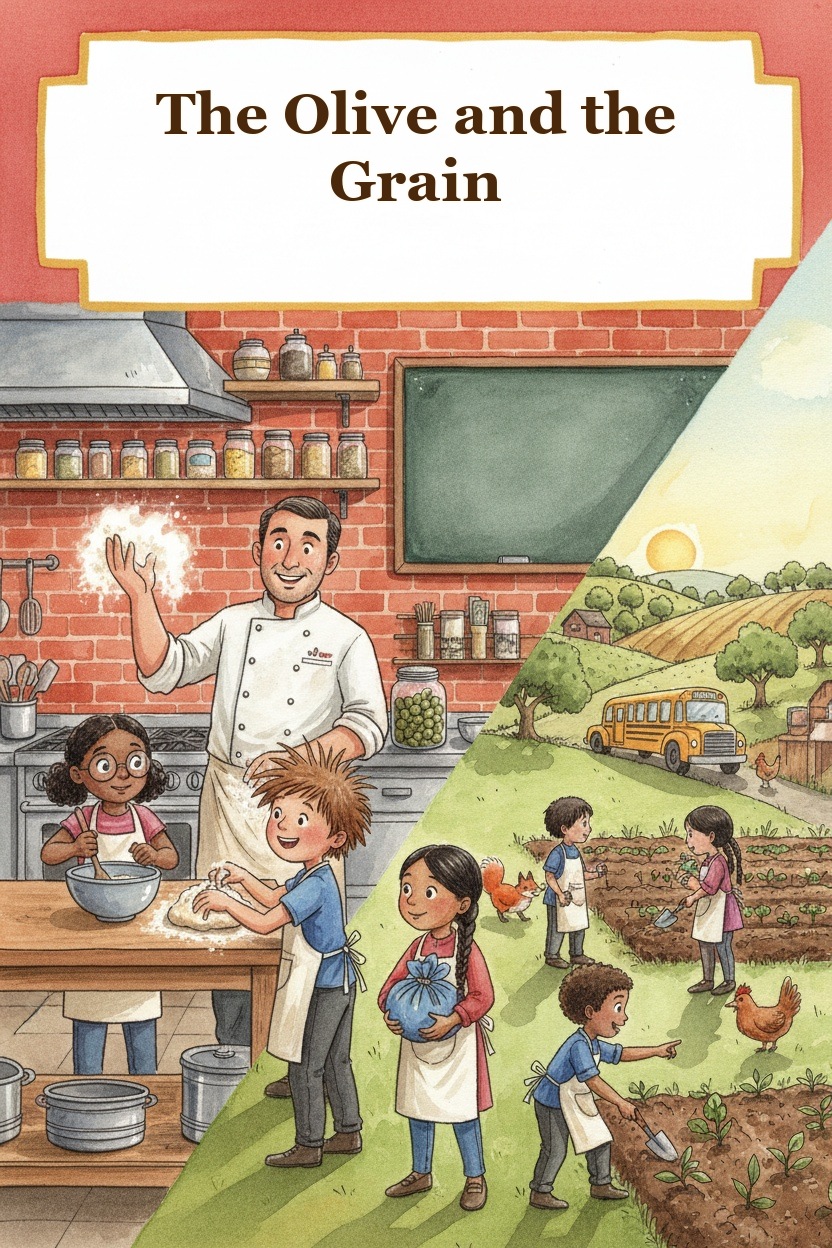
The Three Guests
The Riverside Fire Station smelled like sunshine. Not the kind of sunshine you feel on your skin—the kind you taste. Maya noticed it the moment she walked through the engine bay doors, her usual early arrival giving her time to check the kitchen before anyone else arrived.
"Chef Iggy?" she called. "What's that smell?"
Iggy appeared from the pantry, his apron already dusted with flour. His eyes had the particular brightness they got when he was about to teach something he loved very much. "That, Maya, is the smell of three countries arriving for class today."
Tommy came in next, sniffing loudly. "Smells like... butter? No. Like—" He sniffed again. "Like green apples? But not sweet. Green apples that grew up and got serious."
Priya laughed. "Tommy, that's the best description of olive oil I've ever heard."
The kitchen was arranged differently today. Instead of the usual horseshoe of prep tables, Iggy had pushed three tables together into a long straight line, covered end to end with dishes: bowls of shiny purple olives, plates of flatbread, little white dishes of thick white yogurt, a platter of roasted vegetables glistening with oil, a huge bowl of something green and fragrant.
And standing behind the table were three people.
The first was an older woman with silver hair pulled back in a bun, wearing a flowered apron over a dark blue dress. She smiled at the class and said, in a voice like warm honey, "I am Yiayia Eleni. I am Nikos's grandmother." Nikos, one of the rotating class members, waved shyly.
The second was a woman in a bright green headscarf and a long embroidered caftan. "I am Fatima," she said. "I cook for my mosque's community dinners every Friday. Tonight, I am cooking for you."
And the third was Iggy—but a different Iggy. He stood a little straighter, and when he spoke, his voice had a faint rhythm the class had never heard before. "And I am Ignacio," he said, "but you may call me Iggy. I trained in Italy for three years, and this book—this lesson—is the one I have been waiting to teach since we opened this kitchen."
Maya looked at the spread on the table. "Is all of this from one country?"
"Ah," said Iggy, holding up one finger. "That is exactly the question. Not one country. One sea."
He swept his arm toward the chalkboard—and, as always, the Spark Effect delivered: a jar of honey went spinning off the edge of the prep table, landing with a soft thump on a towel that, conveniently, had been placed there.
"Every week," Tommy muttered, "and I still can't predict it."
The Sea That Cooks
Iggy drew a map on the chalkboard. It was not a very good map—Iggy's strength was chemistry, not cartography—but everyone could see the shape: a vast blue sea, surrounded by land on three sides.
"This is the Mediterranean Sea," he said. "Bordered by Europe to the north, Africa to the south, and Asia to the east. And around this sea, sitting on its shores like people around a campfire, are some of the oldest food cultures on Earth."
Yiayia Eleni nodded. "I grew up on the island of Crete," she said. "My grandmother taught me to cook, and her grandmother taught her. The same recipes, the same olives from the same trees, for hundreds of years."
Fatima added, "In Morocco, my mother taught me to make couscous every Friday. The whole family would come. The whole neighborhood, sometimes."
"What I want you to understand," Iggy said, "is that the Mediterranean diet is not a list of rules. It's not a plan. It's what happens when a particular place meets particular plants and particular people over thousands of years."
Maya raised her hand. "But everyone talks about the Mediterranean diet like it's something you follow. Like a way to eat on purpose."
"Right!" Iggy pointed at her. "And that's exactly backwards. The people around this sea weren't following a diet. They were eating what grew there. And what grew there happened to be remarkably good for them."
He turned to the chalkboard again and drew three things: an olive branch, a stalk of wheat, and a vine with grapes on it.
"Three plants," he said. "These three shaped everything. The olive tree, the wheat plant, and the grape vine. They grew well in this climate—hot, dry summers and mild, rainy winters. They didn't need much water. They could survive on hillsides too rocky for other crops. And they produced food that could be stored for months."
"The olive becomes oil," said Priya. "Wheat becomes bread. Grapes become—" She paused. "Wine, I guess. But we're kids, so maybe grape juice?"
"Exactly right," Iggy said. "But here's the thing about olive oil: it's not just a cooking fat. It's the heart of the whole food culture. What would you eat if you had olive oil?"
"Everything," said Tommy immediately.
"Yes! But why? Why does olive oil go with everything?"
Dev raised his hand. "Because it tastes good?"
"Partly. But there's more." Iggy picked up a bottle of golden-green oil and poured a little into a small dish. "Taste this. Just a tiny bit, on the tip of your tongue."
The class came forward one by one. Maya dipped her finger, tasted, and made a face. "It's... grassy? And a little bit bitter."
"That bitter taste," Iggy said triumphantly, "is what makes it work. Olive oil contains compounds called polyphenols—and they do two things. First, they're antioxidants, which means they help protect the cells in your body. And second, that bitterness and pepperiness is exactly what makes olive oil interesting enough to put on everything from bread to fish to vegetables."
He touched the bottle. "Think about what this means for a food culture. If you have olive oil, you can eat whatever the land gives you—bitter greens, simple grains, fresh fish—and make it delicious. The oil is the bridge between the land and the plate."
Three Kitchens, One Table
Yiayia Eleni beckoned the class over to her station. She had a bowl of dough in front of her, and her hands were already moving, pressing and folding.
"Watch," she said. "I am making spanakopita—spinach pie. My grandmother made this, and her grandmother before her."
She rolled the dough thinner and thinner until it was almost transparent. "This is phyllo dough," she explained. "In Greece, we learn to make it by feel. The dough should be so thin that you can read a love letter through it."
Tommy leaned in. "Can you actually do that?"
Yiayia Eleni laughed. "My grandmother could. I am close. But this—" she layered the dough in a pan, brushing each sheet with olive oil— "this is the secret. The olive oil between the layers is what makes it crisp and golden when it bakes. The oil is not an ingredient. It is the technique."
At Fatima's station, the class found a huge mound of pale golden grains. "This is couscous," she said. "In Morocco, we make it by hand—rolling semolina wheat and water together until they form these tiny balls. It takes hours."
She held up her hands. "My mother's hands knew the couscous. She could feel if it was the right size just by touching it. And when we steam it—" she lifted a special pot with a perforated bottom— "we steam it three times, over a stew of vegetables and lamb. The couscous catches the flavor of the meat as it rises through the steam."
"That's amazing," Priya said softly. "The grain absorbs the flavor while it cooks."
"Yes," Fatima said. "And the wheat—the grain—is what feeds everyone. You cannot afford meat every day. But a little meat, cooked with vegetables, and served over couscous? That is a feast. The grain stretches the feast to feed the whole family."
Iggy was at the third station, and he was doing something the class had never seen before. He was rubbing a clove of garlic in a big stone mortar, grinding it with salt, then adding fresh basil leaves and crushing them with the pestle.
"This is pesto," he said. "From Genoa, in Italy. Watch what happens."
He added olive oil, slowly, in a thin stream, while he kept grinding. The mixture changed as the class watched: from rough and separate to smooth and silky, everything combining into one unified sauce.
"The oil does something special here," Iggy said. "It's not just flavor. The oil wraps around the tiny pieces of garlic and basil and forms a—Maya, what do we call it when two things that don't naturally mix get forced to combine?"
"An emulsion," Maya said.
"An emulsion! And what's the emulsifier in this case?"
Everyone thought hard. Finally, Sam said, "Is it the basil? Or the garlic?"
"The garlic," Iggy said. "Garlic contains a compound that helps the oil and the water from the basil stay mixed together. So this sauce is a permanent emulsion—it stays combined, as long as you make it the traditional way, with a mortar and pestle, which breaks the garlic down enough to release its emulsifying power."
He looked around the kitchen. The spanakopita was in the oven. The couscous was steaming. The pesto was ready. And everywhere the class looked, there was olive oil.
"Now," said Iggy, "let's put it all together."
The Mezze
"This is a mezze," Iggy said, as the class gathered around the long table. "In many Mediterranean countries, a meal can be dozens of small dishes, shared among everyone. Not courses, but a spread—everyone reaches for what they want, in whatever order they like."
The table was transformed. Yiayia Eleni sliced the spanakopita into golden triangles. Fatima fluffed the couscous with a fork and arranged it on a platter with the vegetable stew ladled over the top. Iggy put out bowls of hummus—smooth and pale, made from chickpeas and tahini—and baba ganoush, the smoky purple dip made from roasted eggplant.
There were olives—green, black, purple, some marinated in herbs, some stuffed with pimentos. There was flatbread, warm from the oven, torn into pieces. There were roasted vegetables: peppers, zucchini, eggplant, tomatoes, all glistening with olive oil and herbs.
And there was something the class recognized from Book 1: a simple vinaigrette, which Iggy had made as the very first dish they ever cooked together.
"Some of you remember this," Iggy said, smiling. "The vinaigrette. Oil and vinegar, forced to mix. You learned about emulsification that day. But today, I want you to see it differently. This vinaigrette isn't just a science demo. It's a salad dressing that people around the Mediterranean have been making for thousands of years—because they had olive oil, because they had lemons and vinegar, and because they figured out that these simple things could make any vegetable taste wonderful."
Maya was studying the spread carefully, her label-reading eyes scanning the dishes. "Nothing here has any processed ingredients," she said. "It's all just... food. Grains, vegetables, oil, herbs."
"Exactly," Iggy said. "And that's the real Mediterranean diet. It's not a set of rules about what to eat and not eat. It's a pattern: mostly plants, whole grains, olive oil as the main fat, small amounts of meat and cheese, and fish when available. That's what the land provided, and that's what the people ate."
Yiayia Eleni spoke up. "In my village, we ate meat once a week, maybe twice. On Sundays. The rest of the time, we ate what the garden gave us, and what could be stored: beans, lentils, chickpeas, bread, olives, cheese."
"And what happened to people who ate that way?" Tommy asked, his mouth already full of spanakopita.
"A very good question," Iggy said. "In the 1950s, scientists noticed something remarkable. People around the Mediterranean had much lower rates of heart disease than people in Northern Europe and America. They lived longer. They stayed healthier into old age. And they ate this way—without thinking about it, without dieting, without measuring portions."
He held up his plate, loaded with vegetables and grains. "There are lots of things that contribute to that. But the evidence points to the pattern: lots of plants, healthy fats from olives and nuts, whole grains, not too much meat, and—"
"Eating together," Fatima said. "You cannot have a mezze alone. It is impossible. The food does not work that way. You need people to share it with."
Priya looked around the table at her classmates, at the three cooks, at Iggy. "So the Mediterranean diet isn't just about what you eat. It's about how."
"Yes," Iggy said quietly. "That's the deepest truth about any food culture. The food and the people who share it are one thing."
The First Bite
They all sat down together—students, cooks, and Iggy—and reached for the food.
Tommy loaded his plate with everything, and the class watched in anticipation as he took his first bite. He chewed for a long moment, his face changing through several expressions, and then he made a sound—a two-note hum, rising and falling, that had become class vocabulary.
"That's the Tommy hum," Maya said. "It's a success."
"This spanakopita," Tommy said, his voice almost reverent, "is the flakiest, crunchiest, most buttery thing I've ever had, and it's not even butter, it's olive oil."
Yiayia Eleni beamed. "You understand, boy. The phyllo must sing when you bite it."
Dev was eating the couscous, his engineer's brain clearly analyzing. "The grains are so small," he said. "And they're perfectly separate. Not clumpy at all."
"Three steamings," Fatima said. "The third steaming makes them light. You cannot rush the couscous. It is a lesson in patience."
Maya, who usually approached new dishes with caution, was building a small plate: a piece of flatbread, a spoonful of hummus, a few slices of cucumber, an olive on the side. She dipped the bread into the hummus and tasted it.
"It's creamy," she said, surprised. "And the lemon—and the garlic—" She looked at Iggy. "The hummus doesn't have any of my allergens. I checked the ingredients."
"And what did you find?" Iggy asked.
"Chickpeas, tahini—that's sesame, Iggy, I can't have that—" Maya caught herself. "Oh wait. Did you make it without tahini?"
"I did," Iggy said. "I made yours with a little extra olive oil and lemon instead. It's a version of hummus from some parts of the Mediterranean where they don't use tahini. I checked with you before class started."
Maya looked at her plate, then back at Iggy. "You made me my own version so I could be part of the mezze."
"Of course," Iggy said, as if it were the most obvious thing in the world. "A mezze isn't a mezze if there's an empty plate at the table. The food is only the beginning. The point is that everyone has something to share."
Maya took another bite. Then, very quietly, she said, "This is the best hummus I've ever had."
Priya was eating a piece of flatbread with baba ganoush, her eyes far away. When she spoke, her voice was soft. "You know what this reminds me of? Ammamma's thali. In Indian tradition, a thali is a platter with many small dishes—dals, vegetables, pickles, breads. And you eat a little of everything, in whatever order you want. It's just like mezze."
She looked up at the three cooks. "Your grandmothers and my Ammamma—they never met, but they were cooking the same way. Small dishes. Feeding everyone. Using what the land gives them."
Iggy nodded slowly. "Yes, Priya. That's what food cultures share: they're all answering the same questions. What grows here? How do we store it? How do we share it? The answers are different everywhere. But the love in the answers—that's the same."
The Olive and the Grain
After the meal, as the class helped clear the table, Iggy brought out one last thing: a small dish of olives, plain and simple, and a piece of fresh bread.
"This," he said, "might be the oldest snack in the Mediterranean. Bread and olives. Grain and fruit. The two plants that shaped everything."
He held up an olive. "This olive took eight years to produce its first fruit. The olive tree can live for a thousand years. My teacher in Italy had an orchard where some of the trees were planted by the Romans."
He put the olive down and picked up the bread. "And this grain grew in the fields my ancestors farmed, the same fields their ancestors farmed. Wheat and olives, together, for as long as anyone can remember."
He tore the bread in half and handed a piece to each student. Then he poured a small pool of olive oil on a plate and raised his own bread.
"Thousands of years of Mediterranean cooking, distilled to this one moment: bread, dipped in oil, eaten with friends. The simplest thing in the world. And also the most profound."
He dipped his bread in the oil and ate it. The class did the same.
Tommy chewed, and then smiled. "It's so simple. Why does it taste so good?"
"Because," Iggy said, "simplicity is not the absence of complexity. It's what you get after you understand everything. The olive knew how to grow in rocky soil. The wheat knew how to stretch a meal to feed a family. The people knew how to press the oil and grind the grain. And all of that knowledge is in this one bite."
Yiayia Eleni said, "In Greece, we say that olive oil is liquid gold."
Fatima said, "In Morocco, we say that bread is sacred. You never throw bread on the floor. You never waste it. It is life."
Iggy looked at the class. "Today you've learned the Mediterranean food tradition. You know about olive oil and grains and vegetables. You know about the geography and the history. But there's one more thing I want you to remember."
He held up his piece of bread. "The Mediterranean diet isn't a list of foods. It's a relationship between land and people, developed over thousands of years. And you don't have to live in the Mediterranean to honor it. You just have to remember: eat plants, use good fat, share your food, and don't rush."
He smiled. "And maybe, sometimes, eat an olive."
RECIPE: MEZZE PLATE (Three Ways)
The Kitchen Lab's Simple Mezze Spread
This recipe makes enough for 4-6 people. Ask an adult for help with the knife and the oven.
Ingredients:
For the classic dip (hummus-style):
-
1 can (15 oz) chickpeas, drained
-
3 tablespoons olive oil (plus more for drizzling)
-
2 tablespoons lemon juice
-
1 small clove garlic, minced
-
½ teaspoon salt
-
2 tablespoons water
For the olive-oil dipping plate:
-
Good crusty bread, torn into pieces
-
Extra-virgin olive oil
-
A pinch of salt
-
A pinch of za'atar or dried oregano
For the vegetable platter:
-
1 cucumber, sliced into rounds
-
2 carrots, cut into sticks
-
1 red bell pepper, sliced into strips
-
A handful of olives (green, black, or purple)
-
Feta cheese, crumbled (optional)
Directions:
-
In a food processor, combine the chickpeas, olive oil, lemon juice, garlic, and salt. Blend until smooth.
-
Add the water and blend again. The hummus should be creamy and soft. If it's too thick, add water one teaspoon at a time.
-
Taste it. Does it need more lemon? More salt? You're the chef—you decide.
-
Spread the hummus on a plate and make a swirl in the middle with the back of a spoon. Drizzle with olive oil.
-
Pour a little extra-virgin olive oil into a small saucer. Sprinkle with salt and herbs.
-
Arrange the vegetables, olives, and feta on a big platter.
-
Place everything on the table. Tear the bread into pieces and put it in a basket.
-
Dip, share, and eat together.
Chef Iggy's Kitchen Lab Note:
The hummus in this recipe is a no-tahini version, like the one I made for Maya. In some parts of the Eastern Mediterranean, this is exactly how they make it. A mezze is about adapting and welcoming everyone—so make yours the way that works for your table. And remember: the best mezze always has more food than you think you need, because someone always brings a friend.
Kitchen Lab Notes
Dear Students,
Today we learned that the Mediterranean diet is not a diet. It's a food culture—a way of eating that grew out of a specific place, with specific plants, and specific people over thousands of years. Olive oil, grains, legumes, vegetables, and small amounts of meat and fish created a pattern of eating that scientists have now confirmed is remarkably good for the human body.
But here's what I want you to think about until next time: The Mediterranean diet worked because it was local—it used what the land provided. So what grows near you? What would the food culture of your hometown look like if it was built the same way—from the ground up, using what's around you, shared with people you love?
Ask a grandparent or an older neighbor what food they remember from when they were young. What did they eat? What did they grow? What did they share?
Bring your answer to the next class. We'll start the conversation.
—Chef Iggy