Chef Sparks Kitchen Lab
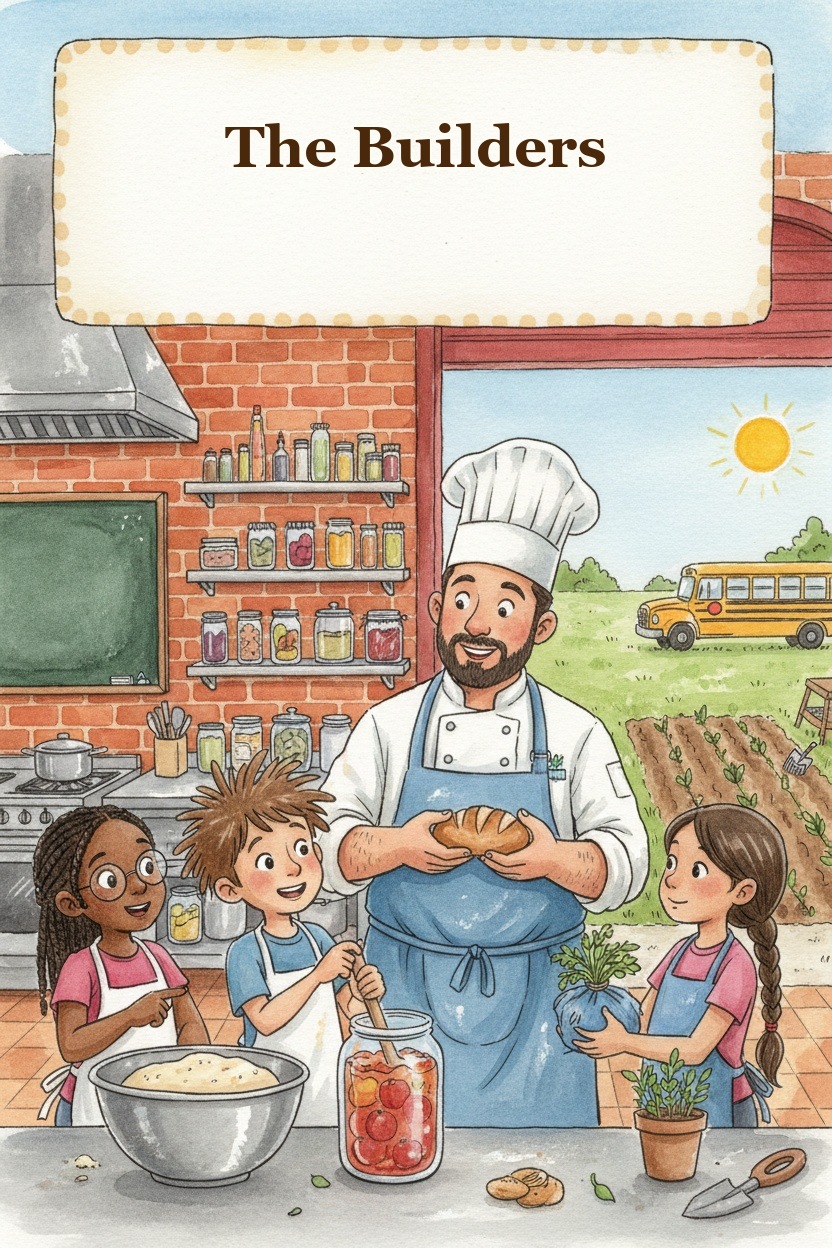
THE BUILDERS
The Mystery Object
Iggy was already at the chalkboard when Maya arrived, which was unusual because Maya was always first. She had her routine: check the counters for crumbs, inspect the cutting boards for cracks, scan the ingredient station for anything that might have snuck in overnight. Today, though, she stopped at the door.
On the central prep table sat a single egg.
Not a carton of eggs. Not a bowl of eggs. One egg, resting on a small white plate like it was something precious. Beside it, a glass of water, a kitchen timer, and a hand lens.
"Morning, Maya," Iggy said without turning around. He was drawing something on the chalkboard—a long chain of circles connected by sticks, like a necklace made of beads. "What do you make of our guest?"
Maya approached the egg carefully. She leaned in and looked at it. It was just an egg. Brown shell. Maybe a little larger than average.
"Is it... a trick egg?" she asked.
"It's a perfect egg," Iggy said. He set down his chalk and turned to face her, his dark eyes bright with the particular excitement he got when he was about to teach something he loved. "Or at least, it's a perfect example of something. We're going to spend ten minutes with this egg before we cook it."
The door banged open and Tommy charged in, backpack swinging. "What's for snack?" he asked immediately.
"That's the thing," Iggy said. "This egg is for snack. But first, we have to understand it."
"Understand an egg?" Tommy squinted at it. "It's an egg. You crack it, you cook it, you eat it."
"You're not wrong," Iggy said. "But you're not entirely right, either. Which is why we're going to look at this egg like it's the most interesting thing in the world. Because it is."
Priya came in next, her dark hair still damp from the morning. She took one look at the egg and smiled. "Ammamma says eggs are the first food. The one that makes everything else possible."
"Your Ammamma is a wise woman," Iggy said. "And she's about to be proven right by science."
The Chain of Builders
By the time the whole class had gathered—Dev, Lucia, Sam, and the rest—Iggy had drawn a second version of his bead-chain on the board, this time with labels. The circles were now colored and named, and the sticks connecting them looked like tiny bridges.
"This," Iggy said, tapping the board with his chalk, "is a protein. It's a chain of smaller building blocks called amino acids. Think of it like a beaded necklace—each bead is an amino acid, and the string holding them together is a chemical bond. When you eat protein, your body doesn't use the whole necklace. It breaks it apart into individual beads, then re-strings them into the exact necklaces you need."
"Why does it need to do that?" Lucia asked, already sketching the diagram in her notebook.
"Because your body is a construction site," Iggy said. "Every day, it's building things: new muscle, new skin, new hair, new blood. Even the little repairs—a scratch on your knee, a ripped fingernail—need building materials. And the building materials for all of it are amino acids."
He picked up the egg and held it so everyone could see.
"Now, here's the thing about this egg. It's what we call a complete protein. That means it contains all nine of the essential amino acids—the ones your body can't make on its own. You have to get them from food. Eggs have all nine, in exactly the right proportions. That makes them the gold standard of protein."
"What about food that isn't eggs?" Dev asked. "Like beans or rice?"
Iggy's face lit up. "Excellent question. Some plant proteins are incomplete—they have some essential amino acids but not all of them. But here's the beautiful part: if you eat beans with rice, the beans provide the amino acids the rice is missing, and the rice provides the ones the beans are missing. Together, they make a complete protein. Different foods working together to build."
"Like a team," Priya said.
"Like a team that builds things," Tommy agreed, nodding sagely.
The Unwinding
Iggy set the egg down on the plate and picked up the hand lens.
"Now," he said, "let's talk about what's inside this egg. Right now, the egg white is a clear, slippery liquid, right? All the protein molecules are coiled up tight, like little springs, floating in water. They're not doing much—just waiting."
He passed the hand lens to Maya, who peered at the egg through it. "I can't see molecules with this," she said.
"No, you can't," Iggy agreed. "But you're going to see what happens to them. Watch."
He filled a small pot with water and set it on the stove. When it was simmering—not boiling, just shimmering at the edges—he gently lowered the egg in with a spoon.
"Now we wait," he said. "And while we wait, here's the secret: heat changes proteins. When the egg gets hot, those coiled-up springs start to unwind. They bump into each other, and new bonds form between them. They link together in a web—a network that traps water. And suddenly, the clear liquid egg white turns solid and white."
"It's cooking," Tommy said.
"It's denaturing," Iggy corrected, with great relish. "That's the scientific word. Denaturation—when heat changes the shape of a protein. The protein isn't destroyed. It's just... rearranged."
He set a timer for eight minutes. "When this timer goes off, we'll have a hard-boiled egg. But that's only one way to denature an egg. There are others."
Three Ways to Build
Iggy cracked a second egg into a small bowl. Then he brought out a third.
"Same protein, three different denaturation methods," he said. "The hard-boiled egg is cooked by water at a hundred degrees Celsius. But what if I cook the egg without its shell, in water that's hot but not boiling?"
He slid the shelled egg into the pot of simmering water. It sank, then floated up, its white feathering around it like a cloud.
"That's a poached egg," he said. "Same protein, same heat, but no shell to hold it together. The denaturation happens in a different shape."
"And the third way?" Maya asked.
Iggy grinned. He reached for a small pan and set it on the range. A knob of butter sizzled. He cracked the third egg directly onto the hot surface.
"The fried egg," he said. "Here, the egg hits something much hotter than boiling water—hot metal. The protein denatures almost instantly. The bottom gets crispy, the top stays soft. Same protein, three different results."
When the timer went off, he fished out the boiled egg and ran it under cold water. He peeled it, revealing a perfect white oval, and sliced it in half. The yolk was solid, a deep golden yellow.
"Look at this," he said, holding it up. "The white is fully denatured—solid, firm, cooked. The yolk is too, but it was a different protein to begin with. Egg yolks have fat and other nutrients mixed in, so they behave differently."
He sliced the poached egg open. Its yolk ran golden across the plate. The fried egg, when he turned it out, had a crisp lacy edge and a soft, wobbling center.
"Three eggs," Iggy said. "Three different textures. Three different experiences. Same protein, same denaturation, different methods."
The Tasting
The class gathered around the tasting table. Iggy had cut each egg into quarters, so everyone could try all three.
Tommy went first. He tried the boiled egg, then the poached, then the fried—and let out the specific two-note hum that meant success. "The fried one tastes different from the boiled one," he said, surprised. "But it's the same egg!"
"Exactly," Iggy said. "The denaturation changes the structure, and the structure changes the flavor. The fried egg has that crispy edge—the Maillard reaction at work, which we'll learn about later. The poached egg is delicate and soft. The boiled egg is firm and clean."
Maya took a poached egg quarter, checking first that the egg wasn't on any allergen list. It wasn't. She ate it slowly, thoughtfully.
"It tastes like... morning," she said. The class laughed. "No, really. It's simple. It's just an egg. But it's a perfect thing."
"The most perfect building material in the world," Iggy agreed. "Every animal that hatches from an egg gets everything it needs to grow a body from scratch. All the protein, all the amino acids, all the building blocks. When you eat an egg, you're using those building blocks to build yourself."
He looked around at his kitchen full of children, all of them eating egg quarters, all of them thinking.
"So the next time someone asks you what proteins are," he said, "you can tell them: proteins are builders. They build muscle, skin, hair, blood—everything. And the building blocks are amino acids, and some you have to get from what you eat. And the wonderful thing is, you already know how to eat."
Priya held up her boiled egg quarter. "To builders," she said.
"To builders," everyone echoed.
And right on cue, Iggy swept his arm toward the chalkboard to underline the word AMINO ACID CHAIN—and knocked the hand lens off the edge of the counter. It clattered to the floor and rolled under the prep table.
"Noted," Maya said, writing something in her notebook.
Iggy pretended not to hear.
Kitchen Lab Notes
Dear students,
Today you learned the most important thing you will ever learn about food: what your body is made of. Protein is everywhere—in your muscles, your skin, your hair, your fingernails. And every protein you have is built from amino acids, many of which you get only from what you eat. That means every bite you take is a decision about what you're building. Make good choices, and you'll build something strong.
Here's your question to think about until next time: If proteins are chains, and heat unwinds them, what do you think happens to the protein in your muscles when you get a fever? Does it denature too? (Spoiler: a little bit. That's why you feel achy. But your body is good at fixing it.)
— Chef Iggy
RECIPE CARD
The Perfect Egg, Three Ways
You will need:
-
3 eggs
-
Butter (a small knob)
-
Salt (optional)
Tools:
-
A small pot
-
A frying pan
-
A slotted spoon
-
A bowl
Boiled Egg:
-
Fill a small pot with water and bring it to a simmer.
-
Gently lower the egg in with a spoon.
-
Set a timer for 8 minutes.
-
When the timer goes off, run the egg under cold water.
-
Crack the shell carefully, peel, and slice in half.
Poached Egg:
-
Bring the same pot of water to a gentle simmer—not a full boil.
-
Crack an egg into a small bowl.
-
Carefully slide the egg into the water.
-
Let it cook for 4 minutes.
-
Remove with a slotted spoon.
Fried Egg:
-
Melt a knob of butter in a frying pan over medium heat.
-
Crack an egg directly into the pan.
-
Let it cook for 3 minutes, until the white is set but the yolk is still soft.
-
Gently slide it onto a plate.
Chef Iggy's Note: Every egg you cook is a protein chemistry experiment. The heat unwinds the protein molecules, and they rebind in new shapes. Different heats, different shapes, different eggs. Same builder, three different buildings.