Chef Sparks Kitchen Lab
THE UNMIXABLE MADE TO MIX
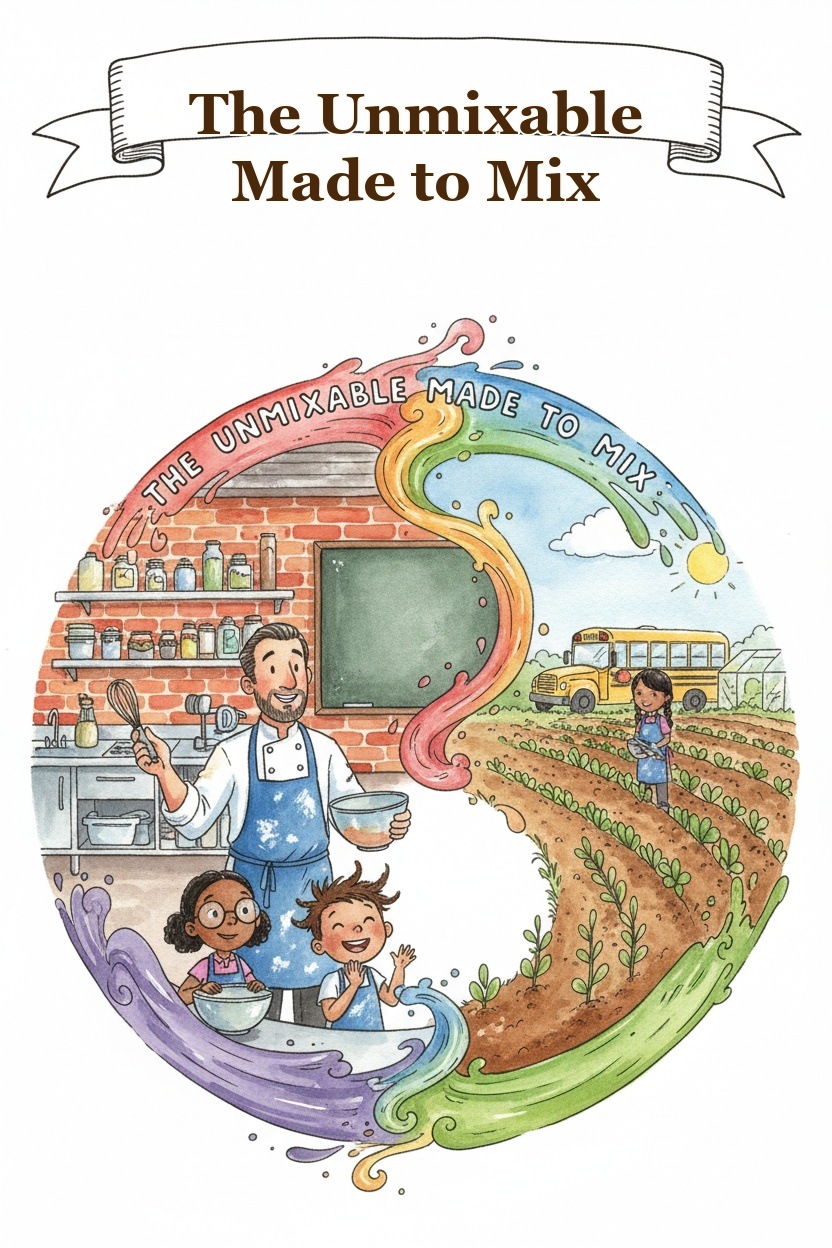
The Great Separation
The Riverside Fire Station kitchen smelled like lemons and possibility. Chef Iggy Spark stood at the center prep table, surrounded by small glass bowls arranged in a perfect circle. In each bowl sat a different liquid: water, vinegar, olive oil, sunflower oil, lemon juice, and something thick and golden that Maya immediately identified.
"Maple syrup," she said, reading the label. "Grade A dark."
"Correct!" Iggy clapped his hands. "Today we begin with a question so old it might as well have dust on it. Who can tell me what happens when you mix oil and water?"
"They don't mix," said Tommy immediately. "That's just a thing. Everyone knows that."
"But why?" Iggy leaned forward, his eyes wide. "Why don't they mix? That's the question. That's always the question."
Priya tilted her head. "My Ammamma says oil floats on top of water. When she makes her special chutney, she has to stir it right before serving because it separates overnight."
"Your Ammamma is absolutely right, and she's been working with this problem for sixty years without necessarily knowing the chemistry behind it. Today, we're going to understand it."
Iggy poured water into a tall glass jar, then carefully added a ribbon of olive oil on top. The class watched as the oil sat on the water like a golden blanket.
"Now watch," Iggy said. He screwed on a lid and shook the jar with theatrical violence. "WAH-LAH!"
The class leaned in. The liquid in the jar was cloudy, mixed. For a moment, it looked like the oil and water had become one.
Then, slowly, the cloudiness began to separate. Tiny droplets of oil rose through the water, finding each other, joining together, until a clear line formed between the two layers again.
"It separated," said Dev, who had been watching with his engineer's eyes. "It always separates."
"IT ALWAYS SEPARATES!" Iggy shouted with joy, and the Spark Effect knocked a small measuring spoon off the edge of the counter. It clattered to the floor. Nobody moved to pick it up. This was the way of things.
"Now," Iggy said, "why? Why does oil always separate from water?"
He drew two circles on the chalkboard. In one, he drew a small shape with a smiley face. In the other, a longer shape with a grumpy face.
"Water molecules," he said, pointing to the small circles, "are like tiny magnets. They're positively charged on one end and negatively charged on the other. So they hold onto each other really tightly. They're constantly linking arms with their neighbors. And the other water molecules are like, 'Yes, friend, hold me!'"
He pointed to the oily shapes. "Oil molecules, on the other hand, don't have those charges. They're not magnetic at all. They're like people at a party who don't want to dance. They just stand there. And when the water molecules try to grab them and dance, the oil molecules are like, 'No thank you. I'm just here for the snacks.'"
"So they separate because water likes water better than it likes oil?" asked Lucia, who was already sketching the two molecule types in her notebook.
"Exactly! Water is polar—it has those two poles, positive and negative, like a magnet. Oil is nonpolar—no poles, no magnets, no dance moves. And polar things prefer other polar things. Nonpolar things prefer other nonpolar things. Water molecules would rather hold onto other water molecules than deal with the oil just standing there in the corner."
"So there's nothing you can do about it?" asked Maya. "They just... always separate?"
Iggy's face split into a grin. "That, my dear Maya, is the exact right question. And the answer is: almost. There IS something you can do about it. Something that changes everything. Today, we are going to make the unmixable made to mix."
The Yolk's Secret Power
Iggy cracked an egg into a clean glass bowl with one swift motion. The yolk sat like a small golden sun in the center of the white.
"This," he said, pointing at the yolk, "is one of the most powerful ingredients in the entire world of cooking."
"That's just egg yolk," said Tommy. "That's not powerful. That's breakfast."
"It's breakfast, yes. But it's also something else." Iggy scooped up the yolk with his fingers, holding it up to the light. "This tiny thing contains a molecule called lecithin. Say that with me. LEC-I-THIN."
The class repeated it: "LEC-I-THIN."
"Lecithin is an emulsifier. An EMULSIFIER! What does that word mean? It means something that makes an emulsion. And what's an emulsion? An emulsion is when you take two things that don't want to mix—like oil and water—and you make them mix anyway."
"How?" asked Sam, who had been rating the classroom setup seven out of ten. "How does it make them mix?"
"Because lecithin is a very special molecule. It's like a person who's friends with everyone at the party. One end of the lecithin molecule LOVES water. It's polar, like the water molecules. The other end LOVES oil. It's nonpolar, just like the oil. So when you put lecithin in a mixture of oil and water, it holds hands with BOTH of them. One end grabs the water, the other end grabs the oil. And suddenly, the water and oil aren't separate anymore. They're linked together, by lecithin, the ultimate diplomat."
Iggy was pacing now, his enthusiasm carrying him around the prep table. The class knew better than to step in his path. "Today, we're going to make mayonnaise. Mayonnaise is a PERMANENT emulsion. It's made from oil and egg yolk—and the lecithin in the yolk—and when you do it right, they will NEVER separate again. Not tonight. Not tomorrow. Not EVER."
"Never ever?" asked Tommy, who was dubious.
"Never-ever-ever. The lecithin molecules have wedged themselves between every single droplet of oil and every single droplet of water. They are holding hands so tightly that nothing can pull them apart."
The class gathered around the big stainless steel bowl. Iggy measured out the egg yolk, a splash of vinegar, and a pinch of salt into the bowl. Then he picked up a whisk.
"Now, here's the thing about making mayonnaise," he said. "You cannot rush it. You cannot dump all the oil in at once. You have to add the oil DROP BY DROP at first, whisking the entire time. Because what you're doing is breaking the oil into tiny, tiny droplets—smaller than your eye can see—and surrounding each droplet with lecithin before the next one comes in."
"Why does the size matter?" asked Dev.
Iggy's eyes lit up. "Because the smaller the droplets, the more surface area they have! And the more surface area they have, the more of them can be surrounded by the yolk's lecithin. If you pour in too much oil at once, the droplets are too big and there's not enough lecithin to hold onto them all, and then—"
"The separation!" the class shouted together.
"THE SEPARATION!" Iggy confirmed.
He drizzled the oil into the bowl in a thin, steady stream, whisking in a smooth circular motion. The mixture in the bowl began to thicken. It changed from a pale yellow liquid to something creamier, more substantial.
"Look at that!" breathed Priya. "It's thickening!"
"Feel this," Iggy said, handing the whisk to Maya. "Whisk it. Tell me what you feel."
Maya took the whisk and began to turn it in the mixture. Her arm moved in a circle, and her eyebrows rose. "It's... heavy. Like the whisk is pushing through something."
"That's the emulsion forming. ALL those oil molecules have been broken apart and are being held in suspension by the lecithin. They're no longer free-swimming. They're trapped. Held. And together, they make a substance that's thick and creamy and absolutely delicious."
Maya handed the whisk to Tommy, who gave it a few turns and made the Tommy hum—the two-note sound of approval that had become class vocabulary.
"It's like magic," he said.
"It's not magic," said Iggy, beaming. "It's chemistry. It's BETTER than magic, because you can do it with your own two hands."
The Wrist Knows
The mayonnaise was finished. It sat in its bowl, pale and glossy, a miracle of lécithin diplomacy.
Iggy spooned some onto a plate and handed out small pieces of bread for tasting. The class spread the mayonnaise carefully, took bites, and made sounds of surprised pleasure.
"That tastes like... the best sandwich spread I've ever had," said Tommy.
"It doesn't taste like oil," said Maya, looking at her bite with scientific interest. "It tastes creamy. And the vinegar comes through. But the oil isn't separate."
"Because it CAN'T be separate," said Iggy. "The lecithin has made it permanent. This mayonnaise will not separate. You could leave it on the counter for two hours and it would still be mayonnaise. That's a permanent emulsion—the oil and water are bonded together with the help of an emulsifier."
He pushed a plate with a bottle of olive oil toward the center of the table. "Now. Let's make a vinaigrette. A simple salad dressing: olive oil, vinegar, salt, and pepper. We will shake it up. And we will see what happens."
The class took turns shaking the small jar of oil and vinegar. Tommy shook it hardest and longest. When he set it down, the mixture was cloudy, thoroughly mixed.
Then they waited.
Within a minute, the cloudiness had begun to clear. Tiny droplets of oil were rising again, rejoining their oily friends. Within three minutes, the separation was complete: a clear line between the golden oil on top and the vinegar below.
"IT ALWAYS SEPARATES!" the class shouted, and this time they were cheering.
"It ALWAYS separates," confirmed Iggy. "But WHY? There's no lecithin in this mixture. No egg yolk. No emulsifier. So the water molecules and the oil molecules do what they always wanted to do: they go back to their own kind. This is a TEMPORARY emulsion. It only stays mixed while you're shaking it. The moment you stop, it begins to separate."
"Then how do you ever use it?" asked Priya.
"You shake it right before you pour it. That's what Ammamma does with her chutney dressing, isn't it? She stirs it right before serving."
Priya's face lit up. "It works! It always works!"
"And the secret is," Iggy patted his own wrist, "your wrist knows. When you shake a vinaigrette, you're making a temporary emulsion. When you whisk mayonnaise, you're making a permanent one. You can FEEL the difference. The vinaigrette fights you—it wants to separate. The mayonnaise cooperates—it wants to stay together."
"A temporary emulsion is like holding two magnets together with your fingers," said Dev. "They stay together as long as you hold them, but the moment you let go..."
"They snap apart," Iggy finished. "Exactly. Exactly! And a permanent emulsion is like gluing them together. The glue connects them, holds them, makes them one thing."
Lucia was drawing in her notebook: a water molecule, an oil molecule, and a lecithin molecule in the middle, stretching one hand to each.
"The lecithin is the glue," she said.
"The lecithin is the glue," Iggy confirmed.
The World of Emulsions
The back counter of the kitchen had a display Iggy had set up sometime during the class—none of the students had noticed when. It held several things the class recognized: a carton of milk, a bottle of creamy salad dressing, a jar of Hollandaise sauce.
"Milk is an emulsion," Iggy said, holding up the carton. "Butterfat suspended in water. The emulsifier here is casein, a milk protein."
"Milk?!" Tommy looked honestly shocked. "Milk is basically the opposite of a regular drink. It's not see-through at all."
"That's the emulsion. The fat droplets in the milk are so small and so well-stabilized that they don't rise to the top. That's why milk looks uniformly white. It's a permanent emulsion."
"Right, except when it separates into cream at the top," said Maya.
Iggy pointed at her. "Exactly. Raw milk separates. The cream rises because the emulsion isn't perfectly permanent. That's why we homogenize milk—we pump it through tiny nozzles that break all the fat globules into even tinier droplets and surround them with even more casein. After homogenization, the permanent emulsion is, well, permanent."
He held up the bottle of creamy salad dressing. "And this is closer to our vinaigrette, except with an added emulsifier— usually a plant gum or a bit of mustard. Mustard is actually a very good emulsifier. The plant compounds in mustard can hold onto both oil and water."
"Mustard has lecithin?" asked Sam.
"Not exactly lecithin, but other compounds with the same let's-get-along idea. Now—" he paused, looking at his display of items. "Which of these is a temporary emulsion and which is permanent?"
"That's an easy one," said Tommy, pointing at the jar. "The prepared salad dressing is permanent because it's made to stay mixed in the bottle. And the hollandaise?"
"Hollandaise is what happens when butter—an oil—is whisked into egg yolk with lemon juice. It's a permanent emulsion, but it's a delicate one. Heat it too much and it separates. That's the difference between permanent and HARD-PERMANENT."
The class laughed. Iggy picked up the jar of hollandaise and looked at it with genuine affection. "Sauces are just emulsions with a flavor plan. Mayonnaise is a permanent emulsion. Vinaigrette is temporary. Hollandaise is permanent but sensitive. And milk is an emulsion we drink, which most of us don't even think about."
"Do they all use lecithin?" asked Dev.
"Materials differ. Casein in milk, lecithin in egg yolk, plant compounds in mustard—but they all do the same job. They hold hands with both water and oil. They make the unmixable mix."
The Taste of Understanding
The class sat down to their finished dishes: thick, golden mayonnaise; fresh bread; and a simple salad drizzled with vinaigrette that had been shaken at the last moment, its emulsion temporary but triumphant.
Maya spread mayonnaise on her bread carefully, examining its glossy surface. "I used to think mayonnaise was just... a thing. A white thing from a jar."
"And now?"
She took a bite and chewed thoughtfully. "Now I know it's a thing from a bowl. An egg yolk and a whisk and a lot of patience. It's... complicated."
"Good complicated?" asked Iggy.
"Good complicated."
Tommy was on his second slice of bread, spreading even more mayonnaise than the first. "I knew it was delicious. I just didn't know WHY it was delicious. Now I feel like I'm eating chemistry."
"You were always eating chemistry," Iggy said, his voice soft. "Now you just know the secret."
Priya looked into her bowl of mayonnaise, then at the salad she'd dressed with the vinaigrette. "My Ammamma makes this dish called tayir sadam—yogurt rice—and she always tells me to stir it right before eating. She says the yogurt and the rice are friends, but they need a reminder."
Iggy nodded deeply. "Your Ammamma gets it. You can't keep a temporary emulsion stabilized without an emulsifier. But you CAN keep it moving. And if it separates, you stir it back together. It's not a failure—it's just the nature of the thing."
Maya looked down at the mayonnaise, then at the vinaigrette. "So mayonnaise is permanent because it has the egg yolk, and the dressing is temporary because it's just oil and vinegar."
"Exactly. And now you know something very few people know: why those two things behave so differently. Do you remember what happened when we first tried to mix oil and water?"
"It separated," said Lucia. "The oil just floated on top like it wasn't interested in being friends."
"And now?"
"Now we made friends." Lucia held up her jar of vinaigrette. "Temporary friends."
"And this?" Iggy gestured to the bowl of mayonnaise.
"Permanent friends."
Iggy laughed, his whole body shaking with joy. "Emulsions are a perfect example of what happens in cooking when you stop guessing and start understanding. The oil and water will always want to separate. Always. It's their nature. But you can work WITH that nature—add lecithin, break the oil into tiny droplets, give the molecules something to hold onto—and you create something new. Something that was never possible before you knew what you were doing."
He looked at the class. "That's what understanding food does. It gives you options. It gives you power. And the best part?" He paused, gesturing to the food. "The best part is that it tastes GOOD."
Tommy raised his plate. "Best white sauce I've ever had."
"It's not a sauce. It's an emulsion," said Maya.
"It's a delicious emulsion," said Tommy.
The Spark Effect chose that moment to knock the pepper grinder off the edge of the prep counter. It rolled across the floor and came to rest against Dev's foot.
Dev picked it up, looked at Iggy. Iggy looked at the ceiling. Nothing was said.
Recipe Card Box
CHEF SPARK'S MAYONNAISE
A permanent emulsion that will never separate.
Ingredients:
-
1 large egg yolk (at room temperature)
-
1 teaspoon vinegar (white wine or apple cider)
-
1/2 teaspoon salt
-
1 cup neutral oil (sunflower or canola; not olive oil for your first attempt)
Steps:
-
Put the egg yolk, vinegar, and salt in a bowl. Whisk together.
-
Drizzle the oil in VERY slowly—a few drops at a time—while whisking constantly. Start tiny. Do not rush. The oil must be whittled into tiny droplets; the smaller the droplet, the better the lecithin can hug it.
-
After about a quarter of the oil is added, the mixture will begin to thicken dramatically. This is the moment of magic. Keep going!
-
Once all the oil is added, taste. Add more salt or vinegar if you like.
-
This mayonnaise will last about 3 days in a refrigerator. It is a chemical marvel. Treat it with awe.
Chef's Note: If your mayonnaise separates—if it turns liquid and weird—you can often rescue it. Put a fresh egg yolk in a new bowl and whisk your broken mixture into it VERY slowly, drop by drop. The new yolk's lecithin can often rebuild the emulsion. This is called a "rescue," and all good cooks do it at least once. It's not a failure. The molecules just needed a better diplomat. 🥄
KITCHEN LAB NOTES — From Iggy Spark
Dear class:
Today you met the molecules that refuse to be friends, and you taught them how. That's not just cooking. That's chemistry. That's engineering. That's diplomacy.
Here's a question to chew on (pun intended): What other emulsifiers can you find in your kitchen? Many mustards contain them. Some fruit juices do too. Even chocolate—my favorite—is a solid emulsion made of cocoa butter and liquid milk held together by the structure of the cocoa. Next time you pour milk in your cereal, remember: you're pouring an emulsion.
Until next time, keep your whisk moving and your lecithin on standby.
— Chef Iggy Spark
Question for next week: What do sugar and salt have in common, and what happens when they each meet water? Think about it. It's a tasty one.