Inside Out Academy
THE BALL AND THE SOCKET
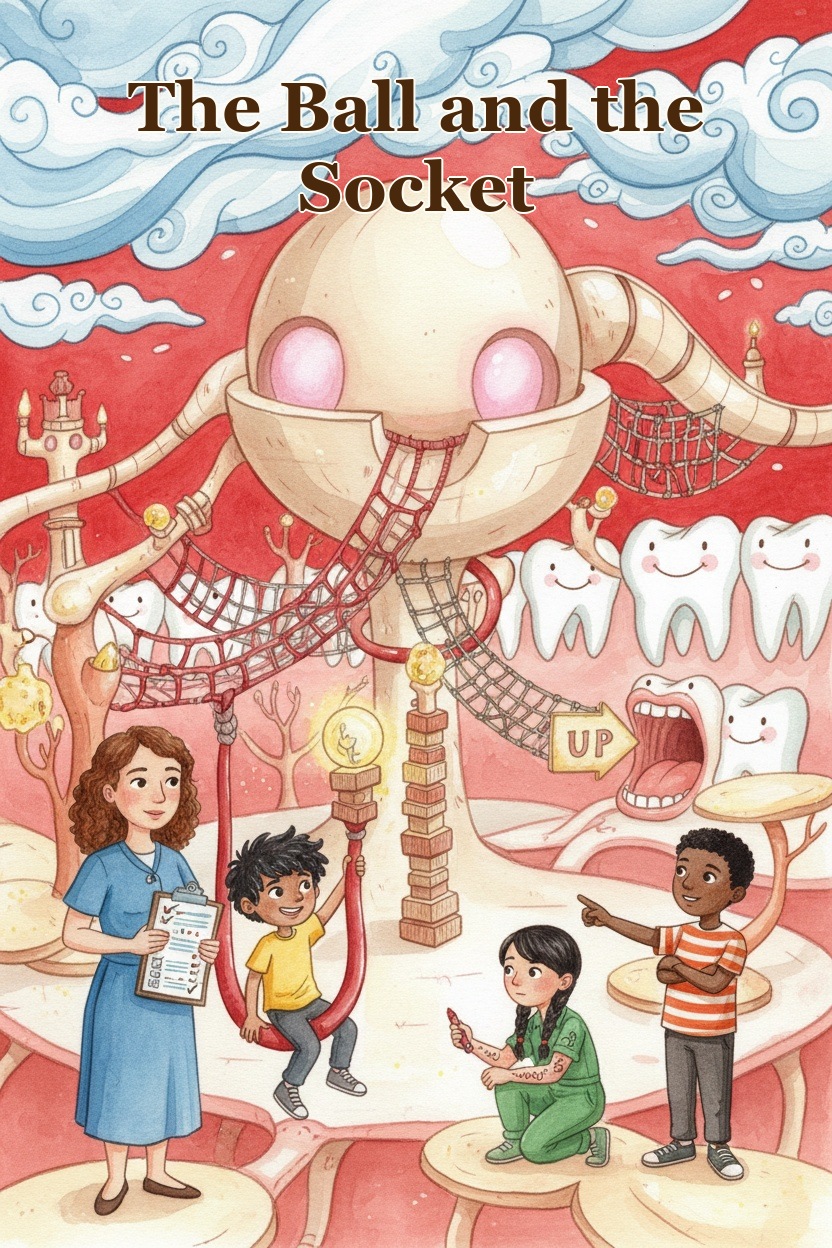
"We Are Definitely Inside Mr. Gomez. Please Remain Calm."
Ms. Vance's Checklist, Day 6
-
Location: Left hip joint, articular cartilage surface
-
Students accounted for: 22 (Leo attempted to slide across the joint surface before being retrieved)
-
Weather: Warm, humid, surprisingly slippery
-
Status: Ms. Vance has added "figure out how to navigate a frictionless surface" to the checklist
-
Mr. Gomez's last report: "My hip is making a weird noise. Is that you?"
Part One: The Impossible Floor
The class had been walking for what felt like hours. After the incredible climb through the femur—that long, hollow shaft of bone with its red marrow glowing like a sunset—they had expected something solid at the end. A landing. A wall. Something to stand on.
Instead, they found the floor.
But it wasn't a floor.
Fatima was the first to notice. She knelt down and touched the surface with one careful finger. Her eyes widened.
"It's smooth," she whispered.
Marcus snorted. "Bones aren't smooth. Bones are bumpy. We saw the spongy bone back there—it looked like a sponge. This is—"
He stopped. He was standing on it, and he could feel the difference through his boots.
The surface beneath them was white and gleaming, like the inside of a pearl. It curved in every direction—up, down, sideways—so smoothly that there was no way to tell where it ended and where it began. The lamp's beam reflected off it in a soft, glowing arc.
"It's like ice," Sadie said quietly. "But not cold. Warm. And so slick I can barely stand."
Leo, of course, was already trying to slide.
"LEO!" Ms. Vance's voice snapped across the space. "We do not know the speed limit of this surface, and we are not testing it!"
"But it's so—" Leo's feet went out from under him. He landed on his backpack with a soft thump. "—slippery."
Ms. Vance sighed and pulled out her checklist. She added a new item: Test surface friction before allowing unsupervised sliding.
"This," she announced, "is cartilage. Specifically, articular cartilage. It covers the ends of bones where they meet other bones. And it is the closest thing the human body has to a miracle."
Sadie nodded, her medical knowledge kicking in. "Okay, so technically, cartilage is living tissue. It has cells in it—chondrocytes. But it's not like bone. It doesn't have blood vessels running through it. It gets its nutrients from... from..."
"From the fluid around it," Fatima finished. Her finger was still pressed to the surface. "It's alive, but it doesn't bleed. It doesn't repair itself very well. Once it's damaged, it stays damaged."
The class went quiet. They were standing on something irreplaceable.
"Which is exactly why," Ms. Vance said, "we are going to be very careful where we step. This cartilage surface is the reason Mr. Gomez can move without pain. Every time he walks, this surface is bearing his weight. And it's almost frictionless—smoother than any surface we've ever walked on."
"Nicer than the floor in the science lab," Leo muttered, still flat on his back.
"Much nicer," Ms. Vance agreed. "The floor in the science lab has never once been described as a miracle."
She knelt down and looked at the cartilage up close. The lamp illuminated a surface that, at their scale, was like a landscape of glass mountains—gently rolling, impossibly perfect, with a texture so fine it seemed almost liquid.
"Do you know what this means?" she asked.
"It means we're somewhere important?" Marcus guessed.
"It means we're at a joint," Ms. Vance said. "The place where two bones meet. And not just any joint. We are standing in one of the most remarkable joints in the entire human body."
She looked up at the smooth white walls curving around them.
"This," she said, "is the hip."
Part Two: The Ball and the Socket
"The hip joint," Ms. Vance explained, "is a ball-and-socket joint. The ball is the head of the femur—that's the bone we just climbed down. The socket is part of the pelvis, called the acetabulum. It's shaped like a cup."
"Like a socket," Fatima said.
"Exactly. And the ball fits into the socket, and the cartilage keeps them from grinding against each other. That's what we're standing on—the head of the femur, inside the acetabulum."
Leo had gotten to his feet. He was now walking very carefully, small steps, arms out for balance.
"So the ball can move in the socket?" he asked. "Like, in circles?"
"A ball-and-socket joint allows movement in multiple directions," Marcus said, getting into quiz mode. "Flexion, extension, abduction, adduction, rotation, and circumduction."
He paused.
"What?"
"That's right," Ms. Vance said. "It's the most mobile type of joint in the body. You have them in your hips and your shoulders."
"So other joints are different?" Fatima asked.
"Very different." Ms. Vance smiled. "There are several types of joints in the human body. Most of them look nothing like this. For example—does anyone remember what kind of joint is in the knee?"
A pause.
"The knee joint is a hinge joint," Sadie said. "Like a door hinge. It opens and closes—mainly in one direction. That's why knees don't rotate like hips."
"The elbows are hinges too," Marcus added.
"And the neck?" Leo asked.
"The neck has pivot joints," Ms. Vance said. "The first two vertebrae allow your head to rotate from side to side. Think about shaking your head 'no'—that's a pivot joint at work."
She traced a circle in the air with her finger. "And then there are gliding joints, in the wrists and ankles, that allow small sliding movements. Saddle joints, in the thumbs, that allow that special thumb movement that lets you grip things. And hinge joints, in the knees and elbows."
"Six types," Marcus said, counting on his fingers. "Ball-and-socket, hinge, pivot, gliding, saddle, and..."
"And condyloid joints," Sadie said. "In the fingers—the knuckles, actually. They let you bend and spread your fingers, but not rotate them fully."
"Right." Ms. Vance nodded. "And all of them are amazing in their own way. But the ball-and-socket joint is the star—the most mobile, the most flexible, and today, the one we're standing inside."
She tapped her ear with one finger. "Mr. Gomez? Are you there?"
"Always," came his voice through the walkie-talkie, slightly staticky but warm. "I'm guessing you made it to the hip?"
"We're standing on the head of your femur right now," Ms. Vance said. "Can you feel anything?"
"Just a little... tingling. Kind of like a soda bubble in my hip. I've been getting a lot of that lately."
"Excellent. Now—I need to ask you to do something very careful. Can you rotate your hip? Just a small rotation, very slowly?"
A pause.
"Make sure the class is holding on to something."
Ms. Vance looked up. The class was spread across the cartilage surface, which was gently curved like the top of a very large ball. There wasn't much to hold on to.
"Everyone down," she said. "Flat on the surface, legs spread, arms out. We're about to experience something extraordinary."
The class dropped to the ground. Leo did not, strictly speaking, get flat. He lay on his back and spread his arms and legs like a starfish.
"On the count of three," Ms. Vance said. "One... two... three!"
From far above—from outside—Mr. Gomez moved his hip.
And the world moved.
Part Three: The Dance of the Joint
It was like being on a playground carousel, but a carousel made of warm, living pearl. The entire surface beneath them rotated—slowly, majestically—and the class slid gently with it.
"Whoa," Leo breathed.
"Hold on!" Sadie shouted.
"Everyone stay down!" Ms. Vance called. "We're not falling—the surface is moving with us!"
The cartilage slid against the socket wall with a smoothness that was almost impossible to believe. There was no grinding, no resistance. The two surfaces just moved—like wet glass on wet glass, like ice on ice, but warm and living.
"We're rotating!" Marcus yelled. "This is circumduction! Full circular movement!"
"Not full," Sadie corrected, her voice barely audible over the rush of movement. "The hip—it doesn't rotate completely—there are ligaments—"
But she was laughing. They all were.
The class slid across the joint surface like marbles in a bowl, carried by the rotation. The walls of the socket curved around them, glowing white and pearl-pink in the lamplight. And as the hip rotated, the ball of the femur moved inside the socket, and the class moved with it.
"Mr. Gomez," Ms. Vance said into the walkie-talkie, her voice breathless, "you can stop now. That was—that was perfect."
The rotation slowed, then stopped. The class lay scattered across the cartilage, giggling and catching their breaths.
"Did you feel that?" Leo demanded. "Did everyone feel that? That was—"
"That's what a joint does," Ms. Vance said, sitting up and brushing herself off. "Every time you move, this is what happens. The ball rotates in the socket, the cartilage glides, and you don't even think about it."
"It's so smooth," Fatima said. "Why is it so smooth?"
That was when Sadie's voice changed. It shifted into the tone they all recognized—the tone that meant she was about to share something her mother the nurse had taught her.
"Cartilage is smooth," she said. "But it's not smooth enough. Not by itself."
She knelt down and ran her hand across the surface. "If you looked at this surface under a microscope, you'd see it's actually rough. Tiny little ridges and valleys. And if two rough surfaces rub together, they wear away. Bone against bone is painful."
"But there's more," Marcus said. "Something else."
"Sadie's right," Ms. Vance said. "Cartilage alone isn't enough. There's one more ingredient—and if we look closely, we might be able to see it."
The lamp's beam swept across the surface. And then—
"There," Sadie said softly.
A thin layer of liquid shimmered on the surface of the cartilage. It was almost invisible—clear, viscous, like the thinnest layer of oil on water. At their scale, it looked like a film of moving glass, constantly replenishing itself, gliding over the pearl-white surfaces.
"Synovial fluid," Sadie said. "Okay, so technically, it's made by the synovial membrane that lines the joint capsule. It's like... it's like the joint's own personal oil. It lubricates the cartilage so everything can glide. And it does something else too."
"It feeds the cartilage," Fatima said. "The cartilage doesn't have blood vessels. So the fluid provides nutrients and carries away waste."
"Exactly," Sadie said, surprised. "How did you know that?"
"I read Ms. Vance's notes," Fatima said. "She left them on the base camp table."
Ms. Vance tried not to look too pleased.
"So the joint has three parts," Marcus said, ticking them off on his fingers. "Bone, cartilage, and synovial fluid. The bone provides structure. The cartilage provides a smooth, low-friction surface. And the fluid provides lubrication and nutrition."
"And together," Ms. Vance said, "they create something that engineers have been trying to replicate for decades. A joint that can move billions of times over a person's lifetime without wearing out. You've seen how smooth it is—and it's been moving like this since Mr. Gomez was born."
"Billions of times?" Leo looked skeptical.
"Every step. Every time you sit down, stand up, climb stairs, dance, kick a ball. Your hip joint moves millions of times a year. And it only needs a tiny amount of fluid to keep it working."
"Wow," Leo said quietly. For once, he wasn't trying to slide anywhere.
Part Four: The Kindness of Cartilage
The class spent the next hour exploring the joint. They walked across the cartilage surface, studying its texture. They found the edges where the cartilage thinned and the bone became visible. They located the ligament that held the ball in the socket—a thick, ropelike band of tissue that wrapped around the joint, keeping it together.
"This is the ligament of the head of the femur," Sadie explained. "It's also called the ligamentum teres. It doesn't do that much—it's not about stability, exactly. But it carries a small blood vessel that feeds the head of the femur."
"Which is why cartilage doesn't heal well," Ms. Vance added. "Bone gets blood. Cartilage doesn't. So if you damage your cartilage, it can't repair itself. The joint will never be quite as smooth again."
"Like a scratch on a record," Fatima said.
"Exactly. And what happens to a scratch on a record?"
"It skips," Marcus said. "It doesn't play smoothly."
"That's what arthritis is," Sadie said. "Okay, so arthritis is a family of conditions, but the most common type—osteoarthritis—is when that cartilage surface wears away. The bones start rubbing against each other. And eventually, it hurts."
The class went quiet, thinking about that.
"Mr. Gomez," Ms. Vance said, "has a family history of joint problems. His grandmother had arthritis. So his knees and hips might start to feel stiff as he gets older—especially if the cartilage wears down."
"Can he prevent it?" Leo asked. "Is there something he can do?"
"Exercise helps," Sadie said. "Strong muscles around the joint support it. And eating well—calcium, vitamin D, all of that."
"And staying active," Marcus added. "Movement helps the synovial fluid circulate. It's like keeping the joint oiled."
Ms. Vance smiled. "You're all exactly right. The human body is remarkable—but it needs care. The joints are a perfect example. They're designed to last a lifetime, but only if the person inside takes care of them."
"Is that why you keep telling us to stretch?" Leo asked.
"Yes, Leo. That's why I keep telling you to stretch."
"Huh." Leo considered this. "I thought it was just to be annoying."
"That too," Ms. Vance said.
The walkie-talkie crackled. "Ms. Vance?" Mr. Gomez's voice came through. "How is everything down there?"
"It's beautiful, Mr. Gomez," Ms. Vance said. "Your hip is a work of engineering genius."
"Huh," Mr. Gomez said. "It's been making a clicking noise since Tuesday. I thought it was worried about me."
The class laughed.
"It's not clicking anymore," Leo said into the walkie-talkie. "We're in here, so it's just... awesome."
"Awesome," Mr. Gomez repeated. "Well, I'm glad somebody's enjoying my bones. I'm going to go make a sandwich. Is that okay with everyone?"
"We'll be done here soon," Ms. Vance said.
The walkie-talkie went quiet.
Part Five: What the Joint Taught Them
The class gathered at the edge of the cartilage, preparing to move on. The map was unrolled, and Ms. Vance was marking their route with a tiny pencil.
"From here," she said, "we move to the muscles. The book says we're heading toward the gluteal muscles—the ones that help Mr. Gomez stand up and walk."
Marcus raised his hand. "Before we go—can I say something?"
"Of course."
Marcus looked at the glowing white surface of the cartilage. Then he looked at the class.
"I didn't know joints were this complicated," he said. "I thought I knew the names—ball-and-socket, hinge, pivot—but I didn't know what they actually did. I didn't know about the fluid, or the cartilage, or the way it all moves together."
He paused.
"It's like a whole machine," he said. "A machine that's been working since Mr. Gomez was born. And it's alive."
Fatima nodded. "It's not just a machine," she said. "It's more than the sum of its parts. Bone plus cartilage plus fluid equals movement. Something that didn't exist before."
"What did we learn today?" Ms. Vance asked.
They answered together, pieces of the lesson ringing out across the smooth white space:
"Ball-and-socket joints are the most mobile!"
"Cartilage is smooth and alive but can't heal!"
"Synovial fluid is the joint's oil!"
"There are other joints too—hinges and pivots and gliding joints!"
"Movement is good for joints—it keeps the fluid moving!"
"And," Leo said, "if I ever meet a skeleton, I'm going to ask it how its cartilage is doing."
Ms. Vance looked at him. "Why?"
"Because it's probably not doing great," Leo said. "And somebody should check."
The class dissolved into laughter. Even Ms. Vance, who was not usually prone to laughing at Leo's jokes, found herself smiling.
"Alright," she said, pulling out her checklist. "We've learned about the joint. And I think we've also learned something else—something about the way the body works."
"What?" Leo asked.
"The body doesn't do anything alone," Ms. Vance said. "The bone supports. The muscle moves. The cartilage smooths. The fluid lubricates. And when they all work together..."
"It makes something amazing," Fatima said.
Ms. Vance nodded. "It makes a miracle."
They packed up their gear and began the climb out of the joint, leaving behind the pearl-white surface that had carried them so smoothly. As they walked, Leo looked back one last time.
"Hey, cartilage," he said. "Thanks for being so smooth."
The cartilage did not respond. But it didn't need to.
It had been doing its job for forty-one years. And it was nowhere near done.
Mr. Gomez's Log, Day 6
Today I learned that twenty-three people can fit inside my hip. They made it "smooth."
It has been a long week. The principal keeps calling, but I have decided to let the custodian's office answer. They are very good at handling awkward situations.
I ate a chicken sandwich for lunch. Ms. Vance told me to eat something with calcium, so I ate yogurt too. My hip has been making a clicking noise all day. I think it was laughing.
Tomorrow they're going to see my muscles. I'm just going to go for a walk.
--Mr. Gomez, Janitor, Westbrook Elementary
Next: Book 7 — The Pulling Machines