Chef Sparks Kitchen Lab
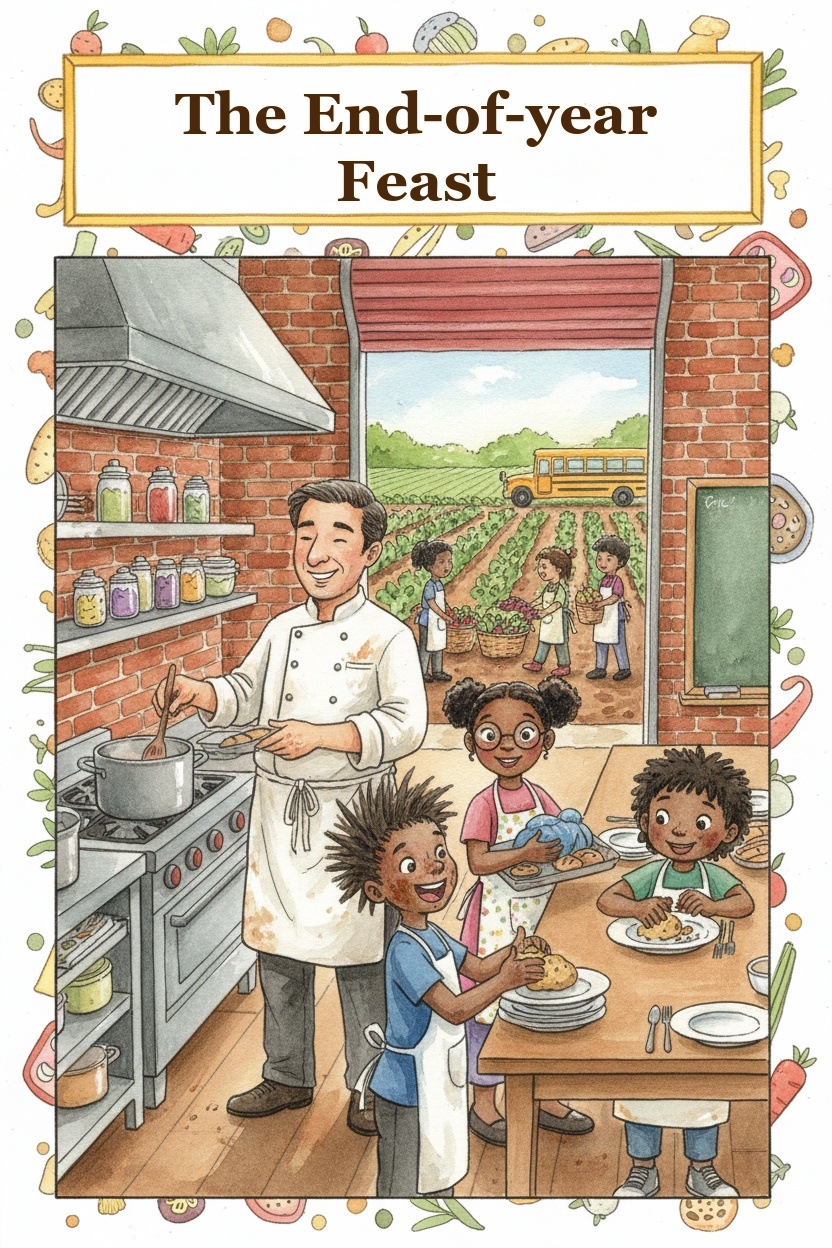
THE END-OF-YEAR FEAST
The Invitation
The morning of the last class, the Kitchen Lab smelled like the whole world.
Iggy had been cooking since six — timing things, arranging platters, polishing the enormous range where a fire engine used to park. A long table stretched across the old engine bay, covered in a tablecloth that had seen forty class sessions and several thousand spills.
"Today," Iggy announced, "is not a lesson."
Maya looked up from checking the label on a jar of honey. "Every day is a lesson with you."
"That's true. But today is also a feast. Every one of you brought a dish from your family's food memory. And I've added something small for every recipe we've made this year — a miniature version, a tiny homage. Look."
He swept his arm toward the table. The sweep knocked the honey jar sideways, but Iggy caught it without pausing. The students stared.
"You caught it," Tommy said.
"I did."
"The Spark Effect is broken?"
"The Spark Effect," Iggy said, "is not broken. It is suspending." He set the honey jar upright. "Today, I am simply not going to knock anything off the counter."
Sam, the future food critic, was already walking the table's length, rating with his eyes. "There are forty dishes here."
"Exactly forty," Iggy said. "One year of cooking. One table. Every recipe we've made together, in miniature. And every student dish, from real family recipes. Now let me see what you brought."
The Table
Tommy went first, because Tommy always went first. He set down a heavy bowl covered in foil.
"Tia Carmen's tamales," he said. "She makes them every December. The masa has to be whipped until it's light, and my cousins and I take turns because your arm falls asleep."
Iggy lifted the foil and inhaled. "The corn is nixtamalized," he said softly. "Using lime water, exactly like we learned in Book Twenty-six. The process that Mesoamerican cooks developed thousands of years ago to unlock the nutrition in corn."
Tommy shrugged. "I just know they're the best tamales in the whole neighborhood."
"Both things are true," Iggy said. "The science and the taste. Never let one steal from the other."
Priya placed a small copper pot on the table. When she lifted the lid, the smell of mustard seeds popping in hot oil filled the bay.
"Ammamma's dal," she said. Her voice was steady, but her eyes were bright. "I made the tarka myself this time. The oil has to be hot enough that the seeds pop, but not so hot that the garlic burns."
"When the seeds pop in the oil," Iggy explained to the class, "that's a physical change — steam expanding inside the seed coat. But it's also a flavor change. The heat releases compounds that the oil then carries through the whole dish."
"Ammamma says the oil carries the love," Priya said.
Iggy paused. "Your grandmother is a food scientist and didn't know it. Heat, chemistry, and distribution of flavor — that's the tarka. The love is the part that doesn't have a chemical name."
Dev set down a loaf of bread with a crackling crust. "My father's sourdough. He's had the starter for eleven years — we feed it like a pet. This is his recipe, but I did the folds."
"From Book Twelve," Maya said. "The yeast ate the sugars and made carbon dioxide. The gluten —"
"The gluten trapped it," Dev finished. "Like a protein balloon."
"The protein net," Iggy corrected gently. "Not a balloon. The gluten forms a network, and the CO₂ inflates it. Your father's starter has been building that network for eleven years."
Lucia brought her paintbox and set up at the end of the table, sketching furiously. "I'm drawing the whole thing," she said. "Every dish. Then we'll know what it all looked like even after we eat it."
"A history of the meal," Iggy said. "Food is always being documented. Always being remembered. That's part of what this table is."
The Scientists and the Storytellers
The students had brought more than dishes. Walking around the table, Iggy made them tell the story of each one.
"Here — the vinaigrette from our very first class," he said, pointing to a tiny jar. "Who wants to explain what it taught us?"
"It's an emulsion," Maya said. "Oil and water don't mix, but with the mustard as an emulsifier, they hold together long enough to dress a salad. Even then, it separates. It always separates, eventually."
"Like everything," Iggy said. "Entropy is real. But the vinaigrette is temporarily defying entropy — because of chemistry. That's what cooking is. Small, delicious acts of organized energy."
Tommy was already eating his way along the table. "The risotto is even better than I remember," he said, mouth full. "Creamy. The starch molecules — what did you call it?"
"The starch molecules release from the rice as it cooks," Iggy said, "and they thicken the liquid into a creamy texture. The stirring helps break down more starch. It's a carbohydrate chain, breaking into edible order."
"So the creaminess is chemistry," Tommy said.
"The creaminess is chemistry that your mouth reads as comfort. That's not an accident — your brain is wired to find soft, warm, savory foods pleasurable. Because of evolution. Because people who enjoyed eating warm, soft foods survived better."
Sam held up his notebook. "I'm rating everything out of ten. The seared fish from Book Twenty is a nine-point-five. The Maillard reaction makes it richer — the amino acids and sugars rearranging into hundreds of new flavor compounds."
"Maillard," Maya said. "Named after the scientist who discovered it. But people have been searing meat and bread since before there was science — they just didn't know what to call the transformation."
"Knowing what it's called doesn't make it less delicious," Iggy said. "It makes it more delicious. Because you can taste the complexity and understand why it's there."
Priya had stopped in front of a small dish of fermented cabbage. The sauerkraut was still bubbling gently in its jar.
"Our fermentation experiment," she said. "It's still alive."
"Thousands of tiny organisms," Iggy said, "eating sugar and producing acid. The acid preserves the cabbage. The microbes are doing chemistry we've been using for ten thousand years. Every culture on Earth figured out fermentation — yogurt in India, kimchi in Korea, sauerkraut in Germany, miso in Japan. Different ingredients, but the same science. The same taming of microbes."
Lucia put down her brush. "So every dish here is really a story about science?"
"And history. And culture. And your families. And geography." Iggy picked up a jar of golden syrup. "This is honey from Maya's uncle's hives. The bees collected nectar from flowers that grew in soil that was shaped by weather and seasons and thousands of years of earth history."
Maya looked at the jar. "I tasted it this morning," she said. "It's different from last winter — the flowers were different. He says each season has its own taste."
"Terroir," Iggy said. "The taste of a place. You can't test for it in a lab, but it's real. It's the whole world in a jar."
The Almost-Spark
The feast had begun in earnest. People were eating. Tommy had started a rumor about a tie between the tamales and the crème brûlée and was conducting his own taste test to break it.
Iggy stood at the center of the table, hands clasped, watching his students.
"Forty lessons," he said. "A whole year. And you know what we've really been doing?"
"Making you proud," Tommy said.
"Also true. But deeper — we've been learning that food is everything at once. It is chemistry. It is culture. It is history, agriculture, ecology, and love. The bread is a chemistry experiment and a family story. The tamales are cultural knowledge and agricultural science — corn, nixtamalized, wrapped in corn husks, steamed. The dal is chemistry — the tarka, the tempering — and it is Priya's grandmother's hands moving in a kitchen in Chennai, sixty years ago."
Priya wiped her eyes. "She would love this," she said. "Everyone at one table."
"That's the point." Iggy's voice had gone quiet, the way it did when he was saying something he really meant. "When you understand food — truly understand it — you understand everything. The earth that grew the grain. The water that carried it. The people who harvested and transformed and cooked it. The microbes that fermented it. Your own body, ready to turn it into energy and growth."
He began to gesture, the way he always did — the wave beginning, the enthusiasm cresting.
"And understanding none of that — not a single gram of it — makes the food less delicious. It makes it more delicious. Because when you eat with full knowledge, you're not just feeding your body. You're —"
His hands swept wide. The pepper grinder at the table's edge tottered.
The whole class went still. The prediction pool all looked at Iggy. He lunged — caught it — set it down — and the salt cellar, knocked loose by his own recovery, slid off the counter behind him with a soft thud.
It settled on the floor. Unbroken.
The class burst into applause.
"The Spark Effect is terminal," Iggy said, looking at the salt cellar. "I almost didn't knock anything over. I stopped myself. And then it fell anyway."
"Chaos theory," Dev said.
"Epistemologically impossible to predict," Iggy agreed. "You'd have to understand the whole universe to know which object would fall. And understanding the whole universe is —"
"Like cooking," Priya said.
Iggy smiled. "Exactly. You assemble the ingredients, you understand the science, you know the history, you honor the people who came before you. And then you let the universe do its thing — and sometimes the salt falls on the floor."
Maya was already picking it up. "Nothing broke," she said. "We can clean it up."
"And then we keep eating," Tommy said. "Because the feast isn't over."
The Last Bite
At the end of the evening, the table was reduced to crumbs and empty platters. Lucia's sketch covered three pages. Sam's rating sheet had been revised six times and still didn't have a final answer.
The students gathered in the horseshoe around the table.
"The whole world was on this table tonight," Iggy said. "Every lesson. Every recipe. Every family that sent food with their children to show them how much they're loved. And you know what? It's still just food. It's still just people cooking for each other."
He picked up the salt cellar from where Maya had set it.
"This is the last job," he said. "Every one of these dishes was made by someone's family. Made with their hands, not just their heads. I want you to remember every time you cook, for the rest of your lives: you are not just doing chemistry. You are not just repeating a recipe. You are continuing the human story of feeding each other."
"What's the question for the Kitchen Lab Notes?" Maya asked.
Iggy considered. Then he smiled.
"The question for next year," he said, "is this: when you cook at home, think about what your family's food says about your history. What is the story of your table? And what will you teach the next person who cooks with you?"
He tapped the salt cellar. "Because the Spark Effect, like cooking, is never finished."
The students looked at the table. At the empty platters. At their own sticky fingers.
And then Tommy said, "Can we take the leftovers home?"
"Tommy," Iggy said, "there are no leftovers."
"I know." Tommy grinned. "I just wanted to check whether you'd noticed."
The laugh filled the old fire station, warm as the oven that had baked a year of bread, and bright as the first flame ever coaxed by a human hand.
Kitchen Lab Notes
Students,
Tonight we set the whole year on one table. Forty lessons, forty recipes, forty families, one meal. You learned this year that food is chemistry — but you knew it all along, in your bones, because your grandmother's dal tastes like your grandmother. You learned that food is history — but you knew it because you tasted it and thought of home. What I want you to hold onto is the thing that none of the science can fully explain: the hunger that brings people to the same table, and the love that comes out of the kitchen in the serving bowl. The science makes that hunger more interesting. It doesn't make it less real.
When you cook at home, think about what your family's food says about your history. And then ask: what will you pass on?
— Chef Iggy
Recipe: A Tiny Year of Feasting — Iggy's Miniature Vinaigrette Table-Splash
Chef's note: This is the first recipe we ever made together. Make it when you're starting something — a new school year, a new kitchen, a new adventure. It comes together in exactly one minute of whisking, and it feels like magic every time.
Ingredients:
-
3 tablespoons extra-virgin olive oil
-
1 tablespoon red wine vinegar (or lemon juice)
-
½ teaspoon Dijon mustard
-
Pinch of salt and pepper
Steps:
-
Put the mustard, vinegar, salt, and pepper in a small bowl.
-
Whisk until the salt dissolves.
-
Slowly drizzle in the oil while whisking constantly. The mixture should thicken and look creamy.
-
Taste it on a piece of bread or lettuce.
-
Tell someone what you're about to start.
What's happening:
The mustard is an emulsifier — it helps the oil and water stay mixed longer. They'll still separate eventually. That's oil and water's true nature. The whisking just buys you enough time to enjoy them together.