Chef Sparks Kitchen Lab
ALIVE AND TRANSFORMING
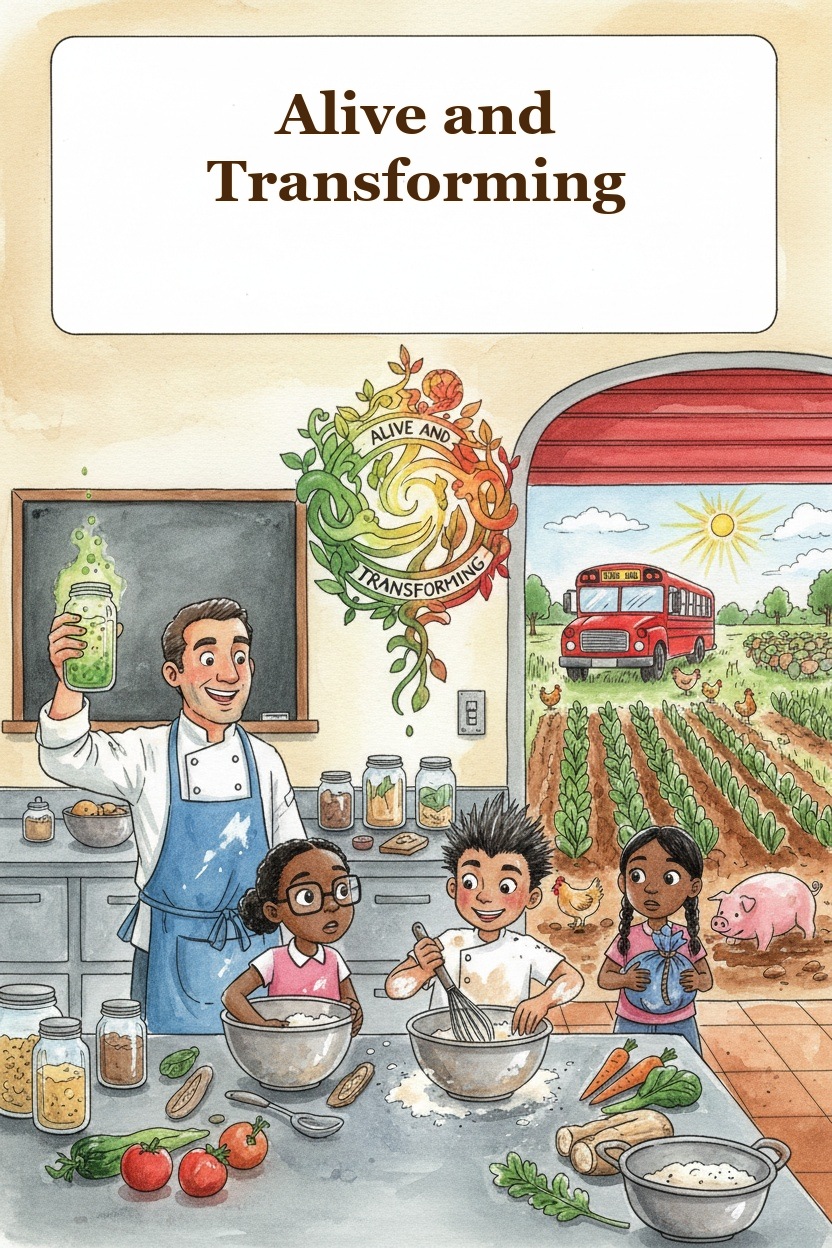
The Jars on the Counter
The Riverside Fire Station smelled like warm milk and something else—something Priya couldn't quite name. She tilted her head, sniffing. It wasn't bad. It was just... alive? Like bread rising in Ammamma's kitchen, but different.
Chef Iggy Spark stood at the great stainless steel range, wearing his usual flour-dusted apron. On the counter in front of him were eight glass jars, each filled with something different. Maya was already reading the labels, though there weren't any.
"All right, scientists," Iggy announced, spreading his arms wide. "Today we're going to talk about one of humanity's oldest magic tricks. Older than the wheel. Older than, hmm"—he paused, considering—"older than the song that got stuck in your head last week and you couldn't get it out no matter how hard you tried."
Tommy hummed two notes of something that might have been a commercial jingle. The class laughed.
"Milk doesn't turn into yogurt by itself," Iggy said. "Well, actually, it does. But only with help. And cabbage doesn't turn into sauerkraut by itself. And grape juice doesn't turn into—" He caught himself. "Actually, let's save that last one for when everyone's a bit older. The point is: there are invisible helpers in this kitchen. Billions of them. And they're alive."
He swept his arm toward the jars in a grand gesture that sent a wooden spoon spinning off the counter. It clattered to the floor. Maya added "wooden spoon" to the class prediction chart without looking up.
"Alive?" Dev asked. "Like, animals?"
"Like microorganisms," Iggy said. "Tiny living things. So small you can't see them without a microscope. And some of them—" He leaned in conspiratorially. "Some of them are the best cooks in the world. Better than me."
Tommy's eyes went wide. "Better than you?"
"Different kind of cooking," Iggy clarified. "They don't use ovens. They don't use knives. They don't even use recipes. They use chemistry. They eat certain things, and they transform those things into other things. And humans figured out thousands of years ago that if we let them do their work, we get food that tastes amazing, keeps longer, and is better for us."
He held up the first jar. It contained warm, creamy milk.
"This is our blank canvas," he said. "And this"—he held up a small container of white, spoonable yogurt—"is our starter."
The Transformation Begins
"What are we making?" Lucia asked, her pencil already sketching the yogurt container.
"Yogurt," Iggy said. "One of the simplest and oldest fermented foods on Earth. And fermentation"—he wrote the word on the chalkboard in big letters—"is what we do when we use living microorganisms to transform food."
He drew a cartoon of a tiny creature with a chef's hat next to the word. The creature had a little smile and was holding a fork.
"So there are these things called bacteria," Iggy said. "Most people hear the word 'bacteria' and think 'germs' or 'getting sick.' But the truth is, we have trillions of bacteria in our bodies right now, and most of them are helping us. Some of them help us digest food. Some of them make vitamins. And some of them, when we put them in milk, turn that milk into yogurt."
"How?" Priya asked. She was leaning forward, her hands clasped. This reminded her of something, but she couldn't think what.
Iggy's eyes lit up. "Great question. Milk contains a sugar called lactose—it's the sugar that makes milk taste slightly sweet. And the bacteria in yogurt are lactose-eaters. They drink up the lactose and they turn it into lactic acid. That's what they're doing in there. They're eating the sugar and pooping out acid."
Sam made a face. "That's gross."
"No, it's brilliant," Iggy corrected. "Watch what happens when the milk gets acidic."
He poured the milk into a clean pot and turned on the heat. "First, we warm the milk. This kills any bacteria that might already be in there, so our yogurt bacteria don't have to compete. Then we let it cool just a little—because if it's too hot, we'll kill our helpers."
He checked the temperature with a thermometer. "One hundred and ten degrees Fahrenheit. Perfect."
Then he stirred in a small scoop of the yogurt. "There. Now our helper bacteria are in the milk. They're a little sleepy right now—they've been in the fridge. But in a warm, cozy place, they'll wake up and start eating. And as they eat the lactose, they'll create lactic acid. The acid makes the milk proteins change shape—they link arms and hold tight to water, forming a thick, creamy structure. That's yogurt."
Maya raised her hand. "Is it safe for me? The milk has lactose."
"Here's the interesting thing," Iggy said. "Most of the lactose gets eaten by the bacteria. That's why some people who can't drink regular milk can still eat yogurt. The bacteria did the digestion for us." He paused, his eyebrows rising. "The bacteria are doing us a favor, and in exchange, the bacteria get food and a warm place to live. We're partners."
He poured the mixture into a tall glass jar and wrapped it in a towel. "Now this jar needs to stay warm for about eight hours. By tomorrow morning, we'll have yogurt."
Priya's hand shot up. "Chef Iggy, my Ammamma does this. She hangs yogurt in a cloth for hours to make it thicker. She calls it thayir—we have it with rice."
Iggy beamed. "Your Ammamma has been doing fermentation science for decades. That hanging cloth is doing something called straining—removing the extra liquid, called whey, to make the yogurt thicker. It's the same science in your kitchen, in your Ammamma's kitchen in India, and in every kitchen that's ever made yogurt."
He wrote thayir on the chalkboard next to yogurt.
"Now," he added, "let's make something that takes a little more patience."
The Crock of Cabbage
Iggy reached under the counter and pulled out a big ceramic crock with a wide opening and a heavy lid. Then he placed a head of cabbage on the cutting board.
"Who can tell me what this is?" he asked.
"Vegetable," Tommy said.
"A salad in waiting," Lucia said, sketching it.
"An opportunity," Iggy said. "Watch."
He sliced the cabbage into thin ribbons. The class watched, and then, with child-safe knives and plenty of supervision, helped shred the rest. The pile of purple-green shreds grew taller and taller.
"Now we salt it," Iggy said. He sprinkled salt over the cabbage and massaged it with clean hands. "The salt pulls out the water from the cabbage cells. In a little while, there will be enough liquid in this crock to cover the cabbage without adding a single drop of water. That liquid will be our environment for the next step."
"What's the next step?" Maya asked.
"The cabbage already has bacteria on it—they're from the field, the air, the natural world. These bacteria are exactly the ones we want. They're called lactic acid bacteria, and they're like the ones in our yogurt, but they don't need milk. They can eat the natural sugars in cabbage."
Iggy packed the salted cabbage into the crock, pressing it down firmly. "We need to keep the cabbage under the liquid. Why do you think that matters?"
Dev raised his hand. "Because bacteria that we don't want need air? The good bacteria work without it?"
"Exactly," Iggy said. "This is called anaerobic fermentation—fermentation without oxygen. The lactic acid bacteria don't need air to do their work. They create acid, which preserves the cabbage and also makes it taste tangy. The acid is so good at preserving that sauerkraut can last for months without a fridge."
He weighted the cabbage down with a small plate and a jar of water, then covered the crock with a clean cloth.
"This will sit in the pantry for about two weeks," Iggy said. "We'll check on it each class and taste it in a few weeks. It will change slowly—the sugars turning to acid, the texture softening, the flavor developing. By the end, it'll be a completely different food from cabbage."
"That's so cool," Sam said. "But wait—isn't this the same thing that makes me sick sometimes? Fermentation?"
Iggy shook his head. "Let's be precise. Any food can go bad if the wrong microorganisms get in. But fermentation is controlled—we set up the conditions so the good microorganisms we want are the ones that thrive. It's not letting food rot. It's guiding a transformation." He grinned. "We're food superheroes."
"Not a superhero," Maya said, grinning. "A chef. With tiny microbiological sidekicks."
Iggy laughed so hard he knocked the salt grinder off the counter. "Maya, sometimes you are the best thing that's ever happened to this kitchen."
The World in a Jar
Iggy led the class to the chalkboard, where he drew a large circle and wrote FERMENTED FOODS in the middle. Around it, he began drawing small pictures.
"Fermentation is everywhere," he said. "Humans independently figured it out all over the world, thousands of years ago, because it solves the same problems everywhere: how to keep food longer, how to make it more nutritious, how to make it taste better."
He drew a small cheese wheel. "Cheese is fermented milk. Different bacteria and molds make different cheeses—that's why camembert tastes different from cheddar."
He drew kimchi jars. "Kimchi, in Korea, is fermented vegetables with chili and garlic—the same science as our sauerkraut, with a totally different flavor."
He drew a loaf of bread. "Sourdough bread uses wild yeast and bacteria. That's why it tastes slightly sour—the lactic acid is doing its work in the dough."
He drew a block of miso. "Miso, in Japan, is fermented soybeans. And tempeh, in Indonesia, is fermented soybeans in a different way, using a mold that binds them into a cake."
He drew a bottle. "And wine and beer are fermentations of grapes and grains, using yeast instead of bacteria. Yeast is a fungus—a cousin of mushrooms—and it eats sugar and produces alcohol and carbon dioxide. In bread, the carbon dioxide makes it rise. In beer, both the carbon dioxide and the alcohol are the whole point."
Priya was studying the board. "So the bacteria and the yeast are doing the same kind of thing? Eating and transforming?"
"Beautifully put," Iggy said. "They eat. They transform. And humans have learned to work with them. We give them food and a good home, and they give us yogurt, cheese, bread, kimchi, miso, tempeh." He paused dramatically. "It's the oldest partnership in cooking."
"It's like they're invisible roommates," Tommy said.
"The best kind of roommates," Iggy said. "Ones that do the cooking."
Maya looked at her notes. She had drawn a careful diagram of the yogurt jar, the bacteria, the lactose turning to acid. "So," she said slowly, "when I eat yogurt, I'm eating something that was transformed by living things. And those living things did half the work of digestion for me."
"Exactly. And some of those bacteria might even make it to your gut still alive, where they can help your own microbiome. We call those probiotics—microorganisms that are beneficial when you eat them." Iggy made a circle with his fingers. "You've got a whole city of microorganisms living in your digestive system. A hundred trillion of them. They help you digest food, they help your immune system, and they communicate with your brain. We'll do a whole class on that later."
"A hundred trillion?" Dev's eyes were huge. "That's more than all the stars in the Milky Way."
"Probably," Iggy said, "though I haven't counted the stars personally. But the point is: you're never eating alone. You're always feeding your inner ecosystem."
The Taste of Tomorrow
The class cleaned up the kitchen. The yogurt jar sat wrapped in its towel, the bacteria busily working through the lactose. The cabbage crock sat in the pantry, slowly turning sharp and tangy.
"How long until we can taste the yogurt?" Sam asked.
"When you come back tomorrow," Iggy said. "It'll be ready. We'll eat it with honey and fruit."
"And the sauerkraut?"
"Patience," Iggy said. "Two weeks at least. But I promise, when you taste it, you'll understand what time does to food. It's a transformation you can't rush."
Tommy was quiet for a moment. Then he said, "Chef Iggy, my grandma makes this thing—she takes cabbage and she makes these rolls, and she leaves them in a jar for days before she cooks them. She calls them sauerkraut rolls. Is that the same thing?"
Iggy's face lit up. "Tommy, your grandmother has been doing fermentation science in her kitchen. The sourness in those rolls comes from the same lactic acid bacteria we're using tonight. She's been partnering with microorganisms for a long time, probably without calling it that."
Tommy nodded, looking at the crock on the counter with new eyes. "I'm going to tell her she's a food scientist now."
"Tell her she's a fermentation master," Iggy said. "It sounds more dramatic."
As the students filed out, Priya lingered by the crock. She put her hand on the cool ceramic.
"Chef Iggy?"
"Yes, Priya?"
"My Ammamma has a jar in her kitchen. It's been there for as long as I can remember. She says it's her 'magic rice water.' She uses it to make something she calls dosa batter. She says the batter needs to 'breathe' overnight before we cook the dosas."
Iggy smiled. "That's fermentation, Priya. The rice and lentils have natural yeasts and bacteria on them. Soaking and grinding them, then letting them sit overnight, gives those microorganisms time to work. They make the batter slightly sour and beautifully light. Your Ammamma is a fermentation master too."
Priya looked at the crock, then back at Iggy. "She never told me it was science."
"She might not call it science," Iggy said. "But that doesn't make it any less true. Science is just the word we use for understanding what's happening. Your Ammamma has understood what's happening for sixty years. She just calls it 'how it's done.' They're the same thing."
Priya smiled. She was going to call Ammamma tonight.
The Crock and the Jar
The next morning, the class gathered around the yogurt jar. Iggy lifted the towel. The milk had thickened. The surface was smooth and glossy, with a slight tang in the air.
"Look," Iggy said, scraping a spoon through it. "Milk has become yogurt. The bacteria ate the lactose and made acid. The protein linked arms and made a gel. It's a new food. It didn't exist before."
He served it to each student with a drizzle of honey and some fresh berries. Tommy took a bite and made the two-note hum that meant success.
"That's so good," he said. "And it's kind of amazing, thinking about the tiny helpers."
"We'll check the sauerkraut in a couple of weeks," Iggy said. "It'll be a little different every time we look. And every time, the flavor will be better."
Maya raised her hand. "I have a question."
"Always welcome."
"What's the deal with the containers that have the words 'fermented' or 'probiotic' on them at the store? Are they all actually fermented?"
Iggy opened his mouth, then closed it. He smiled. "You know what, Maya, that's a question we're going to save for another day. There's a lot of food marketing out there, and not all of it tells the truth. But the principle is the same as anything: understand what you're eating, and you'll know what you're feeding yourself."
He looked around the kitchen—at the chalkboard covered in diagrams, at the crock in the pantry, at the empty yogurt jars, at his students with honey on their faces.
"When we eat, we're never alone," Iggy said. "We're sharing the food with our tiny partners. And that's not strange. It's beautiful. It's how it's been done for thousands of years, in every kitchen, on every continent."
He knocked the pepper grinder off the counter.
No one blinked. Maya wrote "pepper grinder" on the chart.
Recipe Card: Kitchen Lab Yogurt
Chef Iggy's Note: You can't rush the bacteria. They work on their own schedule. But if you're patient, you'll turn milk into something entirely new.
You will need:
-
4 cups whole milk
-
2 tablespoons plain yogurt with live active cultures (store-bought or from a previous batch)
-
A clean jar with a lid
-
A thermometer
-
Honey and fruit for serving
Instructions:
-
Warm the milk in a pot until it reaches 180°F (82°C). Hold it at that temperature for 10 minutes.
-
Let the milk cool to 110°F (43°C). If it's too hot, it will kill the bacteria in the yogurt.
-
In a small bowl, mix 2 tablespoons of the warm milk with the yogurt. Stir until smooth.
-
Add the yogurt mixture back to the pot of warm milk and stir well.
-
Pour the mixture into a clean jar. Close the lid.
-
Wrap the jar in a towel and place it in a warm spot (like an oven with the light on, but turned off) for 8–12 hours.
-
When it's set and slightly tangy, refrigerate it. It keeps for about two weeks. Save 2 tablespoons to make the next batch.
Kitchen Lab Notes:
Today we learned that fermentation is transformation—a partnership between us and microorganisms. We can't see them, but they're always working, always eating, always changing things in ways we can often taste and sometimes find delicious. The world is full of invisible cooks with their own tiny kitchens. Sometimes they're helping us; sometimes they're just living their lives. The best we can do is understand what's happening, work with them, and be grateful for yogurt. Think of it this way: what things in your kitchen are changing right now, without you even knowing? What could you transform if you had patience? And what would your Ammamma call it, if you told her it was science? — Chef Iggy