Chef Sparks Kitchen Lab
FROM THE GROUND UP
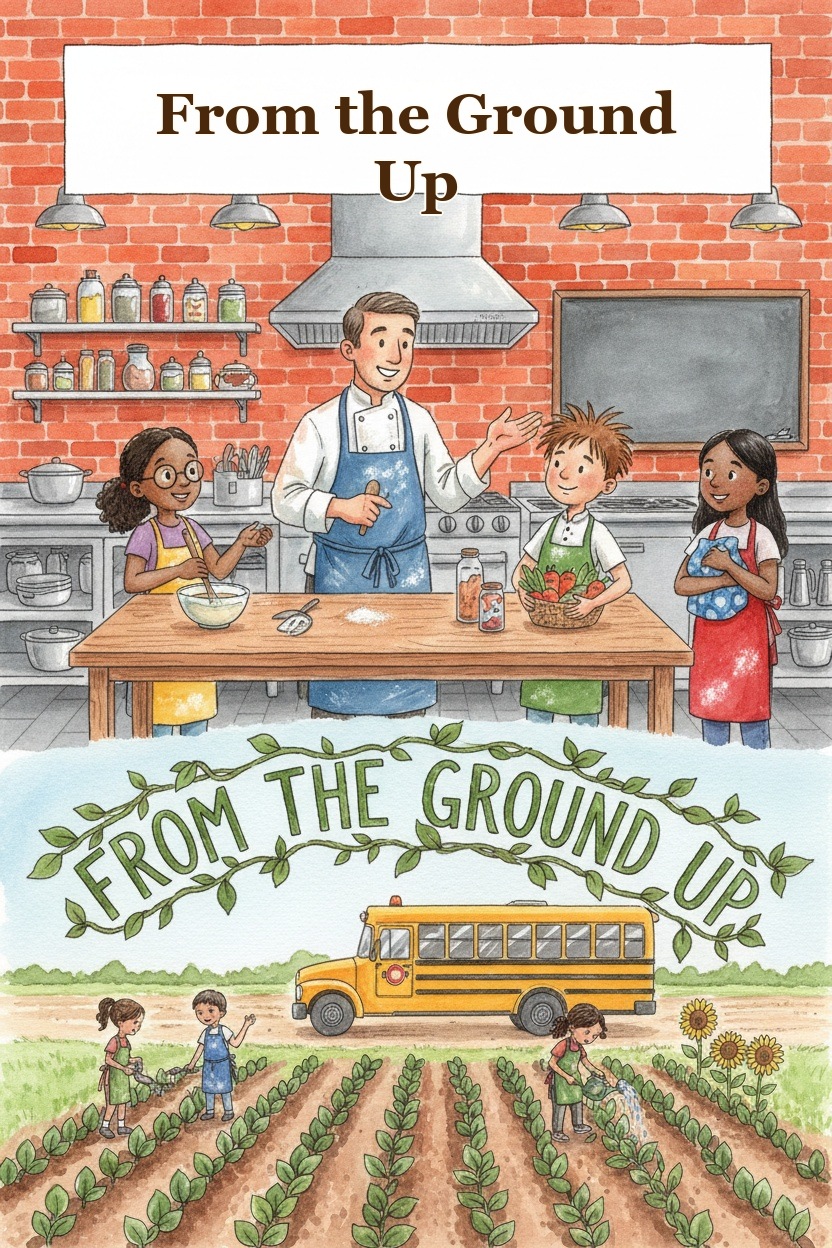
The Field Trip
The Riverside Fire Station's engine bay doors were rolled all the way open on Tuesday morning, which was unusual. Usually, the doors stayed closed to keep the kitchen warm and the smells inside. But today, Maya arrived first—she always arrived first—and found Chef Iggy standing in the open doorway with his hands on his hips, beaming at the courtyard garden.
"Morning, Maya!" he called. "Do you know what today is?"
"We're going to a farm stand?" Maya guessed. She'd seen the note on the chalkboard wall: FIELD TRIP: SMITH'S CORNER FARM STAND, 9:00 AM SHARP.
"Better than that," Iggy said. "We're going to meet a zucchini."
Tommy arrived second, already eating something—a piece of toast with honey, which he finished in three bites. "I love zucchini," he said. "My aunt makes them in the air fryer with garlic."
"Does your aunt know where zucchini come from?" Iggy asked.
"The store?" Tommy said.
Iggy's face did something complicated. "That's... not wrong," he said slowly. "But it's like saying a book comes from the bookstore. Technically true, but you've missed the entire plot."
Priya came through the door with her notebook already out. "Ammamma grows bitter melon on her balcony in pots," she said. "She says the plant is like a person—it needs the right food, the right water, the right amount of sun, and someone who pays attention to it."
"Your Ammamma is a wise woman," Iggy said. "That's exactly what we're going to learn about today. Everyone ready?"
The class piled into the minibus that Iggy had borrowed from the community center. Dev sat in the back and calculated how long it would take to drive three miles at various speeds. Lucia drew the passing buildings. Sam rated the minibus ride out of ten—"Seven, for the bench seat, but minus two because there's no snacks."
The farm stand was at the edge of town, on a road that started as pavement and gradually became gravel. Smith's Corner was a big white tent with wooden tables underneath, covered in crates and baskets and boxes of every color. There were tomatoes in three shades of red and two shades of orange. There were carrots with their green tops still attached, dirt still clinging to their roots. There was corn in piles that made Tommy's eyes light up.
But Iggy wasn't looking at the tables. He was looking at the woman standing beside them—a short woman with a sun-weathered face and arms that looked strong from lifting. She was wearing overalls and a t-shirt that said EAT YOUR VEGETABLES in bold letters.
"Class," Iggy said, "meet Rosa Smith. She grows everything on these tables."
"Everything?" Maya asked. "Even the... what are those?"
She pointed to a pile of knobby brown things that looked like someone had sculpted them out of mud and forgotten to finish.
"Those are Jerusalem artichokes," Rosa said. "Also called sunchokes. They grow underground. Want to try one?"
She cut a thin slice and handed it to Maya, who examined it carefully before eating it. Her eyes widened.
"It tastes like... sweet potato, but crunchier!"
"They're roots," Rosa said. "Everything on these tables is part of a plant. The question is which part."
The Biography of a Zucchini
Rosa led the class to the edge of the farm stand, where a field stretched out behind it. Rows of plants marched across the soil, organized with a neatness that Sam appreciated deeply.
"This is where the magic happens," Rosa said. "And I'm going to show you the biography of a zucchini."
"Vegetables have biographies?" Dev asked.
"Doesn't everything that exists have a story?" Iggy said. "The zucchini's story just happens to involve dirt."
Rosa walked them to a row of broad-leaved plants with yellow-orange flowers peeking out from between the leaves. She crouched down and patted the soil.
"Start here," she said. "Before you grow anything, you have to prepare the ground. This soil was hard and rocky when I first got this land. I had to break it up, pull out the rocks, add compost—which is decomposed plant matter, like a smoothie of nutrients for the soil."
"Like how we preheat the oven before we bake," Iggy added.
"Exactly," Rosa said. "You don't put a cake in a cold oven. You don't put a seed in hard dirt. You prepare."
She dug her fingers into the soil and pulled out a small clump, crumbling it. "Feel that," she said. Tommy reached out and touched it.
"It's soft," he said. "And it smells..." He thought about it. "Deep?"
"That's good dirt," Rosa said. "That's soil that can hold water but also drain it. That's soil with air in it, so the roots can breathe."
"Roots need to breathe?" Dev asked.
"Everything alive needs to breathe," Rosa said. "Even the parts of a plant you can't see."
She moved to another spot where the soil was undisturbed. "These are the zucchini seeds I planted in the spring. Each one is a tiny little sleeping plant, waiting. You plant it about an inch deep. Cover it with soil. Water it. And wait."
"How long does it take to grow?" Lucia asked, sketching the plant in her notebook.
"From seed to first harvest?" Rosa said. "About fifty days. The seed wakes up and grows down first—roots—and then up. The first leaves are called cotyledons. They're like training wheels, the first leaves the plant makes to get itself going before its real leaves grow."
"What are the real leaves for?" Maya asked.
Iggy jumped in, unable to contain himself. "Photosynthesis! The leaves are the plant's solar panels. They take sunlight, water, and carbon dioxide from the air, and they use that to make sugar—the plant's food. The sugar fuels the plant's growth. It's called photosynthesis."
"The sun powers the whole thing," Rosa agreed. "No sun, no zucchini. Simple as that."
She walked them along the row and pointed to a young zucchini growing at the base of a flower. "And here's the thing that surprises most people. A zucchini is a fruit."
"A fruit?" Tommy said. "But it's a vegetable."
"Vegetable is a cooking word," Rosa said. "Fruit is a biology word. A fruit is the part of the plant that holds the seeds. Tomatoes are fruits. So are zucchini, cucumbers, bell peppers, and pumpkins. In biology, a fruit is the plant's seed container."
"So there are no zucchini vegetables?" Sam asked.
"Oh, there are vegetables," Rosa said. "But zucchini is a fruit." She pointed to the plant around them. "And actually, this whole plant is edible. The flowers are edible. These are vegetable parts."
"What's the difference between a fruit and a vegetable, then?" Priya asked.
Rosa turned to Iggy. "You want to take this one?"
Iggy clapped his hands together, delighted. "Okay, class. Botanical definitions time. A fruit is the part of the plant that contains its seeds. Everything else is a vegetable. So a carrot is a root vegetable—that's the plant's storage tank, where it keeps its extra fuel. A stalk of celery is a stem vegetable—that's the plant's delivery system for water and nutrients. Spinach and lettuce are leaf vegetables—the solar panels. Broccoli and cauliflower are flower vegetables—the plant's flower buds. Peas and beans are seed vegetables—the actual baby plants, still in their pods."
"And zucchini," Rosa said, patting the little green fruit, "is a fruit. When I leave a zucchini on the plant long enough, it grows huge and the inside fills with seeds. That's how I save seeds for next year."
"Fifty days," Dev said, doing math in his head. "So you plant in June, you harvest in July?"
"About that," Rosa said. "But here's the thing about zucchini plants—they're generous. One plant can give you twenty, thirty, forty zucchinis in a season. They grow so fast that if you don't pick them, they become enormous. We call them marrows, and they're not great to eat at that size."
"Forty zucchinis," Maya said. "That's a lot of zucchini."
"That's why we give them away," Rosa said. "That's why the zucchini is the most shared vegetable in America. Nobody grows one zucchini. You grow forty. You eat ten. You give away thirty."
Iggy nodded. "The zucchini is a lesson in generosity."
Rosa stood up and brushed off her hands. "How many of you want to pick a zucchini to cook with?"
Every hand went up.
The Journey
Rosa gave each student a small pair of scissors and showed them how to cut the zucchini from the vine, leaving a small piece of stem attached.
"Don't pull," she said. "The plant is still growing. Cutting is gentler."
Tommy cut his zucchini and held it up. It was about the size of his forearm, dark green, with a slight sheen. "It's still warm," he said. "The sun got it warm."
"Everything that grows in the sun carries the sun with it," Rosa said. "That warmth is solar energy, stored."
Maya examined her zucchini carefully. "No dirt on this one."
"It grew above ground," Rosa said. "But look at the bottom—see where it was touching the soil? That part needs washing."
They carried their zucchinis back to the farm stand, where Rosa weighed them on a scale.
"You could pick the zucchinis straight from the plants and eat them in the field," she said. "That's the shortest possible journey—about ten steps. But I'm selling these, so they have to travel to get to you. That journey is called the supply chain."
"Supply chain?" Lucia said. She drew the zucchini in her notebook, then drew a line from it to the farm stand.
"It's the path food takes from where it's grown to where it's eaten," Rosa said. "My zucchinis go from the field to this stand. People buy them and take them home. Some go to restaurants. Some go to the grocery store. Every step in that path is part of the supply chain."
"This zucchini came from that field," Priya said, pointing. "That's about a hundred feet."
"One hundred feet and fifty days," Rosa said. "Now you know the whole biography."
"Time to cook!" Iggy announced. "We're taking these zucchinis back to the Kitchen Lab, and we're going to cook them the simplest way possible—because sometimes the best way to honor a vegetable is to not mess with it too much."
Sauteed Zucchini and the Whole Story
Back in the Kitchen Lab, the students gathered around the prep tables. Iggy had set out cutting boards, knives, a pan, olive oil, garlic, salt, and pepper.
"Okay," he said. "We're making sauteed zucchini. But first—what do we need to do?"
"Wash them," Maya said immediately. "They were touching the ground."
"Correct."
They washed their zucchinis under cold water, admiring the way the dark green skin beaded with water droplets. Then Iggy demonstrated how to cut them into rounds.
"Can you eat the skin?" Tommy asked.
"You can," Iggy said. "It's got fiber and nutrients. And honestly, the skin is part of the texture. If we peeled it, we'd be removing part of the zucchini's story."
"A zucchini's story," Sam said, grinning.
"Everything has a story," Iggy said. "This zucchini's story is that it started as a seed, grew in good soil for fifty days, was picked this morning by Rosa, and is going to be eaten by you. That's a journey worth respecting."
He heated olive oil in a pan and added some sliced garlic. The smell filled the kitchen.
"The word 'saute' comes from French," Iggy said. "It means 'to jump.' The food jumps in the pan. We're cooking at high heat, quickly, so the zucchini keeps its texture and its color."
Dev watched the pan. "Why is the oil hot before the zucchini goes in?"
"Ignacio's rule number one: hot pan, cold oil, never stick," Iggy said. "The hot oil creates a barrier between the zucchini and the pan. It also starts cooking the zucchini immediately—sealing the outside and keeping the inside from getting soggy."
The zucchini slices hit the pan with a satisfying sizzle. Tommy leaned in and inhaled.
"That smell," he said. "It's like... green, but warm."
"That's the Maillard reaction," Iggy said. "That browning you're seeing—those golden edges—that's flavor being created. The heat is turning the sugars and proteins in the zucchini into hundreds of new flavor compounds."
"How long does it cook?" Maya asked.
"Three to four minutes per side," Iggy said. "When to flip it?"
"When it's golden brown," Priya said.
"How do you know?"
"You check," Iggy said. "You peek under one slice. You learn what golden looks like. Cooking is paying attention."
For the next few minutes, the class watched the zucchini cook. Iggy flipped the slices, showing them the golden-brown patterns on the first side.
"Now," he said, "let's think about what we learned today, start to finish."
Maya spoke first. "The zucchini came from Rosa's field, where the soil was prepared with compost."
"And it started as a seed," Dev said. "It grew roots first, then leaves, then the fruit."
"It took fifty days," Lucia said, sketching the whole biography in her notebook: seed, sprout, plant, flower, fruit, harvest, table.
"The zucchini is a fruit because it has seeds," Priya said. "But we eat it like a vegetable."
"And it traveled," Sam said. "From the field to the stand to our kitchen."
"One hundred feet and fifty days," Iggy said. "An entire biography, ending right there in the pan."
He sprinkled salt and pepper over the zucchini and gave it one final toss—the little pieces jumping in the pan exactly like the name said they would.
"Ready," he said.
The students gathered around the serving board, and Iggy placed the sauteed zucchini on a large platter. They each took a slice—Tommy took two.
"Three," Tommy said, and took a third.
They ate. The zucchini was tender but not mushy, golden at the edges, with the garlic infused through the olive oil and salt bringing out the vegetable's sweetness.
Tommy made the two-note hum. The class knew what it meant: success.
Priya took another bite, then smiled. "It tastes like sunshine."
"It was grown in sunshine," Maya said. "Fifty days of it."
"For fifty days, that zucchini grew," Iggy said, "from a sleeping seed in the ground to this moment, right now, in your mouth. And now you know the whole story."
Sam rated it: "Ten out of ten. But I need one more piece to verify."
The Recipe
Sauteed Zucchini
Ingredients:
-
2 medium zucchini (or one per student, if you have a big class)
-
2 tablespoons olive oil
-
2 cloves garlic, thinly sliced
-
1/2 teaspoon salt
-
1/4 teaspoon black pepper
Instructions:
-
Wash the zucchini thoroughly.
-
Cut off the ends, then cut the zucchini into 1/4-inch rounds.
-
Heat a large pan over medium-high heat. Add the olive oil.
-
Add the garlic and cook for 30 seconds, just until fragrant.
-
Add the zucchini slices in a single layer—don't overcrowd the pan.
-
Cook for 3-4 minutes, until the bottoms are golden brown.
-
Flip and cook for 3-4 more minutes.
-
Sprinkle with salt and pepper. Taste, adjust, and eat immediately.
Chef's Note: "This is the zucchini's whole biography in one pan. The simpler you cook it, the more the zucchini can tell you about where it came from. Great zucchini needs almost nothing. Bad zucchini needs everything."
Iggy's Kitchen Lab Notes
"Today we learned that a zucchini is not just a vegetable that appears in the grocery store. It's a fruit that grew from a seed, in soil prepared by someone who cared about it, over fifty days of sunlight and water. We learned that vegetables are parts of plants—roots, stems, leaves, flowers, fruits, seeds—and that each part has a different job. We followed the supply chain from field to farm stand to kitchen, which means we know the whole biography of what we ate. When you understand where food comes from, you understand why it deserves your attention.
Here's your question to think about: Pick one vegetable in your kitchen. Can you figure out which part of the plant it is? Is it a root? A leaf? A flower? A fruit? A seed? Ask the vegetable its biography, and see if you can imagine the fifty days—or more—it took to reach you."