Professor Plunks Impossible Lab
Making Waves
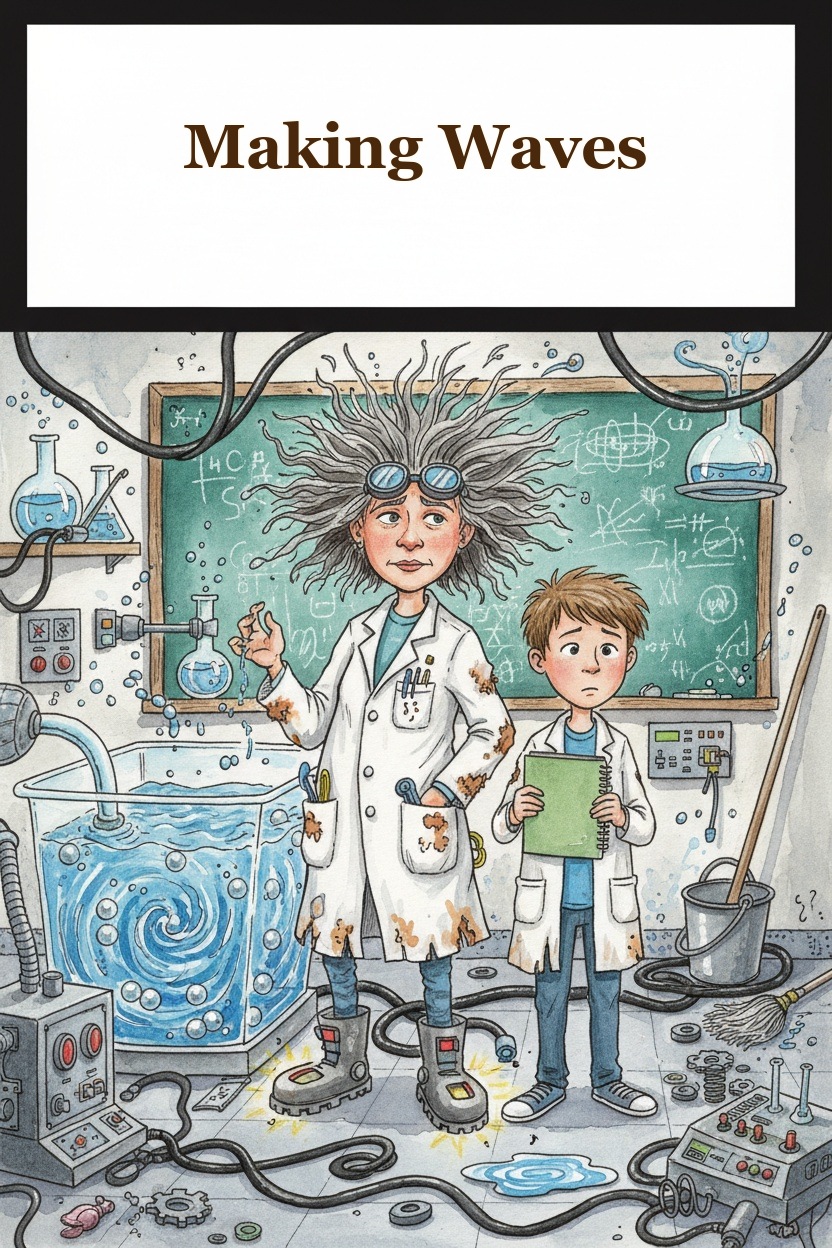
The Wave Tank and the Wobbly Water
"Otto! My careful colleague! Today we make waves!"
Professor Plunk burst through the lab door carrying something enormous and rectangular. It looked like a very long, very shallow bathtub made of glass and metal. Water sloshed over the edges with every enthusiastic step.
Otto looked up from his notebook. He had been carefully documenting the lab's collection of interesting smells (most recently: burnt toast, ozone, and something that reminded him of his grandmother's cough drops).
"That's a wave tank," Otto said. "I read about them. You use them to study how waves move."
"Correct! The Wave Observation and Wonder Apparatus, Mark One!" Plunk set the tank down on the central workbench with a wet thump. "It's a simple device. We fill it with water. We make ripples. We observe. What could possibly go wrong?"
Otto opened his notebook to a fresh page. He wrote:
Experiment #142: Wave Observation
Goal: Observe how waves move through water.
Risk assessment: WATER. On a TABLE. Near PLUGS.
He underlined near PLUGS twice.
Plunk was already filling the tank from a hose. Water rushed in, and Otto noticed, with the sinking feeling he always got right before things went wrong, that the tank had a small motor attached to one end. The motor had a paddle wheel.
"What's the motor for?" Otto asked.
"For making consistent waves, of course! Identical ripples, one after another, perfectly spaced. We'll measure the wavelength—that's the distance between wave peaks—and the frequency—that's how many waves pass a point each second."
Plunk flicked a switch. The paddle wheel began to turn, and gentle ripples moved across the water's surface in neat, regular lines.
"There!" Plunk beamed. "Perfect waves. Small, controlled, completely—"
The water in the tank began to slosh.
Not ripples anymore. Sloshing. The waves were getting taller. They weren't moving from the paddle to the other end anymore—they were bouncing back and forth, growing bigger each time they hit the walls.
"Professor," Otto said carefully, "the waves are getting bigger."
"Of course they are! That's what waves do when they bounce off a surface and overlap with new waves. The incoming waves and the reflected waves are interfering—combining constructively!"
"But they're getting REALLY big." Otto took a step back.
The Growing Waves
The water in the tank was now sloshing high enough to crest the glass walls. Each wave would race to one end, reflect, race back, and meet the new waves coming the other direction. When they met, the peaks combined into peaks twice as tall, and the troughs combined into troughs twice as deep.
"This is still fine!" Plunk shouted over the increasing roar. "The waves are standing waves! They're not travelling anymore—they're just oscillating in place! This is a wonderful demonstration!"
Water splashed onto Otto's shoes. He wrote in his notebook:
The waves are reinforcing each other. Constructive interference. Each bounce adds more energy. THE TANK IS ALMOST OVERFLOWING. THIS MAY BE THE PLAN. I HOPE THIS IS THE PLAN.
"It's the resonant frequency!" Plunk was now standing in a growing puddle, her eyes wide with excitement. "The motor is matching the natural frequency of the water in the tank! Every push comes at exactly the right moment to make the waves bigger!"
Otto looked at the ceiling. He looked at the tank. He looked at the wave that was now nearly two feet tall and climbing.
"Professor," he said, "the tank is only three feet long. The wave is almost as tall as the tank is long. That seems like a problem."
"Nonsense! It's a beautiful demonstration of—"
The wave crested the tank's wall entirely. A waterfall of cold water poured onto the workbench, and then over it, and then onto the floor, and Otto was suddenly standing in what felt like the world's shallowest swimming pool.
"Ahem," said a voice from the doorway.
Gloriana stood there, holding a very large mop. She looked at the spreading lake on the floor. She looked at the wave tank. She looked at the wave that was now four feet tall and showing no signs of stopping.
"Need a bigger tank," she said.
"That's exactly what I was thinking!" Plunk's eyes lit up. "Gloriana, you're brilliant!"
"I know," said Gloriana.
"Wait," said Otto, "bigger? You mean we're not stopping?"
"Stopping? Otto, we've barely started! This is incredible! Look at this wave—it's beautiful!"
And it was, if you liked being very wet and slightly terrified. The wave was now a perfect, towering curve of water, standing in the middle of the tank like a liquid wall. It wasn't moving forward or backward. It was just… standing there, shaking slightly, growing taller with each pulse of the paddle.
"THIS IS NOT IN THE PLAN!" Otto wrote, his handwriting barely legible. "THE PLAN WAS: SMALL WAVES. OBSERVATION. DRY CLOTHES. THE PLAN DID NOT INCLUDE A WATER WALL."
The Upstairs Neighbours
The problem, as Otto later wrote in his notebook, was that Professor Plunk's lab was on the top three floors of a very old building, and the building had a personality. More specifically, it had a resonant frequency.
The water in the tank was oscillating at exactly the same frequency as the building's support beams. And the building was old. And the beams were tired. And when you push something at exactly the right rate, over and over again, even a little push can make it shake like crazy.
The floor began to vibrate.
"It's spreading!" Otto shouted. "Why is it spreading?"
"The tank is transferring energy to the table! And the table is transferring energy to the floor! And the floor is transferring energy to the building! Wave energy travels through matter, Otto! The energy is being conducted through everything!"
"But the water isn't moving the building!" Otto was holding onto the doorframe as the room began to shake. "The water is in the tank!"
"The WAVES are in the tank! But the ENERGY is everywhere! Waves transfer energy, not matter, Otto! The water molecules are just moving up and down—but the energy they're carrying is passing through the table, and the floor, and the walls!"
This, Otto would later admit, was the most terrifying science lesson he had ever received. The floor was now rippling visibly, like the surface of a very stressed-out pond. The chalkboard was swaying. The lab equipment was dancing across shelves.
And then the ceiling began to creak.
"Professor," Otto said, his voice very small, "there are people upstairs."
"Of course there are! That's Professor Albright's lab—the acoustics laboratory!"
"THE ACOUSTICS LABORATORY?"
"Don't worry, Otto! They work with SOUND waves. This is WATER waves. Completely different!"
On the floor above them, three acoustics researchers were having a very strange morning. Their carefully calibrated sound equipment was shaking. Their rubber duck collection (one of them had a thing for ducks) was quivering. And the enormous bowl of water they kept on the central bench—for testing the way sound waves disturbed water surfaces, naturally—had begun to produce waves.
Waves that matched the exact frequency of the shaking floor.
Waves that were, extremely rapidly, getting taller.
The acoustics team looked at their bowl. They looked at each other. They looked at the ceiling, where the light fixture was now swaying in a rhythmic, almost musical pattern.
"What," said the lead researcher, "is happening?"
"Energy transfer!" said her assistant, who had read a book about waves. "Something below us is creating vibrations, and they're travelling through the building, and they're interacting with our water."
"But why are the waves so—"
She was interrupted by a knock on their floor. A very rhythmic knock. Bap-bap-bap-bap-bap.
A voice floated up through the floor: "SORRY! WE'RE DEMONSTRATING WAVE RESONANCE! IT WILL STOP—"
The voice paused.
"—PROBABLY!"
The water in the acoustics lab's bowl crested the edge.
The Impossible Wave
Back in Plunk's lab, Otto was having an idea. Waves, he remembered, could also cancel each other out. His notebook had said something about it. Destructive interference, the book had called it. When a wave peak meets a wave trough, they cancel each other out.
"Professor!" Otto shouted over the roar of what was now a very large and very wet wave. "Can we make another wave with the opposite frequency? A counter-wave?"
Plunk's eyes went wide. "Otto! That's brilliant! Destructive interference! We can create a second wave source, perfectly out of phase, and it will cancel the first wave!"
"Or at least make it smaller!"
"Smaller, bigger, it's all good data!" Plunk was already scrambling toward her supply shelves, which were now shedding their contents onto the wet floor with every shake. "But we need a second motor, and we need to drive it at exactly the same frequency, out of phase!"
The lab door burst open. The acoustics researcher stood there, soaked from head to toe, holding what was left of her research bowl.
"THERE ARE WAVES IN MY LAB!" she shouted.
"There are waves in EVERYONE'S lab!" Otto shouted back. "And there are about to be MORE waves unless we get a second motor!"
The acoustics researcher blinked. "A second motor? For phase cancellation?"
"YES EXACTLY THAT!"
"You need to offset the phase by half a wavelength," she said, "and you need to match the amplitude exactly."
"I KNOW THAT! I READ A BOOK!"
Professor Plunk emerged from the supply closet, holding a small motor triumphantly. "Found one! The Phase-Reversal Anti-Wave Generator! Well, no, it's just a motor. But if we run it backwards—"
It was, Otto would later write, the most unlikely scientific collaboration in history. A materials physicist, a water wave expert, a lab custodian, and an eight-year-old with a very wet notebook, all trying to stop a wave that was very nearly touching the lab's ceiling.
The wave was eight feet tall now. The tank was still only three feet long. The surface tension of the water—the same force that let insects walk on ponds—was somehow keeping the wave contained. For now.
"I'll run the motor!" the acoustics researcher shouted.
"I'll adjust the phase!" Plunk shouted.
"I'll—" Otto looked around. "I'll yell useful things!"
"Can you pass the wrench?" Gloriana asked, appearing beside him with a toolbox that had definitely not been there a moment ago.
Otto passed the wrench.
The motor whirred. Plunk twisted dials. The water in the tank began to develop a second set of waves, smaller ones, moving in the opposite direction.
"Not enough power!" Plunk shouted. "The waves are too strong! We need a bigger counter-wave!"
Gloriana reached into her toolbox and produced a second, larger paddle. She held it out. Plunk grabbed it without looking.
"What would we do without you?" Plunk asked.
"Flooded," said Gloriana.
The new paddle was attached. The motor whirred harder. The counter-waves grew. And then, with a sound like a giant sighing, the enormous wave began to shrink.
It didn't slam down. It didn't crash. It just… settled. Peak met trough. Trough met peak. The energy of the wave was meeting equal and opposite energy, and the result was calm.
"Well!" Plunk announced, as the water in the tank returned to a gentle ripple. "That demonstrated wave interference rather more vividly than I intended!"
The acoustics researcher stared at her. "Your lab has a resonant frequency."
"Every lab has a resonant frequency!" Plunk beamed.
"Your lab's resonant frequency matches the frequency of people's water bowls!"
"That's what makes it interesting!"
Otto looked at his notebook. It was soaked. The ink was running. But he could still read his final entry:
What I learned today:
Waves transfer energy without moving the thing they're travelling through.
The energy can go through the table, the floor, and the building.
When waves match their natural frequency, they get BIGGER.
When waves meet opposite waves, they cancel out.
Your ideas can help, even when everything is going wrong.
Wrenches are useful.
THIS WAS NOT IN THE PLAN.
BUT THE PLAN WAS WRONG.
"There's one more thing to see," Plunk said quietly. She pointed at the tank.
The water had gone still. Completely flat. But every few seconds, a tiny shimmer ran across its surface—a ripple so small it barely moved the water at all.
"That's the last of the energy," Plunk said. "It's still travelling. Still moving back and forth, a little less each time. Eventually it will stop completely. But right now, it's still going. The same energy that made our huge wave is still in there, still moving, just too small to see."
Otto leaned over the tank. The shimmer was beautiful—like the surface of the water was breathing.
"Energy doesn't just disappear," he said.
"Exactly!" Plunk put her hand on his shoulder. "Energy is always conserved. It just spreads out, and changes form, and becomes harder to see. But it's always there."
"Like the experiment," Otto said.
"Like the experiment," Plunk agreed.
Gloriana appeared at the door, carrying a stack of towels. She looked at the two of them, standing over a tank of perfectly still water.
"Nice wave," she said.