Lighthouse Cats
The Ship in the Bottle
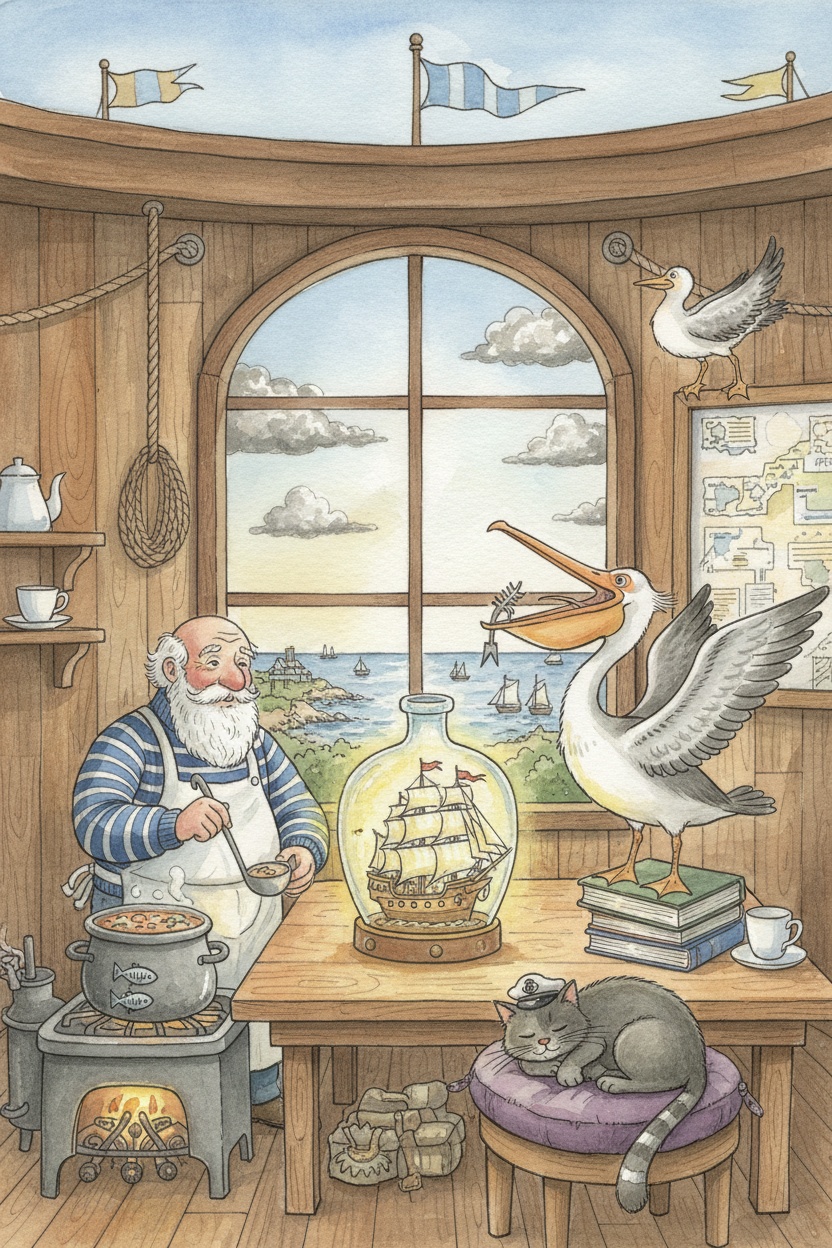
Captain Whiskers sat in her window at the top of the lighthouse, watching the morning sea turn from grey to gold. Below, old Angus was already stirring his famous fish chowder, humming a sea shanty about a whale who learned to dance.
Morris the Seagull landed on the sill with a dramatic flutter.
"Whiskers! WHISKERS!" he squawked. "There's a ship coming! But it's — it's — I can't explain it. It's the WORST thing that has EVER happened at this lighthouse!"
Penny the Pelican waddled up the stairs, her large bill clacking with excitement.
"Captain! There's a strange ship rounding the point!"
"Morris said it's terrible," Whiskers said calmly. "What does it actually look like?"
Penny tilted her head. "Well… it looks like a normal ship. A little sloop with a red sail. But it's…"
"Yes?"
"It's very small. And very shiny. And it appears to be inside a bottle."
Captain Whiskers did not panic. She never panicked. She simply blinked once, twice, and then descended the spiral stairs with measured steps.
At the harbour's edge, floating gently in the water, was a bottle. A proper glass bottle with a cork stopper. And inside that bottle was a perfectly formed little ship — masts and rigging and a tiny red sail. Through the glass, Whiskers could see tiny figures rushing about on deck.
A very small voice came through the bottle, muffled but clear:
"HELLO? CAN ANYONE HELP US? WE'RE A LITTLE LOST!"
Captain Whiskers stepped to the edge of the dock and studied the bottle carefully.
"Morris," she said, "has this bottle been here long?"
"IT CAME IN WITH THE TIDE, WHISKERS, AND IT's — wait, I thought you'd be more alarmed."
"Alarm is unhelpful," said Whiskers. "Investigation is helpful."
Penny peered at the tiny ship. "How did they get in there?"
"That," said Whiskers, "is a philosophical question."
"It is?" said Penny.
"It is. Because the more important question is not how they got in, but how they will get out."
The tiny crew had gathered at the glass. There was a mouse captain in a tiny hat, a beetle boatswain, and a ladybug navigator holding a tiny telescope.
"WE WERE SAILING ALONG," called the mouse captain, "AND THEN EVERYTHING WENT SHINY AND SUDDENLY WE WERE IN HERE! WE CAN'T SAIL ANYWHERE! WE'RE STUCK!"
"Have you tried pushing on the cork?" asked Whiskers.
"YES, BUT WE'RE TOO SMALL AND THE CORK IS TOO BIG!"
Whiskers examined the bottle. The cork was indeed quite large — at least as big as the whole ship.
"This requires thinking," she said.
She sat down on the dock, wrapped her tail around her paws, and closed her eyes. Penny and Morris waited in silence. The tiny crew waited too, pressing their little faces against the glass.
Captain Whiskers opened her eyes.
"Morris," she said. "You are a seagull. You have a strong beak. What would happen if you pulled the cork out?"
Morris puffed out his chest. "I could do it! I could definitely do it! I shall save the day! I shall — "
He hopped onto the bottle, gripped the cork with his beak, and pulled with all his might. The cork did not move.
"PUSH!" squawked Morris. "PUSH, PUSH — "
He pulled so hard that he flipped backward into the water with a great splash.
Whiskers sighed. "Penny. Your bill. It's large and strong. Perhaps you could grip the cork differently."
Penny stepped forward carefully. She wrapped her great bill around the cork and pulled. Her webbed feet slipped on the glass. The cork wiggled — just a little.
"It's moving!" cried the mouse captain.
But Penny couldn't get a good grip. The cork slid back into place.
"A problem," said Whiskers, "has layers. We have discovered the first layer — the cork is stuck. But there is a deeper layer: the bottle is glass, and glass is smooth. We need something to hold onto. Something rough. Something that can wrap around the cork completely."
She looked at her paws. She looked at the sea. She looked at the tiny ship.
Then she smiled.
"Morris," she said. "You are still dripping wet."
"THANK YOU FOR NOTICING, WHISKERS, IT'S VERY UNCOMFORTABLE."
"Your feathers are wet. And wet feathers are slippier than dry ones. But dry feathers grip well."
She turned to Penny. "Do you remember the shorebird way? When you were a chick, how did you keep things from falling out of your bill? When it was too big?"
Penny's eyes lit up. "You grip it with the edge of your bill! The little comb part! It catches!"
She turned back to the bottle, opened her bill wide, and clamped down on the cork — not with the full bill, but with the very edge, where her bill had tiny ridges like a comb.
She pulled.
The cork popped free with a sound like FWOOP!
A rush of tiny cheering came from the bottle. The sea water rushed in through the opening, and the tiny ship floated up and out — sailing free onto the harbour water, its red sail catching the wind beautifully.
The mouse captain tipped his tiny hat. "THANK YOU! WE OWE YOU EVERYTHING!"
"Every ship gets home," said Captain Whiskers. "That's a promise."
The tiny ship sailed off into the harbour, and the mouse captain waved until they were a speck on the horizon.
Penny looked at the empty bottle in the water. "What should we do with it, Captain?"
Whiskers studied it for a moment. "Put it at the repair shed. It might be useful. And it tells a good story."
Morris shook himself dry. "That was — actually — a fairly good rescue. But it was STILL nearly a catastrophe. The WORST one yet, probably."
"Was it?" asked Whiskers.
"Well… no," admitted Morris. "It was quite a nice one, really."
Captain Whiskers padded back up to the lighthouse. Inside, Angus was just waking from his nap.
"Funny," he said, blinking. "I thought I heard a cork pop."
Captain Whiskers blinked at him neutrally.
"You must have been dreaming, Angus."
And she sat in her window, watching the tiny ship sail home, and said nothing more about it at all.