Just Like Me
Too Many Sounds at Once
Sam loved the first day of school.
Not the morning part—the morning part was good too. The new backpack. The sharp pencils. The way Mama always made pancakes shaped like octagons on the first day.
But the best part was the afternoon. Because after lunch, Ms. Chen said they would start their unit on weather. And Sam knew everything about weather.
"Do you want to sit with me and Jordan?" asked a voice.
Sam looked up. It was Leo, from across the street.
"I do want to sit with you," said Sam carefully. "But I also want to sit with Jordan. And I want to look at the weather poster on the wall. And I want to eat my sandwich before it gets warm."
"That's a lot of wants," said Leo.
"Yes," said Sam. "That's how wants work."
The cafeteria door swung open.
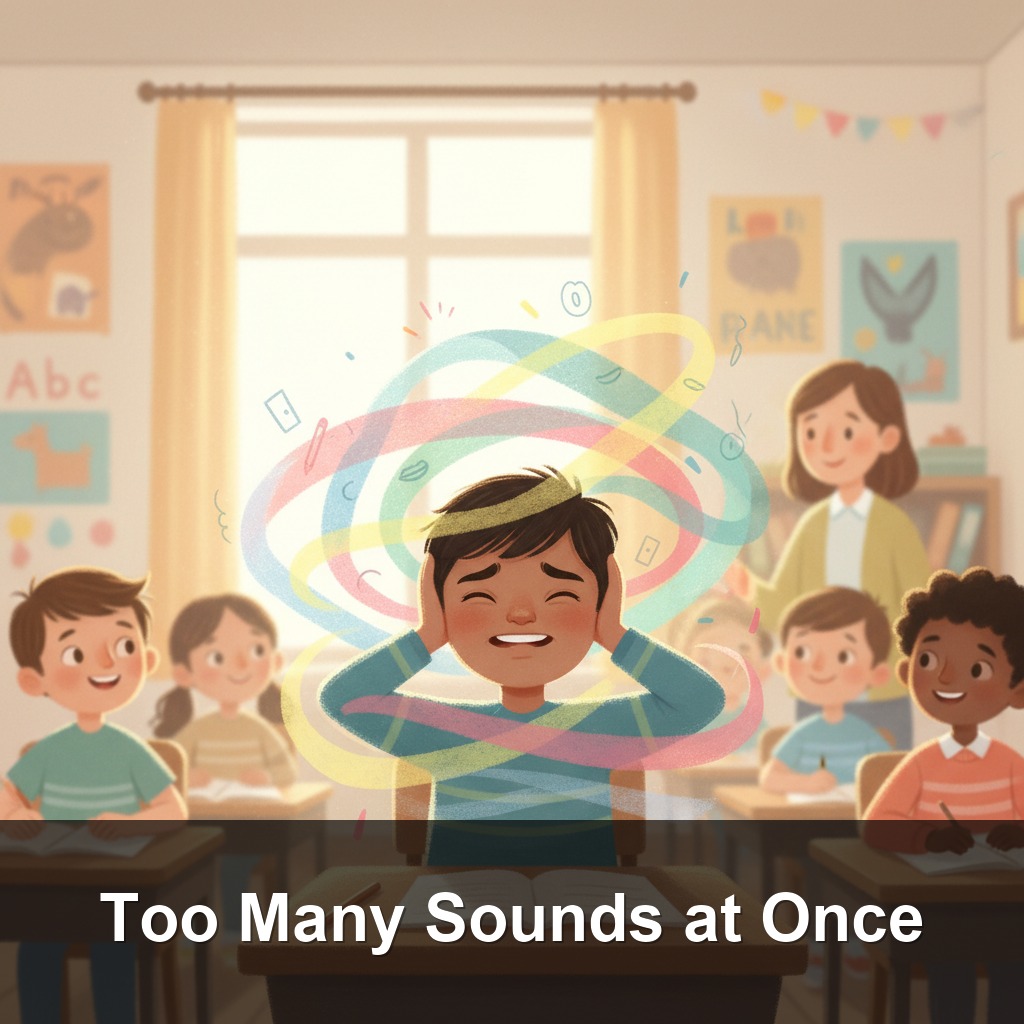
And the sound hit Sam like a wall.
Not a regular wall. A wall made of noise.
A hundred voices bounced off the ceiling. Trays clattered. Chairs scraped. Somewhere, a cart squeaked. The refrigerator hummed and buzzed like a trapped bee. Someone dropped a spoon. Someone else laughed. The laugh was too sharp, like it had edges.
Sam stopped walking.
The sound was inside Sam's ears now. Not outside. Inside. It pressed against the back of Sam's eyes. It made Sam's teeth feel tight.
"Come on!" said Leo. "I saved us seats!"
Sam tried to take a step. But the noise was so loud, and there was so much of it. It came from everywhere at once. It had no shape. No pattern. Sam could find patterns in rain. In waves. In the sound of wind against the window.
But this? This was just all sounds at once, tangled together like a knot of yarn with no end.
Sam's hands came up to cover Sam's ears.
But it wasn't enough. The sound leaked through. It wiggled in through the cracks between fingers. It vibrated in Sam's chest.
"I need a minute," said Sam. But Sam didn't think anyone heard. The words were too small. The noise was too big.
Jordan appeared. Jordan's mouth was moving, but Sam couldn't sort the sounds. It was like trying to find one specific raindrop in a whole storm.
"It's too—" Sam started. Then stopped. Because there wasn't one name for this. It wasn't just loud. It was too many sounds at once. Each one scratching to be heard. Each one demanding attention.
Sam's brain was trying to listen to all of them. That was the problem. Sam couldn't not listen. The sounds didn't fit together. They weren't supposed to. They were just... all there. All at once.
Sam's eyes found a spot on the floor. A gray tile. A pattern in the speckles—little dark chips scattered like seeds. Sam counted them. One. Two. Three. Four. Five. The counting made a path through the noise. A tiny path. But a path.
Six. Seven. Eight.
Sam counted to twenty.
Then Sam looked up.
Jordan was sitting on the floor nearby. Not talking. Just sitting. Jordan had scooted close enough to be there, but not close enough to touch.
"Okay?" said Jordan. Slowly. One word. Easy to sort.
"Not yet," said Sam.
Jordan nodded. Then Jordan pointed at Sam's lunchbox. Sam looked down. On the outside was a picture of a hurricane. Sam had drawn it. The spiral had taken three hours. Sam had used seven different blues.
Sam traced the spiral with one finger. Around and around. The spiral made sense. It all moved together. It all went in the same direction.
The noise was still there. But the spiral helped Sam remember something important:
The noise was outside. Sam could make it smaller.
Sam took a deep breath. "I'm going to try something," Sam told Jordan.
Jordan nodded again. "Tell me what you need."
"I need my sandwich," said Sam. "And my apple. And my water bottle. And I need to sit in the corner. Against the wall. So nothing can come up behind me."
Jordan stood up. "I'll get your stuff. You pick the spot."
Sam picked the spot. Far corner. Wall on one side. No one behind. Jordan brought the lunchbox and sat across from Sam. Not too close.
Leo came over with a tray. Leo's tray was loud. The plate clattered. The milk carton thumped. Leo sat down hard, and the bench squeaked.
"It's too many sounds at once," said Sam. "That's what it is. It's not too loud. It's too many at once."
Leo looked at the ceiling. Then at the floor. Then at all the kids talking. Leo tilted their head, like they were trying to hear it the way Sam heard it.
"I think I get it," said Leo. "It's like... everyone is a radio playing different stations."
"Yes," said Sam. "And I'm trying to listen to all of them at the same time."
"How do you stop?" asked Leo.
Sam unwrapped the sandwich. Octagon-shaped. Mama had cut it that way on purpose.
"I don't stop," said Sam. "I just make the other stations quieter."
Sam took a bite. Then Sam counted the speckles on the table. Then Sam looked at the hurricane on the lunchbox. Around and around and around.
And slowly—very slowly—the sounds began to sort themselves out.
The hum of the refrigerator became a low, steady song. Sam knew that song. The scrape of chairs became a rhythm—up, over, down. The voices blended into a wave that rose and fell like weather on a screen.
Sam could see the pattern now. Not all of it. But enough.
"I know the schedule," Sam said. "Lunch. Then weather."
"Weather!" said Jordan. "You're going to tell us everything about clouds, aren't you?"
"Yes," said Sam. "I know everything about clouds. There are ten main types. But actually, that's a simplification—"
Leo laughed. Not a sharp laugh. A round laugh. A laugh that Sam could hold in one hand.
"Tell me more about the clouds," said Leo.
And Sam did.
Later, back in the classroom, Ms. Chen smiled at Sam. "How was lunch?"
Sam thought about it. Really thought. The beginning had been hard. The middle had been better. And the end—
"The end was good," said Sam. "I found a way to make the sounds sort themselves out."
Ms. Chen leaned forward. "What did you do?"
"I counted the patterns," said Sam. "And I ate my octagon sandwich. And Jordan sat quietly. And Leo asked me about clouds."
Ms. Chen wrote something on a sticky note. Sam couldn't see what it said. But the sticky note was orange, which was Sam's favorite color.
"Tomorrow," said Ms. Chen, "I'll put a sign on the corner table. It will say 'Sam's Spot.' And you can go there anytime you need it."
Sam felt something warm spread through Sam's chest. Like the sun coming out behind a cloud.
"Thank you," said Sam. "That will help. I know it will."
And it would. Not because the corner was quiet. Because someone had remembered. Because someone had written it down.
That night, Sam drew a picture for Ms. Chen. A corner table. A sign. A hurricane on the lunchbox. And all around it, the ten main types of clouds.
Sam wrote at the bottom:
Dear Ms. Chen, thank you for helping me sort the sounds. I know everything about weather. Do you want to know?
From, Sam
A Note for Grown-Ups:
This story is about sensory overload—when sound comes in bigger and faster than the brain can sort it. For many autistic children, this is an everyday experience, not a moment of misbehavior. Sam doesn't need to be "fixed." Sam needed time, a safe spot, and one friend sitting nearby. If your child recognizes themselves in this story, know that their experience is real, their needs are valid, and their way of being in the world is exactly right.