Chef Sparks Kitchen Lab
THE COLOR OF DELICIOUS
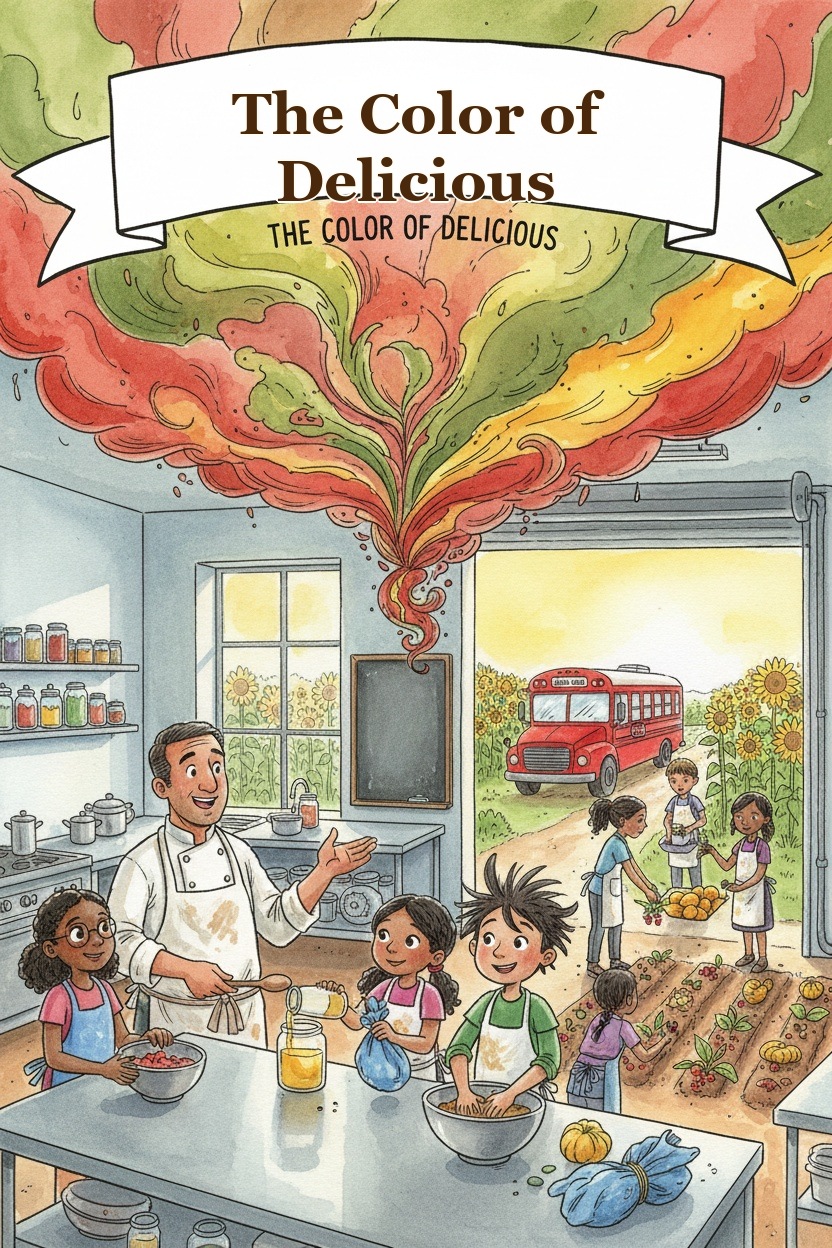
Chapter One: The Mystery of the Two Browns
The Riverside Fire Station smelled like vanilla and warm sugar before the students even walked through the door. Maya arrived first, as always, checking the countertops with her careful eyes.
"Chef Spark?" she called. "Why does it smell like dessert?"
Iggy Spark appeared at the top of the fire pole, slid down with a practiced thump, and grinned. "Because today, we are making dessert! And bread. And we are going to solve one of the greatest mysteries in all of cooking."
Tommy bounded through the door. "Dessert AND bread? Is it French toast?"
"No, but I like the way you think." Iggy tied his apron. "Today's question: why do things turn brown when you cook them?"
"That's easy," said Priya, setting down her backpack. "They get cooked."
"Ah, but that's not an answer. That's a description." Iggy's eyes sparkled. "A description says what happens. Science says why." He gestured to the chalkboard, where he had drawn two small circles side by side. Both were brown. "Here are two identical-looking browns. They look the same. They are not the same. They are made by two completely different reactions, and they taste different from each other. Today, we're going to make both of them so you can taste the difference."
Dev raised his hand. "Are they both delicious?"
"Ah, my young engineer, they are both delicious in completely different ways." Iggy pulled a tray of vanilla beans from the pantry. "And to prove it, we're going to make crème brûlée."
Tommy's hand shot up. "What's that?"
"Literally, 'burnt cream.'" Iggy held up a ramekin. "A custard — cream, egg yolks, vanilla, and sugar — baked until set. And then, at the very end, we add a layer of sugar on top and apply intense heat to turn that sugar brown. That, my friends, is caramelization. Sugar alone. High heat. Nothing else."
"And the bread?" asked Maya.
"We'll see that after." Iggy winked. "One mystery at a time."
Chapter Two: The Sugar That Changes Everything
The class gathered around the horseshoe of prep tables. Iggy had already prepared the custard base — it had been baking in the oven for the past hour — and now he brought out the ramekins, each one filled with a pale golden custard that wobbled gently when he set them down.
"This is the part where we get to play with fire," he said, and Sam, who wanted to be a food critic, immediately pulled out his rating notebook.
"On a scale of one to ten, how dangerous is this?"
"On a scale of one to ten, about a four. But we're going to be very careful." Iggy demonstrated with a small kitchen torch. "We sprinkle a thin layer of sugar on top of the custard. Then we pass the flame over it — not too close, not too long — and watch what happens."
He lit the torch and moved the blue flame in a slow spiral over the sugar. The students watched, mesmerized, as the white crystals first melted into a clear liquid, then began to turn gold, then amber, then a deep honey-brown.
"Smell that?" Iggy asked, holding the ramekin up.
"It smells like..." Maya paused. "Like caramel. Like the inside of a candy shop."
"That's caramelization." Iggy set the ramekin down. "Now, here's what just happened, and I want you to remember this. Sugar is a molecule. When you heat it high enough — and we're talking about three hundred degrees Fahrenheit or more — that molecule breaks apart and recombines into hundreds of new molecules. All of them are brown. All of them smell and taste different from plain sugar."
"Three hundred degrees?" Dev looked alarmed. "That's really hot."
"It is really hot. That's why we use a torch instead of a regular oven. The torch gets the sugar hot enough, quickly enough, while the custard underneath stays cool." Iggy held up a second ramekin. "Now — before I do this one, I need someone to tell me: was the custard already sweet?"
"Yes!" said Tommy.
"Of course! It has sugar in it. But was the custard brown?"
"No," said Maya. "It's pale."
"Exactly. And that's because the custard baked at a temperature of about three hundred degrees Fahrenheit — wait." Iggy paused. "That's the same as the torch. But the custard didn't brown. Why not?"
The class fell silent. Iggy let the question hang.
"Because of water?" Maya said slowly. "The custard has water in it. And water—"
"Water!" Iggy whirled around and, in his excitement, knocked an empty ramekin off the counter. It clattered to the floor. No one gasped — the Spark Effect was so well-known that the students barely looked up. Tommy, who had the prediction pool this week, noted it in his book: Empty ramekin, 2:30 PM.
"Sorry about that," Iggy said, entirely unaware that he had knocked anything over. "Maya, you're exactly right. Water is the key. Listen carefully, because this is the secret to so much of cooking."
He picked up a clean ramekin and held it up. "Water boils at two hundred twelve degrees Fahrenheit. It cannot get hotter than that — it turns into steam and floats away instead. So if food is wet, if it's full of water, it can never get above two hundred twelve degrees while there's still water in it. And two hundred twelve degrees is not hot enough for browning."
"Not hot enough?" asked Lucia.
"Not even close." Iggy shook his head. "Browning — whether it's Maillard or caramelization — needs three hundred degrees or higher. So as long as the water is still in the food, the food stays wet, and the surface stays cool." He pointed at the custard. "This custard baked in a three hundred fifty degree oven. But the water inside it kept the custard itself at two hundred twelve degrees. The water was like a tiny bodyguard protecting the custard from the heat."
"So when we use the torch on the sugar," Priya said slowly, "the sugar doesn't have any water in it. So it can get up to three hundred degrees."
"YES." Iggy pointed at her with the torch. "Brilliant, Priya. The sugar on top is dry. It has no water to protect it. So the flame passes over it and the sugar gets hot — hot enough to break apart and recombine into those hundreds of new molecules. The sugar caramelizes. The custard underneath stays cool and creamy."
"So the sugar turns brown, and the custard doesn't."
"Exactly. Now, who wants to help torch the rest?"
Chapter Three: The Bread That Tells a Different Story
The students took turns with the torch — carefully, with Iggy hovering to guide their hands — until all six ramekins were topped with glossy brown sugar. Tommy gave his a ten out of ten before he'd even tasted it.
"Not so fast," Iggy laughed. "The custard needs a minute to set. And we have our second mystery to solve."
He pulled out a loaf of bread, a cutting board, and a cast-iron skillet. "Now," he said, slicing off a thick piece, "I'm going to ask a question. When you toast bread — when it turns brown — is that caramelization?"
"Sure," said Dev. "The bread has sugar in it, right?"
"The bread does have sugar in it. And when you toast bread, the sugar on the surface does - some of it - caramelize. But that's not the main brown you're seeing." Iggy set his pan on the stove. "There's another reaction happening. A bigger one. And it's the difference between a plain sugar candy and a perfectly roasted everything."
He placed the bread in the dry pan and turned the heat to high. "What's in the bread besides sugar, Priya?"
"Flour?" she said. "And flour has protein in it. Gluten."
"Yes! And what are proteins made of?"
"Amino acids," said Maya. "Chains of amino acids."
"Chains of amino acids. And here's the beautiful part: when you heat amino acids and sugars together — when they're both present, on the same dry surface, at the same high temperature — they react with each other. The amino acids and the sugars combine. They break apart. They rearrange. And they form hundreds of new flavor compounds that taste like toast, like roasted meat, like seared fish, like golden bread crust."
By now the bread in the pan was beginning to brown. A savory, toasty smell — completely different from the sweet caramel of the crème brûlée — drifted up from the skillet.
"That smell," said Tommy, inhaling deeply. "That's the best smell in the world."
"That smell is the Maillard reaction." Iggy wrote the name on the chalkboard. "Pronounced 'my-yard.' Named after the scientist who discovered it. And it is one of the most important reactions in all of cooking."
Maya raised her hand. "Why haven't we learned about it before?"
"Because I was saving it for the right moment." Iggy smiled. "This is the moment. Because I needed you to see the two browns side by side. Look at the sugar on your crème brûlée. Now look at that bread." He held one up in each hand. "They're both brown. They're both made by heat. But the crème brûlée is caramelization — sugars alone. And the bread is Maillard — amino acids and sugars together. They look almost the same. But they taste different. They smell different. They are different."
Lucia was already sketching both in her notebook. "So caramelization is one ingredient, and Maillard is two?"
"Two ingredients that react with each other. And the reaction creates hundreds of new compounds. Hundreds! That's why toasted bread doesn't just taste sweeter — it tastes toastier. That's why a seared steak doesn't just taste like meat — it tastes roasted. The Maillard reaction is where flavor is born."
Iggy flipped the bread in the pan. The other side was already browning, a deeper golden Brown with darker patches at the edges.
"Why doesn't it brown on low heat?" asked Dev. "If the reaction works, why not just cook it longer?"
"Because heat is like a key in a lock." Iggy held up a finger. "The Maillard reaction needs a certain amount of energy to unlock it. Below about three hundred degrees, the reaction barely happens — it's so slow you'd have to wait days to see real browning. But above three hundred degrees, it takes off. The heat is like a running start at a jump. Without the running start, you can't clear the gap."
"And water stops it because..." Tommy squinted, trying to remember.
"Because water keeps the surface cool!" Maya said. "If the bread were wet, the water would soak up the heat and keep the bread at two hundred twelve degrees. The surface would dry — the water would boil away — before the browning could begin."
"So if I put wet bread in the pan," said Tommy, "it would just steam?"
"Exactly. You'd get soft, soggy bread. No Maillard, no golden crust. That's why, if you want a good sear on anything — bread, meat, vegetables — the surface needs to be dry. The water needs to leave first."
Chapter Four: The Taste Test
Iggy finished the toast — golden brown, slightly darker at the edges, with that smell that made Tommy hum a low note of pure happiness — and set it on a cutting board with the crème brûlée. Each student received one ramekin and one slice of toast, cut into strips.
"Now for the best part," Iggy said. "The taste test."
"Can I go first?" asked Sam, who had been writing notes furiously.
"Go ahead."
Sam took a bite of the toast first, then a spoonful of the crème brûlée. He chewed. He thought. He wrote something down.
"Well?" asked Lucia.
"Both brown. Completely different." Sam held up his notebook. "The toast is... savory. Toasty. You can taste the bread, but it tastes like bread only on the lowest level. There's something else. Something like... like the smell of warm flour, but intensified."
"That's the Maillard compounds," said Iggy. "Some of those compounds are also found in roasted coffee, grilled meat, baked potatoes. The same reaction, over and over, in different foods."
"Now the crème brûlée," Sam continued. "The sugar topping is... intense. Sweet but not just sweet. It tastes like toasted sugar. Like caramel. It tastes like the smell at the fair where they're making candy apples."
"That's caramelization. Pure sugar, transformed." Iggy looked at the class. "Notice — the toast has sugar in it too. So there's some caramelization happening in the toast crust as well. But the main flavor-building reaction is Maillard, and the flavor is mainly savory and toasty."
Tommy took his bite of crème brûlée and paused. He took another. Then he took a bite of toast. Then another bite of crème brûlée.
"They're both amazing," he said finally. "And they're not the same at all."
"That's the point." Iggy began gathering dishes. "Two browns. Two reactions. Two different kinds of delicious. And now you know how to make both of them — and when to expect each one."
Priya was quiet for a long moment. Then she said, "My grandmother makes a pudding that has a brown top too. She has this little flame brûleur."
"Crème brûlée is the classic version, but many cultures have their own caramel-topped custards." Iggy nodded. "Because the same chemistry shows up everywhere. Different recipes, different flavors — but the same love of that sweet, toasted brown."
"And the toast," said Dev, holding up his third piece. "This is the same as making a crust on a French bread, right? The Maillard reaction makes the crust."
"Yes! And on a steak. And on roasted vegetables. And on roasted coffee beans. Everywhere you see deep brown color on food, ask yourself: is this sugar alone — caramelization? Or is this sugar plus protein — Maillard?" Iggy smiled. "Now you'll never taste brown food the same way again."
Chapter Five: The Brûlée Moment
When the custards had fully set, each student got to crack the surface of their crème brûlée with the back of a spoon. The satisfying crack of the caramelized sugar breaking apart was, as Tommy said, "at least a nine out of ten."
"Wait, it's a ten," he corrected after tasting it. "The crack is a ten. The custard inside is a ten too. Everything is a ten."
"Tommy, you give everything a ten."
"Not true. I gave Kimchi a seven. In Book 14. Remember?" Tommy pointed at the chalkboard. "Sauerkraut was an eight, but kimchi was a seven. I wrote it down."
"Sorry, I forgot. You're serious about your ratings."
"The public needs to know."
Maya took a careful bite of her crème brûlée and smiled. "I like knowing which reaction made the brown. I feel like... I can taste it better."
"That, Maya, is the best thing a chef can hear." Iggy leaned against the counter. "When you understand what you're tasting, you taste more. The same food becomes richer, deeper, more interesting. That's the whole point of this Kitchen Lab — not to make you smarter about food so that you can show off, but so you can love it more."
Dev looked at his bread. "So... the Maillard reaction. Why did no one tell me about this before? It's the reason everything tastes good!"
"It's a big part of the reason cooked food tastes good." Iggy took a bite of toast himself. "Humans have been using the Maillard reaction for thousands of years — ever since we first learned to cook meat over fire. We just didn't know the name until about a hundred years ago. But we knew the flavor. We knew that fire made food better."
He gestured at the chalkboard, where he'd drawn the reaction as a little cartoon. "So here's the takeaway: the next time you see food turn brown in a pan, ask yourself two questions. One: is there water still in this food? If yes, it can't brown — it's just cooking in steam. Two: is it mostly sugar, or sugar plus protein? If it's mostly sugar, it's caramelization. If it's sugar plus protein, it's Maillard. Either way — and this is important — stop and smell it before you eat it."
"Why?"
"Because half of taste is smell. The Maillard reaction makes hundreds of compounds, and your nose can detect them all. So smell first, taste second. You'll get twice the delicious."
The class ate their crème brûlée and toast, and Iggy let them talk about their favorite brown foods. Maya admitted to a weakness for well-toasted bagels with cream cheese. Priya described her grandmother's pan-seared fish, with its crisp golden-brown skin that she insisted was the best part. Tommy described a perfect grilled cheese sandwich — butter and bread seared to a golden brown, cheese melted inside.
"I made one at home last week," he said. "I didn't know about Maillard then. Now I need to make another one and see if it's even better."
"It will be," said Iggy. "Because knowing what you're tasting is the best seasoning there is."
The Recipe: Crème Brûlée
From Chef Spark's Kitchen Lab
Ingredients:
-
2 cups heavy cream
-
1 vanilla bean (or 1 teaspoon vanilla extract)
-
4 large egg yolks
-
1/4 cup sugar (plus 2 teaspoons for the topping, per ramekin)
Equipment:
-
4 ramekins
-
A pan deep enough for a water bath
-
A kitchen torch (or a very hot broiler with adult supervision)
-
A small fine-mesh strainer (optional)
Steps:
-
Heat the cream and vanilla bean (split lengthwise) in a saucepan until it just begins to steam — do not boil.
-
While the cream heats, whisk the egg yolks with the sugar until pale and smooth.
-
Slowly pour the warm cream into the egg mixture, whisking constantly. This is called "tempering" — you're bringing the yolks up to temperature slowly so they don't scramble.
-
Pour the mixture into the ramekins, straining if you want extra smoothness.
-
Place the ramekins in the deep pan, pour hot water around them until it comes halfway up the sides, and bake at 300°F for about 40 minutes, until the edges are set but the center jiggles gently.
-
Cool completely, then refrigerate for at least 2 hours (or overnight).
-
Just before serving, sprinkle 2 teaspoons of sugar on top of each custard. Torch the sugar with a kitchen torch until it melts and turns golden brown. Let it sit for 2 minutes — the sugar will harden into a glassy crunch.
Chef's Note: The custard is cooked by water — that's why it stays pale. The sugar topping is dry, so it can get hot enough to caramelize. Two different browns? No — one brown (the caramel), and one pale custard with vanilla-scented creaminess. The contrast is part of the magic.
Kitchen Lab Notes
Dear students,
You have now witnessed one of the great wonders of the kitchen: the moment when identical-looking browns turn out to be completely different. Caramelization is sugar alone, breaking apart in the heat. The Maillard reaction is sugar and protein together, creating hundreds of new flavors. Now you know the secret behind every golden toast, every seared steak, every roasted marshmallow.
Here's this week's question: next time you eat something brown, see if you can figure out which reaction made it. Ask yourself: was this brown made from sugar alone, or from sugar and protein together? You might be surprised how often you can guess.
Until next time — keep your pan dry, your heat high, and your nose open.
— Chef Spark
Maya was the last to leave, as usual, wiping down the counter even though Iggy had already done it. She paused at the chalkboard and looked at his cartoon Maillard reaction — two little stick figures (the amino acid and the sugar) holding hands and becoming one bigger stick figure.
She smiled. Then she wrote, very small, in the corner of the board: "Maillard #1, Caramelization #2."
"Keeping track?" Iggy asked.
"Making sure I remember." She capped the chalk. "Two browns. Don't mix them up."
Iggy nodded gravely. "That's the whole lesson in one line."
She left, and the fire station grew quiet. Iggy looked at the chalkboard and smiled, then set the empty ramekin back on the counter where it belonged — right at the edge.
Just in case.