Chef Sparks Kitchen Lab
THE CODE ON THE PACKAGE
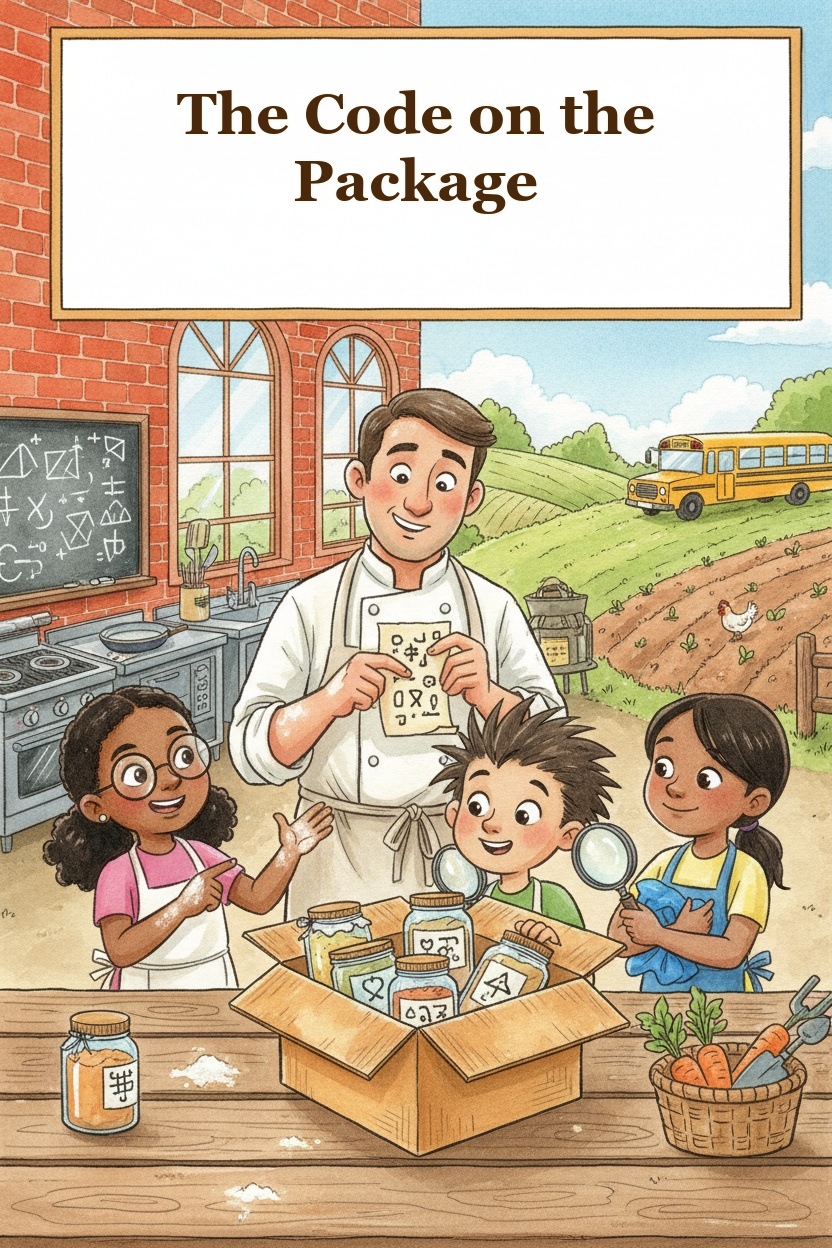
THE MYSTERY OF THE PACKAGE
The Riverside Fire Station kitchen was quiet when Maya walked in. That was unusual. Usually, Iggy was already there, humming opera loudly while clattering pans, or sliding down the fire pole (which everyone had asked him not to do, and which he did anyway). But today, the kitchen was still. The great range sat cold. The prep tables gleamed empty.
On the biggest table, Maya spotted ten items laid out in a neat row. Boxes, bags, bottles, jars. Cereal. Crackers. A carton of yogurt. A jar of pasta sauce. A can of soup. Something wrapped in bright paper that looked like a candy bar.
Maya walked closer. She knew exactly what these were.
"Smells like knowledge," said a voice behind her.
Maya didn't jump. She'd been coming to Kitchen Lab long enough to expect Iggy to appear where he hadn't been a second before.
Chef Spark stood in the doorway, holding a cup of coffee. "I found these in my pantry. All packaged foods. All with secrets inside." He grinned. "Today, Maya, you're the teacher."
Maya blinked. "I'm what?"
"You're the teacher," Iggy said. "You know food labels the way other people know song lyrics. Fluently. Fully. Automatically." He set down his coffee and spread his arms wide. "I'm your assistant today. I'll be taking attendance and pretending to know things."
The door banged open and Tommy Reyes rushed in, already talking. "What are we cooking? I'm hungry, I had cereal but it wasn't enough, and my mom said—" He stopped. He saw the packages. He saw Maya at the front of the room. He saw Iggy standing beside her with a dish towel folded over his arm like a waiter. "Whoa. What's happening?"
"Reading labels," said Maya.
Tommy squinted. "Like, reading the words on them?"
"Like cracking a code," said Iggy. "A code about what's really in your food. And Maya's going to teach us how to read it."
Priya and the others filed in, murmuring curiously as they saw the unusual setup. When everyone was seated at the horseshoe of prep tables, Maya took a deep breath.
"Okay," she said. "First thing you should know: a food package is trying to sell you something. So it's going to say whatever it can to make you want to buy it. 'Natural.' 'Healthy.' 'Good source of—' all of that."
"But don't you believe what the package says?" asked Dev.
Maya held up a bright blue box. "This says 'MULTIGRAIN CEREAL' in big letters." She turned it around. "Let's look at the real story."
THE INGREDIENT LIST AND THE LAW OF FORWARD
Maya turned the box so the back faced the class. There was a long list of tiny words, plus a rectangular panel full of numbers.
"It looks like another language," said Lucia, pulling out the tiny sketchbook she drew everything in.
"It is a language," said Maya. "And once you know it, it's easy."
She pointed to the ingredient list. "Ingredients are listed by weight. The thing there's the most of comes first. The thing there's the least of comes last."
"So if I want to know what I'm mostly eating," said Priya slowly, "I read the first few ingredients."
"Exactly." Maya scanned the cereal box. "So this 'multigrain cereal' has: whole grain corn, sugar, whole grain wheat, corn meal, sugar, brown sugar, salt, and then about fifteen other things. Can anyone tell me something about this cereal?"
There was a moment of silence. Then Tommy, who had been squinting at the box, said, "It's got more sugar than whole grain wheat."
"Right!" Maya beamed. "It's got three kinds of sugar in the first six ingredients. Corn syrup. Sugar. Brown sugar. So even though it says 'multigrain' and pretends to be healthy, the front of the box is what the company wants you to think. The ingredient list is what's actually true."
Iggy nodded, wiping a dry counter with his towel, as if he were serving at a fancy restaurant. "And here's a secret about sugar words. They don't always look like sugar. Sugar hides behind other names."
"Sugar names," said Priya, pulling out a notebook. "Like what?"
Maya started listing them on her fingers. "Sugar. Brown sugar. Corn syrup. High-fructose corn syrup. Honey. Molasses. Maple syrup. Malt syrup. Rice syrup. Dextrose. Fructose. Glucose. Lactose. Maltose. Sucrose. Fruit juice concentrate. Agave nectar. That's not even all of them."
"Wait, honey?" said Dev. "Honey counts as sugar?"
"Honey is sugar," said Maya. "Delicious, natural, wonderful sugar. But your body treats it basically the same as any other sugar. Now, the second secret—" She picked up a jar of pasta sauce. "This says 'No high-fructose corn syrup.' That's true. But look at the ingredient list: tomatoes, onions, sugar, garlic, sugar, basil, sugar."
Tommy laughed. "They hid it in the middle!"
"The ingredients are in order by weight, so sugar is the third thing in there. And there's more sugar than garlic—which seems wrong for a pasta sauce." She set the jar down. "When you're reading ingredients, look for every sugar word. Add them up. If sugar shows up three times under different names, that's a lot of sugar."
THE NUTRITION FACTS PANEL
"Okay," said Tommy. "That round box with all the numbers. What's that?"
Maya smiled. "That's the nutrition facts panel. It's the most important box on the package."
Maya pulled out her own lunch—a sealed container of yogurt she'd brought from home. She turned it around. "This is the code. The first number is serving size. That's the amount the information is talking about. But here's the tricky part—"
"They lie about it," said Iggy, popping in from behind a shelf. He was now wearing a cheesy bowtie that he must have found somewhere in the pantry. "They make the serving size small so the numbers look good. A serving of this yogurt is half a cup. But who eats half a cup of yogurt?"
"I eat a full cup," said Sam, writing notes like a food critic at a restaurant. "That means every number I see, I have to double."
Maya nodded. "Which is the first rule: check the serving size, then check how many you're actually eating."
She pointed to another line. "Now, the second line tells you calories. That's energy. But calories aren't the whole story, right, Chef?"
Iggy looked overjoyed. "RIGHT! A hundred calories of broccoli and a hundred calories of chocolate are not the same thing. Calories are just energy, but food is more than energy—it's information for your body. Come on, Maya, I want to hear about the Daily Value."
Maya pointed to the column of percentages. "These are Daily Values. They're based on a standard diet where someone eats about 2,000 calories a day. If a food has 5% Daily Value of something, that's considered low. 20% or more is considered high."
"So if I eat something with 30% daily value of calcium," said Priya, "I'm getting almost a third of what I need for the whole day?"
"If you're an average adult," said Maya. "But the important thing is the pattern. You want a food to have low Daily Values of some things and high Daily Values of others. What do you think we want low?"
"Sugar," said Tommy immediately.
"Right. And sodium—salt. Now let's look at this." She held up the box of crackers. "The nutrition panel says: sodium 320 milligrams, 14% Daily Value. That's 14% of your sodium for the whole day—and that's just from a small handful of crackers."
"But they don't even taste salty!" said Lucia, looking shocked.
Maya smiled a very patient smile. "Exactly. That's the lesson. Salt doesn't always taste salty when it's inside other flavors. It's there to enhance the other tastes, not to taste like salt. Crackers don't taste like a salt lick, but they're full of sodium because salt makes the flour taste better and helps the dough come together."
"And sugar doesn't always taste sweet," added Iggy, holding up a jar of tomato sauce. "This has sugar in it, but when you taste it, you taste tomatoes and herbs—not candy. Sugar is there to balance the acid in the tomatoes and make the sauce taste smoother."
"So the package tells you what it wants you to taste," said Priya, writing in her notebook. "But the label tells you what's really there."
THE SURPRISE WAKE-UP CALL
Maya moved through the ten packages, holding each one up and reading the label. The class discovered, one by one, that:
-
The cranberry juice they thought was "healthy" had almost as much sugar as a soda.
-
The trail mix with "no added sugar" had chocolate chips in it—which are, as Tommy pointed out, mostly sugar.
-
The soup that tasted cozy and warm had over a third of the day's sodium in one bowl.
-
The granola bar had three words for sugar and only one word for oats.
-
The "protein" crackers had more flour than protein.
-
The fruit-flavored yogurt had twice the sugar of the plain yogurt.
"Wait," said Sam, staring at the yogurt's label. "If I buy fruit yogurt, I'm basically buying yogurt with sugar and a little bit of fruit flavor?"
"Basically," said Maya. "But this doesn't mean you can't eat fruit yogurt! Just know what you're eating. If you eat yogurt with sugar in it, you're choosing to eat yogurt with sugar. It's not a mystery. It's just information."
"How do I know which ones to choose?" asked Dev.
Maya shrugged. "You don't have to choose 'perfect' foods. Nobody eats perfect. But you should know what you're eating. It's like... you start with what the food is supposed to be. Like for yogurt, the first ingredient should be milk. And then the less stuff after the milk, the closer to plain it is."
"So real food first, and fake junk second," said Tommy.
"That's not a bad rule," said Iggy, looking at the ceiling thoughtfully. "The code on the package is really just a map. And the map shows you the whole journey: where the ingredients came from, what's in them, what they'll do for your body."
At that exact moment, Iggy swept his arm toward the chalkboard to illustrate his point. A glass jar of tomato sauce, sitting at the edge of the counter, tumbled off and shattered on the floor.
The class held its breath.
"THAT was the Spark Effect," said Iggy, trying to ignore it. "We'll clean that up after lunch."
Tommy wrote "jar of pasta sauce" in his prediction notebook, then looked up with a grin. "That's twelve points for me."
THE KITCHEN LAB RECIPE: PLAIN YOGURT PARFAIT
Normally, Kitchen Lab ended with a dish. Today, the dish was analysis. But Maya made a small demonstration anyway, because she didn't want the class to end with no food at all.
She put plain yogurt in a bowl. She added fresh berries, a drizzle of honey, and a sprinkle of granola. She held up the container of plain yogurt and showed the label: one ingredient. Milk.
And she held up a container of berry yogurt, just so everyone could see the difference. Nine ingredients: milk, sugar, strawberries, corn syrup, natural flavors, pectin, and a few things no one could pronounce.
"Same bowl of yogurt," she said. "One of them has information I can understand. The other has a code—and now I know how to read it."
The class ate their parfaits in appreciative silence.
IGGY'S KITCHEN LAB NOTES
Dear students,
Today you learned that a package of food is a message—and that the truth is printed in small letters, not big ones. Fight the urge to believe the front of the box. The back of the box is your friend. The ingredient list is honesty. The nutrition facts are the facts.
Here's your question until next time: Pick any packaged food in your kitchen. Read the ingredient list out loud to your family. Count the sugar words. Count the sodium lines. Then, maybe, try the whole-food version of that same thing—not because packaged food is bad, but because you should always know what you're choosing. Information tastes better than surprise.
—Chef Spark
RECIPE CARD: MAYA'S YOGURT PARFAIT
Ingredients:
-
1 cup plain yogurt
-
1/2 cup fresh berries (strawberries, blueberries, or raspberries)
-
1 teaspoon honey
-
2 tablespoons granola
Steps:
-
Scoop the yogurt into a bowl.
-
Wash the berries, then scatter them on top.
-
Drizzle with honey.
-
Sprinkle granola over everything.
-
Eat it slowly, and think about every ingredient you're tasting.
Chef's Note: This parfait is a wonderful breakfast because it has protein, healthy fats, and vitamins—but you could also swap the berries for a sliced banana or chopped apple. The best ingredient is the one you choose with your eyes open.