Chef Sparks Kitchen Lab
THE SWEET SCIENCE
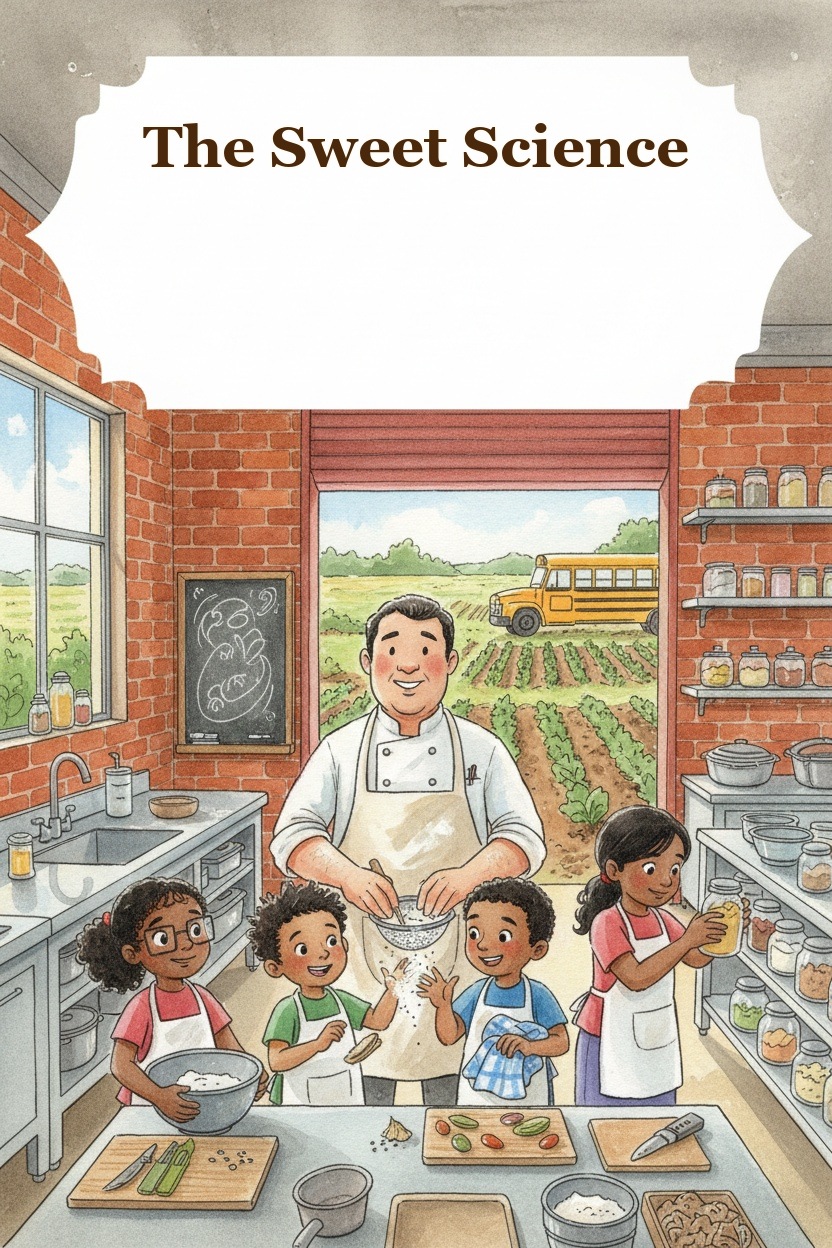
Section 1: The Mystery Basket
The Riverside Fire Station kitchen smelled like rain and apples. Chef Iggy Spark stood at the great stainless steel range, holding a brown paper bag above his head like a trophy.
"Today," he announced, "we are going to solve a mystery."
Tommy Reyes leaned forward on his stool. "Is the mystery what's for snack?"
"The mystery," Iggy said, "is sugar."
Maya Okonkwo raised an eyebrow. "Sugar isn't a mystery. It's sweet."
"Sugar IS sweet," Iggy agreed, setting the bag down with tremendous ceremony, "but sweetness is the least interesting thing about it."
Priya Subramaniam tilted her head. "That's like saying the least interesting thing about Ammamma's dal is that it's warm."
"Exactly! Well, no, but exactly!" Iggy was already moving, his hands sweeping toward the chalkboard wall where a cartoon diagram showed a lumpy white crystal wearing sunglasses. "Sugar is a worker. A builder. A chemist. A firefighter who puts out dehydration fires. Sugar has a JOB, and today we're going to watch it work."
The Spark Effect happened then, exactly as it always did. Iggy gestured toward the board and his elbow caught the edge of a wire whisk, sending it clattering to the floor. None of the students reacted. The prediction pool now had forty-three entries.
"Chef," Lucia said, not looking up from her sketchbook where she was drawing the sugar crystal, "what's in the bag?"
Iggy's face split into his widest grin yet. He reached into the bag and pulled out—an apple.
"A mysterious apple," he said. "One apple. Do you know what's inside it?"
"Fiber," said Sam. "Vitamins," said Dev. "Deliciousness," said Tommy.
"Sugar," said Iggy. "In three different forms. Fructose, glucose, and sucrose. The apple is a sugar delivery vehicle." He placed it on the scale. "And this apple weighs less than it did three days ago. Not because it lost water—"
"Actually," Maya said, "it DID lose water. The skin is slightly wrinkly."
Iggy beamed. "Maya is correct. The apple lost water. But here's the puzzle: sugar is what helped it keep the water it still has." He tapped the apple. "Sugar holds onto moisture. It's a sponge for water molecules. And that single fact is going to make our dessert extraordinary."
He pulled a frying pan from the rack—not a regular frying pan, but a wide, shallow, copper one with sloping sides.
"This is a tarte tatin pan," he said. "And today we're making the greatest French apple dessert you've ever tasted. But first—" He set down a glass bowl filled with small paper cups, each containing a pinch of something white. "Tasting lab. Tell me what you taste."
Section 2: The Sugar Family
Each student took a cup. Tommy's was gone before anyone else's.
"That's sweet," he said, "but kind of... simple? Like a quick high-five."
Priya was next. "This one's sweeter. Sharper. Like a happy noise."
Maya took hers carefully, touched a tiny bit to her tongue. "This one tastes like the sugar I know. Regular sugar."
Iggy clapped his hands together. "You've just met the sugar family!" He turned to the chalkboard and drew three circles, connecting them with lines.
"Meet glucose—the body's favorite fuel. It's the one your cells actually run on. Every sugar you eat eventually becomes glucose, or gets processed through it."
He drew a second circle. "Meet fructose. It's the sweetest of the family—it tastes almost twice as sweet as glucose. It's found in fruits, honey, and root vegetables. Your body processes it a little differently—it goes mostly to your liver."
The third circle got a star. "And meet sucrose—which is TWO sugars stuck together. Glucose plus fructose, bonded like siblings holding hands. Table sugar is sucrose. The sugar in the apple is partly sucrose. And when you eat sucrose, your body breaks that bond and processes both halves."
"So all sugar becomes glucose eventually?" Maya asked.
"Eventually," Iggy said, "but 'eventually' matters. Some sugars are processed fast, some slow. Some go to your liver, some go everywhere. Some give you energy for a long time, some give you a quick spike. That's the difference between the sugar in an apple—which comes with fiber and water and nutrients—and the sugar you'd get from a candy bar." He paused. "Not that I'm telling you not to enjoy a candy bar sometimes. But you should know they're not the same."
"What about the sugar in milk?" Priya asked. "Ammamma always says milk has sugar."
"It does! Lactose—glucose and galactose stuck together. And there's maltose in grains. Sugar is everywhere in food. The question isn't whether something has sugar. The question is—"
"What ELSE it has," Maya finished.
Iggy pointed at her. "Exactly. The apple has sugar AND fiber AND water AND vitamins. Sugar alone? Just sweetness." He held up the apple. "This is why the apple is the star of our dish. But first, let me show you what sugar does when you get it hot."
Section 3: The Caramel Dance
Iggy poured a cup of white sugar into the copper pan and set it over medium heat.
"Watch," he said.
The students leaned in. For a moment, nothing happened. Then the sugar at the edges began to change—first clear, then golden, then amber.
"Now," Iggy said, "talk to me about what you see."
"It's melting," said Dev.
"Is it?" Iggy asked. "Actually, sugar doesn't melt the way ice melts. Heat does something more dramatic. It breaks sugar molecules apart. It rips the water out of them and rebuilds them into new compounds—hundreds of them. Some taste sweet. Some taste bitter. Some taste nutty, or buttery, or like caramel."
"So caramelization is a chemical REACTION," Priya said slowly, "not just melting."
"It's the sugar molecules dancing apart and coming back together in different shapes," Iggy said. "New flavors, new colors, new structure." He swirled the pan and the amber liquid rippled. "And when it cools, it becomes glass. Hard, shiny, brittle sugar glass."
The color deepened to a copper brown. Iggy tilted the pan so everyone could see.
"This is what we want. Not too dark—that would taste bitter. But dark enough that the flavor is deep and complex. This caramel is about to do three jobs at once."
He arranged the apples—cut into quarters, arranged in a beautiful spiral—over the caramel in the pan.
"Job one: the caramel is the sauce. Job two: as it heats, it's going to absorb into the apples, giving them flavor and helping them hold their shape. Job three: watch."
He set the pan back on the heat. The apples began to sizzle and release their juices into the caramel.
"Those juices are mostly water," Iggy said. "And what's in water?"
"Sugar," the class said in unison.
"The apple's own sugars are cooking too! Fructose and glucose and sucrose, all caramelizing, all reacting with the caramel in the pan. The apple is sweetening its own sauce." He smiled. "Sugar is the only ingredient in this pan. But it's doing everything."
"Why don't the apples turn to mush?" Tommy asked. "They're cooking in syrup."
Iggy's face lit up. "That is the perfect question. Because sugar is also a STRUCTURE builder. When sugar absorbs into the apple's cell walls, it helps them keep their shape. Sugar is like a scaffold—it holds the apple up while it cooks. That's the same reason sugar helps cookies stay chewy and cakes stay moist."
He took a flour, butter, and sugar mixture from the refrigerator and rolled it flat. "And in this pastry dough, sugar has a different job. It's not just for sweetness. It affects the texture—the way the dough holds together, the way it browns in the oven, the way it crisps."
"One ingredient, four jobs," Maya said.
"At least," Iggy said. "Sugar is the most useful ingredient in the kitchen. But here's the question nobody asks: what does it do to the BODY?"
Section 4: The Body's Response
Iggy set the tarte tatin in the oven and turned to face his students. The kitchen was warm and smelled like caramel and butter. The students were arranged in their usual horseshoe, and Iggy perched on a stool.
"Everyone here has felt sugar enter their body," he said. "What does it feel like?"
"Good," said Tommy.
"Energy," said Dev.
"Happy," said Priya.
"Fast," said Maya. "If I eat something sweet without any protein or fat, I feel it almost immediately."
"Because glucose enters your bloodstream quickly," Iggy said. "It crosses from your digestive system into your blood and then into your cells, where it becomes energy. That's why sugar gives you a burst."
He stood and walked to the chalkboard, drawing a wavy line.
"But your body also has a response system. When sugar enters your blood, your pancreas releases insulin—a hormone that tells your cells to open their doors and let the sugar in. That's healthy. That's normal." He drew a second line, spikier. "But when you eat sugar WITHOUT other nutrients—without fiber, without fat, without protein—your blood sugar spikes fast. Your body has to release a lot of insulin fast. And then your sugar drops fast. That's the crash."
He turned around. "This is why the apple is different from the candy bar. The apple's sugar comes with fiber, water, and nutrients that slow down how quickly your body absorbs it. The candy bar's sugar hits your system fast."
"So sugar isn't bad," Priya said. "It's about what comes with it."
"AND how much," Iggy said. "And whether you need energy RIGHT NOW or over the next few hours. Your brain runs on glucose—it's the only fuel your brain can use. You NEED sugar. Everyone here needs sugar." He held up the apple. "This apple is feeding your brain. It's feeding your muscles. It's giving you energy to think and run and grow."
"Then why do people say sugar is bad?" Tommy asked.
"Because sugar is powerful," Iggy said. "And anything powerful needs to be understood. Sugar in an apple is different from sugar in a soda, because the apple has so much more with it and the sugar takes longer to hit your system. Natural sugars—like the ones in fruit and milk—come with their own helpers. Added sugars—like the ones in candy and soda and packaged food—enter alone." He paused. "And the science is clear: your body doesn't process them the same way."
"So our dessert has natural sugar from apples," Maya said, "and added sugar in the caramel."
"Yes," Iggy said. "And when you eat it, you'll get BOTH. You'll get the slow, steady sugar from the apple and the quick, bright hit from the caramel." He smiled. "But you'll also get the protein and fat from the pastry and the butter, which slow everything down. A good dessert is a balanced meal in disguise."
The oven timer beeped. Iggy pulled on his oven mitts—bright red, with a cartoon whisk pattern—and opened the oven. The smell that came out made Tommy actually groan.
"Now," Iggy said, "the dramatic part."
Section 5: The Flip
Iggy placed a plate over the top of the copper pan—a wide, flat, white plate. The students gathered closer.
"In France," Iggy said, "the tarte tatin is the most famous dessert from the Touraine region. It's named after the Tatin sisters—two women who ran a hotel in the 1880s. And the story says that one sister was baking an apple tart and accidentally overcooked the apples in butter and sugar. She put the pastry on top anyway, baked it, then flipped it over to serve."
"An accident," Priya said.
"An accident that understood sugar," Iggy said. "She saw what caramelization did and trusted it. Then she flipped the whole thing so the caramel was on top." He gripped the pan handle. "It's the single most dramatic move in pastry."
Tommy held his breath.
Iggy counted: "One. Two. Three."
The pan came down on the plate with a confident clap. Iggy paused, one hand on the upturned pan.
"The moment of truth."
He lifted the pan.
The tarte tatin sat on the plate, golden and glistening. The apples were arranged in their spiral, each one glazed with the deep amber caramel. The pastry was crisp and golden brown, rimmed with sugar juice that had bubbled up around the edges.
It was, by unanimous class agreement, the most beautiful thing they'd ever seen.
"Now," Iggy said, cutting it carefully, "we taste."
The first bite was a room of quiet. Then Tommy let out his two-note hum—the one that meant complete success.
"Okay," Maya said, "I understand the science, but this is ridiculous."
"The caramel is—" Priya started, then stopped, then laughed. "It tastes like Ammamma's oven. Like everything good at once."
Iggy leaned against the counter, holding his own plate. "Do you taste the caramel? That's sugar transformed by heat. Do you taste the apples? That's sugar holding them together, keeping them tender, absorbing flavor." He took a bite. "And the pastry—that's sugar feeding the yeast that made it rise, sugar giving the crust its color, sugar holding onto just enough moisture to make it tender."
"So sugar is doing the work," Tommy said, reaching for another piece.
"Sugar is doing the work," Iggy confirmed. "And now you know what it's doing. When you taste something sweet, you can ask yourself: where is this sugar from? What else came with it? What did heat do to it? And what will my body do with it?"
Maya looked at her plate. "I always thought sugar was the thing I had to avoid. But this is fruit. This is food."
"It's both," Iggy said. "The sugar in this dessert is part of a whole meal—feed apples, flour, butter, eggs. It's working with the other ingredients, not against them. That's what good cooking is. Understanding each ingredient's job."
The Recipe
Chef Iggy's Tarte Tatin
adapted for child cooks with adult help
Ingredients:
-
6 medium apples (Golden Delicious or Fuji work well)
-
1 cup white sugar
-
4 tablespoons butter, cut into pieces
-
1 sheet puff pastry (thawed)
-
1 teaspoon lemon juice
Steps:
-
Prep the apples. Have an adult help you peel and quarter the apples. Toss them with lemon juice.
-
Start the caramel. Put the sugar in a heavy oven-safe pan (cast iron or copper works best). Cook over medium heat WITHOUT stirring. Swirl the pan occasionally. Watch as the sugar melts and turns golden-amber. This takes about 8–10 minutes.
-
Add butter. Once the caramel is deep amber, remove from heat and stir in the butter pieces until melted and smooth.
-
Arrange the apples. Stand the apple quarters on their sides in the caramel, rounded side down, in a spiral pattern. Pack them tight.
-
Top with pastry. Lay the puff pastry sheet over the apples, tucking the edges down inside the pan. Poke a few holes in the pastry with a fork.
-
Bake. Place the pan in a 375°F oven and bake for 30–35 minutes, until the pastry is golden and puffed.
-
The flip (adult help!). Let the pan cool for 10 minutes. Place a plate over the pan, grip firmly with both hands, and flip quickly. Lift the pan carefully—the tarte tatin will slide onto the plate.
-
Serve warm. Eat it right away, with the caramel on top.
Chef's Note: "If your caramel is too light, you'll taste mostly sweet. If it's too dark, it'll taste bitter. The right moment is when the color looks like a new copper penny—that's the moment all the flavor compounds are at their best. This is a lesson in paying attention, not following instructions."
Iggy's Kitchen Lab Notes
"Today you learned that sugar is not one thing. It's a family—glucose, fructose, sucrose, lactose—each with its own job. You learned that sugar can build structure, hold moisture, change color, and create flavor. You learned that the sugar in an apple and the sugar in a candy bar enter your body differently because of what comes with them—fiber and water versus nothing at all. And you learned that your body turns every sugar into glucose, the fuel your brain runs on.
Here's your question to think about until next time: Look at the label of one packaged food in your kitchen. Can you identify which sugar it contains? Is it natural or added? What else came with it?
When you understand sugar, you don't have to fear it. You get to choose it—knowing exactly what you're choosing."