Lighthouse Cats
The Night of Too Many Stars
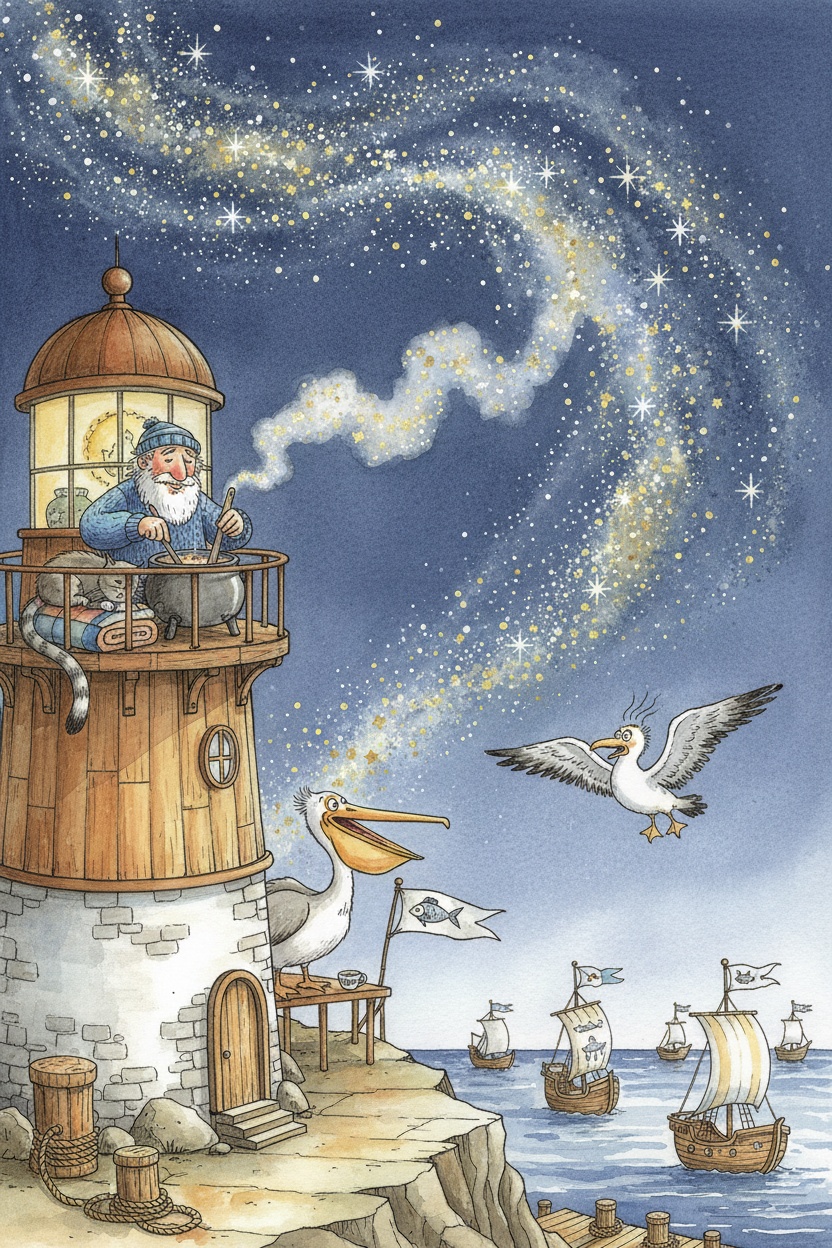
The sun had dipped behind the sea, and the sky had turned the colour of a mussel shell. Captain Whiskers sat in her window, watching the first stars prick the darkness. It was a clear night — a very clear night — and the stars were coming out in their droves.
Morris the Seagull landed beside her with a theatrical gasp.
"Whiskers," he squawked, "there are TOO MANY of them! I counted three hundred and twelve stars, and then I lost count, and now there are at least FOUR HUNDRED. This is the WORST star situation that has EVER happened at this lighthouse!"
Captain Whiskers blinked slowly. "The stars have not changed, Morris."
"THEY HAVE CHANGED! Look!"
She looked. The sky was, indeed, unusually bright. But Captain Whiskers had seen many skies, and she knew the difference between a star and something else. She said nothing. Instead, she stood up, stretched her front paws, then her back paws, and trotted down the spiral stairs to the harbour.
Penny the Pelican was bobbing by the dock, her bill pointed at the horizon.
"Captain Whiskers!" she called. "The Navigator's Starling has come in! Her crew look most confused!"
The ship was a small, tidy vessel, and standing at its bow were two bats — the navigator crew — wearing tiny brass spectacles and clutching charts that flapped in the breeze.
The larger bat, whose name was Barnaby, doffed his cap as Whiskers approached.
"Captain Whiskers," he said gravely, "we are in a pickle. A navigation pickle. Our method, you see, is to count the stars in a fixed patch of sky and compare them with the chart. If the number matches, we know our position. If it is one more, we are a league east. One fewer, a league west. But tonight—" He shook his head. "Tonight there are TOO MANY STARS. We counted thirty-one in the southern patch. The chart says nineteen. We are lost. Terribly lost."
"Or perhaps," said a second, smaller bat, whose name was Beatrix, "we have sailed clean off the edge of the world."
"Don't be dramatic," said Captain Whiskers mildly.
She hopped onto the harbour rail to get a better view. The sea was calm, almost glassy, but far out past the point there was a long, low swell breaking — a gentle line of white. And in that white, she saw something curious.
Tiny pinpricks of light. Dozens. Hundreds.
They were not stars up in the sky.
They were stars down on the water.
"Penny," said Captain Whiskers, "fetch my spyglass."
Penny retrieved it from the shed with her bill, and Captain Whiskers raised it to her eye. The white foam of the breaking wave glittered with cold, blue-green fire — thousands of tiny lights, each one no bigger than a grain of sand.
She lowered the spyglass.
"Barnaby," she said, "you are not lost. The stars are in the wrong place, that is all."
Barnaby blinked. "In the wrong place?"
"Look," said Captain Whiskers, pointing with her tail. "When the swell breaks over the shallows, it disturbs tiny creatures in the water. They are called phosphorescent plankton. They glow when they are stirred. They are not stars. They are sea-fire."
The bats squinted at the glittering wave.
"But—but—" said Beatrix, "they look exactly like stars!"
"They look like stars," said Captain Whiskers. "They do not behave like stars. A star stays fixed. A star does not move with the tide. And a star, gentlemen, does not taste of the sea."
She dipped one paw into the harbour and flicked a tiny drop of water onto the dock. In the dark, it glowed faintly.
Barnaby dipped his own wing into the water. When he lifted it, the droplets sparkled.
"Sea-fire," he whispered. "All along, we thought we were counting stars, and we were counting—" He paused. "What did you call them?"
"Plankton," said Captain Whiskers. "A word which is considerably harder to say than 'star.'"
Beatrix laughed. She had a very small, squeaky laugh.
"But how do we navigate now?" asked Barnaby. "If our count is wrong because of the sea-fire, we cannot trust our charts."
Captain Whiskers looked up at the sky. The stars were out — the real stars — steady and patient and above them all.
"You count the fixed stars," she said. "Not the moving ones. The sea-fire will vanish when the wave calms. Wait for the swell to pass, and count again. You will find the chart is correct."
Barnaby and Beatrix pressed their noses to their chart. Together, they counted the real stars in the southern patch — carefully, slowly, ignoring the glittering line on the water.
"Nineteen," said Barnaby at last, with a great flutter of relief. "Nineteen! We are exactly where we thought we were. We are not lost at all."
"Imagine that," said Captain Whiskers.
The crew of the Navigator's Starling set off again, waving their tiny bats' wings in gratitude. Beatrix called back, "Thank you, Captain Whiskers! We shall never mistake a plankton for a star again!"
"See that you don't," said Captain Whiskers.
Penny hopped up beside her. "That was brilliant, Captain. How did you know?"
"Because the sky does not lie, Penny," said Captain Whiskers. "It is the water that likes a joke."
They walked back up the path to the lighthouse, and Penny paused to look up at the sky.
"It's funny," she said. "With all those extra stars, it seemed so special. So… big."
"It is still special," said Captain Whiskers. "It simply does not need the plankton's help."
She settled back into her window as the lighthouse beam swept out across the sea — steady, and bright, and counting only the stars that stayed where they were put.
Morris appeared beside her once more.
"I have decided," he announced, "that it was NOT the worst star situation in history. It was, in fact, the most beautiful."
"Good," said Captain Whiskers.
She closed her eyes.
The night was quiet now, and the true stars hung over Pelican Point like a promise kept.