The Number Kingdom
The Time Tangle
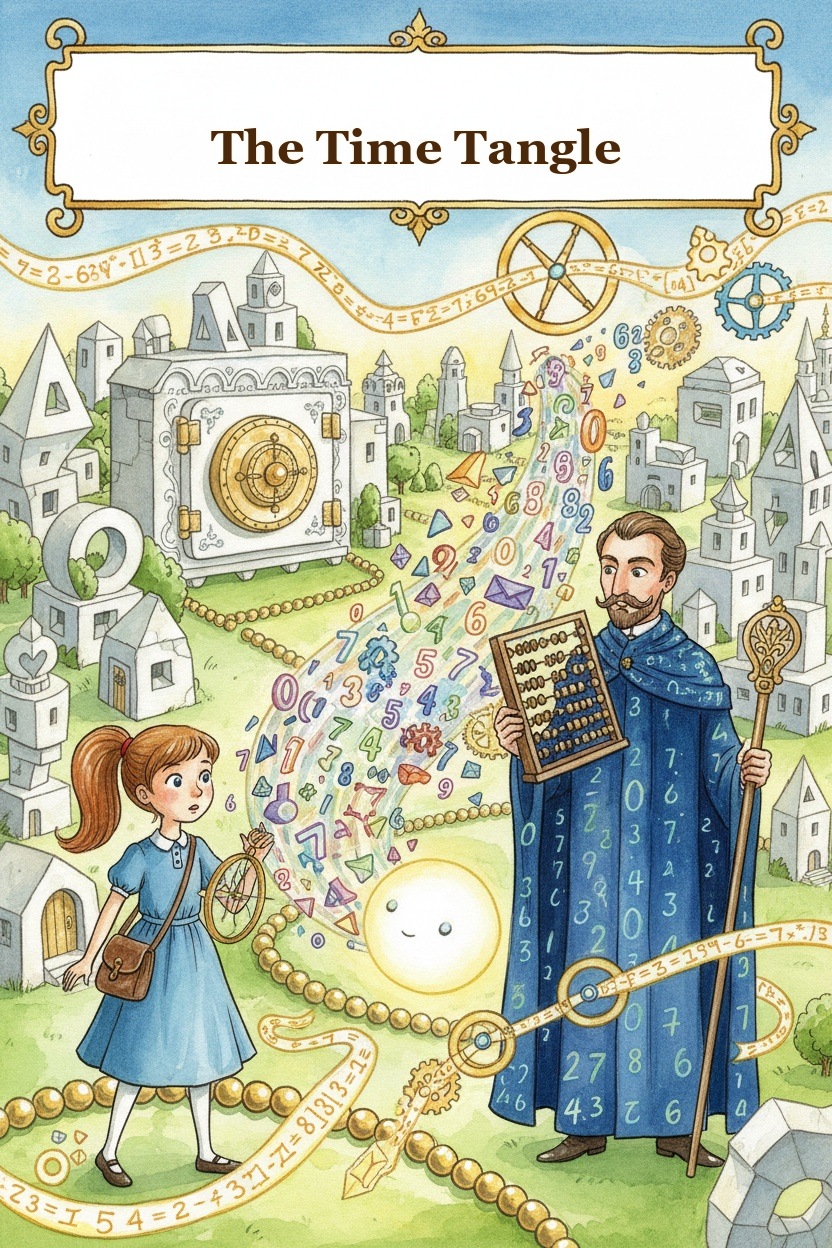
The Stopped Clock
"Right. Let's see what's broken," Mira said, sliding off the garden wall and landing in the palace courtyard.
What she saw was very strange indeed.
The great clock tower in the center of the Counting District was... well, it was everywhere. The hands spun forward, then backward, then forward again. The bells rang midnight at breakfast time. The sun was rising in the west while the moon hung stubbornly in the east. And the citizens of the Number Kingdom were walking in wild circles, looking up at the sky with worried faces.
The Count stood at the palace gates, his numeral-covered robes fluttering in a wind that seemed to blow from three different directions at once.
"The crisis is as follows," he said gravely. "The Remainder has disrupted the kingdom's clock. Time is jumping forward and backward unpredictably. Some citizens are experiencing their morning twice. Others have lost their afternoons entirely. The bakery opened at what it believed was 8:00 a.m., only to discover it was actually 11:00 p.m. The bread is—" he paused, shuddering, "—very confused."
A small silver circle rolled up beside Mira. "I noticed," Zero said quietly, "that no one has considered the problem of when anything is happening. They rarely do. But it might be worth considering."
Mira was already walking toward the clock tower. "Let me look at the mechanisms first."
Inside the tower, the great clock's gears were spinning in a way that made no sense at all. The hands weren't connected to the gears properly. The chimes were striking in no particular order. And sitting cross-legged on top of the main gear wheel, looking absolutely delighted, was the Remainder.
"Oh, hello!" it said, its shape shifting between a wisp of smoke and a grinning child made of half-finished numbers. "Isn't this WONDERFUL? Time was so boring before. Always going forward, one minute after another, tick-tock, tick-tock. But now! Now it goes wherever it wants! Backward! Forward! Sideways!"
"Time doesn't go sideways," Mira said, pulling out her notebook.
"That's what they all said about zero once," the Remainder said slyly. "And look how that turned out. Impossible, they said. Nothing, they said. But Zero knows better, don't you?"
Zero said nothing, which was its way of saying everything.
Mira ignored the Remainder's taunting and examined the clock face. The numbers were all there—1 through 12—but the hands were loose, not catching on the gears properly.
"The problem isn't complicated," she said slowly. "The hands aren't connected to the gears. Time isn't broken. The clock is broken. The Remainder just made it look like time was misbehaving."
The Remainder clapped its half-formed hands. "Right! But can you fix it? The gears are all scrambled, and I've mixed up the pieces. You'll have to figure out what connects to what, and you'll have to do it while time is... let's say... flexible."
The Jumping Hours
Mira grabbed the main gear shaft and tried to fit the hour hand back onto it. But the shaft kept moving—forward, backward, forward again—and she couldn't get the hand to stay in place.
"I need to understand how much time is jumping," she said to herself, pulling out her compass. It spun wildly, then settled, pointing toward the gear mechanism. "Okay. If I can measure how much time is being lost and gained, I can figure out how to correct it."
She looked at the clock. The hour hand was pointing at 9. The minute hand was pointing at 3—which meant it was quarter past something. But the chimes suddenly rang twelve times, then three times, then twelve again.
"This is impossible," she muttered. "If I can't tell what time it is, how can I fix what time it should be?"
The Remainder giggled. "That's the fun part! You can't!"
Mira sat down on the stone floor and looked at her notebook. Her first instinct had been wrong—she'd been trying to fix the clock by force, but she needed to understand the pattern of the disruption first.
"The clock face shows me between 1 and 12," she said, writing as she talked. "But there are 24 hours in a day. So the hour hand goes around twice. Midnight to noon is one trip. Noon to midnight is another."
Behind her, Zero placed a small item on the floor. It was a second clock face, this one showing 24 numbers instead of 12.
"I've been keeping count," Zero said quietly. "The clock jumped forward one hour, then back two hours, then forward three hours. It's following a pattern."
Mira's eyes widened. "Forward one, back two, forward three... that's counting! It's jumping in increasing amounts!"
She grabbed her pencil and started marking the jumps on a piece of paper. "So if it starts at 9:00, and it goes forward 1 hour, it's at 10:00. Then back 2 hours, it's at 8:00. Then forward 3 hours, it's at 11:00."
"But time isn't actually moving," Zero said. "The clock is just displaying wrong times. The real time is still passing normally. The citizens are just reading the clock and believing it."
Mira looked at the big clock tower, then back at Zero's 24-hour clock.
"Wait," she said. "I've been making this too complicated. The clock is only showing 12 hours. But there are 24 hours in a day. So what time is it really?"
She looked up at the doorway, where the sun was sending long morning shadows across the floor. The sun was in the east, low in the sky.
"The sun rises in the east," Mira said slowly. "And it's low, so it must be morning. But the clock says..."
She looked at the clock. It had stopped moving during her calculations, now frozen at 9:15.
"The clock could mean 9:15 in the morning," she said. "Or 9:15 at night. I know it's morning because of the sun. So it must be 9:15 a.m."
She started writing quickly in her notebook. "That's the problem with a 12-hour clock! You need to know whether it's a.m. or p.m.! The clock can show 12:00, but you need to know if it's noon or midnight!"
The Remainder tilted its head. "But that's fascinating. You mean the same numbers can mean two completely different times? Two 9:15s in a single day?"
"Yes," Mira said. "And there are 24 hours in a day, but the clock only shows 12, so each time on the clock face happens twice. Once in the morning, once in the evening."
"Then how does anyone know which is which?" the Remainder asked, genuinely curious.
"The sun," Mira said. "And the pattern of the day. Breakfast is in the morning. Dinner is at night. School starts at 9:00 a.m., not 9:00 p.m."
She stood up, looking at the clock mechanism with new eyes. "But the clock can't tell me which 9:15 it is. It can only tell me what the little hand and big hand are pointing at. So I need to track the 24 hours properly."
The Correct Sequence
Mira climbed up to the main mechanism and examined the gear shaft more carefully. The hour hand was loose, but there was a mark on the shaft—a tiny line that showed where the hand should attach.
"If I can calculate how much time has passed between the disruptions," she said, "I can correct the clock by moving the hands forward the right amount. But I need to know how long things are taking."
She pulled out her notebook and looked at the page.
"Say something starts at 2:30," she said. "And it ends at 4:15. How long did it take?"
She drew a number line in her notebook.
"From 2:30 to 3:00 is 30 minutes," she said. "From 3:00 to 4:00 is 1 hour. From 4:00 to 4:15 is 15 minutes. So the total is 1 hour and 45 minutes."
"That's one way," Zero said. "Counting through the hours."
Mira nodded. "Another way is to subtract—convert everything to minutes. Two-thirty is 2 hours and 30 minutes after midnight, which is 150 minutes. Four-fifteen is 255 minutes. The difference is 105 minutes, which is 1 hour and 45 minutes."
The Remainder's eyes lit up. "You can CONVERT time? Turn hours into minutes? That's like... that's like turning whole numbers into smaller pieces!"
"Exactly," Mira said. "One hour is 60 minutes. One minute is 60 seconds. And there are 24 hours in a day. Counting time is just... counting with different-sized groups."
She looked at the mark on the shaft, then at the gear train beneath it. The main clock was showing 9:15. But the sun had moved higher in the sky while she'd been working. She looked at Zero's 24-hour clock.
"In 24-hour time," said Zero, "9:15 in the morning is written as 09:15. But 9:15 at night is written as 21:15—because it happens 12 hours after 9:15 in the morning."
Mira calculated quickly. "So to convert p.m. times to 24-hour time, I add 12 to the hour!"
She looked at the sun again, squinting. "I think it's been about 45 minutes since I arrived. But the clock's been jumping. I can't trust it."
She looked at the mechanism more carefully, and there—hiding behind the main gear—was a small piece of paper, folded into a tiny square.
She unfolded it. Written in the Remainder's messy handwriting was a puzzle:
*"The tangle starts at 3:00.
Forward 2 hours, back 1.
Forward 3 hours, back 2.
Forward 4 hours, back 3.
Where is the tangle now?"*
Mira grinned. "It's a pattern! But I need to know the real elapsed time, not the confused clock time."
She worked through it carefully.
"Starting at 3:00. Forward 2 hours to 5:00. Back 1 hour to 4:00. Forward 3 hours to 7:00. Back 2 hours to 5:00. Forward 4 hours to 9:00. Back 3 hours to 6:00."
She looked at the clock. It was showing 6:00 now.
"But how long did all that take?" she asked. "If each jump is instant, then no real time passed at all! The clock just shows 6:00. But the actual time should still be..."
She looked at the sun. It had moved noticeably higher while she was working. If she'd arrived around 9:00 a.m., and she'd been working for maybe half an hour, then the real time was probably around 9:30 or 9:45.
"But the clock is showing 6:00," she said. "That's wrong. I don't just need to fix the clock. I need to set it to the correct time."
The Final Fix
Mira climbed up to the clock face, positioning herself carefully on the ledge. The gears were still spinning in their backwards-forwards dance, but now she understood the pattern.
"The clock's not broken in a confusing way," she said to Zero, who had floated up beside her. "It's broken in a mathematical way. The hour hand and minute hand have to move in the right relationship to each other."
At that moment, the clock struck 7 with seven bells.
"See?" Mira said. "It's striking 7. But the correct time should be..." She checked the sun's position. "About 9:45 in the morning. I've been working for about 45 minutes, and I arrived around 9:00."
"That's an estimate," she admitted. "But the kingdom's daily schedule is my check. The baker always makes bread at 7:00 a.m. The bread is already cooling on the racks outside. So 7:00 a.m. has already happened. The school doors opened at 8:30 a.m., and I can see the children are already at their desks. So 8:30 has passed too."
She looked at the clock mechanism, then had an idea.
"I don't need the sun. I can check my work against the real events that I know have happened! The baker's bread was made at 7:00 a.m. I arrived just after that, which is why the bread was still warm. So when I arrived, it was probably about 7:15 or 7:30, not 9:00 at all!"
She looked at her compass, which pointed toward the mathematical truth of the situation. "The compass says the correct time is 9:47 a.m. I miscalculated when I arrived. I assumed 9:00 because of the clock's reading, but the clock was already wrong then."
Zero nodded. "Estimation is useful. Verification is essential."
Mira positioned the hour hand at 9 and the minute hand at almost 10 (which would be about 47 minutes past the hour). The gears clicked into place. The clock's hands began to move properly—the minute hand advancing smoothly, the hour hand creeping forward slowly.
The clock struck 10 o'clock.
"Wait," Mira said, doing the math. "If it's 9:47 now, then the next strike should be at 10:00, which is 13 minutes away. The clock just struck 10 immediately, which means... it's running fast."
She examined the gear ratio. The Remainder had swapped two gears, making the clock run nearly twice as fast.
"I need to swap these back," she said, removing the gears and examining their teeth. "If the big gear has 40 teeth and the small gear has 20, then the big gear turns once and the small gear turns twice. But they've swapped the gear sizes, so the clock runs at the wrong speed."
She swapped the gears back. The clock's hands slowed to the correct pace.
The Remainder, watching from the shadow of the bell, tilted its head. "You know, I never thought about it before, but time is just... counting. Counting backward and forward, counting in groups of 60 and groups of 24. It's not different from counting anything else."
"It's the same mathematics," Mira agreed. "Just applied to a clock face."
She looked at her notebook one last time. "From 9:47 to 10:00 is 13 minutes. From 10:00 to 10:15 is 15 minutes. So the bread will be ready for the morning market at..." She paused, pointing at the real clock. "At 10:15 a.m. And since the market opens at 10:30, everything will be on time."
The clock tower chimes rang one final time—exactly 10:00.
Throughout the kingdom, the citizens looked up in surprise. The sun was where it should be. The shadows pointed the right direction. The bakery, which had been opening for the third time that morning, finally stayed open.
The Remainder bowed, flickering into a shape that was almost respectful. "You've restored order. But I've learned something genuinely interesting: time isn't a thing. It's a measurement. And measurement is mathematics."
Zero, floating beside Mira, said quietly: "Yes. That tends to work."
Mira put her notebook back in her satchel and looked at the clock tower, its hands moving correctly at last.
"Right," she said. "Let's see what's broken next."
But first, she wrote down one final note in her book:
Time is not magic. It's math. 60 seconds = 1 minute. 60 minutes = 1 hour. 24 hours = 1 day. And knowing how long things take is just another way of counting—carefully, accurately, and with your eyes open.
The clock struck 10:15. The day was back on schedule. And in the Number Kingdom, time was finally telling the truth again.