Professor Plunks Impossible Lab
The Heat Highway
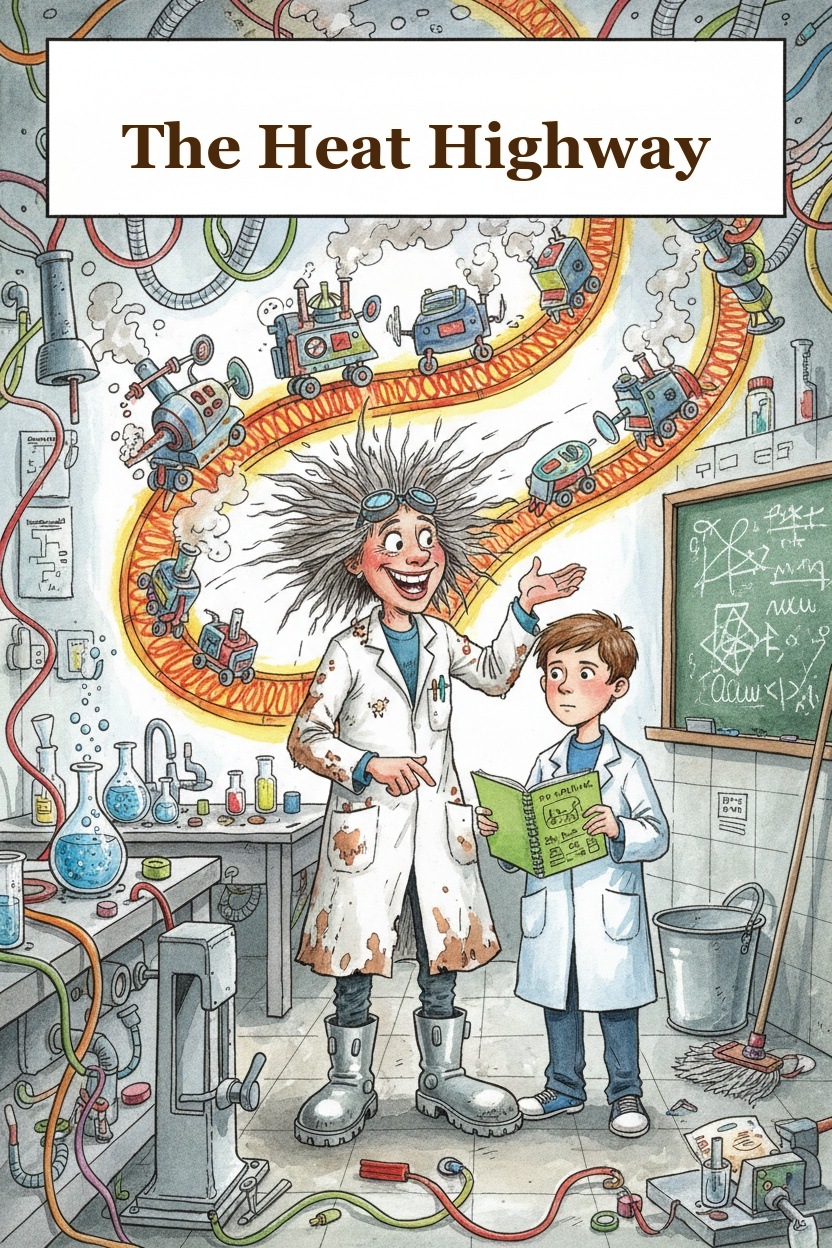
The Grand Announcement
Otto Finch was carefully arranging his lab notebook when Professor Plunk burst through the door with a cart. On the cart sat three objects: a metal rod, a glass tank of water, and a strange lamp with a curly bulb.
"My careful colleague!" she announced, her wild grey hair crackling with static. "Today we will conquer heat itself!"
Otto's pencil paused. "Conquer it?"
"Well, demonstrate it. All three ways it travels!" Plunk gestured grandly. "Conduction through solids. Convection through liquids. Radiation through empty space."
She patted the cart proudly. "I call this the Triple Threat Thermal Demonstrator!"
Otto looked at the three objects. They didn't appear connected to anything. "How does it work?"
"Simple! I turn on the lamp. The lamp radiates heat through the air. The water tank catches the radiation and warms up. As the water warms, convection currents begin to circulate. And the metal rod? It conducts heat from the water tank to... somewhere!"
Plunk paused. "Actually, I haven't quite decided where the rod should go."
Otto opened his notebook to a fresh page.
Experiment: The Heat Highway
Prediction: Heat will travel in order — radiation, then convection, then conduction. One at a time. Neatly. The way heat is supposed to travel.
He underlined neatly twice.
The Wrong Order
Plunk flicked a switch. The curly lamp hummed.
"Observe!" she cried. "The radiation will warm the water—"
The lamp exploded with light. A beam of invisible warmth shot across the room, hitting the far wall. The metal rod began to glow orange at its tip, then along its entire length.
"Wait," said Otto. "That's not right."
The water in the tank started bubbling. But instead of circulating in gentle currents, it erupted in a fountain that rose toward the ceiling.
"The radiation... went through the wall?" Otto blinked. "I think I see heat waves on the hallway floor."
"The rod is conducting heat backward!" Plunk squinted at it. "That's physically impossible. The heat should move from the hot end to the cold end. It's going from the cold end to the hot end!"
Otto pointed at the ceiling. "The water is boiling upward. The steam is rising, but it's also going down. I see steam going down."
Indeed, the steam from the tank had split into two streams. One rose. One fell. The falling steam condensed and created a rain cloud inside the lab.
Professor Plunk clapped her hands in delight. "Magnificent! All three heat transfers happening at once! But in completely the wrong order!"
Otto scribbled frantically in his notebook:
HEAT IS NOT COOPERATING. Radiation went sideways. Conduction went backward. Convection went up AND down. THIS WAS NOT IN THE PLAN.
Otto's Observation
The lab was becoming very hot in a very strange way. The far wall was roasting while the near wall was freezing. Otto could see frost forming on one window and steam fogging another.
"Quick, Otto!" Professor Plunk handed him a pencil. "Draw what you see!"
Otto took the pencil and began sketching the lab. On the far side, the metal shelf was so hot that a jar of jam was starting to bubble. On the near side, the chalkboard was covered in ice crystals.
"The heat is going every direction at once," Otto said. "The lamp is radiating in waves, like light. The rod is conducting—wait."
He stopped sketching. "Professor, why is the rod glowing?"
"Because it's conducting heat, of course!"
"But heat moves from hot to cold. The hot end is the lamp. The rod touched the lamp, but the glow started at the other end."
Professor Plunk walked over to the rod. She touched it and immediately pulled her hand back. "Ow! That end is extremely hot. And the lamp end is..."
She touched the other end. "Cold! The rod is conducting heat in the opposite direction of the temperature difference!"
Otto looked at the lamp. "Unless it's not conducting through the rod."
"What do you mean?"
"Maybe the lamp is radiating heat through the room. And the rod is absorbing the radiation on the far side. The rod IS conducting, but it's conducting heat that came from the radiation!"
Professor Plunk stared at Otto. Her mouth opened. Then closed. Then opened again.
"My careful colleague," she said slowly, "I believe you have just understood everything."
The Heat Highway
Professor Plunk grabbed a piece of chalk and rushed to the board. Frost crackled beneath her chalk as she drew.
"Observe! The lamp radiates electromagnetic waves. Those waves travel through empty space — through the air — and strike everything in the room. The far wall. The shelf. The rod!"
She drew arrows. "When radiation hits a solid surface, it warms it. The rod absorbs radiation all along its length. Then conduction takes over INSIDE the rod, moving heat particle to particle."
Otto wrote in his notebook:
Radiation = heat traveling as waves through empty space. Conduction = heat traveling through solids by particles bumping into each other. Convection = heat traveling through liquids and gases by currents.
"But why is the water doing the fountain thing?" Otto pointed at the tank, which was now spraying water in two directions — up and down.
"Convection!" Plunk beamed. "When water warms, it expands. Hot water is less dense, so it rises. Cold water falls. That creates a current — a circulation loop!"
"Then why is some of the steam falling?"
Plunk looked at the tank. Then at the lamp. Then at the ceiling.
"I believe," she said, "the radiation is heating the water so unevenly that some parts of the tank are creating upward currents while other parts create downward currents. The water is convecting in both directions at once!"
Otto sketched the tank. Up arrows. Down arrows. Circles. Spirals. "It's like a heat highway with no speed limit and no rules."
The ceiling above the tank began to drip. Gloriana, the lab custodian, appeared at the door holding a mop, a bucket, and a small umbrella. She looked at the raining ceiling, the frozen chalkboard, and the bubbling jam jar.
"Told her so," she said. She handed Otto the umbrella. Then she left.
Professor Plunk turned from the board, covered in chalk dust and frost, with a puddle forming around her feet.
"Well!" she declared, pushing her safety goggles up from where they had slid down her nose. "That demonstrated heat transfer rather more vividly than I intended."
The Beautiful Part
Otto was drying his notebook with a towel when he noticed something. The frost on the chalkboard was melting. But it was melting in patterns — spirals and swirls that moved across the board in slow, deliberate circles.
"Professor," he said quietly. "Look."
Plunk turned. The ice on the chalkboard was forming convection currents of its own — tiny crystals melting and refreezing in response to the heat in the room.
"It's trying to circulate," Otto said. "The cold air meets the warm air, and it moves. Like the water in the tank. Like the steam on the ceiling."
Professor Plunk knelt beside him. "Heat is always on the move, Otto. From warm places to cool places. Through solids, through fluids, through empty space. It never stops. It never gives up."
Otto looked at the melting patterns. "It's beautiful."
"It's physics," Plunk said. "Which, when it's working properly, is the same thing."
The frosted window began to clear, revealing a view of the city. The sun was setting, painting the sky in orange and pink. The jam jar stopped bubbling. The metal rod began to cool.
Gloriana returned with a second bucket. She placed it under the dripping ceiling, looked at the lab, and nodded once.
Otto closed his notebook. On the final page of the experiment, he wrote:
Heat moves three ways:
-
Conduction — through solids, particle to particle.
-
Convection — through fluids, rising and falling currents.
-
Radiation — through empty space, traveling as waves.
It did all three at once. It filled the lab from both ends and the middle.
I understand it now.
THIS WAS NOT IN THE PLAN.
IT WAS BETTER.
THE END
Next: Book 18 — Ice, Water, Steam, and Chaos