Professor Plunks Impossible Lab
Ice Water Steam and Chaos
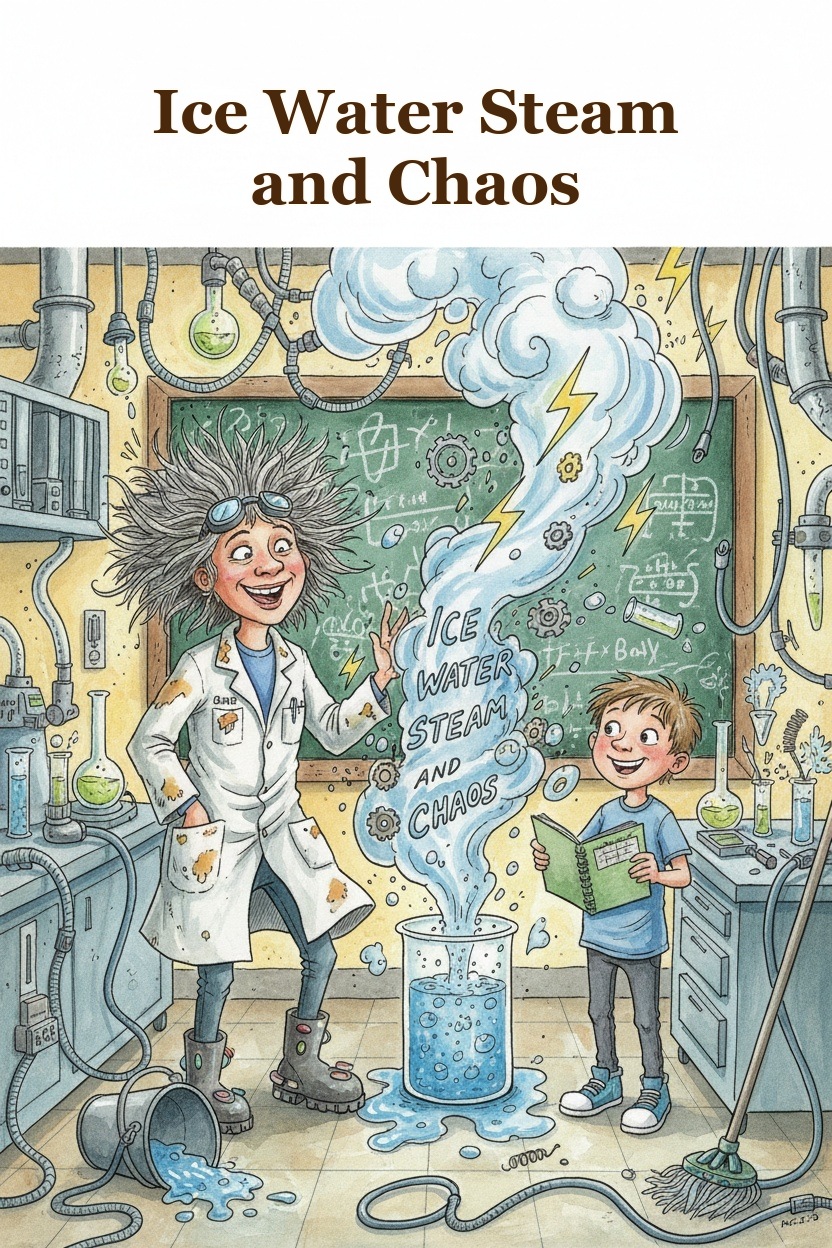
Section 1: The Grand Demonstration
"Otto! My careful colleague! Today we shall witness the most magical transformation in all of physics!"
Professor Plunk stood at the center of the lab, her wild grey-streaked hair crackling with static electricity. She gestured dramatically at a machine that looked like a cross between a stove, a refrigerator, and something that might have been a very confused organ.
"I call it the State Changer 3000!" she announced, patting the machine fondly. "It can heat things and cool things—at the same time, if necessary!"
Otto looked at the machine. Then at his notebook. Then back at the machine.
"Professor," he said carefully, "there are at least seven different pipes coming out of that, and I'm pretty sure one of them is connected to the coffee maker."
"Exactly!" Plunk beamed. "Efficiency!"
Otto opened his green lab notebook and wrote:
Today's Experiment: States of Matter Demonstration
Equipment: State Changer 3000 (concerning)
Expected Outcome: Ice cubes will melt, water will freeze, water will boil, steam will condense.
Prediction: This will go perfectly.
He paused. Then added a small note in the margin: "I have made this prediction before. I should know better by now."
"Now," Plunk said, pulling something out of her lab coat pocket, "what do we have here?"
It was a small, perfectly clear ice cube. It glittered in the lab light.
"That's just an ice cube," Otto said.
"It's a special ice cube," Plunk corrected. "I froze it myself. It contains precisely twenty-five millilitres of pure water. And today, we're going to show every child watching exactly what happens when matter changes state!"
She placed the ice cube on a small silver tray on top of the State Changer 3000.
"First—" Plunk flipped a switch and a gentle hum filled the air. "—we apply heat. Watch closely!"
Otto leaned in. The ice cube began to shimmer. A tiny bead of water appeared on its surface. Then another. Then the whole cube seemed to collapse in on itself, becoming a small puddle of water that wobbled on the tray.
"Melting!" Plunk announced triumphantly. "Solid to liquid! The particles were packed together tightly in a fixed pattern—when we added heat energy, the particles absorbed that energy and began to move faster, breaking out of their rigid arrangement!"
Otto scribbled in his notebook:
Solid: Particles packed tight, vibrating in place.
Add heat → particles move faster → solid becomes liquid.
Melting point: 0°C for water.
"Now!" Plunk's eyes sparkled. "Watch what happens when we remove that heat!"
She flipped another switch. The tray hummed and grew cold. Frost crept across its surface. The puddle of water trembled—and then began to freeze, solidifying from the outside inward until it was once again a solid block of ice.
"Freezing!" Plunk declared. "Liquid to solid! We removed heat energy, so the particles slowed down and locked into their fixed arrangement again!"
Otto wrote:
Liquid: Particles sliding past each other, not fixed.
Remove heat → particles slow → liquid becomes solid.
Freezing point: 0°C (same temperature!)
"Now for the exciting part!" Plunk clapped her hands. "Let's add LOTS of heat!"
She grabbed a large lever on the side of the machine and pulled it hard.
Section 2: The Problem With Levers
The lever did not want to be pulled.
"Come on," Plunk grumbled, tugging harder. "I installed this lever myself! It was meant to—"
The lever came free with a loud POP. Something else came with it.
A small metal valve flew across the room and hit the chalkboard, leaving a scorch mark in the shape of a question mark.
"Oops," said Plunk.
The State Changer 3000 began to make a sound like a teakettle with strong opinions.
"What was that?" Otto asked, stepping backward.
"That was the valve that regulates the heating element," Plunk said, examining the hole where the valve had been. "Hmm."
"Hmm?" Otto repeated. "Professor, what does 'hmm' mean in this context?"
"It means," Plunk said brightly, "that the heating element is now stuck in the ON position."
A jet of steam shot out of the machine's side.
"On the bright side," Plunk added, "that demonstrates boiling beautifully!"
The puddle of water on the tray was now bubbling vigorously, bubbles rising to the surface and popping with little puffs of steam. Soon it was completely gone, replaced by a cloud of invisible water vapour drifting upward.
"Boiling!" Plunk shouted over the growing hiss. "Liquid to gas! The particles absorbed so much energy they broke free entirely and flew apart, spreading throughout the room!"
Otto was writing frantically:
Gas: Particles far apart, moving very fast!
Add LOTS of heat → liquid becomes gas.
Boiling point: 100°C!
"That's great," Otto said, snapping his notebook shut, "but the steam is getting—"
"ILLUSTRATIVE!" Plunk shouted. "This is condensation! Watch!"
She held up a cold glass plate. Steam rose and hit the plate, forming tiny droplets of water on its surface.
"Gas to liquid! When the steam hits a colder surface, it loses heat energy, and the particles slow down enough to stick together as liquid again!"
Otto opened his notebook and added:
Condensation: hot gas on cold surface becomes liquid!
Then he looked up. The lab was filling with steam. The good news: it looked mysterious and scientific. The bad news: he could no longer see the door.
"Professor," Otto said, "maybe we should turn the machine off?"
"I can't," Plunk admitted. "The off switch was on the same valve."
"THE OFF SWITCH WAS ON THE SAME—"
The machine shuddered. A new sound emerged—a low, groaning rumble like a giant clearing its throat.
"What's that?" Otto asked.
Plunk frowned. "That's the cooling element."
"That's still working?"
"Working might be an overstatement," Plunk said. "I think it's working harder."
The steam in the room began to move. It swirled toward the machine in curling ribbons, drawn into a vent on its side. For a moment, Otto felt a flicker of hope.
"See?" Plunk said cheerfully. "The cooling element is drawing in the steam! Soon it will condense it back into water, and we'll have a lovely demonstration of the full cycle!"
Otto watched as the center of the machine began to glow with a frosty blue light. The groaning grew louder. Ice began to form on the machine's pipes, spreading outward in delicate crystalline patterns.
"That's nice," Otto said. "That looks nice. That looks contained."
"PERFECTLY contained!" Plunk agreed.
A pipe burst.
Section 3: The Ice Storm
It was not ice that burst from the pipe.
It was snow. Hundreds of spinning, twirling snowflakes erupted from the broken pipe like confetti from a very eager cannon. They filled the air, mixing with the steam to create a thick, glittering fog.
"Ah," said Plunk, her goggles frosting over. "That's the condensation working!"
"WHERE IS THE SNOW COMING FROM?" Otto yelled, hiding behind his notebook.
"The cooling element is so cold that the water vapour in the air is not just condensing—it's FREEZING before it can form droplets! Gas straight to solid! That's deposition!" Plunk's voice was muffled by frost. "A bonus concept!"
The snow continued to fall. The floor was becoming a miniature winter landscape. And the steam was still pouring out of the broken heating element.
"Professor," Otto said, trying to sound calm and scientific, "I want you to know that I am going to record this in my notebook."
"That's very professional of you!"
"THIS IS NOT IN THE PLAN!" he shrieked, writing it in very large letters.
The machine made a sound like a tuba falling downstairs. Then it started to shake. The shaking became a rattling, and the rattling became something Otto could only describe as lively.
The heating element was now shooting out so much steam that a cloud reached the ceiling, condensed on it, and began raining back down on them.
"It's raining," Otto said numbly.
"Yes!" Plunk was delighted. "The steam rises, hits the cooler ceiling, condenses into droplets, and falls BACK as liquid water! We're demonstrating the water cycle indoors!"
"I can't see my hand in front of my face!"
The machine hiccuped. A burst of extra-cold air swept through the room, and the falling rain froze mid-drop. Hailstones the size of peas bounced off Otto's head.
"Hail!" Plunk announced. "Falling liquid water freezes as it travels through a cold layer of air! We are discovering meteorology!"
The floor was now a slippery patchwork of ice, snow, puddles, and rapidly cooling areas. Otto skated across the room, arms flailing, and crashed into the chalkboard. The scorch mark in the shape of a question mark now had a friend: a smear of whiteboard eraser shaped like nothing in particular.
"It's getting cold in here," Otto said through chattering teeth.
"Of course it is!" Plunk said. "Freezing releases energy to the surroundings, but we're doing SO MUCH freezing that we're also pulling heat OUT of the room! Extra heat removed means the room gets colder!"
The machine shuddered again. The heating element let out a dying hiss and went quiet. The cooling element continued to hum.
"We're out of steam," Plunk said. Then, "I mean that figuratively. There's plenty of steam. But the machine—"
The machine gave one last, weird groan. A single, perfect snowflake drifted out of the broken pipe. Then it was still.
"And done!" Plunk said, wiping frost from her goggles. "Let's see what we've got!"
Section 4: What We've Got
What they had was this:
An iceberg. Well, a lab-sized iceberg. The entire front half of the lab was now a frozen landscape. Snow covered the workbench. Hailstones littered the floor. A column of ice had formed where the falling rain had met the freezing air, and it stood in the center of the room like a glittering crystal sculpture.
And there was still steam escaping from the broken heating element in wispy, ghost-like curls.
Otto stood in the middle of it all, notebook frozen open, pen held stiffly in his half-frozen fingers. He looked at the scene. He looked at his notebook. He wrote:
The State Changer 3000 has created the following:
-
Ice (solid)
-
Water (liquid)
-
Steam (gas)
-
Snow (gas to solid!)
-
Rain (gas to liquid)
-
Hail (liquid to solid!)
He paused. Then wrote:
moment of silence for the lab room
"And they say physics can't be beautiful," Plunk said softly.
Otto looked up. She wasn't talking about the machine, or the mess. She was looking at the ice column, which caught the late afternoon light filtering through the windows. Rainbows danced inside it, shimmering and shifting as the last wisps of steam curled around it.
"Look at that," Otto said quietly.
"The ice lattice," Plunk said. "Each water molecule is connected to its neighbours in a repeating pattern. That's the crystal structure of ice. When the water froze slowly, the molecules had time to arrange themselves perfectly."
The light refracted through the crystal, splitting into a small, perfect rainbow on the opposite wall.
"It turned into art," Otto said.
"Water always does," Plunk said. "Every single snowflake is a crystal. Every ice spike in your freezer grew in a pattern determined by the arrangement of molecules. It's happening right now in every frozen puddle in the city. Physics building little sculptures everywhere."
Gloriana arrived.
She surveyed the frozen lab, the steam, the iceberg, the hailstones, and the rainbow with the expression of someone who had seen everything. She reached into her tool belt and pulled out a mop. A squeegee. A snow shovel (new). And one of those mirrors on a stick, which Otto thought was for seeing things, but which Gloriana used to check the ceiling.
"Right," Gloriana said. That was her only word.
Plunk dusted ice crystals off her lab coat. She pushed her goggles up onto her head. She looked around at the winter wonderland she had created.
"Well!" she said. "That demonstrated states of matter rather more vividly than I intended."
Otto wiped his glasses. "Professor, we learned that matter changes state when energy is added or removed. We learned that solids have packed particles, liquids have sliding particles, and gases have free particles. We learned about melting, freezing, boiling, condensation, deposition, and hail."
"See?" Plunk grinned. "Fully educational!"
"And we learned," Otto added, "that the same matter can go through multiple state changes in rapid succession if you remove the wrong valve."
"That too!" Plunk said happily.
Otto looked at his notebook. At the frozen lab. At the rainbow still dancing inside the ice. He added one more line:
Today I learned the same water can be ice, water, steam, snow, rain, and hail.
It's always still water.
Just in different moods.
Science is wonderful.
He wrote the last part so no one would see him smile.
But Gloriana saw. She nodded once, approvingly, and handed him the snow shovel.
"Start here," she said.
And for a moment—as Otto began to shovel, and Plunk began to talk about crystal lattices, and the rainbow deepened and glowed—the impossible lab felt like the most beautiful place in the world.
THE END