Lighthouse Cats
The Lost Whale
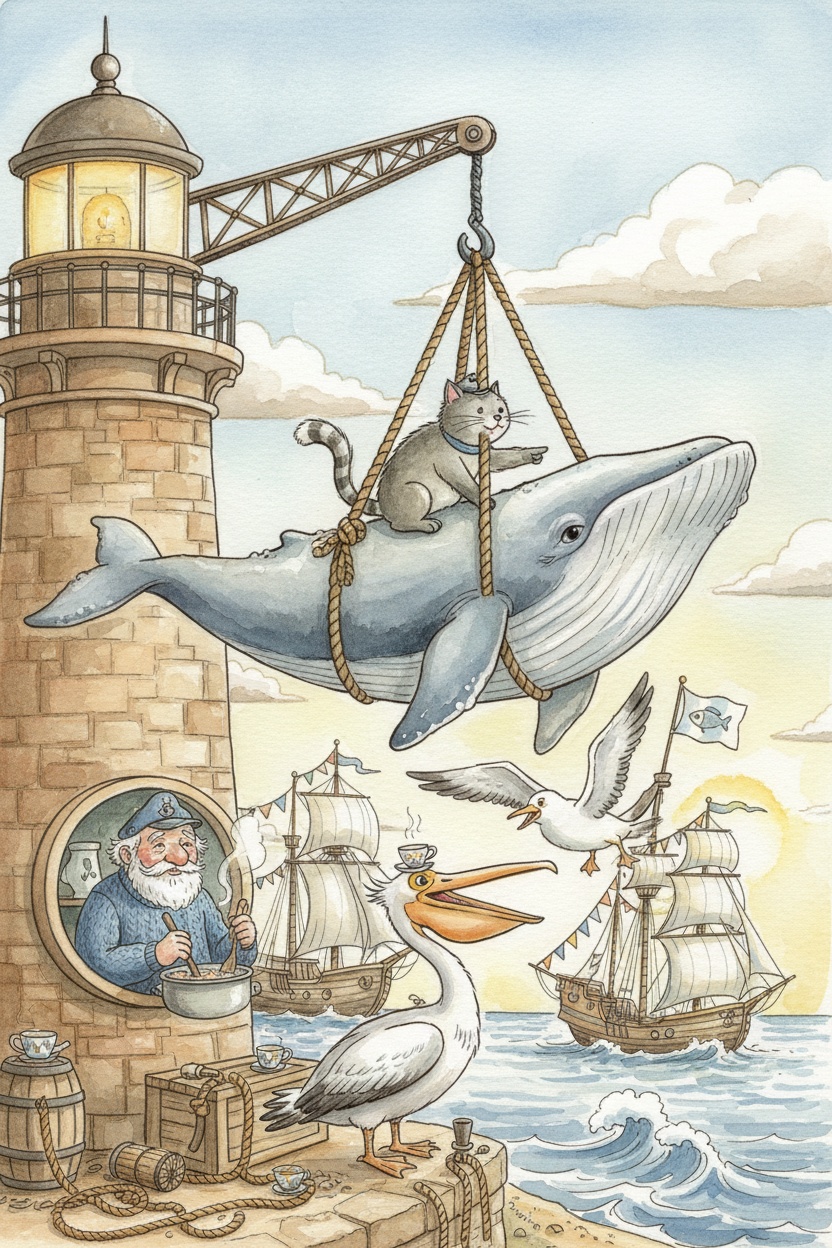
Captain Whiskers sat in her window at the top of Pelican Point Lighthouse, watching the morning sea roll in. It was a calm day. Too calm, some might say.
Morris the Seagull landed beside her with a dramatic flapping of wings.
“Whiskers! WHISKERS! There’s a WHALE!” he screamed. “A WHALE, I tell you! The biggest whale that has EVER— well, it's medium-sized, actually, but still! A WHALE!”
Captain Whiskers narrowed her green eyes. Out past the rocks, a small dark shape rose from the water, then sank again. Then rose. Then sank.
“I see him,” she said quietly.
Penny the Pelican wobbled onto the widow’s walk, nearly tripping over her own large bill.
“A whale? Where? Oh! Oh, he looks lost. He looks VERY lost. Should we help him, Captain? Should we?”
Captain Whiskers studied the whale. He was young — a humpback calf, far too small to be travelling alone. He swam in slow circles, blowing air through his blowhole in short, nervous puffs.
“He is lost,” Whiskers said. “And he is looking for something.”
She leapt down the stairs, three landings at a time. Morris and Penny followed.
Down in the little harbour, the water was glassy and quiet. The young whale had come closer now, floating beside the floating dock, his great dark eye blinking up at them.
“Hello,” said Captain Whiskers. “You are far from home.”
The whale made a soft, high sound. Not a song, not a call — more like a question.
“I’m Bumble,” he said, in the way whales speak — a voice that came from deep inside and was felt more than heard. “I was with my mother. And then the big ships came. And then everything was loud, and I swam. And now I don’t know where the channel is. I can’t find the way home.”
Morris gasped. “THE CHANNEL IS GONE! The whole channel is GONE! This is the WORST thing that has EVER happened at this lighthouse!”
“Morris,” said Captain Whiskers. “Quiet.”
Morris went quiet. For a moment.
“The channel is not gone,” Whiskers said to Bumble. “It is still there. You have simply forgotten how to find it.”
Bumble blew a sad spray of water. “I’ve been swimming for two whole days. Everything looks the same. Blue water, blue sky, more blue water. I think I’m going the wrong way. I think I’ll never get home.”
Penny flapped her wings. “We’ll help you! We’ll — we’ll draw you a map! We’ll get Angus to point the lighthouse at you! We’ll figure it out!”
Angus, just waking up from his morning nap inside the lighthouse, mumbled to himself: “Funny. I could have sworn I heard a whale.”
Captain Whiskers blinked neutrally at the lighthouse wall.
“Bumble,” she said. “Do you know the song of your mother?”
Bumble’s eye blinked once. Twice. “My song?”
“Your family’s song. The one she sang to you when you were very small. All humpbacks carry one. It is your oldest memory.”
Bumble was quiet for a long moment. Then he opened his mouth, and out came a sound — low and long, rising and falling like the swell of the sea. It was not a loud song. But it was deep, and it seemed to make the water shiver.
“Good,” said Captain Whiskers. “That is your home. That song lives in you. And the channel — the channel always leads where the song begins.”
Bumble looked at her with his enormous eye. “But how do I know which way to swim?”
Captain Whiskers climbed onto the end of the floating dock and stood very still. She looked at the sky, which was clear and pale. She looked at the sun, which hung low over the water. She looked at the horizon, and she read the sky like a page in a book.
“The stars,” she said. “Even now, when you cannot see them, the stars are there. And at night, they will appear — and the brightest one, the one that sits just above the southern horizon, will guide you. That star is older than any map. It has led every whale home since the world began.”
Bumble blew a soft spray. “The stars? But… but what if it’s cloudy?”
“Then you will listen to your song,” said Whiskers. “And what if the sea is loud?” asked Bumble.
“Then you will float,” said Whiskers, “and wait. And when the sea is quiet again, you will listen again. Patience is a sailor’s oldest tool.”
Penny gasped. “That’s brilliant! That is the most brilliant thing anyone has ever said!” She turned to Bumble. “I wish I knew my family song. I mean, I probably do. It’s probably in me somewhere. I just sing loudly instead.”
“That’s very much like you, Penny,” said Whiskers kindly.
Bumble’s eye grew bright. “The southern star,” he said. “I remember it. Mother used to point at it with her flipper. She said, ‘Every whale knows the way home. Even when you forget everything else, you will not forget that star.’”
“She was right,” said Captain Whiskers.
For a long moment, Bumble floated still. Then he lifted his head and sang again — the same song, but fuller this time, and steadier.
“Thank you,” he said. “I think… I think I know the way now.”
He turned, slowly, toward the open sea. The morning light shimmered on his back as he began to swim.
“Wait!” cried Morris. “What about the shipping channel? The big ships? The noise? The DANGER?”
Bumble paused and looked back. “I’m not afraid of the noise anymore,” he said. “I have a song to sing over it.”
And he swam away — south, toward the place where the star would rise.
Captain Whiskers watched until he was only a speck on the horizon. Then she climbed back up the lighthouse stairs, leapt onto her window sill, sat down, and began to wash her face.
Angus walked in, yawning, stirring a pot of chowder with a wooden spoon.
“Whiskers,” he said, “I had the strangest dream. I dreamt a whale came to visit.”
Captain Whiskers blinked at him, completely neutral.
“A whale?” she said.
Angus shrugged. “Then I woke up. Did anything happen while I was asleep?”
Captain Whiskers looked out the window at the empty, sunlit sea. She tipped her head, just slightly, and a faint purr rumbled in her chest.
“Nothing much,” she said. “A ship got home. That’s all.”
And on the wall behind her, she tucked a tiny curl of driftwood — shaped, if you looked closely, exactly like a southern star.