The Number Kingdom
The Fraction Highlands
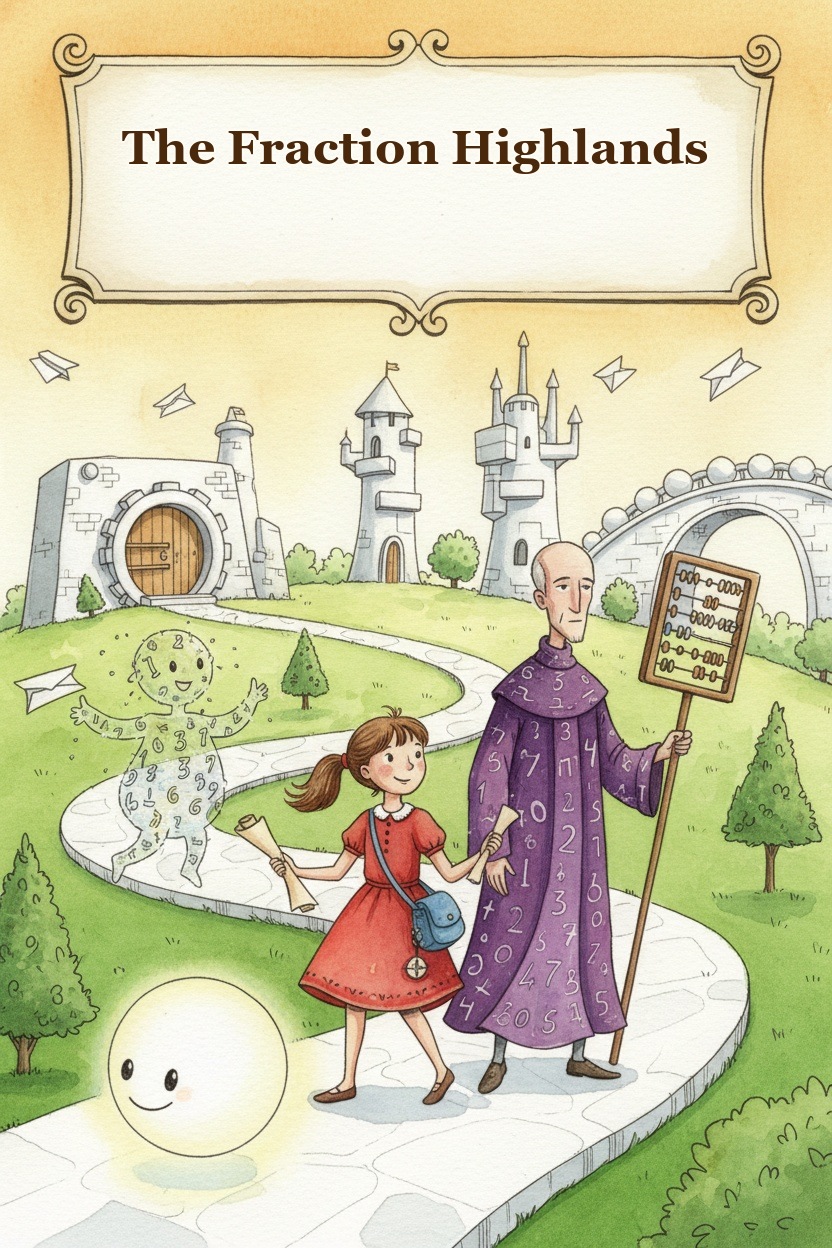
The Path to the Highlands
"Right. Let's see what's broken," Mira said, sliding off the back of the cart and landing in the soft grass at the edge of the kingdom.
Before her rose the Fraction Highlands — a towering range of steep, rocky hills that Mira had never crossed before. The path ahead was narrow and winding, and high above, she could see bridges spanning the gaps between peaks. They were strange bridges, unlike any she'd seen in the Counting Districts or the Arithmetic Quarters. Each one was made of wooden planks of different lengths, and beside each bridge stood a tall stone pillar with markings carved into it.
The Count stepped forward, his robes shifting with slowly rearranging numerals. "The crisis is as follows," he said gravely. "The Remainder has been here. The Highland bridges will not open for anyone who cannot correctly name the fraction describing their span."
Mira squinted at the nearest bridge. "Fraction?"
The Count raised an eyebrow. "You have not encountered fractions before?"
"I've heard the word," Mira admitted. "When we divided the festival goods evenly in Book 10, sometimes things were left over. The Remainder said something about fractions then, but I didn't understand what it meant."
"Then you will learn now," said the Count. "The Fraction Highlands are the kingdom's steepest territory. Every bridge here spans a distance that is not a whole number of steps. The bridges only open for travelers who can name exactly what portion of the span they can cross."
A small, silver-white circle appeared at Mira's elbow. "The bridges here are honest," said Zero quietly. "They simply want to know what part of them you understand."
Mira looked at the nearest bridge. It was short — only a few planks long — and carved into the stone pillar beside it was a strange symbol: a line with a number above it and a number below it. The top number was 1. The bottom number was 2.
"One over two," Mira read aloud. "What does that mean?"
"Indeed," said the Count. "What does it mean? The bridge will not open until you know."
The First Bridge
Mira walked up to the bridge and studied it carefully. The planks stretched across a narrow gap between two rocky ledges. She noticed something odd: there were marks on the stone at each end of the bridge, and the marks were spaced evenly along the gap.
"Wait," she said, kneeling down. "Look at this. The distance between the two ledges — there are two equal spaces marked along it. And the bridge only covers one of them."
She looked at the symbol on the pillar again. "One over two. One part out of two equal parts. So the bridge spans half the gap?"
The moment she said "half," there was a soft click. The bridge began to extend, sliding out smoothly until it spanned the entire gap. A small puff of golden dust rose from the mechanism, and the bridge settled with a solid thunk.
"Correct," said the Count, and there was something like warmth in his voice. "One half. Written as 1/2. The top number — the numerator — tells you how many parts you have. The bottom number — the denominator — tells you how many equal parts make up the whole."
"So 1/2 means one part out of two equal parts," Mira said slowly. "The line in the middle just means 'out of.'"
"Precisely."
Mira crossed the bridge carefully. On the other side, the path wound upward between tall, rocky outcroppings, and soon she came to a second bridge. This one was longer, and the pillar beside it showed a different symbol: 1 over 3.
"One third," Mira said confidently. "One part out of three equal parts."
The bridge didn't move.
Mira frowned. She looked more carefully at the gap the bridge needed to span. Along the stone ledges on either side, she could see marks dividing the gap into three equal sections. The bridge itself — the planks that were already there — only covered one of those sections.
So why hadn't it opened?
She read the symbol again: 1 over 3. "One third," she repeated. "One part out of three equal parts."
Still nothing.
Mira sat down on a rock and pulled out her satchel. She took out a pencil and paper and began to draw the bridge, the gap, and the marks she'd seen.
"Okay," she said to herself. "The symbol says 1/3. One part out of three. But I said that and it didn't work. So what am I missing?"
She looked at her drawing. She'd drawn the gap divided into three equal parts. She'd drawn the bridge covering one of those parts.
"Maybe the fraction is the other way around?" she wondered aloud. She scratched out her drawing and drew it again, this time labeling the parts. "If the whole gap is three parts, and the bridge covers one, then the bridge covers—"
She stopped. She looked at the bridge. She looked at her drawing.
"The bridge isn't covering one part," she said slowly. "The bridge is made of planks. The planks cover the bridge span. But the marks on the stone — they're measuring the gap, not the bridge. The gap is the whole."
She looked up at the bridge, truly looked at it. The planks stretched across the gap — all of them. The bridge was whole and complete. A person could walk across it right now.
"But the bridge didn't open," Mira said. "So it must be that the bridge isn't spanning the whole gap. It's spanning only part of it."
She crouched down and looked along the underside of the bridge. Sure enough, she could see a seam where the bridge ended and empty air began. The bridge was only one third of the way across the gap. The rest was open space.
"But I said one third," Mira said, confused. "One part out of three. That's what it says."
The Remainder appeared, perched on a rock above her, looking delighted. It was a small, jagged shape, like a piece of something that hadn't quite fit together. "Oh, but you didn't say which third!" it said gleefully. "One part out of three — but is the bridge the one part, or is the gap the whole? You have to name what the whole is! You have to say what the one is one of!"
Mira blinked. "The numerator is the part you're talking about," she said. "The denominator is the total parts the whole is divided into. But you have to know what the whole is."
"Exactly, exactly!" The Remainder clapped its jagged hands. "Fractions are always about a specific whole. Half of a cake and half of a pie are different sizes because the wholes are different! The numerator and denominator tell you the relationship, but you have to know what you're cutting up!"
Mira thought about this. She looked at the bridge, spanning one third of the gap. The whole was the gap. The bridge covered one part out of three equal parts of the gap.
"The bridge covers 1/3 of the gap," she said. "One third of the whole span."
The bridge clicked and extended smoothly, sliding the rest of the way across the gap until it was whole and complete. Mira crossed it, and the Remainder drifted alongside her, humming.
"You're learning," said the Remainder. "You're definitely learning. But there's a trickier one ahead. I drew it myself!"
The Group of Birds
The third bridge was the longest yet, and it didn't seem to be over a gap at all. It crossed a shallow, wide valley, and below, Mira could see a flock of birds wheeling and circling. The pillar beside this bridge showed: 1 over 4.
"One fourth," Mira said. "One part out of four equal parts."
She waited for the click. Nothing happened.
"You also have to say what the whole is!" called the Remainder from somewhere behind her.
Mira looked at the bridge. It was long and flat, stretching all the way across the valley. There was no seam, no gap, no visible way it was incomplete. It already spanned everything.
"Maybe the whole is the valley," Mira said. "And the bridge covers one fourth of it?" But the bridge clearly covered the entire valley. That didn't work.
She sat down and got out her paper again. She drew the bridge, the valley below, the birds.
"Birds," she said, looking at her drawing. There were eight birds in the flock. "The remainder said it drew this one. What's special about the birds?"
She counted them again. Eight birds.
She looked at the bridge. It was whole. There was nothing missing.
And then she remembered what the Remainder had said: "Fractions are always about a specific whole." The bridge was whole. The valley was whole. But what if the whole wasn't a thing at all?
"Fractions can describe parts of a group," she said slowly. "Not just parts of a whole object. Parts of a group of things."
She looked at the birds. There were eight of them. If the whole was the group of birds, then—
"One fourth of the group means one bird out of every four," Mira said. "If I take one out of four equal groups of birds, that's two birds. Two birds out of eight is one fourth of the group."
The moment she said it, the birds below reshaped themselves into four perfect circles of two birds each. One circle separated from the others and rose upward, becoming the bridge in front of her, solid and complete.
Mira stared. "The bridge was the birds the whole time?"
"One quarter of the group made the bridge," said Zero quietly, appearing beside her. "Four groups of two. One group became the span. The rest flew on."
Mira crossed the wooden bridge, and when she reached the other side, she looked back. The birds were gone.
"Fractions can be parts of a group too," she said, writing it down in her satchel. "Not just parts of a whole thing. If you have eight birds and you take one fourth, you get two birds."
"Indeed," said the Count, who had been following at a distance. "A fraction can describe any portion of any collection of equal parts — a single cake cut into slices, or a group of birds divided into equal flocks. The denominator tells you how many equal parts the whole has been divided into. The numerator tells you how many of those parts you are naming."
Mira nodded. "Unit fractions," she said. "The ones with 1 on top. 1/2, 1/3, 1/4. They're always one part out of some number of equal parts."
"The word 'unit' means one," said Zero. "A unit fraction is one piece of something divided evenly."
The path continued upward, and Mira followed it, feeling more confident. She had learned something real. She had learned it by getting it wrong and trying again. And there was one bridge left.
The Long Bridge
The last bridge was enormous — longer than any of the others, stretching across a wide chasm between two towering peaks. And carved into the pillar beside it was a symbol that made Mira stop: 2 over 3.
"Two thirds," she said. "Two parts out of three equal parts."
The bridge didn't move.
Mira took a breath. "Okay," she said. "I know how this works now. I have to see what the whole is." She studied the chasm. It was divided into three huge sections, marked by massive stone pillars that rose from the depths below. The bridge planks currently covered two of those sections. The third section was empty air.
"The whole is the chasm," Mira said. "It's divided into three equal parts. The bridge covers two of them. So the bridge spans 2/3 of the chasm."
Still nothing.
"Maybe the whole isn't the chasm," Mira said. She looked at the bridge itself. The planks were in three different colors — red, blue, and green — and they were arranged in a pattern that repeated. Mira counted: three planks in the pattern, and the pattern repeated twice across the span. Six planks total.
"If the whole is the bridge," Mira said slowly, "then the bridge has six equal parts if I count individual planks. Two thirds of six planks is... four planks. But the bridge has six planks. That doesn't work."
She sat down and drew it. The chasm divided into three parts. The bridge covering two. The pattern of planks.
"Two thirds," she said. "The numerator is 2. The denominator is 3. Two parts out of three."
She looked at the bridge again and realized what she'd been missing. The bridge planks — red, blue, green — were grouped in sets of three. One red, one blue, one green. The pattern repeated.
"If each set of three planks is a whole," Mira said, "then each set has three parts. The bridge has two complete sets. So the bridge has 2/3 of... no, that's not right either."
She was stuck. She sat with the not-knowing for a while, just looking at the bridge, the chasm, the pillar with its symbol.
"Unit fractions," she said finally. "I learned unit fractions. 1/2, 1/3, 1/4. One part out of some number of equal parts. But this is 2/3. Two parts. So I'm taking two parts, not one."
She looked at the chasm again. Three equal parts. The bridge covered two of them.
"The bridge covers 2/3 of the chasm," she said. "The numerator is 2 — the number of parts I have. The denominator is 3 — the number of equal parts the whole is divided into. Two parts out of three."
The bridge clicked. It slid forward, extending smoothly across the third section of the chasm until it was complete. The sound of the mechanism was satisfying, solid, final.
Mira crossed.
The View from Above
At the top of the Highlands, the path leveled out, and Mira stopped to catch her breath. Below her, the kingdom stretched out — the Counting Districts with their numbered streets, the Arithmetic Quarters with their bridge networks, the beginnings of the Geometric Provinces in the distance.
The Remainder appeared beside her, quieter now, almost thoughtful. "You know," it said, "a fraction can be any number of parts, not just one. 2/3, 3/4, 5/8. The numerator can be any number. It's just how many parts you're taking."
"I know," Mira said. "The numerator is the parts taken. The denominator is the total parts. And the line between them means 'out of.'"
"Out of," the Remainder repeated, and there was something almost longing in its voice. "Everything is out of something. A remainder is what's left over when you divide. A fraction is what you have when you name the parts you kept."
Mira thought about this. "That's not wrong," she said.
"No," said the Remainder. "I suppose it isn't." And then it was gone, dissolving into the mist between the peaks like a leftover thought.
Zero appeared at Mira's feet. "You did well," it said. "You didn't know what a fraction was this morning, and now you can read them, write them, and understand what they mean."
"Unit fractions," Mira said. "1/2, 1/3, 1/4. One part out of two, three, four equal parts. And other fractions too — 2/3, two parts out of three."
"Parts of a whole," said Zero. "And parts of a group."
Mira pulled out her satchel and wrote it all down. Fraction: a part of something. Numerator: how many parts you have. Denominator: how many equal parts the whole is divided into.
She looked at the view, and something settled in her chest — that particular confidence that came from solving something hard.
"I think I'm ready for wherever the next crisis is," she said.
"Yes," said Zero quietly. "That tends to work."