Professor Plunks Impossible Lab
Inside the Atom
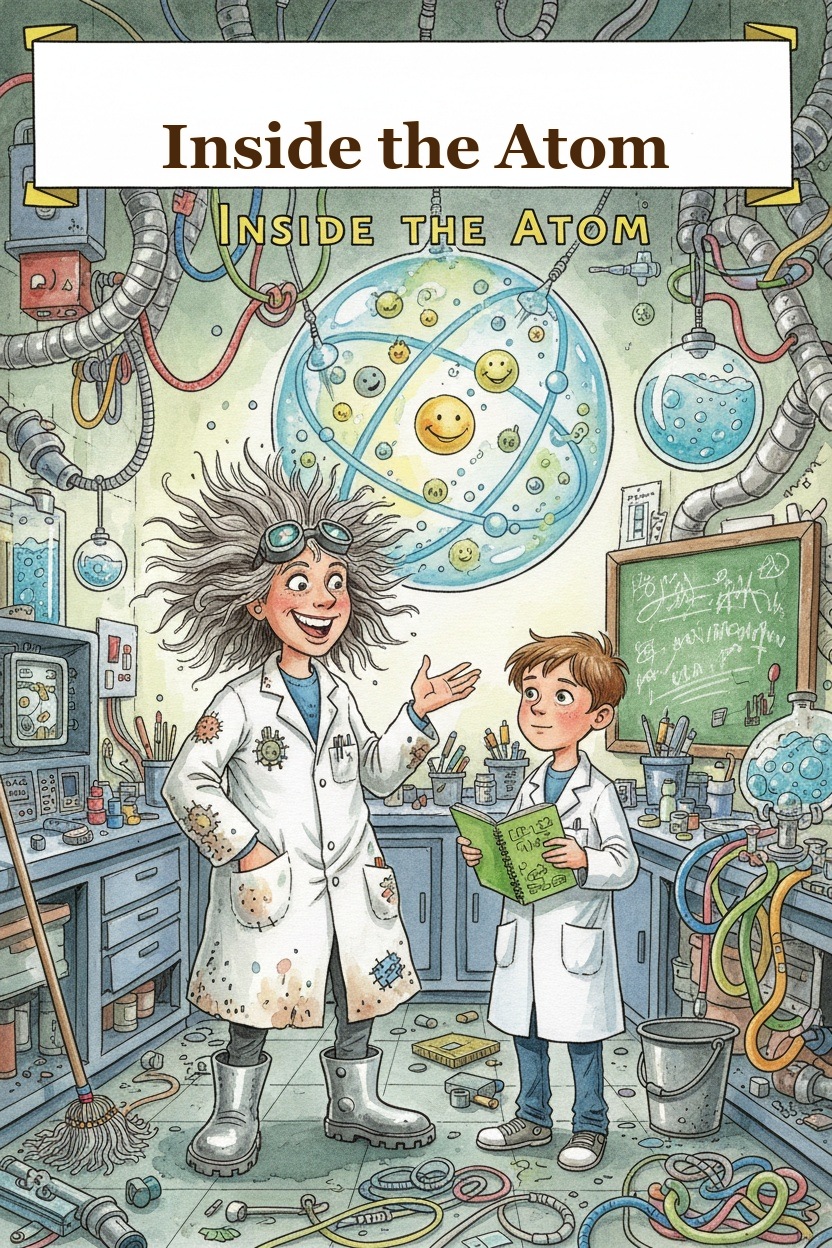
Where We Were Going
“My careful colleague!” Professor Plunk announced, bursting through the lab door with a box the size of a small refrigerator. Her hair was doing something particularly spectacular that morning—it stood out in every direction, as if it had been startled. “Today, we go where no physicist has gone before! Well, many have gone, but none have gone with our particular flair!”
Otto looked up from his notebook. He had just finished writing the date and the word PREDICTIONS in neat, color-coded capital letters. He eyed the box. It was covered in dials, switches, and one very large red button that looked older and more confident than the rest of the machine.
“What is it?” he asked.
“The Subatomic Spectacular Holographic Navigator, Mark One!” Plunk declared, setting the box on the workbench with a heavy thunk. “It will project a perfect, three-dimensional model of an atom—so big we can walk right inside it! We will see the nucleus! We will see the electrons! We will see—“
“Is it supposed to be smoking?” Otto asked.
A thin wisp of purple smoke curled from the top of the machine. Plunk peered at it, then waved her hand through it. “Aromatic cooling vapor,” she said confidently. “It’s a feature.”
Otto wrote: Holographic Navigator. Possible small fire.
“Now, stand back,” Plunk said, her finger hovering over the red button. “I call this the Great Levitation Into the Microscopic Realm! Or G.L.I.M.R. for short. Ready?”
“Are the straps for the machine or for us?” Otto asked, pointing to two helmets with thick chin-straps that were attached to the side of the box.
“For authentic immersion!” Plunk said. She handed him one. “Helmets on!”
Otto put his helmet on. It was too big and fell over his eyes. He pushed it up. “Okay,” he said, with the tone of a person who had learned that okay was the best they were going to get. “Go.”
Plunk pressed the red button.
For one glorious, peaceful moment, nothing happened. Otto almost relaxed. Then the entire lab began to hum. The hum became a buzz, the buzz became a roar, and the air in front of them began to shimmer.
“Initiating holographic projection!” Plunk yelled over the noise.
A whirlpool of light swirled in the middle of the room. It spun, it sparkled, and then it exploded outward—not into a neat sphere, but into a blizzard of glowing, colored dots. The dots swarmed around the lab like angry bees.
“Area of effect too wide!” Plunk observed. “Noted!”
A giant, glowing ball of red and blue particles appeared in the center of the room, hovering about a meter off the ground. It was beautiful. It was also spinning in a way that made Otto feel a little sick.
“That’s the nucleus!” Plunk said, pointing at the ball. “Protons in red, neutrons in blue!”
Then, a blur of fast-moving sparks zipped around the nucleus. There were many of them, and they were moving in dizzying circles that were not quite flat and not quite round. They looked like a swarm of confused fireflies.
“And those are electrons!” Plunk said. “See the shells! The first one is—“
The machine made a sound like a kettle being drop-kicked. The purple smoke became a thick, pungent cloud. The red button popped out and rolled across the floor.
“Oh dear,” Plunk said, which was not a word she used often.
The glowing electrons, which had been zipping neatly in their orbits, suddenly all changed direction at once. The nucleus wobbled. And then, without any warning, the entire holographic atom grew to fill the whole lab.
Otto felt a strange, fizzy sensation all over his body, like every hair was standing on end. The world dissolved into a swirl of color. When his vision cleared, he was not standing in the lab anymore.
He was floating inside something enormous, pink, and surprisingly quiet. The walls pulsed with a soft, rhythmic thump-thump. Everything was tinted a curious shade of blue.
“Professor?” he called. His voice echoed.
“I am HERE!” Plunk’s voice boomed from somewhere to his left. She floated into view, her hair standing out even more wildly than usual. She looked delighted. “The holographic navigator has penetrated our own matter! We are inside the atom! We are in it, Otto!”
“This is what I was afraid of,” Otto said, pulling out his notebook. The page was blank. He wrote: WE ARE INSIDE THE ATOM. THIS WAS NOT IN THE PLAN.
The Confused Shells
The inside of the atom was not solid. It was a vast, echoing space. In the distance, the nucleus glowed like a distant, chunky sun—a pulsing ball of red and blue clusters.
“Look!” Plunk said, pointing. A small, shimmering dot zipped past them at impossible speed. “That’s an electron! It’s in the first energy shell—the one closest to the nucleus. That’s its happy place. It has the least amount of energy there.”
“It’s going fast,” Otto observed.
“Electrons are always moving!” Plunk said. “They don’t sit still. They whiz around the nucleus constantly, like bees around a particularly tasty hive.”
More electrons zoomed past. They were all moving in different directions now, some close and some far. It was pure chaos.
“They’re not staying in their little circles!” Otto said, pointing. “That one just jumped from the close-up ring all the way to the far-away ring! And that one went the other way! They're all mixed up!”
Plunk put her hands on her hips and studied the mayhem. “Ah,” she said. “It appears the holographic model is adding a feature I didn’t request: Extreme Electron Chaos. It’s a good learning opportunity.”
“It looks like a disorderly ball of lightning,” Otto said.
“That’s not so far off,” Plunk said approvingly. “Electrons are tiny bits of energy, remember. They like to live in specific zones—we call them energy levels, or shells. The smallest, lowest-energy shells are closest to the nucleus. The higher-energy shells are further out.”
“Okay,” Otto said. “But why do they keep jumping?”
A slow, cheerful voice came from everywhere at once. “BECAUSE THE MODEL IS CONFUSED.”
Otto and Plunk looked at each other.
“I’m the Holographic Electron Shell Arranger,” the voice continued. “The navigator’s main projector is broken. I’m using my backup. And I’m not sure where the electrons are supposed to go.”
A shimmering, see-through shape appeared next to them. It looked vaguely like a very tall, very friendly spiral. “Welcome to the atom. I apologize for the confusion. Sometimes the first shell feels full, and then I think, ‘move them all to the fourth shell!’ But then I say, ‘No, that’s too far!’ And by then, everyone is zipping everywhere.”
The Element Key
The spiral, who introduced itself as “Shell,” was very helpful. It shimmered a gentle purple as it pointed to the nucleus.
“You see those?” it asked. The giant clump of red and blue particles pulsed gently. “The red ones are protons. They have a positive charge. The blue ones are neutrons. They have no charge. They just add bulk, like the weight in a pool noodle.”
“And the number of protons?” Otto asked, remembering his predictions. “Doesn’t that decide what element it is?”
“EXACTLY!” Plunk roared, so loudly that the floating sparks scattered. “The number of protons! That’s the element’s identity card! If you have six protons, you have carbon! If you have eight, you have oxygen! If you have one, you have hydrogen—the simplest element of all!”
“And that’s what makes them different?” Otto asked. He looked at the nucleus. “Besides having a different number of neutrons?”
“Yes,” Plunk said. “Neutrons can change, and they make the atom heavier, but they don’t change what the atom is. You could add a neutron to a hydrogen atom, and it’s still hydrogen—just a heavier type of hydrogen. But the moment you change the number of protons, you have a completely different element!”
“So the protons are the boss,” Otto said.
“They are the defining factor,” Plunk agreed.
“That's correct,” Shell said. Its spiral shape wobbled with pleasure. “And I arrange the electrons around the boss. The protons have a positive charge, and electrons have a negative charge. The opposite charges attract, like magnets. But the electrons have their own energy, so they don’t just crash into the nucleus. They balance—they orbit instead.”
Just then, the electron chaos intensified.
Sparks flew from the first shell to the third. Several electrons from the fourth shell dropped down to the second, and then immediately bounced back up.
“Oh my,”